Luxury Coastal Vacations in Private Residences
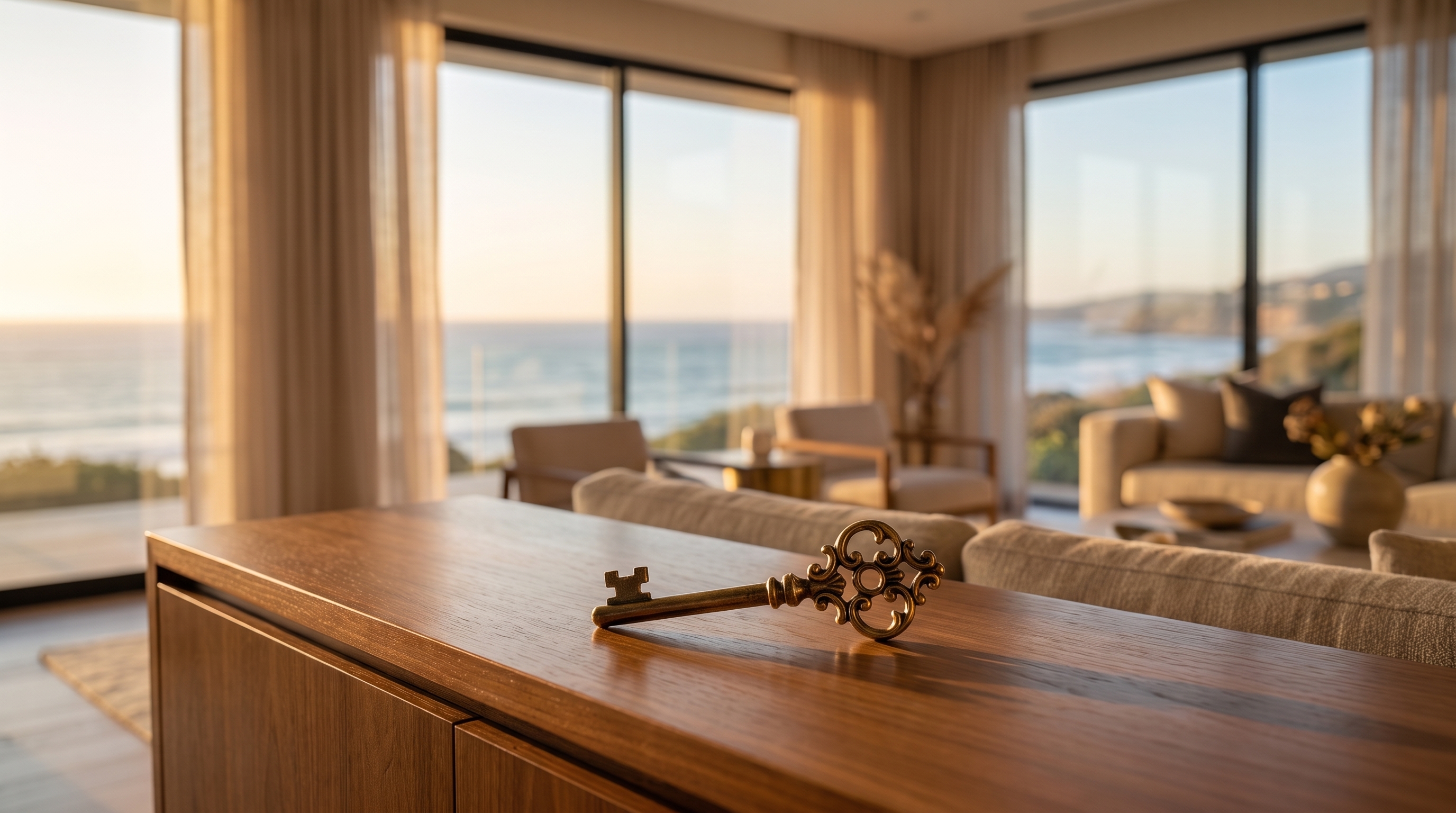
The term gets used loosely, so let's be precise. A coastal private residence at the luxury tier is not defined by square footage, or by the number of bedrooms, or even by the price. It is defined by its relationship to the water. Direct access, unobstructed views, outdoor living that extends toward the shoreline rather than being separated from it by a parking structure or a hotel garden: these qualities make the experience or render it ordinary. Without them, you have an expensive house that happens to be near the ocean. That is a different product entirely.
The range within that definition is genuinely wide. Beachfront villas, cliffside estates, Gulf Coast compounds, private island configurations in the Caribbean: each has a distinct sensory character and a distinct kind of guest it suits well. But all of them share the same core proposition. The water is not a backdrop. It is the organizing principle of the property, the thing every room orients toward, consciously and architecturally.
Beach villas dominate the luxury rental market, and that concentration reflects what travelers at this tier are actually seeking. The beach-specific pull points to a preference for a particular sensory relationship with the coast that other formats, however dramatic their settings, simply do not replicate. A clifftop estate with a panoramic view is extraordinary. It is also a different experience than walking barefoot from the kitchen to the sand. Both have their devotees.
What separates a hand-selected, professionally managed residence from a privately owned home listed on an open platform is the curation layer. At the luxury tier, a private pool, beach access, and quality furnishings are the price of entry. They are not differentiators. The defining question is whether the property and its surrounding service infrastructure actually deliver the experience of living on the coast, not merely passing through it. Most disappointments at this tier trace back to that gap, and it is a gap that listing photography almost never reveals.
The Sensory and Spatial Qualities That Define the Coastal Residence Experience
Space is the primary differentiator, and it operates on several levels simultaneously. A private residence gives a group room to coexist without constant choreography. Separate bedrooms with their own bathrooms. A kitchen that functions for a real meal. A terrace that belongs entirely to the people staying there, not to the property's other guests or the hotel's operational schedule. Some members of the group can gather in the common areas while others find quiet. None of this requires negotiation with staff or strangers, and the relief of that, the dropping of a low-level social vigilance you didn't realize you were carrying, is something you notice immediately on arrival.
The acoustic and visual environment matters more than most travelers anticipate before they have actually lived inside it. Waking to the sound of water without a hotel corridor between you and it, opening doors directly onto a private terrace rather than a hallway where someone is already rolling a cart: these restructure the entire sensory register of the morning, and by extension, the rhythm of the entire day. That sounds like a small thing until you've experienced both back to back.
Private beach access deserves its own mention because the contrast with hotel beach culture is stark in a way that's almost comic once you've seen it. No towel reservation theater. No competition for chairs at 7 a.m. No strategic positioning relative to other families. The ability to leave your things, swim, come back, leave again, without having staked territorial claims in advance. And the uncrowded early morning, which is frequently the finest hour of any coastal day, belongs entirely to the group. I have never spoken to a repeat villa traveler who doesn't mention the morning beach as a specific, named reason they came back.
Spatial layout also fundamentally changes how time organizes itself. No checkout from the pool at 6 p.m. No breakfast dress code. No kitchen dictating the meal schedule. The group's preferences set the schedule, not the property's operational structure. For multi-generational groups, where ages and energy levels and dietary requirements vary considerably, this flexibility is not a nicety; it is what makes the trip functional for everyone, including the people who would otherwise feel like they were slowing things down.
Coastal architecture at the best properties uses light, materiality, and indoor-outdoor transitions to make the water a constant presence rather than something you have to walk to. The finest residences are designed so that the sea is visible from the kitchen, audible from the bedroom, accessible within steps of the main living space. That design intention makes the coast feel inhabited rather than visited. It is the difference between a property that uses the coast as its setting and one that is genuinely built around it.
The Service Model That Makes Private Residences Feel Like Five-Star Stays, Not Self-Catering
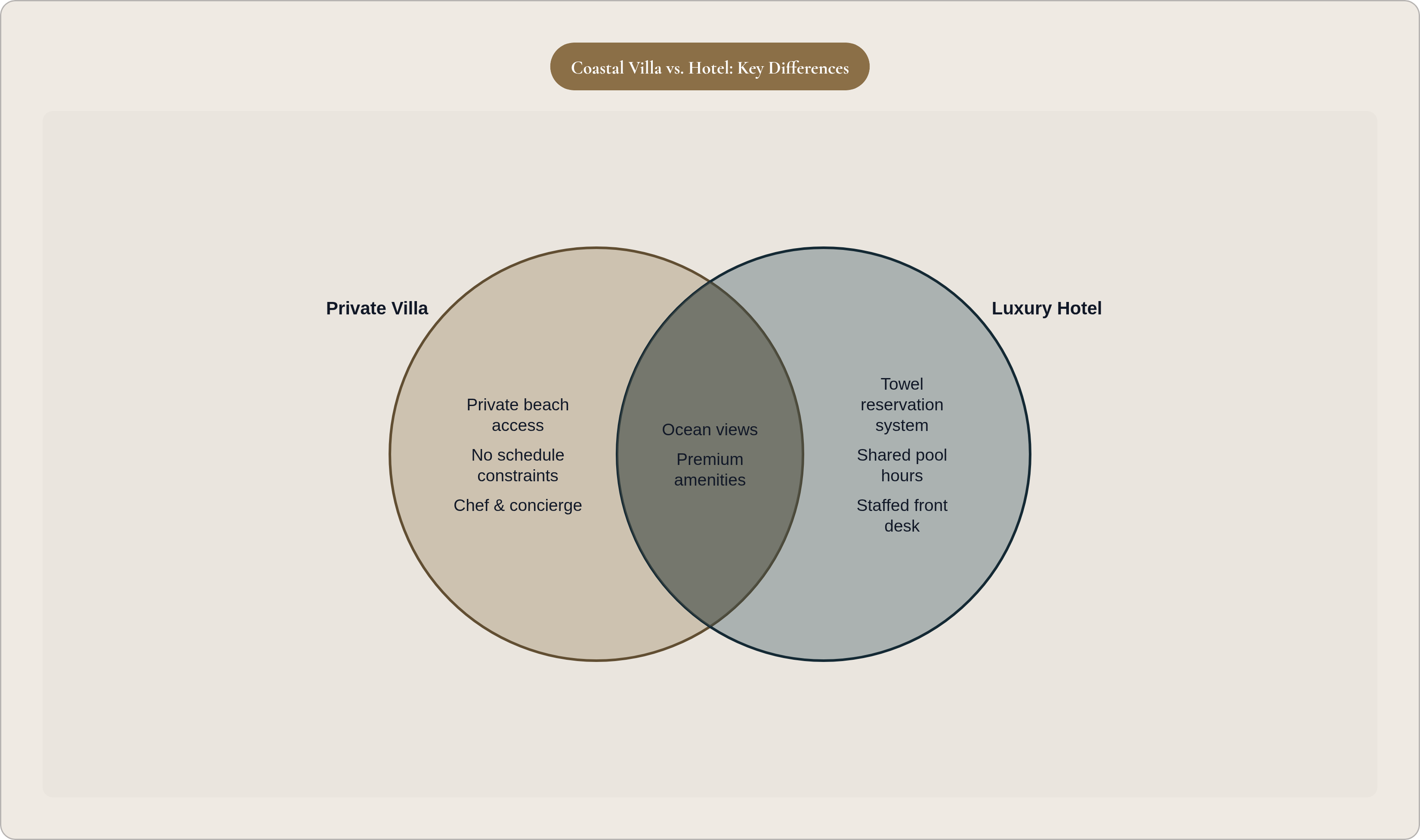
One version of the private residence experience is upscale self-catering: a beautiful house, local restaurant recommendations, a property manager's number if something breaks. And then there is the version where a chef has sourced from local markets, stocked the kitchen before your group arrives, and will quietly adapt every menu to the dietary preferences you mentioned once, weeks ago, without being reminded. Those are not variations on the same experience. They are different offerings wearing the same name.
At the top tier, embedded concierge is the operational backbone of the stay. Pre-arrival grocery stocking calibrated to the group's actual preferences, not a generic welcome basket. Daily coordination for whatever the group needs, whether that is water-sport bookings, dinner reservations at the restaurant that doesn't take walk-ins, or a boat charter arranged before anyone thought to ask. Discreet availability throughout: present when needed, genuinely invisible when not. The best house managers I've encountered operate with a kind of anticipatory intelligence that takes real skill and local knowledge to execute. It looks effortless. It is not.
A bolted-on concierge service, reactive to requests and available by phone, is a hotel feature transplanted into a rental setting. It functions adequately. What it cannot do is remove friction before it appears, because it has no mechanism for anticipation. You feel the difference by the second morning of the stay, sometimes sooner, in the small frictions that either don't arise or do.
Wellness has become a standard service category at this tier, not an upgrade or a specialty offering. On-call practitioners, nutritional programming for the week, sunrise yoga on the terrace arranged without a formal request: these are increasingly expected by experienced travelers who treat restoration as the actual purpose of the trip rather than a byproduct of it. That shift moved faster than most property managers anticipated. Properties that adapted early now hold a meaningful service advantage.
Professional management is what makes the whole thing consistent and trustworthy across seasons. A privately owned home without managed service can disappoint in ways that listing photography will never reveal. The curation layer, the vetting of the property itself, the service standards, the staff caliber, is what makes the experience repeatable. Without it, you are relying on the owner's attention and disclosure, which varies enormously, and the stakes of that variance at this price point are considerable.
The Destinations Where Coastal Private Residences Deliver This Experience Most Fully
Geography shapes not just the setting but the entire character of the experience, and matching destination to group intent is one of the most consequential decisions in planning. It gets underweighted relative to amenity comparison, because amenities are easier to compare in a grid.
The Caribbean
The Caribbean is the canonical luxury villa destination, and the reasons are structural, not simply traditional. The private-island and chef-staffed villa model is more fully developed here than anywhere else in the world. Turks and Caicos, particularly the Grace Bay corridor, delivers some of the most consistently exceptional water quality in the Atlantic basin: that specific shallow-water turquoise that photographs well and is even better in person. St. Barts offers a refined sensory register: French culinary culture, dramatic topography, genuine seclusion, the kind that requires a small plane or a ferry and rewards the inconvenience. Barbados and the British Virgin Islands provide privacy that you have to work to reach, and that work functions as its own form of arrival ritual.
Peak Caribbean inventory, particularly Christmas and New Year week, firms early. For 2026 holiday periods, lead time is a practical necessity.
The Mediterranean
The Mediterranean operates on a different sensory register. Groups sometimes discover mid-trip that they wanted one and booked the other. Architecture, culinary culture, and walkable historic environments exist alongside the water here, not incidentally, but as central features of the experience. The Amalfi Coast offers vertiginous drama and extraordinary local food culture that rewards exploration. Ibiza and Mykonos deliver high-design, high-energy coastal experience with a particular kind of social energy that suits some groups well and exhausts others. Santorini's caldera orientation is architecturally singular, built around a view that actually delivers on the photograph.
The Mediterranean estate implies something specific about service: local culinary access, cultural excursion infrastructure, a genuine connection to the food and history of the place. Groups drawn to the Mediterranean typically want that cultural dimension alongside the water. It is a different kind of coastal trip than the Caribbean, and the confusion between them is one of the more common sources of mild disappointment I've seen in this space.
The U.S. Gulf Coast
The Gulf Coast ultra-luxury model is more recent in its development but increasingly serious as a competitive destination. White-glove pre-arrival stocking, private beach configurations separated from public access, and concierge infrastructure comparable to the best Caribbean operations characterize the top end of this market. For groups who want the full private-residence experience without the logistical overhead of international travel, flights, customs, currency, it deserves consideration, not reflexive dismissal.
What to Look For Beyond Location
Regardless of destination, the physical orientation of the property is non-negotiable and surprisingly easy to misread from a listing. Does the main living space face the water? How far is the interior from beach access, measured in actual steps rather than marketing language? How are the outdoor spaces configured for a group of the specific size traveling? These questions are answerable from high-quality imagery and 3D tours if you know to ask them before you book rather than after you arrive.
What Genuinely Separates One Luxury Coastal Residence From Another
The amenity baseline no longer differentiates anything. Private pool, hot tub, fire pit, high-end kitchen: these are expected at this tier. Their presence in a listing does not signal quality. Their absence would signal a problem. The questions that reveal a property's caliber operate at a different level, and they are not the questions most travelers think to ask.
Is beach access genuinely private, or shared with neighboring properties? The experiential difference between stepping directly onto a private stretch of sand and navigating a semi-public right-of-way, past other guests or other properties, is real and daily. Is the chef arrangement vetted and managed by the property, or a referral the guest coordinates independently? Those are not equivalent service models. How is the concierge layer structured: embedded from day one, or available by request after arrival? Has the property been professionally managed for consistent quality, or is it owner-listed, where the experience varies with the owner's attention and mood?
Smart-home integration is a genuine signal of intentional preparation, not a tech amenity. Remote climate control, integrated entertainment systems, automated outdoor lighting: someone has thought through the friction points of arrival and daily use and resolved them in advance. After a long travel day with children or elderly family members, arriving at a house where nothing requires figuring out is an underrated relief.
Sustainability is becoming a real quality signal rather than marketing positioning, particularly at the top end of this market. A meaningful share of luxury travelers now report genuine willingness to pay a premium for environmentally conscious accommodations. Biophilic design, renewable energy systems, organic sourcing for the kitchen: these increasingly reflect a coherent design philosophy. Together, they indicate an owner or operator who has thought carefully about what the property is and what it is for, which tends to predict quality in other dimensions.
The value of a curated marketplace over an open platform: the vetting happens before the traveler sees the listing. You don't need to read between the lines of property descriptions if someone whose entire expertise is exactly that has already done the work.
How to Plan and Book a Coastal Private Residence Stay to Get the Most From It
Lead time is the variable most consistently underestimated. The regret of moving too slowly on a property is specific and preventable. Caribbean Christmas and New Year inventory firms months in advance. Mediterranean peak summer fills on a similar timeline. Gulf Coast spring demand requires planning measured in seasons, not weeks. Moving early is not overcaution. It is the only way to access the best properties in any given destination during peak periods.
Start with group composition, not destination. Number of bedrooms required, ages present in the group, whether young children or members with specific mobility requirements are traveling, whether the goal is shared common space or maximized privacy within the property: these parameters should drive the search from the beginning, not get added as filters after you've already fallen for a property that doesn't quite work for your group.
Match destination character to the group's actual purpose. Couples seeking complete seclusion and couples who want cultural immersion alongside the water are better served by different geographies, sometimes dramatically so. Families with young children who want structured water-sport access have different requirements than a multi-generational group whose primary goal is shared meals and unstructured time. The destination shapes the experience as much as the property. Conflating those two decisions is a common planning error.
Have the service conversation before booking, not after. Confirm what is included in the chef arrangement: which meals, which days, how dietary requirements are handled. Confirm whether concierge service is pre-arrival, on-call, or embedded throughout the stay. Identify which activities require separate coordination and which are managed through the property's service infrastructure. These are not details to clarify on arrival, when the flexibility to act on them has already disappeared.
On pricing: entry-level premium coastal properties typically begin around $1,500 per night. Fully staffed Caribbean or Mediterranean villas with embedded concierge and a full house team run substantially higher, often $3,500 to $7,000 or more per night depending on scale, destination, and season. The relevant question is not what a property costs per night in isolation but what it costs per person per day when distributed across the group. At that point, the comparison to a hotel, including the suite accommodations and service levels required to approximate a comparable experience for the same group, usually looks quite different than it did before the math.
Use the imagery and 3D tours that quality platforms now provide as diagnostic tools, rather than as confirmation that the pool exists. Verify the water orientation. Examine the outdoor living configuration and how it functions for a group of your actual size. Assess the real distance from the interior to the beach. These details are visible in good photography if you are looking for them with intention rather than simply admiring the light.
The difference between booking a property and booking an experience is real, and the best outcomes at this tier come from working with a platform or manager who builds the stay around the group's specific intentions. Who is traveling. What the trip is meant to accomplish. What would make it genuinely exceptional rather than merely very good. The planning process is where that gap either gets closed or doesn't.