Pet Friendly Luxury Rentals Without Compromise
Why Pet-Owning Travelers Are Done Settling The reckoning arrives within the first hour. You've paid $600 in non-refundable fees, you're standing in a rental that technically…

Why Pet-Owning Travelers Are Done Settling
The reckoning arrives within the first hour. You've paid $600 in non-refundable fees, you're standing in a rental that technically allows your dog, and you're looking at one ceramic bowl on the counter, a laminated vet list by the door, and carpet. Wall-to-wall carpet. The performance collapses right there. "Pet-friendly" turned out to mean "pet-tolerated." By the time you understand the distinction, you're already unpacked.
This is not a niche grievance. Ninety-four million U.S. households own at least one pet, per the American Pet Products Association's 2025-2026 National Pet Owners Survey. Americans spent $152 billion on their animals in 2024. The people making these bookings are not asking for special accommodations. They are the dominant consumer class in hospitality, and a meaningful portion spend accordingly, walking away from properties that treat pets as a footnote.
Millennials, who represent 33% of pet-owning households, drove this shift. They built daily routines around their animals before remote work made travel with them possible. Month-long stays in cities they want to actually inhabit, laptop open, dog underfoot, are now a travel pattern. Zillow's 2023 Consumer Housing Trends Report found pet-friendly features among the most-searched filters on rental platforms. Anyone who has spent 45 minutes narrowing results to three viable options knows this.
What fills most of the gap between supply and demand right now is marketing, not substance. The market is responding, slowly, unevenly, but it isn't reversing.
The Pet-Friendly Illusion: What Most Properties Actually Offer
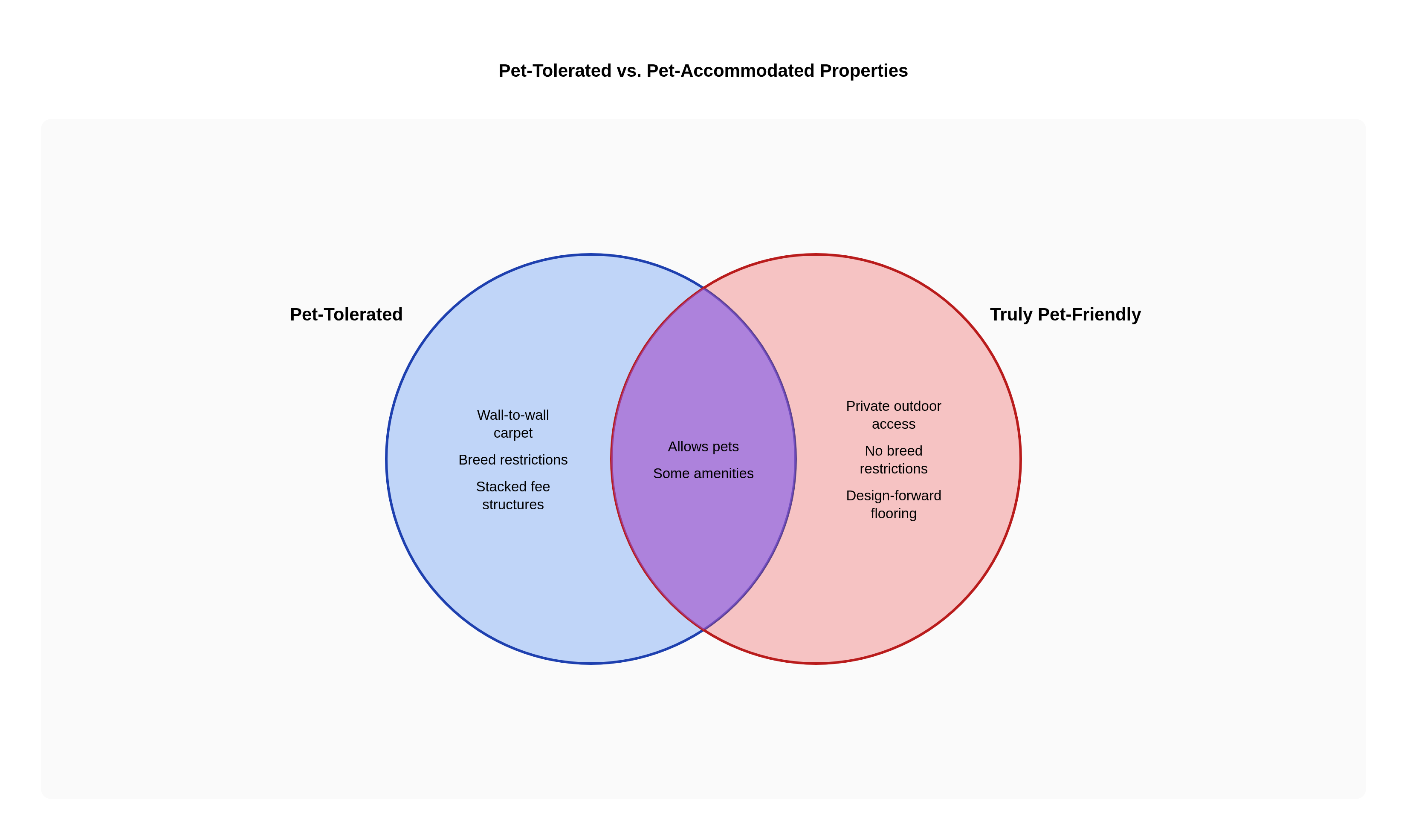
There is a real difference between a property that allows pets and one that actually accommodates them. Learning the distinction after booking costs real money.
The fee structure is the first place the illusion shows. Most U.S. jurisdictions permit three distinct cost mechanisms to be legally stacked: a non-refundable pet fee averaging $150 to $300, climbing to $800 or more at high-end properties; a refundable deposit typically running $200 to $600; and pet rent on top of both, usually $25 to $100 per animal per month. Properties frequently apply all three. Most listings won't surface the full picture until you've invested significant time in an inquiry. That is not accidental.
Breed and weight restrictions are the second layer. The 25-pound cap that appears constantly across listings is almost never the product of careful thinking about animal behavior. It's an insurance carrier requirement, not a property-level policy decision. Once you understand that, negotiating becomes pointless. Stop trying and look elsewhere.
What remains, at most properties claiming to welcome pets, is cosmetic: a bowl, a treat, sometimes a branded bandana. The amenity is present; the infrastructure is not. Properties with enthusiastic pet-friendly reviews have no usable green space within a reasonable walk. You find this out when you're already there, the worst moment for a non-refundable booking.
What "Without Compromise" Actually Looks Like in a Private Residence
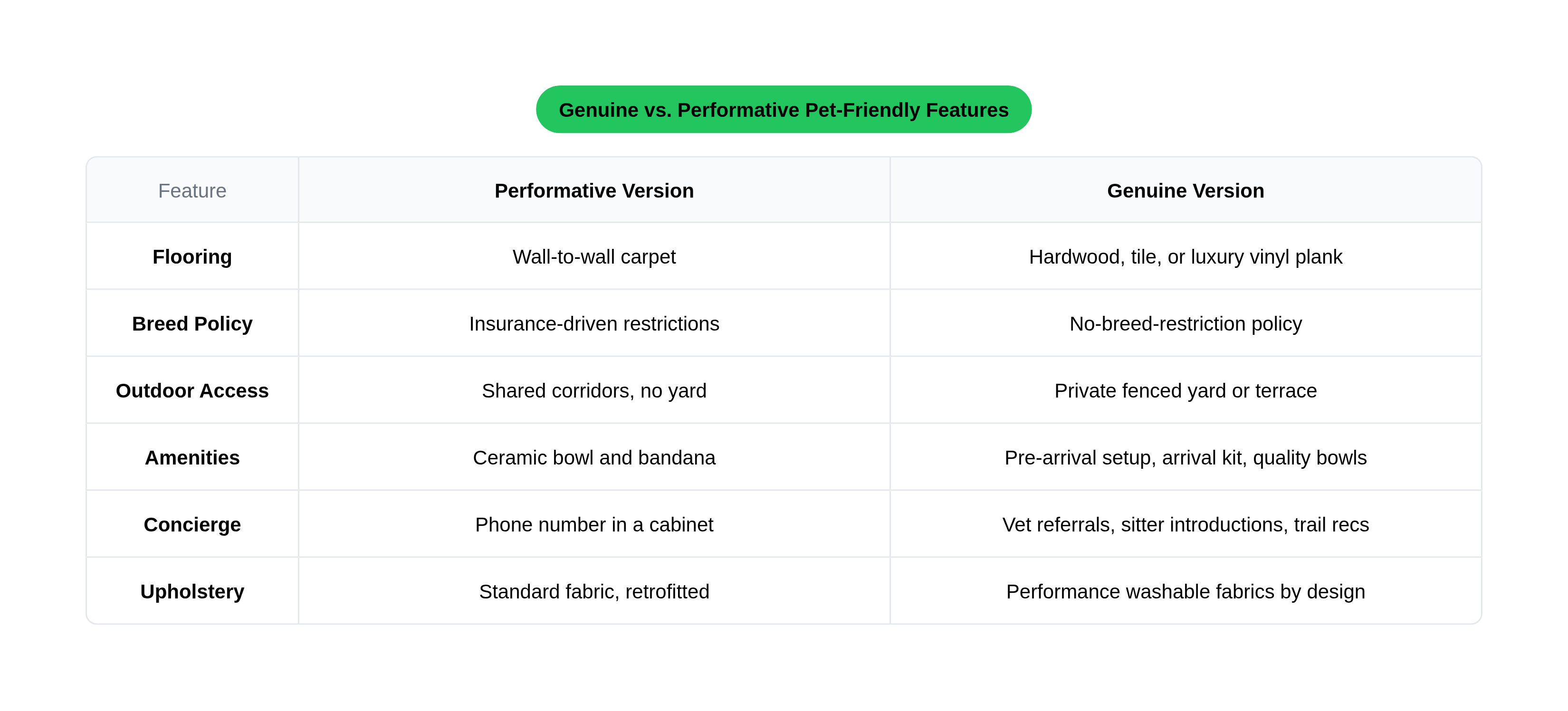
Space comes first. Private residences win this argument before you've opened a bag. Multiple rooms, functional separation between zones, private outdoor access, no shared corridors where a dog's 7 a.m. energy becomes a formal complaint. No hotel room, regardless of thread count or skyline view, replicates what a private home provides structurally.
Flooring is not a design detail. It's the thing you think about constantly for a week when you're in the wrong rental with a wet dog. Hardwood, tile, and high-grade luxury vinyl plank clean easily, resist odor, and hold up under actual use. Carpet absorbs everything, retains dander, and degrades visibly. A property that thought seriously about its pet guests made the right call here, and you'll see it in the listing photos, if those photos are honest.
Performance upholstery in washable fabrics is another concrete indicator, not because the material is exotic, but because choosing it tells you something: pets were included in the design logic, not retrofitted afterward. Same with dedicated sleeping areas that have real bedding rather than a folded towel on tile. You know within ten minutes whether those choices were deliberate. The entire stay follows from that.
Breed restrictions are the clearest dividing line between genuine and performative inclusion. A property welcoming all breeds, including those on standard insurance-driven prohibited lists, is making a deliberate, operationally costly commitment. Properties like Instrata at Legacy West and Los Altos at Trinity Green in Dallas have adopted no-breed-restriction policies as an explicit market statement. That decision costs something. Properties that haven't made it chose not to.
Outdoor access is non-negotiable. A private yard, a fenced terrace, actual green space where a dog can behave like a dog without waiting for an elevator. Proximity to walkable parks and green corridors is a core requirement in location selection, not a discovery made after checkout.
Concierge service that extends to the animal rounds this out. Pre-arrival amenity setup, local veterinary referrals, pet-sitter introductions, curated recommendations for dog-friendly dining and trails. An arrival kit with quality bowls and a genuine welcome tells you how a property thinks about its guests.
The Questions to Ask Before You Book
Don't rely on the listing. Ask directly, specifically, and in writing, because what's in writing is what can be enforced.
Start with the full fee structure. Is there a pet fee, deposit, pet rent, or a combination? What is the total cost before, during, and at checkout? A refundable deposit is reasonable at a genuine luxury property. A non-refundable fee of $800 or more for a large dog is at the outer edge of the market; assess whether the finish level justifies it, not the property's self-description.
Policy specifics come next: breed restrictions, weight caps, number of pets permitted, which areas of the property are accessible. If any answer requires follow-up parsing, pay attention. How a property handles ambiguity in a pre-booking inquiry previews how it handles ambiguity mid-stay.
Space and layout deserve their own line of questioning. What are the flooring materials in the main living and sleeping areas? Is there private outdoor access, and is it fenced? What is the walking distance to the nearest substantive green space? A property that regularly hosts pet-owning guests has specific, ready answers. A pause followed by a redirect to the listing tells you something too.
Pet-specific amenities require direct questions. Is a washing station available on-site or nearby? Can the concierge arrange walking, grooming, or sitting, or does "concierge" mean a phone number taped inside a cabinet? What does the arrival kit contain, specifically?
Damage and liability require explicit clarification before anything is signed. What is the documented process for assessing and disputing damage claims? Is the deposit genuinely refundable, and under what written conditions? Vague answers here reflect a policy problem, not a communication one, and they predict how disputes get handled.
If you're traveling with a service animal or emotional support animal, know your federal protections before the conversation begins. Under the Fair Housing Act, service animals and ESAs are exempt from pet fees, deposits, and pet rent, with narrow exceptions for owner-occupied small buildings. Consult current HUD guidance directly for the full scope of applicable protections. A property that resists this: walk away.
The Regulatory Shift Changing Pet-Friendly Housing for the Better
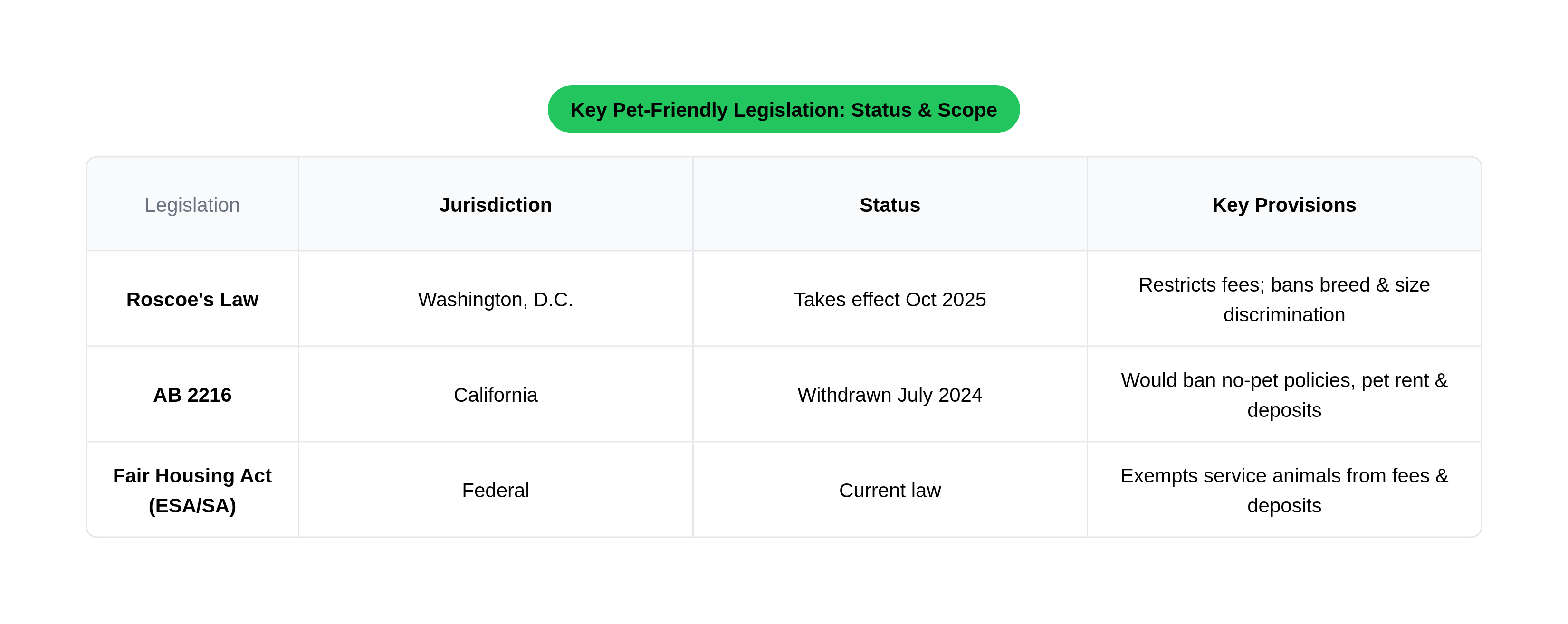
The policy environment is improving. It's uneven. Let it inform your expectations, not replace your due diligence.
Washington, D.C.'s Pets in Housing Amendment Act, informally called Roscoe's Law, takes effect in October 2025. It restricts pet fees and explicitly prohibits breed and size discrimination in pet-friendly rentals, a level of specificity the industry hasn't seen at this scale.
California's AB 2216, introduced in 2024, would have gone further: banning blanket no-pet policies and prohibiting both pet rent and additional deposits entirely. It passed the State Assembly before being withdrawn in July 2024 under pressure from rental property associations. The advocates behind it have signaled intent to return with successor legislation. The political constituency for this is too large to dissipate.
Across jurisdictions, policy language is beginning to treat pet-owning renters as a population with legitimate housing access interests rather than a specialty group accommodated at landlord discretion. Individual bills fail, get narrowed, get withdrawn. The directional pressure doesn't reverse. Different things.
Separately from legislation, some operators have moved away from blanket breed prohibitions toward behavior-based evaluations and formal pet screening services. The recognition that penalizing a dog for its genetics reflects an insurance convention rather than an evidence-based safety position is growing. Operators who say this openly create real pressure on others to follow or to justify their reasoning, a harder position to hold publicly than it once was.
Sustainable and Design-Forward: The Next Frontier of Pet-Friendly Luxury
There's a traveler who books design-forward private residences and brings her own coffee beans, her own values, her own settled sense of sourcing. She doesn't expect those values to stop at the door. A property that stocks small-batch organic coffee and hands her a single-use plastic bag for her dog creates a visible contradiction. She notices it. She writes about it.
Organic pet food, biodegradable waste products, sustainability-minded sourcing: these are extensions of choices this traveler already makes at home. Their absence in a pet-friendly context registers as an oversight rather than a luxury shortfall, harder for properties to dismiss.
Waste management is where operational seriousness becomes most legible. A dispenser with single-use plastic bags by the back gate is no longer sufficient at the genuine luxury tier. In-ground composting systems and composting partnerships that handle pet waste as a distinct stream are appearing at forward-thinking properties. Guests who care are explicit in their reviews. The issue has migrated from niche preference to visible performance gap.
Design coherence is the clearest signal of actual commitment. A residence where pet-friendliness was factored into the material palette from the beginning, with durable but visually considered flooring, performance fabrics, and sleeping areas that look deliberate, reads differently from one that retrofitted it. You know within minutes which you're in.
The amenity baseline at the luxury level has shifted considerably. Pet lounges, pet-friendly co-working spaces, app-integrated walking and grooming services, in-building daycare: all of these appear at properties like Village at Commonwealth in North Carolina. What were differentiators two years ago are becoming baseline expectations among this tier of traveler. Properties still treating them as extras are behind.
Finding the Properties That Actually Deliver
A hand-selected, professionally managed private residence evaluates pet-friendliness as part of its quality criteria, not individual owner discretion or a platform checkbox. That structural difference matters before you've looked at a single listing. Starting with better preconditions is the practical advantage in a search full of ambiguity.
When evaluating a platform or marketplace, look for explicit, itemized pet policies per property rather than a blanket "pets allowed" filter applied uniformly across wildly different actual situations. Look for concierge access before and during the stay: the practical ability to arrange services, not merely a policy permitting you to arrange them yourself. Look for listing descriptions specific enough to name flooring materials, outdoor access, and amenities in concrete terms. A named point of contact rather than a help desk ticket signals that issues, when they arise, will be handled by someone with real accountability for the outcome.
The red flags are equally readable. "Pets considered" language with no policy detail. Non-refundable fees paired with no documented damage-assessment process. Listings that omit any mention of outdoor access or pet amenities entirely. Breed or weight restrictions that exclude common family dogs are usually worth walking away from rather than negotiating around; the underlying policy infrastructure is rarely more flexible than its written terms, and you find out at the worst possible moment.
High-quality supply is growing. Regulatory pressure is beginning to hold the worst actors accountable. The luxury pet-friendly segment is projected to expand substantially through 2035. None of that changes what you need to do before you book: ask specifically, ask in writing, and do not let a beautiful listing photo substitute for an actual answer.