Pet Friendly Waterfront Vacation Rental Standards
Why Waterfront Vacation Rentals That "Allow Pets" Often Fall Short of Being Genuinely Pet-Friendly "Pets allowed" is a checkbox …

Why Waterfront Vacation Rentals That "Allow Pets" Often Fall Short of Being Genuinely Pet-Friendly
"Pets allowed" is a checkbox. It communicates almost nothing about what you will actually find when you show up with your dog.
I have seen this firsthand enough times to stop being surprised by it. A listing accepts dogs, but there is no fencing, no rinse station, no clarity on where the animal is actually permitted to go. The policy says yes, and that is where the thinking stopped. For a standard rental, that gap is inconvenient. At a waterfront property, it becomes a safety problem.
Open water, slippery dock surfaces, resident wildlife, boat traffic: these are not hypothetical concerns. A Labrador chasing a bird off an unguarded dock, a small terrier slipping through a gap in a gate facing the shoreline, a dog who has never seen an alligator encountering one at dusk on a Florida lake property. These are foreseeable events. Most pet policies at waterfront rentals do not come close to addressing them.
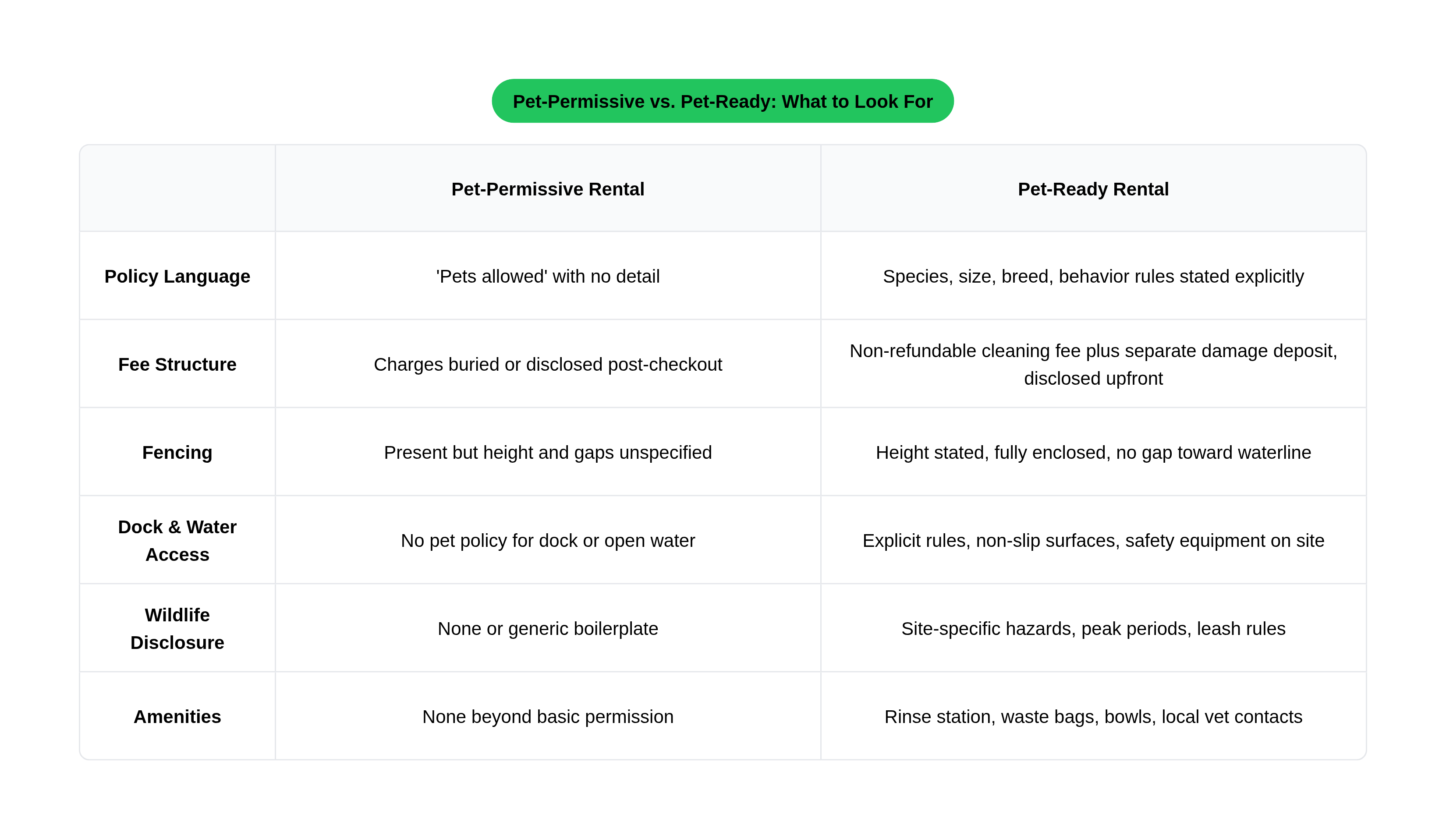
The phrase "pets allowed" was never designed to carry this much weight. But the market has expanded, the checkbox has proliferated, and the underlying preparation has failed to keep pace. What follows is a framework for distinguishing a waterfront rental that tolerates pets from one that has genuinely prepared for them.
How Strong Demand Has Outpaced Meaningful Quality Standards in Pet-Friendly Waterfront Rentals
This is not a niche market. According to APPA's 2025 data, 78% of American pet owners travel with their pets annually. That is a mainstream behavior, not a fringe preference. And pet travelers are not casual customers: Vrbo's 2024 Travel Trends Report found they book an average of 4.8 nights per stay versus 3.2 nights for non-pet travelers. Longer stays, fewer turnovers, more revenue per booking. The demand case for hosts is not subtle.
Waterfront and coastal destinations absorbed a disproportionate share of that demand, particularly during the travel surge of the early 2020s. The occupancy divergence between pet-friendly and non-pet-friendly waterfront properties during that period was sharp. Hosts noticed. Listings began advertising pet acceptance at a pace that had nothing to do with actual readiness.
Here is where it gets frustrating if you have spent any time watching this market closely. Somewhere between 22 and 27% of vacation rental listings across major platforms now claim pet-friendliness. But a listing that accepts pets and a listing that is prepared for them are not the same thing, and the gap between those two categories is where most of the guest complaints, post-checkout disputes, and avoidable accidents live.
Supply has grown. Preparedness has lagged behind. That is the problem. Understanding it is the prerequisite for navigating this market intelligently, whether you are booking or listing.
What a Complete, Specific Pet Policy Looks Like — and Why Vague Ones Create Problems at Waterfront Properties
A vague policy does not just fail guests. It fails the host. "Pets allowed" without further detail gives a guest no guidance on whether three large dogs are welcome, whether breed restrictions apply, or what constitutes damage. It gives the host no defensible framework when something goes wrong. Vagueness creates disputes by leaving every contested question open.
A complete policy works sequentially. Species first: dogs and cats only, or does the property also accept birds, rabbits, or other companions? Number and size limits follow. Then breed restrictions, which are more common at waterfront properties than guests expect. A real example from a New Hampshire pond property explicitly excludes Akitas, Cane Corsos, Rottweilers, Wolf Hybrids, and any mixed breed including those listed. That specificity is not hostile; it is honest. It prevents arguments at check-in. Per a PetScreening survey, pet limits per household were the most cited restriction among operators, followed by breed restrictions and weight limits. All three require explicit policy language to be enforceable.
Behavior expectations belong in the policy too: crating requirements when pets are left unattended, conduct standards near the water, and prohibitions on leaving animals alone at the property. Documentation requirements should be stated upfront, including vaccination records and licensing, and for larger dogs at some properties, veterinary references or training certificates.
At a waterfront property, a generic policy is structurally incomplete by default. It needs additions specific to the environment: whether pets are permitted near or on the dock, rules around animals and watercraft, and wildlife-awareness requirements for properties where alligators, venomous snakes, or similar hazards exist within realistic proximity. These are not edge cases on a Florida lake or a South Carolina tidal property. They are foreseeable events, and a policy that ignores them fails to protect anyone.
Penalty clauses need to be disclosed before arrival. One New Hampshire waterfront property charges a specific dollar amount for uncollected waste and a separate charge for excessive pet hair on linens. The amounts matter less than the fact that guests see them before checkout, not after. Surprise charges drive negative reviews. Clearly stated penalties, even firm ones, rarely generate friction.
One item is non-negotiable regardless of everything else: service and assistance animals must be accommodated without additional fees. This applies across Airbnb's platform and under federal fair housing frameworks. It is not discretionary.
A distinction worth tracking as the market matures: some operators are beginning to use "pet-inclusive" to signal an open, unrestricted welcome, reserving "pet-friendly" for properties that still carry meaningful size or breed limitations. Guests are starting to look for the difference.
How Fee Structures Communicate Seriousness and Protect the Property Without Alienating Guests
The fee is not the point. What the fee signals is.
A property that charges thoughtfully, explains what the fee covers, and delivers on the implied promise is a property guests trust. A property that buries charges in the fine print or surfaces them post-checkout is not a pet-friendly property. It is a pet-permissive one with a grievance mechanism.
The standard range for vacation rentals is roughly $25 to $75 per pet per stay. At beach and waterfront properties in premium markets, a one-time non-refundable fee of $100 to $250 per pet is typical. Sea Scape Properties, a coastal North Carolina operator, charges $200 plus tax per pet. That functions as a useful real-world benchmark for what that segment looks like in practice.
The recommended structure separates a non-refundable fee from a refundable damage deposit. The non-refundable fee covers cleaning: hair removal, deep cleaning, odor treatment, wear on pet-specific amenities, and inspection of dock and exterior areas after checkout. The deposit covers damage and is returned when none occurs. That structure is transparent, defensible, and gives guests a clear incentive to leave the property in good condition.
One structural point specifically for hosts: applying the pet charge as a custom fee rather than folding it into the base nightly rate keeps the listing price competitive in platform search results. The total cost is identical. The visibility in filtered searches is materially better.
The Amenity Baseline That Genuinely Pet-Friendly Waterfront Rentals Provide
A fenced yard is the single most searched amenity by dog owners booking vacation rentals. Its absence disqualifies the listing for many guests, regardless of policy language. But fence presence is only the beginning. Fence quality is what actually matters.
Height must be appropriate for the guest's dog. A three-foot decorative fence will fail to contain a Labrador or a Husky. Full enclosure means no gaps at the bottom, no open gate facing the water. And at waterfront properties, the critical question is how the fence relates to the shoreline. A yard that stops 20 feet from the water without a gated passage is a meaningful limitation. The listing should disclose it, and the guest should ask.
Beyond fencing, any competent waterfront property provides water and food bowls, a waste bag dispenser near the door, and an outdoor rinse or shower station for sandy or salty paws. At a beach or lake property, a rinse station is a baseline expectation, not a premium amenity. Guests with dogs who have spent the day in the water will use it every single time.
Mid-tier differentiators include a pet bed and blanket, a doggy first-aid kit, and interior pet gates for zoning. These cost almost nothing and signal that the host prepared for the guest experience rather than simply permitting animals. That distinction is felt immediately on arrival.
Top coastal operators go further. The Ocean Villa Inn in San Diego offers a named example: a dog wash station with a bathing tub, shampoo, and dedicated towels. Pet-safe patio surfaces, a gated path from the fenced yard to a private dock, curated local information covering nearby pet-friendly beaches, walking trails, and veterinary contacts. These are not extravagant. They are the logical extension of taking the guest's situation seriously.
The financial case is direct. A fenced yard with confirmed water access commands a 20 to 30% nightly rate premium in most markets and fills weeknight inventory that comparable non-pet properties cannot fill. The amenity investment returns.
Waterfront-Specific Safety Measures That Go Beyond What Any Standard Pet Policy Covers
Waterfront rentals carry elevated baseline exposure compared to standard short-term rentals before a pet is even in the picture. Unfamiliar environments, slippery surfaces, open water, and boat traffic are already present. A dog is an additional moving variable, often off-leash, operating in an environment it has never encountered.
The legal stakes have become concrete. In 2024, Airbnb and the host of a waterfront New York property were named in a negligence suit after three guests drowned at an unmarked underwater drop-off between a pier and a floating dock. That case made the point plainly: physical safety documentation is not optional at waterfront rentals. Guests expect disclosure. Its absence creates liability that runs in one direction.
Dock-specific safety measures start with non-slip tape on surfaces. Low cost, high risk reduction. Visible signage communicating that swimming is at the guest's own risk belongs at the dock and at yard access points facing the water. Coast Guard-approved life rings, pool hooks, or life jackets should be accessible near the dock and labeled clearly.
For pets, the dock edge is the most acute hazard. A dog chasing a ball or a bird off an unguarded dock edge is a predictable scenario. The property needs a stated policy on whether pets are permitted on the dock at all, and if they are, what guarding measures exist. Water depth and drop-off conditions near areas where pets might swim should be disclosed. Rules around pets and watercraft need to be explicit.
Properties in areas with significant alligator populations, venomous snakes, or other wildlife hazards should include a dedicated wildlife safety document in the rental agreement. Site-specific information, rather than boilerplate: the specific hazards present, peak activity periods, leash requirements near the shoreline, and garbage securing protocols. Guests need this information. Providing it is the difference between a prepared host and a passive one.
All of this must be legible before or at arrival. Safety information buried in paragraph eleven of a twelve-paragraph terms document is not the same as safety information that is organized, front-facing, and easy to find when it matters.
How to Read a Waterfront Pet Rental Listing as a Guest — and What the Absence of Certain Details Signals
A listing that says "pets welcome" without specifics on fence height, dock policy, and fee structure is describing tolerance, not preparation. The difference matters before you drive four hours with your dog to find out which one you booked.
Before booking, ask these questions directly: Is the yard fully enclosed, and what is the fence height? Does the fencing extend to the waterline, or is there a gap between the yard and the water? Is dock access included, and if so, is there a policy on pets near or on the dock? What safety equipment is on site? What does the pet fee cover, and is a damage deposit held separately? Are there wildlife disclosures specific to the location?
A host who cannot answer those questions, or answers them vaguely, is telling you something. A host who has genuinely prepared for pet guests knows those answers without having to look them up. Vagueness is not a personality trait in this context. It is a data point about the property.
Listing photos are often more informative than policy language. A visible rinse station, legible fencing, dock layout, exterior surface materials: these tell you what the property actually looks like, not what the host believes about it. Look for what is there and note what is conspicuously absent.
Depth of detail in the pet policy tends to correlate with the overall quality of the property management. A host who has thought carefully enough to define breed restrictions, document the fee structure, create a dock safety policy, and compile local veterinary contacts has almost certainly maintained the interior well and handled prior damage claims fairly. The specificity in the policy reflects the same rigor applied everywhere else.
The distinction between a pet-permissive rental and a pet-ready one is easy to identify. It requires knowing what to look for and asking before you book rather than after you arrive.