1031 Exchange Eligibility for Short-Term Vacation Rentals
Meet four specific thresholds on both properties to establish investment intent safely.

A short-term vacation rental can qualify for a 1031 exchange, but regular bookings alone do not settle the question. IRS Revenue Procedure 2008-16 gives owners a reliable way to meet the rules when a property has both rental and personal use. Meet its ownership, rental-day and personal-use thresholds on both sides of the exchange, then keep the records that prove it.
Why Section 1031 creates a specific problem for vacation rentals that it does not create for pure investment property
An owner has a cabin or beach house listed on a booking platform, rented regularly, and now wants to trade up. The property earns income, so exchanging it for another rental may seem straightforward. But if the owner also vacations there, the same property serves two purposes. Section 1031 requires property held for investment or business use.
The nightly-rental format is not the obstacle. A short-term rental operated as an income business can qualify just as a warehouse or long-term apartment can. The tension comes from mixed use, because rental income and personal enjoyment can exist at the same address. The more the property functions as a personal retreat, the harder it becomes to establish the investment purpose that the exchange requires.
What Revenue Procedure 2008-16 is and why the IRS issued it
The Tax Court held in Moore v. Commissioner, T.C. Memo 2007-134, that a vacation property held primarily for the owner’s and family’s enjoyment did not establish investment intent merely because the owner hoped it would gain value. The IRS then put out Revenue Procedure 2008-16, effective March 10, 2008, to give owners a clear safe harbor for vacation properties. Rather than approve or reject short-term rentals as a category, the procedure sets measurable conditions for their use. Those tests give owners a way to plan around a question about purpose that would otherwise be open to dispute.
The safe harbor makes a specific promise. If its requirements are met, the IRS will not challenge whether the vacation home was held for productive use in a trade or business or for investment. That protection is limited to the property’s qualifying use. An owner outside the safe harbor can still argue investment intent from the facts, but loses that clear protection. For most owners, the safe harbor is therefore the practical standard.
The four specific thresholds that define the safe harbor
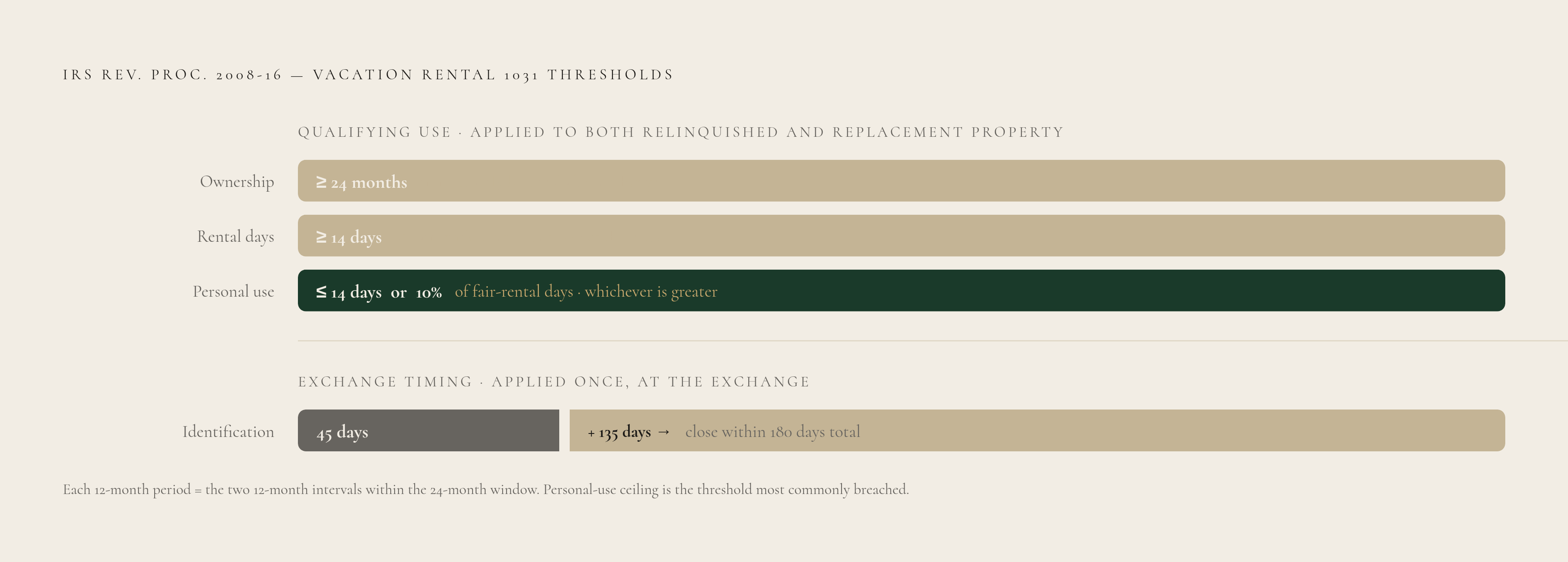
The numbers fall into four groups, namely ownership periods, rental days, personal-use limits and exchange deadlines. The first three establish the safe harbor, while the fourth governs the exchange itself. Together, they require planning across a four-year window. Both the property being sold and the replacement property must qualify on their own.
The ownership requirement is at least 24 months immediately before the exchange for the relinquished property, which is the property being sold. The replacement property must be owned for at least 24 months immediately afterward. Each property must pass the rental and personal-use tests in each 12-month period of its holding window. A strong first year cannot make up for an empty second year.
The rental minimum is 14 days at fair market value in each required 12-month period. The rate must reflect what an unrelated tenant would actually pay. Below-market stays by friends or family do not count toward that minimum. Nor does simply offering the property for rent establish the required rental days. The test concerns actual qualifying rentals.
Personal use cannot exceed the greater of 14 days or 10% of fair-rental days in each 12-month period. With 200 rental days, the allowance rises to 20 days. Below 140 rental days, the flat 14-day allowance governs, while above that point the percentage gives more room. Maintenance visits generally do not count as personal use, but their dates and purpose must be documented.
Replacement property must be identified within 45 days of the relinquished property’s transfer, and the exchange must be completed within 180 days. Meeting those deadlines does not shorten either 24-month holding period. Even with a perfect rental history, the owner must meet the exchange deadlines.
How conversion from personal vacation home to exchange-eligible rental actually works
A mostly personal vacation home needs a genuine conversion to rental use, followed by a full 24-month period that meets the rental and personal-use tests, to become exchange-ready. The practical commitment is two years of qualifying operation before the transfer.
That change starts with listing the property at fair market rates based on what similar rentals charge. Removing personal belongings that mark it as a private retreat also supports the shift to a rental asset. Professional management, or documented active efforts to find tenants, helps show that the property is being operated as a business. Personal stays need to stop or become much less frequent well before the qualifying window begins.
Even so, abandoning personal use alone does not establish investment intent. If the change is primarily preparation for a sale, the IRS may not accept it as a genuine conversion. The distinction is between a property that has actually become an investment and one dressed up as a rental for the transaction.
What documentation must exist to survive an IRS audit of the exchange
The exchange file needs to prove the use of the property. For rentals, it should have signed agreements for every guest that show the dates, rates and terms. Booking platform records and payment receipts should support the occupancy dates and amounts paid. Advertising materials should show that the property was actively marketed at market rates. Together, those records support both the rental-day count and the claim that the rentals were genuine market transactions.
Schedule E filings for each year are the IRS’s main record of rental income and expenses. Those expenses include cleaning fees, maintenance costs, utilities and management fees. Property management contracts, where applicable, add support for the property’s operation as a business. These records serve a different purpose from a booking calendar. They document the financial activity behind the stays.
The owner needs to keep a separate day log for personal use, with the dates and reasons for each visit. Maintenance visits need dates and tasks so they can be distinguished from vacations. For the exchange itself, the file needs the qualified intermediary’s exchange agreement and identification letters. IRS Form 8824 must also be filed for the tax year of the exchange.
Three structural traps that disqualify otherwise clean exchanges
Three separate mistakes can break the exchange or leave part of the transaction taxable, namely entity mismatch, personal property allocation and boot. Their consequences differ, so treating them all as a simple pass-or-fail issue is misleading.
Entity mismatch concerns who sells and who buys. The tax owner relinquishing the old property must be the same tax owner acquiring the replacement. A title change made for liability protection can create a problem if it changes that owner. Forming an LLC for the replacement purchase therefore raises a qualification question that needs to be resolved before closing. It is not a detail to leave until the tax return is prepared.
The Tax Cuts and Jobs Act of 2017 eliminated like-kind exchange treatment for personal property, so furniture, appliances, linens and electronics associated with a furnished rental do not qualify. A sale price that includes those items must allocate value between real and personal property before closing. The part of the price assigned to personal property is taxable even if the real estate exchange qualifies. A furnished sale therefore needs more than one undivided price for tax purposes.
Boot is cash, debt relief or other non-like-kind value received in the exchange. Taking cash out or receiving debt relief can leave taxable value even when the real property qualifies. A lower mortgage balance on the replacement property is one situation that can create this problem. Boot can defeat the expectation that the entire transaction will be tax-deferred.
How local STR regulations in the replacement property's market can independently undermine a qualifying exchange
Federal tax eligibility cannot make a rental legal under local rules. If those rules keep the replacement property from having at least 14 qualifying rental days in each required post-exchange period, the owner can miss the safe harbor even when the exchange itself was done correctly. Past bookings do not prove that the next owner will be allowed to rent out the property. Local permission is a separate gate.
New York City’s Local Law 18, adopted January 9, 2022, with enforcement effective September 5, 2023, sharply restricts traditional short-term rentals in most apartments. Its requirements include host presence for stays shorter than a monthly term and a maximum of two guests. Those restrictions can make a conventional whole-property vacation-rental plan unworkable. An exchange plan that depends on that use cannot simply assume the necessary bookings will be available.
New Orleans City Council approved a measure removing exceptions to its STR rules. The rules require a city-issued permit and limit STRs to one property owner per city square. In Athens-Clarke County, Georgia, a change in ownership removes an STR’s legal non-conforming status and requires compliance with the current ordinance. Houston City Council also adopted a new STR ordinance on April 16, 2025, effective January 1, 2026, adding requirements that belong in any replacement-property analysis there.
The qualified intermediary’s work tracking the exchange does not cover these local questions. Registration under home-sharing rules is not the same thing as federal tax qualification. The owner must check local rules and make sure the needed permits can be obtained before the 180-day exchange clock runs out, so any problem is found before closing. Otherwise, a replacement property chosen for rental income may be unable to produce the rental days its tax treatment depends on.
What happens when the safe harbor is missed — and when it is still worth trying anyway
Missing the safe harbor removes its protection, but does not automatically disqualify the exchange. The owner must instead use a facts-and-circumstances argument to prove investment intent. That case is harder when personal stays were substantial relative to paid rentals. It also carries real audit risk, with qualified intermediary documentation, identification letters and the handling of boot among the areas of IRS enforcement attention.
The downside is not limited to extra paperwork. If the exchange fails because the property is treated as a non-qualifying personal-use asset, capital gains tax and depreciation recapture become immediately due. On a large gain, the result can be a six-figure liability, plus interest and potential penalties. A successful exchange instead defers both taxes until a later taxable sale of the replacement property. Continued qualifying exchanges can extend that deferral indefinitely, and a stepped-up basis for heirs can eliminate the deferred tax at death.
A facts-and-circumstances case may still be worth pursuing when rental days substantially outweigh personal-use days, the records are strong and personal enjoyment was genuinely incidental. But it calls for a CPA and qualified intermediary from the beginning. The safe harbor exists so owners do not have to make that harder case. Meeting it cleanly, with documented rental history and disciplined personal-use limits, is the better plan. Engage a CPA and qualified intermediary before the 45-day clock starts, while there is still time to assess whether the property qualifies and act on that assessment.