Self-Managing vs Hiring a Property Manager for a Luxury Rental
At $15,000 a week, guests expect hotel-level service that most self-managers cannot deliver alone.

A guest paying $15,000 a week isn't comparing your estate to the rental down the street. They're comparing it to a five-star hotel that happens to have a pool instead of a lobby, and that comparison changes everything about what "good service" has to mean.
Pre-arrival messages need to get ahead of the guest, rather than react to them. Groceries stocked before anyone lands, a car arranged, staff scheduled if the house calls for it — texting over a door code and calling it a day won't cut it at this price point. Turnover needs to run like hotel housekeeping: every room checked against a list, every amenity tested, every towel replaced — a higher bar than the loose sense most of us mean when we say "clean." Someone also needs to be reachable at 11pm, because a dripping faucet reads completely differently to a guest paying $10,000 for the week than it does to someone paying a budget nightly rate. A broken air conditioner in Aspen or South Florida in July becomes a serious problem up here, and it's a refund. Sometimes it's a lawsuit.
I keep coming back to the Hamptons market because the numbers there make the point cleanly. Median sale price hit a record $2.34 million in Q4 2025, and sales over $10 million jumped 75% year over year. Owners of homes at that value are handing keys to strangers who booked for $20,000 to $50,000 a month, expecting the place to run like a resort. If you've got a full-time job in the city, or you live an hour or more away, you cannot physically deliver that, and that's not a knock on anyone — it's just math, the kind that doesn't care how good your intentions are.
Knowing the standard is the easy part, honestly. What actually breaks self-managers is the long, unglamorous list of tasks that standard demands, and figuring out exactly where those tasks tend to fall apart.
Guest screening at the luxury tier is not optional and not simple
Screening on Airbnb or VRBO leans on review history and an ID check. Fine for a budget-nightly-rate condo, but nowhere close to enough for a $10,000-a-week estate.
Real screening means verifying who's actually booking, rather than trusting whatever profile shows up on the platform. It means asking uncomfortable questions about intent, because "family vacation" sometimes turns out to be a 40-person party or an undisclosed commercial photo shoot. It also means a lease agreement with terms you can actually enforce in a dispute, and a security deposit sized to the real replacement cost of the furniture and art sitting in that house, rather than some flat number somebody pulled from a template three years ago.
Most self-managing owners don't have the legal language, the leverage, or the track record to hold any of this line. You end up negotiating one-on-one with a guest who's used to getting exactly what they ask for, and saying no without backup is a lot harder in practice than it sounds on paper. One bad booking can cost multiples of what it paid you, and without a real screening process behind you, you're mostly guessing. Professional operators have years of screening data and enough standing to turn a booking down without losing sleep over it that night. A self-managing owner turning away $15,000 has no reliable way to know whether that call was even right.
Pricing strategy is where self-managers leave the most money on the table
Most owners who self-manage pick a nightly rate and barely touch it again. Fine in a commodity market, expensive in a market with sharp seasonal swings, which is most luxury markets.
Demand moves in windows: Memorial Day through Labor Day in the Hamptons, ski season in Aspen, winter in South Florida, Fashion Week and other big events in New York. Each window can support a wildly different rate, and pricing them all the same way you'd price a dead week in March leaves real money on the table, every single time. Firms running AI-driven pricing tools have reported revenue gains up to 25% just from better rate-setting and tighter gaps between bookings. The vacancy math is brutal too: one dead month wipes out roughly 8 to 10% of a property's annual rental income, often more than the entire management fee for the year.
Self-managing owners tend to price off a handful of comparable listings instead of watching demand build in real time. Professional managers work off occupancy trends, booking lead times, and local event calendars, moving rates ahead of the market instead of catching up to it after the fact. That 8 to 12% fee carries real value in return: good pricing can claw back some or all of it through stronger rates and fewer empty weeks.
Damage protection and liability are structurally different at the luxury tier
Homeowner's insurance and the standard platform deposit were built for an ordinary rental — never for a house with designer furniture, original art, a wine collection, custom millwork.
The exposure here is specific, and it's real. Contents damage that standard policies exclude, or cap well below what replacement actually costs. Liability from a pool, a hot tub, a sport court, anything that turns a nice amenity into a legal problem waiting to happen. Reputational damage that spreads through the exact social circles your next booking was supposed to come from, which stings in a way a bad Yelp review never quite does. Even routine eviction and dispute costs run $3,500 to $10,000 industry-wide once you add up legal fees and lost rent, and luxury turnovers already cost more before anything goes wrong.
Professional managers carry structural protection that's tough to build alone: damage waiver programs, commercial insurance coordination, legal relationships already in place before you need them. Rove backs stays with substantial damage protection, laid out as a defined framework both owner and guest understand before check-in and well ahead of any support ticket filed after the fact. Owners who haven't closed this gap are carrying risk they've never actually priced out, and the money saved by skipping a manager can disappear in a single claim.
Tax compliance and local regulations carry penalties most owners don't price in
Short-term rental tax rules have gotten more tangled almost everywhere, and luxury markets are no exception. Occupancy taxes, transient lodging taxes, local registration, and in some places zoning rules that need someone actively watching them. New York City, the Hamptons, Aspen, South Florida, the exact places where luxury short-term rental volume runs highest, have all seen regulatory shifts recently that affect who's allowed to operate and under what terms.
Owners handling this solo run into the same handful of problems, over and over. Occupancy taxes go unpaid and quietly accumulate interest and penalties, and registration gets missed, opening the door to fines nobody saw coming. Lease language unintentionally grants a guest long-term tenancy rights, a real risk in New York if a stay runs long enough without the right wording. There's also a quieter trap: the IRS's Real Estate Professional Status requires 750 hours a year of active work on the rental business, so owners chasing that status by self-managing sometimes spend time worth more than the tax break itself, while owners who hand off management may lose eligibility for it entirely.
Managers working a defined set of markets build this compliance work into the service itself, as a standing part of what the fee pays for.
Turnover quality is the most visible signal of how a luxury property is managed
Turnover at this level means a full inspection, reset, and staging job, every single time a guest leaves.
A real turnover means a checklist covering every room, every appliance, every amenity, rather than a quick once-over with a mop. It means coordinating a cleaning crew, a linen service, a pool technician, a landscaper, sometimes a separate inspector, all before the next guest's key card even works. It means restocking coffee, toiletries, and supplies to the same standard every time, no exceptions. And it means photographing the property on departure and on arrival, so there's an actual record tied to each stay if something's disputed later.
During peak weeks, Hamptons summer, Aspen ski season, self-managing owners face back-to-back Saturday turnovers where five vendors need the same three-hour window while guest messages keep piling up. The failure mode is almost always the same: a cleaning crew running late, a broken amenity nobody caught in time, a turnover that drags past check-in. The guest who paid $10,000 for the week finds out first, which is exactly the guest you can least afford to disappoint. Professional managers build turnover systems as standing infrastructure, ready before the season starts, while self-managers are usually building it from scratch, often in the exact markets where seasonal labor is hardest to find and most expensive to hire.
What professional management actually costs versus what it actually returns
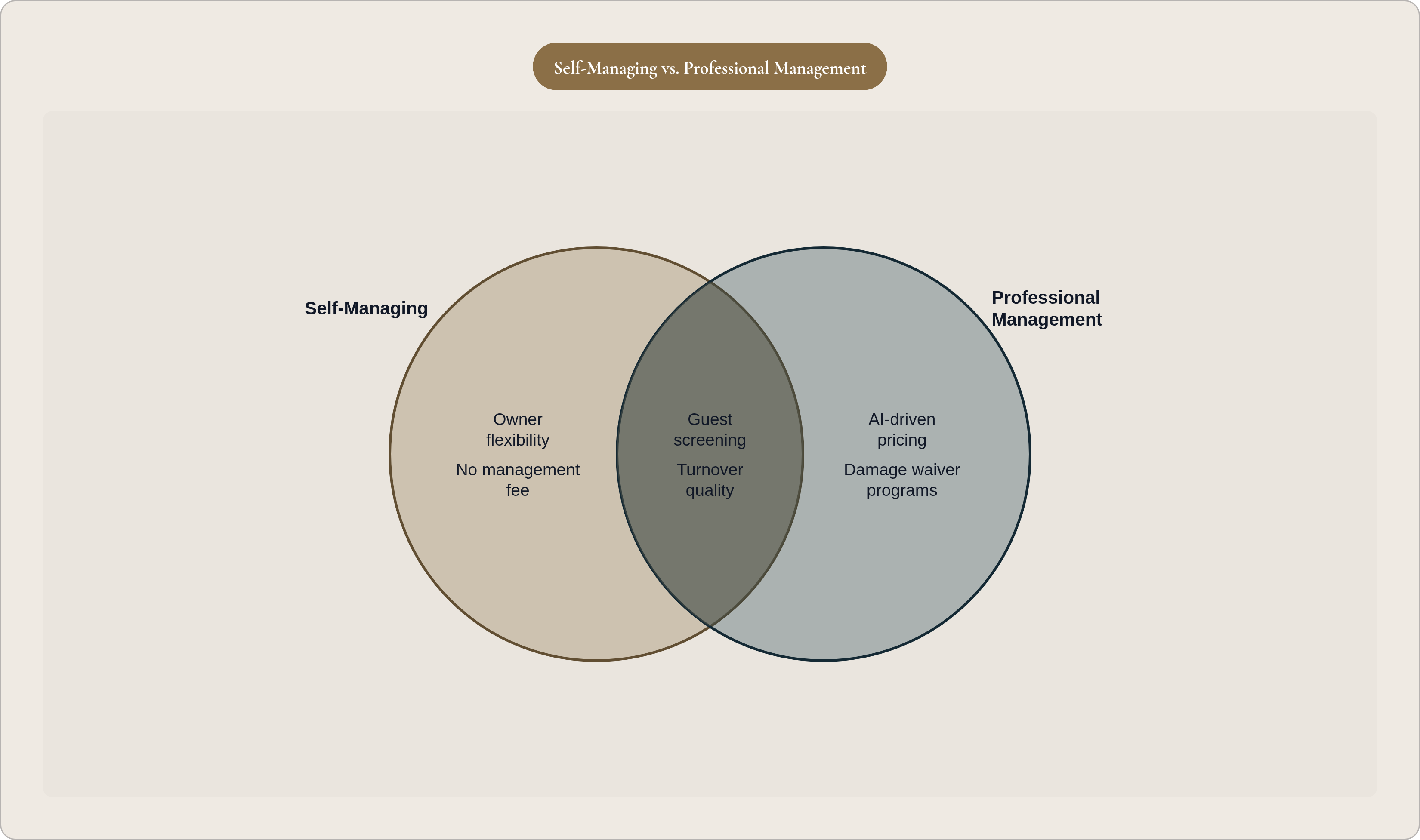
The advertised fee, 8 to 12% of collected rent, is a starting point rather than the whole story. First-year costs often land closer to 18 to 20% of gross rent once setup, listing, and onboarding fees get folded in. That number usually drops back toward the standard 12% in renewal years, once the one-time costs are behind you. Watch the repair markups too: firms running in-house maintenance crews often tack on 10 to 25% over the cost of the repair itself.
Luxury-specific operators structure fees differently than long-term residential managers a lot of the time, and some settle toward 8 to 10% because high nightly rates make that percentage plenty of revenue on its own without stretching. What you get for it, assuming the manager actually knows the market: pricing that recovers some or all of the fee through stronger rates, fewer vacant weeks (one recovered week at $5,000 to $10,000 can cover a year's fee several times over), plus the vendor relationships, compliance work, screening systems, and damage protection you'd otherwise be building yourself, from zero, under pressure.
Not every manager is worth the fee, and I'd rather say that outright than dance around it. Plenty are generalist residential operators with no real luxury track record, and owners who hire them pay the percentage and still don't get the standard their guests are expecting. Picking the wrong manager might be riskier than self-managing badly, if I'm honest, because now you're paying for a service you're not actually receiving. A manager who's deep in one market, who knows the pricing patterns, the vendors, and the local rules cold, tends to beat a big national name spreading the same playbook across fifty markets it barely understands.
How to decide: a framework built around five honest questions
Forget the checklist mentality for a second. These five questions are meant to force honesty about your real capacity, rather than the capacity you wish you had.
Can you be on-site, or reachable, within an hour when something goes sideways at 10pm? If not, you need someone local who can act with your authority, which is informal property management whether you put that label on it or not.
Can you consistently deliver the pre-arrival, in-stay, and post-stay experience that justifies your nightly rate? Guests are comparing you to a hotel whether you like it or not, so your operation has to run like one.
Do you actually have forward-looking demand data for your market, and the time to act on it? Setting a July 4th rate back in March and leaving it there is a guess made early, not a pricing strategy.
Have you addressed damage exposure, liability coverage, and tax compliance for your specific market, by name? Not in the abstract, not "eventually" — if any of those three is still a question mark, the cost of finding out through a claim or a fine will blow past the management fee fast.
Last one, and it's the one people skip: what's your time actually worth? Self-managing a luxury property runs 3 to 5 hours a week even when nothing's going wrong, more during peak season, more during emergencies, more during turnovers, and what would you be doing with those hours otherwise?
There's a middle path worth knowing about too, for owners who don't fit neatly into "hire someone" or "do it all." Tiered setups exist for people who are local, experienced, and just want help with pricing and distribution without giving up day-to-day control. Rove runs two versions: RoveCore, which handles listing and marketplace distribution for owners who want curated exposure without full delegation, and Rove+, which covers pricing, screening, turnovers, tax handling, and the $5 million damage protection end to end. No single model fits everyone here. The point is picking the structure that actually matches your situation, not whichever one happened to come up first in conversation.