What Property Management Fees Cover for Luxury Vacation Rentals
Luxury managers charge 30-45% because they deliver concierge service, not just logistics.

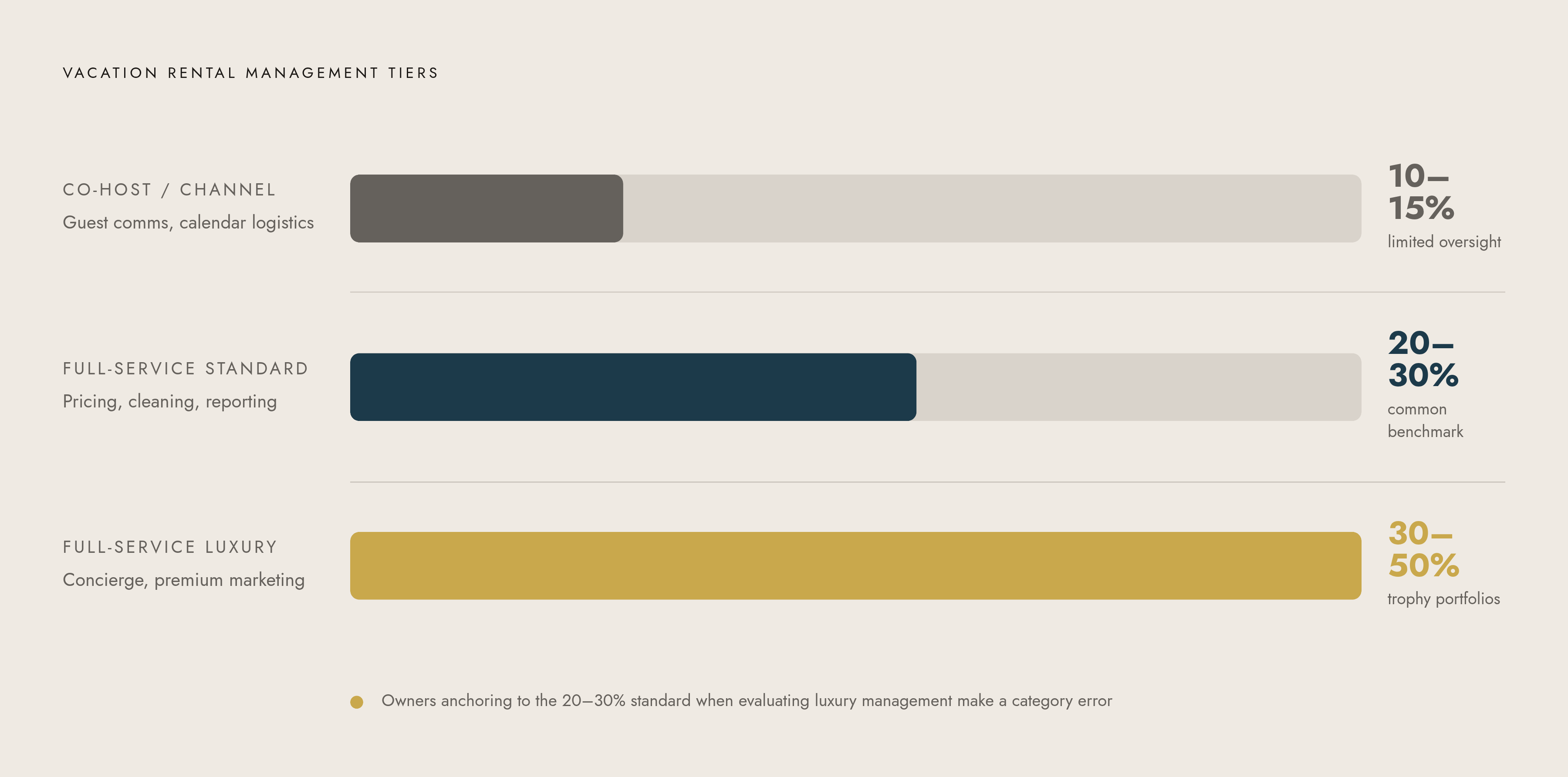
Three tiers exist in the market right now, and they are not interchangeable. Treating them as if they are is the first mistake most owners make, and it costs them before they've signed anything.
Co-host or channel management runs roughly 10 to 15%. You get guest communications, basic check-in coordination, and limited operational oversight. It works if you want to stay involved and just need someone handling inquiries and calendar logistics. Nothing more.
Full-service standard management sits in the 20 to 30% range, which is the number most often cited in industry reporting. Professional photography, listing distribution across major platforms, dynamic pricing, cleaning management, financial reporting. The broadest band in the market, and wildly inconsistent in quality within it. Two managers charging 25% can be running completely different operations. That range tells you almost nothing on its own.
Full-service luxury management runs 30 to 45%, and this is the tier that actually applies to properties clearing $2,000 a night. Everything in the standard tier, plus concierge-level guest experience, premium marketing aimed at high-net-worth travelers, rigorous legal compliance, and genuine in-person availability. Not on-call. Present. There's a difference, and any owner who has called a manager at 10pm about a broken water heater the night before a $15,000 booking knows exactly what that difference feels like.
At the very top of the market, operators managing curated portfolios of trophy homes sometimes approach 50% revenue share. The ceiling is defined by what the property generates and what the service actually delivers.
Flat-fee models exist, typically $500 to $1,000 a month, but they're uncommon in vacation rental management because occupancy fluctuates too much for fixed fees to serve either party cleanly.
The practical problem is this: most luxury owners anchor to the 20 to 30% standard-market benchmark when they evaluate proposals. That's a category error. Comparing a 25% luxury-tier fee to a 25% standard-tier fee is like comparing a Four Seasons room rate to a Holiday Inn rate because the percentages on a hotel P&L look similar — same number on paper, completely different rooms. The only useful comparison is service-for-service within the luxury tier, not rate-for-rate across the entire market.
The calculation basis matters as much as the percentage itself
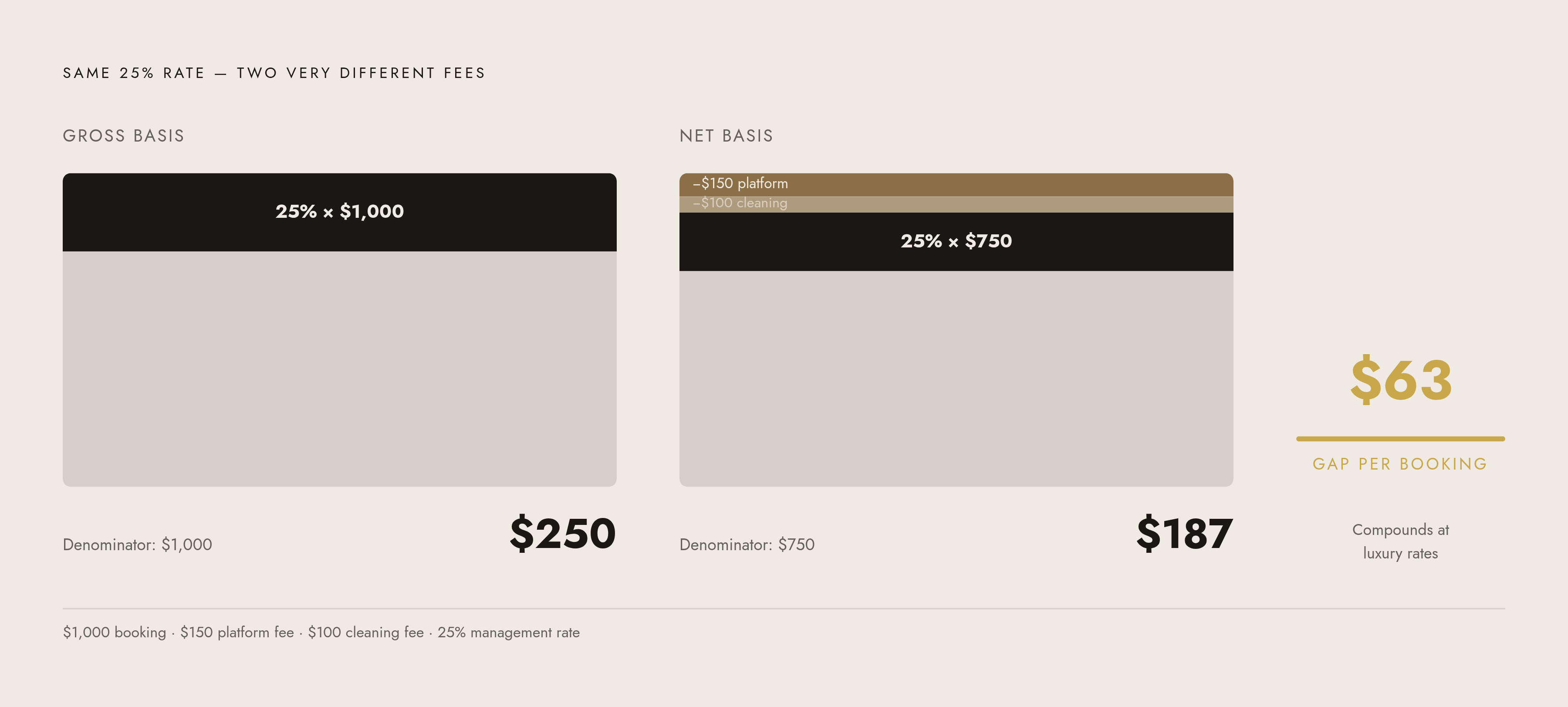
Two basis methods are in common use, and conflating them produces misleading comparisons that will cost you real money.
Gross revenue: total booking value before platform fees and taxes are deducted. Simple to verify because it maps directly to booking confirmations.
Net revenue: booking value after OTA fees are subtracted, sometimes after cleaning fees as well. This basis looks more competitive on paper because the denominator is smaller. It requires actual arithmetic to compare accurately, and most owners skip that step.
The dollar gap is real. On a $1,000 booking, a 25% gross-basis fee yields $250 to the manager. Apply that same 25% to net revenue after a $150 platform fee and $100 cleaning fee and the fee drops to roughly $187. That's a meaningful difference on a single booking. At luxury nightly rates, the annualized gap is the kind of number that should stop you before you sign anything.
When comparing proposals, convert every fee to the same basis before you compare percentages. Ask directly: "Is your percentage applied to gross booking revenue or net, and exactly what is subtracted before the fee is calculated?" If the answer comes with qualifications, or requires a follow-up email to clarify, you've learned something important about how they operate.
What full-service management actually does, service by service
Marketing and listing distribution
Professional photography and listing copywriting are table stakes at this tier. What actually separates managers is distribution breadth. Standard full-service covers Airbnb, Booking.com, and VRBO. Luxury managers add exclusive channels, including American Express Global Homes and Retreats, which puts properties in front of a clientele that expects premium positioning and books accordingly. Platform algorithms reward response rate and listing quality consistently over time, so this is ongoing optimization work, not a one-time setup.
Guest communications and booking management
Inquiry response through post-stay follow-up is the operational spine of the guest relationship. Platforms reward high response rates with better search placement, which directly affects occupancy. At the luxury tier, guest vetting before someone arrives at a high-value asset is substantive work, not a formality.
Cleaning and turnover
Sourcing and managing cleaning teams, scheduling between stays, executing deep cleans, restocking supplies. One poor turnover at a luxury property damages the rating, and rating damage compresses pricing power. This is the most direct operational link to revenue. Cleaning costs are sometimes bundled into the management fee and sometimes not, and the variation here across contracts is significant. Confirm it in writing before signing, because finding out after the fact is an unpleasant conversation.
Maintenance coordination
Reactive maintenance handles the plumbing failure at 11pm, the appliance that stops working an hour before check-in. Handling these without pulling the owner in is a baseline expectation at the luxury tier. Preventative maintenance, meaning scheduled inspections before problems emerge, reduces the reactive work over time. And vendor relationships matter more than most owners realize until they're in a constrained market. In places like the Hamptons or Aspen, where reliable trades are genuinely difficult to access quickly, a manager with established contractor relationships is substantively more valuable than one without them. That's not a marketing claim. It's logistics.
Dynamic pricing and revenue management
Dynamic pricing adjusts nightly rates in real time based on demand signals, seasonality, competitor behavior, and local events. AvantStay operates on a 75-plus micro-season framework, capturing demand spikes that quarterly or seasonal pricing simply misses, with ADR increases of up to 178% during peak periods. A manager running static seasonal rates on a luxury property is leaving identifiable revenue on the table, and the cost of that underperformance often exceeds the management fee difference between a sophisticated and an unsophisticated operator. Run that math before you make a decision based on headline percentages.
Financial reporting and owner access
Payment collection, expense tracking, owner disbursements, detailed monthly reporting. Better managers provide real-time owner portals so you can observe reservations without contacting anyone. Tax handling, specifically occupancy tax remittance, is sometimes included and sometimes a separate line item. Confirm this explicitly. It's the kind of detail that becomes expensive when it's assumed rather than agreed upon.
Legal and regulatory compliance
Short-term rental regulation is tightening across major markets. New York now mandates formal registration; other markets have introduced density caps and operational restrictions that shift with some regularity. Compliance management has become substantive service work. At the luxury tier, the legal and financial exposure from a non-compliant property scales with the nightly rate and the property's visibility.
The services that separate luxury management from standard management
Concierge-level guest experience
Tailored itineraries, restaurant and event bookings, transportation arrangements, private chefs, chauffeurs, personal trainers, in-house spa treatments, VIP access. None of this is standard management. These are luxury-tier differentiators, and the billing structure around them varies enough to warrant a direct conversation with any manager you're evaluating. Luxart includes concierge coordination in the management fee and passes through only actual third-party costs. Guests pay for the private chef; they don't pay an additional coordination fee layered on top. That distinction affects the experience guests report in reviews, and those reviews affect your rates.
Premium marketing and staging
Reaching high-net-worth travelers requires more than OTA visibility. Editorial-quality photography, professional staging, and sometimes social media and PR strategy. The property's visual presentation is a direct revenue driver. It determines click-through rates, inquiry quality, and the caliber of guests who book. At this price point, generic listing photography is a quiet tax on revenue.
Inventory and high-end amenity management
Maintaining premium furnishings, linens, and amenities to a consistent standard, and replacing them when they degrade, is ongoing work at this tier. A damaged piece of furniture left unreplaced shows up in guest reviews. At the luxury level, review quality has a direct and measurable effect on pricing power, and the relationship between the two becomes very clear once you've watched a property's ADR soften after a string of mixed reviews citing deferred maintenance.
Technology integration
Smart home systems, security infrastructure, climate and entertainment automation, energy management, remote monitoring, guest-facing apps for in-stay communication. These systems reduce operational friction for guests and give managers real-time oversight of property conditions. In a portfolio of high-value assets, that oversight is not optional.
Guest screening and asset protection
A multi-million dollar property warrants rigorous protection, and "resolution center" outcomes after an incident are not adequate protection at this tier. Rove builds guest screening into its platform as a structural feature alongside substantial damage protection. The distinction worth noting is that protection is built into the relationship, not bolted on after something goes wrong. That framing sets a useful standard for what to expect from other operators.
What the fee typically does not cover, and where extra charges appear
Even comprehensive full-service contracts have exclusions. The most expensive ones are usually buried in the fine print rather than disclosed upfront, which is its own form of information about the operator.
Pool and hot tub servicing is one of the most common exclusions, billed as a recurring charge regardless of what the management fee covers. Deep cleaning after long stays or damage events is typically billed separately from routine turnover. Restocking consumables above a baseline threshold is often a pass-through cost. Major repairs above a defined dollar threshold are usually owner-direct costs; the manager coordinates, but the invoice comes to you.
Photography refreshes after renovations, setup and onboarding fees for the initial listing build, tax remittance: all potential separate charges that vary by manager and are worth asking about before you're looking at your first monthly statement. Professional furnishing and interior design, when offered as a bundled setup service, is a meaningful one-time investment. For a vacation rental at the luxury tier, professional furnishing typically runs tens of thousands of dollars depending on size and positioning. It's not a recurring cost, but it affects nightly rate and review quality from the first booking.
The complete cost picture is the management rate plus add-on fees plus pass-through costs. Request a full fee schedule, not just the headline percentage. Anything less is an incomplete picture.
How to read a management proposal and evaluate whether the fee is justified
Start with the service list, not the rate
Map every service in the proposal against what the property actually needs. A Manhattan condo and a Hamptons estate have different operational rhythms and different guest profiles. Identify which services are bundled into the fee and which are billed separately. The proposal at a higher headline rate is structurally cheaper than the proposal at a lower rate once add-on fees are totaled in more cases than owners expect, and usually the owner who discovers it is the one who didn't ask.
Ask about pricing sophistication specifically
Dynamic pricing is one of the most direct performance levers available. Ask what model the manager uses, how frequently rates are updated, and whether the system responds to local event demand and competitor rate movements. A manager running static seasonal pricing on a luxury property is a revenue liability. The question is worth asking directly, and the answer is usually revealing in ways that go beyond the specific numbers.
Evaluate the protection layer
Damage protection and guest screening are not equivalent across managers. Ask for specifics: coverage limits, what the claims process actually looks like, and who carries the burden of documentation and follow-up after an incident. When evaluating proposals, look for structural inclusion of high-limit damage coverage alongside rigorous screening as a useful benchmark.
Consider the two-tier model as a structural option
Some platforms separate marketplace listing from full property management, offering a tiered architecture where one level provides curation and direct-booking access for owners who want visibility without surrendering full operational control, while another provides complete management for owners who want comprehensive service. The value of that structure is that it lets owners enter the relationship at the listing tier and step into full management as trust develops, rather than committing to an all-or-nothing contract from day one.
Benchmark correctly
The relevant benchmark is not the industry average fee percentage. It's what you net under this management arrangement versus your next best alternative. A higher management fee on a well-managed luxury property generating premium ADRs returns more to you than a 20% fee on a property running lower occupancy with static pricing and minimal guest experience infrastructure. That comparison requires actual numbers, not percentages in isolation, and building your evaluation around net owner income rather than fee percentage is the only framing that gives you an accurate picture.