Photography and Listing Accuracy in Luxury Rentals
Mismatched photos tank luxury rental reviews faster than actual flaws.
The luxury vacation rental segment recorded 119% booking growth and nearly a threefold increase in revenue value year over year. Airbnb reported 30% year-over-year growth in demand for luxury properties. Average daily rates for upscale listings grew more than five percent while budget-tier rates declined. The premium segment is not just growing, it is separating structurally from the rest of the market. That separation changes what it costs to get listing quality wrong.
More properties are now chasing the same high-value bookers across a marketplace with millions of active listings. Visual quality becomes the primary sorting mechanism, the first filter a guest applies before reading a single word of copy. But the same abundance of choice that makes luxury listings attractive to operators makes the market ruthless toward the ones that overpromise.
Here is something I have watched play out enough times to state it plainly: guests respond to disappointment in proportion to what they paid. A budget traveler who finds a smaller room than expected is annoyed. A luxury traveler who finds a property that does not match its images feels deceived. Those are not the same experience. A guest paying a thousand dollars a night has calibrated their trust accordingly. Every discrepancy between image and reality lands proportionally harder. The photography decision is not aesthetic. It is operational. Put simply: in the luxury market, a misleading photo is not just a bad first impression — it is a loaded gun aimed at your reviews.
What professional photography actually does to booking performance
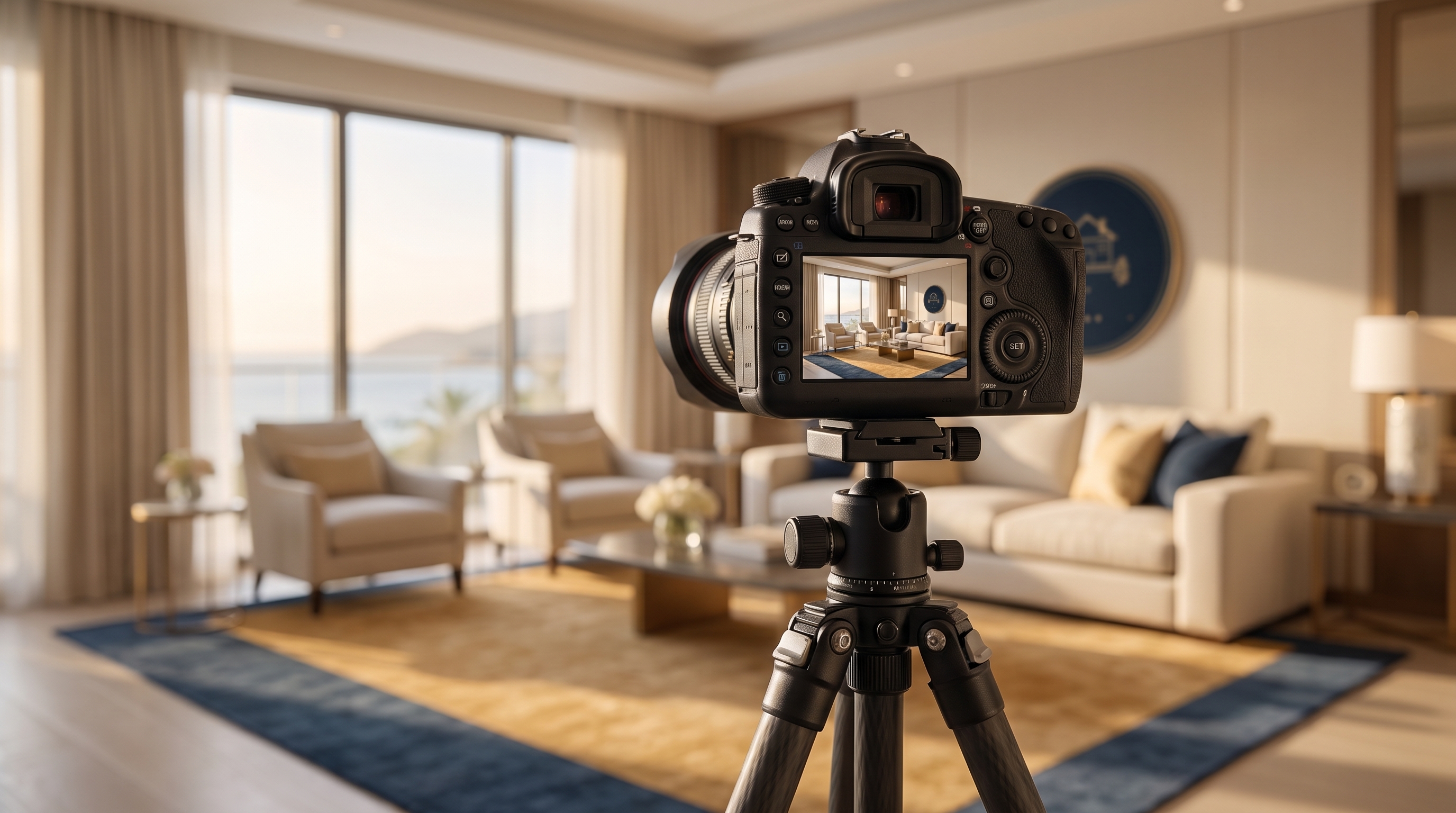
The performance gap between professional and amateur photography is real and measurable. Airbnb's own data shows listings with professional photos earn roughly 20% more revenue and receive 20% more bookings on average. Their professional photography program data pushes that further: 40% more bookings and over $2,400 more in annual revenue compared to host-taken photos. Properties with professional photography convert at two to three times the rate of comparable listings with amateur work, and they rank higher in platform search results.
The return on investment is unusually legible. A professional photography session for a standard property runs $200 to $600. At a 20% booking uplift on a $200 nightly rate, the session fee recovers itself within one to three bookings. For luxury properties, session costs scale to $800–$1,500. Nightly rates scale proportionally; the payback window stays equally short. This compounds across an entire booking calendar. Most operators underestimate it until they run the numbers.
Volume and sequencing matter, too. Research puts the optimal photo count for top-performing listings somewhere between 25 and 35 images. Below 20, guests lack the confidence to commit. Cover photo selection is not cosmetic. Featuring the living room as the lead image increases booking rates by 35% and generates measurable additional revenue during high-demand periods, compared to other cover choices.
I have watched operators spend significantly on photography and still underperform because they led with a generic exterior shot that communicated nothing particular about the property. The cover image is doing the same job a headline does in print. It either stops the scroll or it does not.
When good photography works, guests are not consciously evaluating composition or lighting. They are forming an impression of whether a property feels like the experience they are seeking. Professional photography shapes that impression reliably. Amateur photography undermines it, regardless of how good the actual property is. The image is doing underwriting work that price and amenity lists cannot, because it operates on a faster, more instinctive register.
Where professional photography crosses into misrepresentation and why that gap destroys reviews
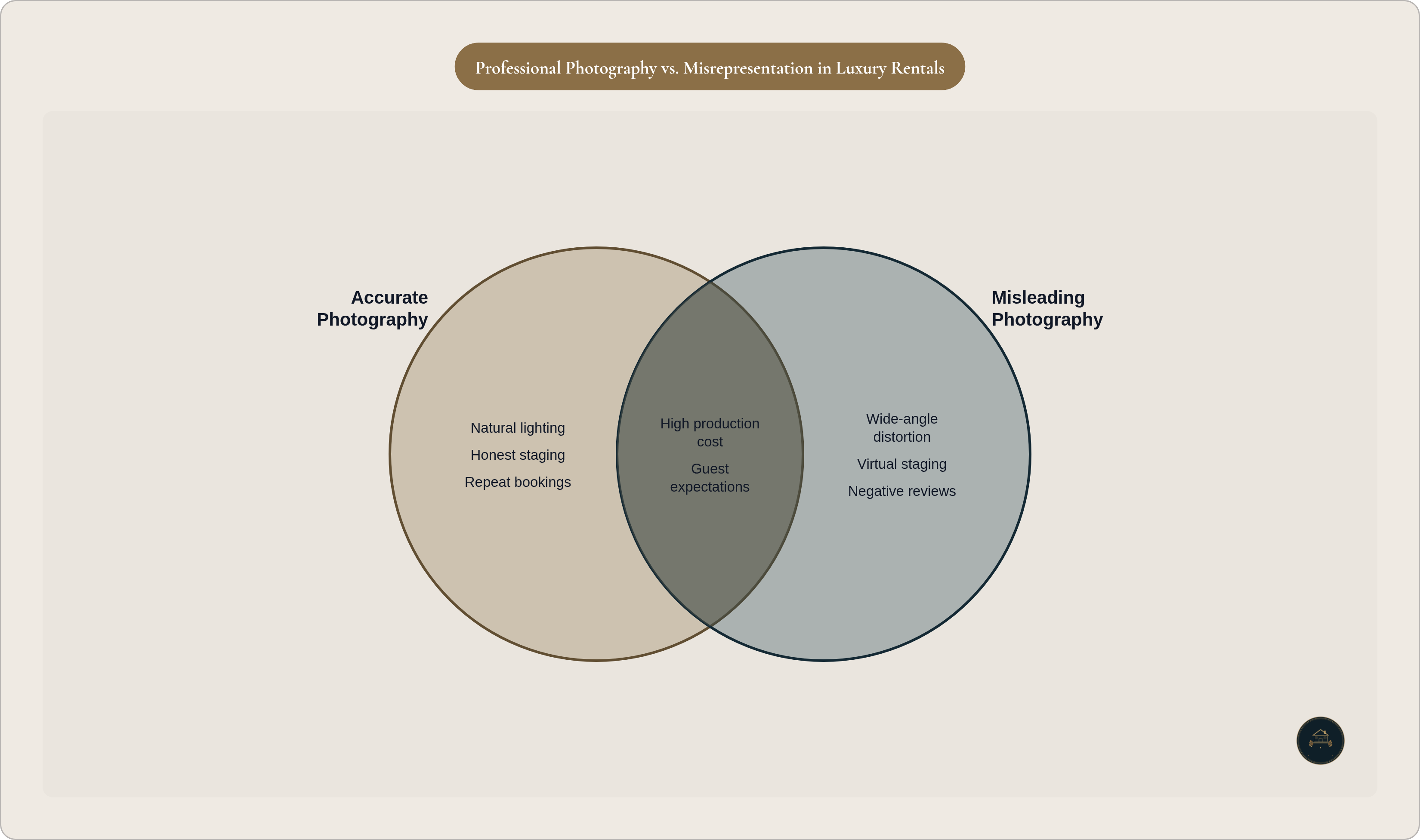
A wide-angle lens makes a room appear significantly larger than it is. At the budget tier, that is a minor surprise on arrival. At the luxury tier, it is a broken promise, delivered at the moment the guest has committed and cannot recover the experience they were anticipating. I have seen this dynamic produce reviews so specific and damaging that a property never fully recovered its ranking, not because the property was bad, but because the photography had promised something the property could not deliver. A misleading listing photo is like a magician's trick: impressive until the audience figures out how it was done, and then they never look at you the same way again.
The most common root cause of negative reviews in luxury rentals is not the property itself. It is the mismatch between what the photography implied and what the guest actually found. Reviews carry particular weight in this segment because they are the social proof that justifies a premium rate and the reassurance that allows someone to book a distinctive home sight unseen. A single disappointed luxury guest writing a detailed account of that disappointment is more damaging than multiple budget guests expressing similar frustration. The audience reading it is weighing a higher-stakes decision and actively looking for reasons to hesitate.
The vectors through which misrepresentation enters listings are predictable. Over-saturated color grading and extreme brightness adjustments make spaces look more vibrant than they are. Photographing a property with staging or furnishings that will not be present during guest stays creates a visual inventory the property cannot keep. Using photos from a previous renovation that no longer reflects current conditions is an inaccuracy that accumulates quietly until a returning guest notices the discrepancy. At the far end of the spectrum, digitally adding features that do not exist crosses from misrepresentation into something with a different name entirely.
Virtual staging deserves specific attention. Where it is used, best practice requires explicit disclosure. Undisclosed virtual staging at the luxury tier reads as deception when the guest arrives to find a differently furnished space, because the expectation created was specific, and the reality diverges from it in a way they cannot ignore. Photography should be refreshed whenever the property changes in ways guests would notice. The guest who spots a discrepancy does not give credit for anything having improved; they focus entirely on the gap between what they were shown and what they found.
The legal and platform-enforcement context that makes accuracy a compliance issue, not just an ethical one
When a guest books a vacation rental, the listing description, photographs, and amenity representations constitute the terms of a binding contract. If the property does not match what was advertised, the host has breached the contract. Consumer protection laws in most U.S. states prohibit deceptive trade practices, and false advertising in rental listings falls within that category. This is the standard legal framing that applies to rental listings across professional management contexts, not a novel interpretation.
Professional management carries additional obligations. The REALTORS® Code of Ethics explicitly prohibits misleading images and requires avoiding exaggeration, misrepresentation, or concealment of pertinent facts wherever professional managers operate under that framework. These are conditions of professional operation, not aspirational guidelines.
Platforms are not waiting for litigation. Airbnb removed over 400,000 low-quality listings in 2024, which produced a 15% reduction in quality-related customer service issues and a 30% reduction in host cancellation rates. The listings are simply gone. Guests also have recourse: when a property is materially misrepresented, most platforms approve full refunds plus moving costs when problems are reported within 24 hours of arrival. At the most egregious end, FBI data recorded over 9,500 complaints and $145 million in losses from rental fraud in 2023, the most common mechanism being real or fabricated luxury property photos used to direct guests to substandard alternatives.
For legitimate luxury operators, the enforcement context resolves a question that should not require much deliberation: accuracy is a condition of operating at scale, not a differentiator for operators who feel like being ethical.
How 3D tours and virtual walkthroughs close the expectation gap photography leaves open
Still photography, however accurate and skillfully executed, is editorially selective. A guest sees what the photographer chose to frame. A virtual tour replaces that curated impression with a navigable record the guest controls.
Vacasa's adoption of 3D Matterport tours across nearly 90% of its portfolio produced a 12% increase in booking conversion and 14% higher occupancy on listings with tours. The reason is not complicated. A virtual tour answers the spatial questions guests would otherwise leave unanswered: how far is the primary suite from the living area, what is the actual scale of the terrace, does the flow of the space match what the still photos imply. These questions matter considerably more at $1,500 per night than at $150, because the stakes of getting them wrong are proportionally higher.
For guests booking luxury properties sight unseen, that level of transparency functions as both reassurance and differentiation. It signals that the operator has nothing to conceal, a meaningful brand signal at a tier where concealment is reasonable to suspect. Vrbo now accepts Matterport virtual tour links directly in property descriptions, making integration into standard listing practice operationally simple.
Adding a virtual tour runs from a few hundred dollars for 360-degree photography to a couple thousand for full 3D Matterport, depending on property size. At luxury nightly rates, a single incremental booking covers the cost. The deeper return is in expectation management. A guest who books after completing a virtual tour arrives having already walked the property. The arrival experience confirms rather than surprises, and that confirmation is the foundation on which the review gets written.
What honest, accurate luxury listing photography looks like in practice
The goal is not flattering photography, and it is not forensically literal photography. It is both, simultaneously. Images that make the property look its best while showing it as it actually is. These are not competing objectives, and operators who treat them as competing objectives are already losing.
Lighting and lens selection
Bright photos receive substantially more booking requests, and natural light at golden hour or well-balanced artificial fill achieves that brightness without the distortion that extreme post-processing introduces. On lens choice, a standard wide-angle captures rooms generously without the spatial exaggeration of a fisheye. The practical test: does the room in the photograph and the room in person produce the same first impression? If the answer is no, the lens or the processing has introduced a gap that will eventually become a review.
Sequencing and coverage
Lead with the room that defines the property. For a cliffside villa, that is the terrace and the view. For an urban penthouse, it might be the great room or the primary suite. A generic exterior shot as the cover image misses the opportunity to communicate immediately what distinguishes the property from every other luxury listing competing for the same guest.
Coverage should be comprehensive without being repetitive. Twenty-five to thirty-five images handles most luxury properties thoroughly; penthouses, multi-villa compounds, and large-format estates may justify more. Every space that could influence a booking decision should appear: bedrooms, bathrooms, kitchen, outdoor areas, any premium amenity. A guest who cannot see the primary bathroom of a $1,500-per-night property will ask or book elsewhere. Both outcomes are avoidable.
Staging and post-processing standards
Staging for photography should reflect the property as guests will actually find it. If a particular piece of furniture, art installation, or floral arrangement will not be present during stays, it should not appear in listing photography. The test is not whether the photo looks good; it is whether the photo accurately represents what the guest will experience on arrival.
Post-processing should correct for exposure and white balance. It should not introduce saturation boosts that shift the perceived color of materials guests will actually see and touch, and it should not remove structural features, neighboring buildings, or contextual elements that affect how a guest will experience the space. Adjacent construction, a neighboring rooftop, a power line in the sightline of the view: these are facts, not defects to be erased.
Alignment between photography and copy
Each area shown in photography should be described honestly in the written listing: square footage, sleeping configuration, view orientation. Photography and copy are two inputs to the same expectation. When they reinforce each other, guests arrive with an accurate mental model of what they have booked. When they contradict each other, guests arrive suspicious, and the stay begins in deficit before anything has gone wrong.
Refresh cadence
Update photography after any significant change to furnishings, layout, or outdoor spaces. At the luxury tier, a guest who recognizes a discrepancy between the photos and the property does not just feel disappointed. They feel misled. That distinction in emotional register is what separates a mildly negative review from a detailed account of feeling deceived, and the latter has a substantially longer half-life in search results.
Why listing accuracy, not just image quality, is what converts first-time bookers into repeat guests
Professional photography drives the first booking. Accuracy drives the second.
A guest whose stay matches or exceeds the promise of the listing does not need to be persuaded again. The photographs have been validated by experience, and trust transfers not just to that property but to every other property in the same portfolio. Reviews are the downstream consequence of how accurately photography set expectations the property could actually meet. That is the whole mechanism, and it is not subtle once you have watched it operate across a portfolio at scale.
The compounding dynamic works in both directions. Accurate listings generate better reviews. Better reviews generate more bookings at sustainable rates. More bookings generate the revenue that funds property investment and portfolio growth. When listings oversell, that cycle runs in reverse, and at the luxury tier it accelerates, because the guests affected have louder voices, higher expectations, and considerably less patience for feeling misled. Overpromising in this segment is not just a reputational risk — it is like pulling a thread on a cashmere sweater: one tug, and the whole thing unravels.
For professionally managed portfolios, consistent listing accuracy becomes a brand asset that individual host listings structurally cannot replicate. A guest who has been burned by a misleading listing on a mass marketplace has no rational reason to trust the next listing they encounter. A guest who has booked repeatedly from a portfolio with a demonstrated track record of showing properties honestly has every reason to return. That trust accumulates image by image, stay by stay, far more durable than any single high-production photography campaign.
The operators who understand this are not trying to make their properties look better than they are. They are trying to make sure the guest who arrives is the guest who was looking for exactly this property. That alignment is what the best listing photography accomplishes. It compounds in ways the session fee never fully captures.