Consistency and Quality Control Across Multiple Properties
Systems, not goodwill, close the quality gap when managing multiple properties.
What's Actually at Stake When Quality Slips Across Properties
There's a comfortable story that gets told about hospitality quality: hire good people, care about the guest, and the experience will follow. At one property, goodwill and good intentions can carry you surprisingly far. Across five, ten, or twenty properties, they collapse. Each additional location multiplies the variables: different buildings, different teams, different maintenance histories, different local suppliers, different managers with different instincts and different blind spots. The enforcement gap that opens up isn't a failure of caring. It's a failure of systems. Most multi-property operators know what their brand requires. The difficulty is ensuring those requirements are met consistently across locations they don't personally walk every day. That gap is where quality dies, and closing it is harder and more specific than most operators want to believe.
Hospitality has one of the lowest customer retention rates of any service industry. Guests are already predisposed to leave. Every stay either reinforces loyalty or accelerates defection, and a poor stay doesn't just lose that guest. It erases the equity that better properties in your portfolio spent real money building. Think of your brand as a savings account: one bad property making withdrawals can drain what ten good ones spent years depositing.
Reviews are the public ledger where this plays out. Cornell University research found that for every one-star decrease in rating, hotels need to reduce prices by approximately 11% to maintain the same occupancy. Inconsistency doesn't just cost you guests; it compresses your revenue and forces pricing concessions that compound over time in ways that don't show up cleanly in any single quarter's numbers.
The brand visibility dimension makes this worse in a way that operators routinely underestimate. Travelers don't disaggregate your portfolio. They experience your brand. And they rarely articulate inconsistency in operational terms; they feel it. A room that looks slightly off, a detail that doesn't match the expectation set by the last stay. Those moments accumulate quietly and erode confidence in ways that don't announce themselves until they appear in your ratings, your occupancy numbers, and your pricing power, usually all at once.
The Building Blocks of a Quality System: Standards, SOPs, and What They Actually Specify
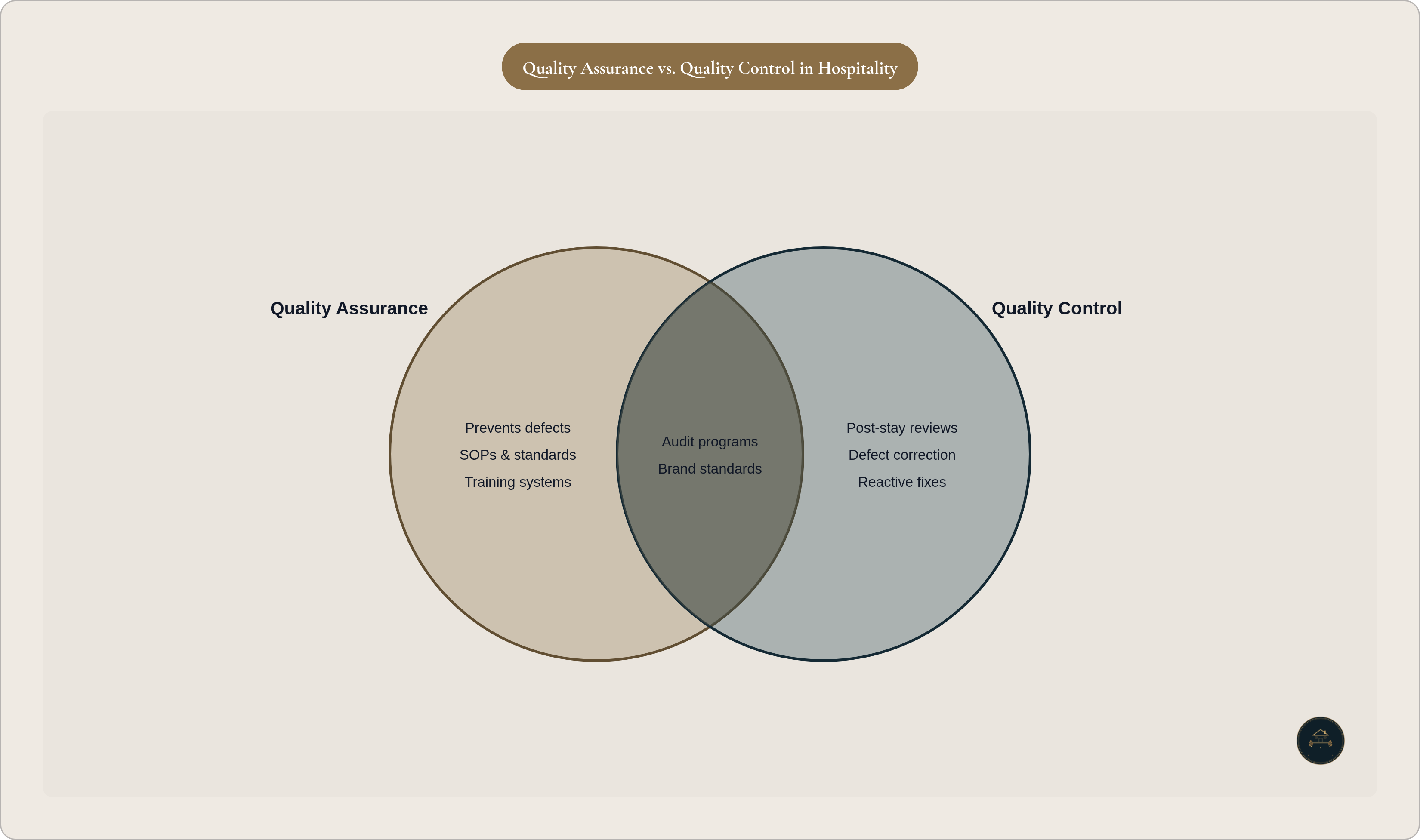
Quality control is reactive: finding and fixing defects after the fact. Quality assurance is proactive: preventing defects through established systems before the guest ever encounters them. Both matter, but quality assurance is what makes scale possible. You cannot inspect your way to consistency across a large portfolio. You have to build it in from the start.
Brand standards are the foundation. They govern physical design, service operations, safety, and technology infrastructure. The word "standards" sounds aspirational, but standards worth having are verifiable and inspectable. They're not statements of intent. They're requirements, and the difference between those two things is the difference between a brand promise and a brand reality.
SOPs are the operational translation of those standards into daily practice. Without them, tasks get performed inconsistently, especially during high-volume periods and especially with new staff, who will default to whatever feels natural rather than whatever the brand requires. Concrete service benchmarks illustrate what genuine specificity looks like: a maximum of three rings before a phone is answered, a ten-minute resolution target for room service complaints, a two-hour ceiling for maintenance responses. Those aren't aspirational targets. They're auditable commitments, and the distinction matters every shift.
The Oberoi Hotels approach is instructive here. Their internal standards specify the angle at which towels should be folded and the exact greeting phrases staff should use. That level of specificity reads as excessive until you understand what it's actually doing: removing ambiguity from the guest-facing moments that matter most, so a room prepared in Delhi looks and feels the same as one prepared in Cairo. General guidelines produce general results. The operators who understand this go considerably further, and their consistency shows.
A full brand standards document can run hundreds of pages. The challenge isn't writing it. It's making it usable and enforceable at the property level, by people doing five other things at once, in the middle of a busy check-in rush, with a new housekeeper who started Tuesday. Procurement is an underrated component of this work, too. Standardizing suppliers and materials reduces variability in ways that rarely get enough credit. The small physical details are not trivial. They accumulate, and guests notice them even when they can't name them.
How Audits Actually Enforce Standards Rather Than Just Document Them
Most audit programs are built to document what's happening. The good ones are built to verify that what's supposed to be happening actually is, in practice rather than on paper. Those are different objectives, and the gap between them is where accountability either lives or dies.
Scheduled audits serve a purpose. Unannounced audits serve a different and equally important one. Staff who know an inspection can happen at any time behave differently than those preparing for a visit they saw coming three weeks ago. The combination is what keeps quality consistent across time, not just across the calendar of planned reviews.
An audit that finds a problem is only useful if there's a corrective action cycle behind it: a system that assigns ownership, sets a due date, and requires re-inspection. Findings without accountability loops don't close. They become a record of recurring failures, reviewed periodically, changed by nobody.
Manual auditing is a bottleneck that limits scale, and plenty of operators are still running audit programs on spreadsheets, which is time-consuming, error-prone, and scales badly. The Independent Food Company was spending an average of four days per audit cycle before switching to digital tooling; most issues were then resolved within the same day. That's not a marginal efficiency gain. That's a structural change in what's operationally possible.
The volume difference at scale is striking. LaTour Hotels previously conducted 30 QA audits per year using spreadsheets; after the switch to digital audit software, the team performed over 20,000 yearly audits. That kind of volume is simply impossible with manual methods, and what digital tools add beyond volume is equally significant: real-time visibility across locations, prompt corrective action, and a clear record of accountability that paper trails cannot provide. Room cleanliness consistently ranks among the top drivers of positive guest reviews. The audit focus should reflect that reality, which means cleanliness gets the most scrutiny, every time, without exception.
The Staff Turnover Problem and What It Does to Institutional Quality
US leisure and hospitality attrition has reached approximately 50% in recent years. These aren't abstract figures. They're the operational conditions quality systems have to be built for, not the exception the system assumes away.
What turnover actually destroys isn't just warm bodies on a shift. It's institutional knowledge: the nuances of how this specific property runs, what guests here have come to expect, where the quirks are, which supplier is unreliable on Fridays, which maintenance request always takes longer than the system says it will. That knowledge doesn't live in the SOP manual. It lives in experienced people, and it walks out the door with them. Losing a seasoned front desk manager isn't just a staffing gap — it's like losing the index to a book the new hire now has to read cover to cover without knowing what they're looking for.
The cost compounds before you even factor in service quality. The average cost per hire for non-executive roles runs well above $5,000 per placement by most industry benchmarks, and that figure doesn't account for the productivity gap during transition or the guest-facing errors that happen while someone is still learning the property.
Here's the failure mode that almost nobody talks about honestly: the training-fade problem. A property can run thorough onboarding and hold regular refresher sessions, and still, when a shift gets genuinely busy, people revert to what feels natural. Not what's in the manual. What feels natural to them, based on habits formed at previous jobs, under previous managers, with different standards. I have watched training investments dissolve in real time at properties that spent real money on them, and the decay happens faster than anyone wants to admit to the person who approved the budget.
The implication for system design is direct. Quality systems built on the assumption of stable, experienced teams will fail — not this quarter, but eventually. Systems designed to work with someone hired last week are more robust. SOPs aren't just about standardization; they're about capturing institutional knowledge in a form that survives turnover. The manual doesn't replace the experienced employee, but it preserves what they knew in a form the new hire can actually use.
How Multi-Property Operators Structure Oversight Without Being Everywhere at Once
Quality cannot depend on an owner or central executive walking properties. The system has to run without them. Most governance structures fail precisely because they haven't internalized this constraint. They've built systems that require a specific person's judgment, presence, or attention to function, and then they're surprised when consistency breaks down during periods of leadership transition or rapid growth.
The primary mechanism that effective operators use is the regional brand steward: an operations leader who understands both global standards and local market conditions. Regional stewards interpret brand requirements, train department heads, monitor consistency across their assigned properties, and escalate issues when local conditions are pulling against standards. They're the human bridge between corporate mandates and property-level execution, and the role is conspicuously underutilized in most mid-size portfolios. Usually because someone looked at the headcount cost without modeling the consistency cost of not having them.
Beyond the steward role, durable oversight structures centralize governance of process, not just content. That means standardizing the templates, workflows, and documentation for training, audits, corrective actions, and change control, so the process itself is consistent even when individual properties vary in age, market, and physical configuration.
There's a legitimate tension in the industry between rigid standards enforcement and allowing properties latitude to respond to regional market expectations. The resolution most effective operators land on is this: non-negotiable standards for the elements guests directly experience, cleanliness, service responsiveness, core amenities, combined with controlled flexibility on locally relevant touches. The structure is fixed. The decoration has some range. That's not a compromise; it's a design choice.
Feedback loops function as a governance tool that most operators underutilize, not because they don't collect data, but because they don't act on it with any real urgency. Consistent metrics across all locations, NPS, complaint resolution time, audit scores, allow direct performance comparison. They identify underperforming properties early and surface best practices that can be replicated elsewhere. The data is only useful if someone is looking at it, interpreting it, and acting on it with actual authority. Data reviewed in a quarterly deck by someone who can't make operational decisions is not a feedback loop. It's a filing system.
Leading and Lagging Indicators: Measuring Quality Before It Shows Up in Reviews
Most operators over-index on lagging indicators. Review scores and occupancy are easy to read, visually obvious, and tied to revenue. They're also the last signal, not the first. By the time a lagging indicator moves meaningfully, the guest has already experienced the failure and written the review. You're reading the autopsy.
Leading indicators, audit scores, training completion rates, complaint resolution times, let management act before guests feel the problem. The distinction isn't academic. It's the difference between preventing a service failure and managing a crisis that's already public, already indexed by Google, and already influencing the next traveler's booking decision.
Benchmarking across properties is where standardized metrics earn their keep. The same question asked consistently across locations reveals which properties are trending in the wrong direction before the reviews catch up. The early signal is the entire point. A lagging indicator tells you what happened. A leading indicator tells you what's about to happen if you don't intervene, and that window is where operators with good systems actually have an advantage.
Where Quality Systems Most Commonly Break Down in Practice
The most common failure mode is mundane, and that's precisely why it's so persistent. Most quality initiatives fail not because the standard was wrong but because rollout was inconsistent, the system was too cumbersome to follow daily, or the standard never became embedded in routine work. It existed on paper and nowhere else, which is worse than having no standard at all, because it creates the illusion of coverage.
The momentum problem follows a recognizable pattern. Quality initiatives launch with genuine intention and visible executive support, then lose energy when there's no clear ownership, no usable workflow, no reinforcement mechanism, and no visibility into whether the system is actually working. Without those components, the initiative becomes background noise, present in every binder and followed by nobody. The binder gets thicker every year. The behavior doesn't change.
Communication gaps at scale allow small deviations to accumulate invisibly. Without real-time visibility into operational compliance across locations, management doesn't know a property is drifting until a guest review or a failed inspection surfaces it. By then, the drift has compounded considerably, and the corrective action required is proportionally larger.
Brand drift is almost never one decision. It's a sequence of small compromises: a substituted supplier here, a skipped retraining there, a maintenance request that got deprioritized one Friday and then again the following Friday, each one defensible in isolation. The cumulative effect is a property that no longer matches the brand promise, and no single person made a conscious decision to let that happen. That's what makes it so difficult to address after the fact. Brand drift is like gaining weight slowly — no single meal is the culprit, but one day you can't button the jacket anymore.
Technology adoption is its own category of risk that operators routinely underestimate. New tools improve consistency when fully adopted, but phased or incomplete implementation creates a two-tier operation: some properties running on the new system, others still on the old one. That variation is itself a source of inconsistency, and it's harder to detect than a process failure because it presents as a technology issue rather than a quality issue, which means it gets routed to IT rather than operations, and it sits there.
What the Best-Run Multi-Property Operators Do Differently
The practices that distinguish operators whose quality holds at scale are, without exception, unglamorous. There is no elegant shortcut here.
Standards are written to be usable at the property level, not just defensible at the corporate level. There's a meaningful difference between documentation that protects the brand in a legal review and documentation that actually guides behavior on a busy Saturday night. The best operators write for the latter, and the difference in clarity between those two types of documents is immediately apparent to anyone who has had to implement both.
Audits are frequent, unannounced, and tied to corrective action with real due dates and re-inspection requirements. Not compliance theater. Actual accountability, with consequences that are visible to the people being held accountable. Training is reinforced in daily workflow rather than delivered once at onboarding and then left to atrophy through normal operational pressure. Metrics are standardized across properties so performance can be compared directly, not just reported in isolation by managers with a natural interest in favorable framing. Regional stewards own quality in their geography, with the authority to act and the accountability for outcomes.
Technology in this context is an enabler, not a substitute. Digital audit platforms, centralized operations systems, and AI-assisted maintenance tools extend the reach of quality programs, but they amplify a good system. They do not replace the need for one. Predictive maintenance is a useful illustration: AI-driven systems that detect early signs of equipment issues reduce costly repairs and extend asset lifespan. Guests experience that as reliability. They don't know how it got there, and they shouldn't have to.
The global quality management software market was estimated at over $11 billion in 2024 and is projected to approach $21 billion by 2030. Investment in these systems is accelerating across the industry. Operators still running quality programs on goodwill and spreadsheets are competing against portfolios that have systematized the problem entirely, and the compounding gap between those two approaches grows every year.
The operators who deliver a reliably excellent guest experience across multiple properties aren't doing so through exceptional individual effort or personal charisma. They've built systems that make excellence the default, and then they've staffed and governed those systems with enough discipline to keep them running when no one senior is watching.