How Luxury Rental Properties Are Hand Selected
What the industry means by "luxury" before any inspection begins. before a single evaluator sets foot in a property, the word …

What the industry means by "luxury" before any inspection begins
before a single evaluator sets foot in a property, the word must mean something concrete. The industry has landed on three components: exclusivity, meaning a one-of-a-kind experience that cannot be replicated elsewhere; attention to detail, meaning every element has been deliberately considered; and an elevated guest experience that is service-forward and tailored, not merely comfortable.
Here is the hard line: price is not the criterion. Luxury refers to properties where location, architecture, privacy, and embedded service quality exceed what money alone can replicate. You can spend a great deal of money and still fail to produce a luxury property. That distinction matters enormously. The evaluator's job is to verify irreplaceability, not cost.
Above that standard sits a further tier, sometimes called ultra-luxury or trophy property, where exclusivity and bespoke lifestyle criteria operate entirely outside standard market logic. Not simply more expensive. Categorically different, and the distance between them and a merely expensive rental is wider than most owners realize, because the gap is qualitative, not quantitative.
What has also shifted is the affluent traveler's definition of aspiration. Opulence was once sufficient. The modern luxury guest seeks authenticity, privacy, and frictionless living: a curated gateway to a locale rather than a showcase of expense. Evaluators ask whether a property delivers something a five-star hotel cannot, not whether it photographs well. That is a harder question. Most properties cannot answer it.
Why location is assessed before a single interior detail is examined
Even spectacular properties in mediocre locations face rejection. This is the first filter, applied before any physical inspection begins, and it eliminates a meaningful share of applicants before anyone opens the front door.
Location assessment is specific and categorical. Urban properties must sit in aspirational neighborhoods, places like Chelsea in London or Milan's fashion district, not merely central or convenient ones. Rural and nature properties are evaluated on distinctive geography, genuine accessibility, and meaningful privacy. Resort properties face a more complex calculus: proximity to attractions balanced against maintaining exclusivity, because proximity is not exclusivity. Inspectors also assess whether curated local experiences are actually accessible to guests, rather than theoretically possible on paper.
The market validates this hierarchy in a concrete way. Traditional U.S. luxury destinations lost market share in 2024 as affluent travelers moved toward destinations that had not yet been overrun. Location quality is not fixed. A destination that felt exclusive a decade ago no longer is. A property's competitive position is partly outside its owner's control. That is precisely why evaluators weight location so heavily at the outset.
I have watched owners pour seven figures into renovations and still fail to qualify, not because the work was poorly done, but because the neighborhood had moved on without them. No amount of interior investment recovers a failed location score. That is not a cruel or arbitrary outcome. It is the logical consequence of a standard that measures irreplaceability, and irreplaceability is, by definition, geographic before it is anything else.
How the physical inspection actually works: the 300- and 500-point frameworks
Two frameworks define the current standard for rigorous selection, and understanding both makes clear why self-reported property information is useless in this tier.
The Airbnb Luxe process
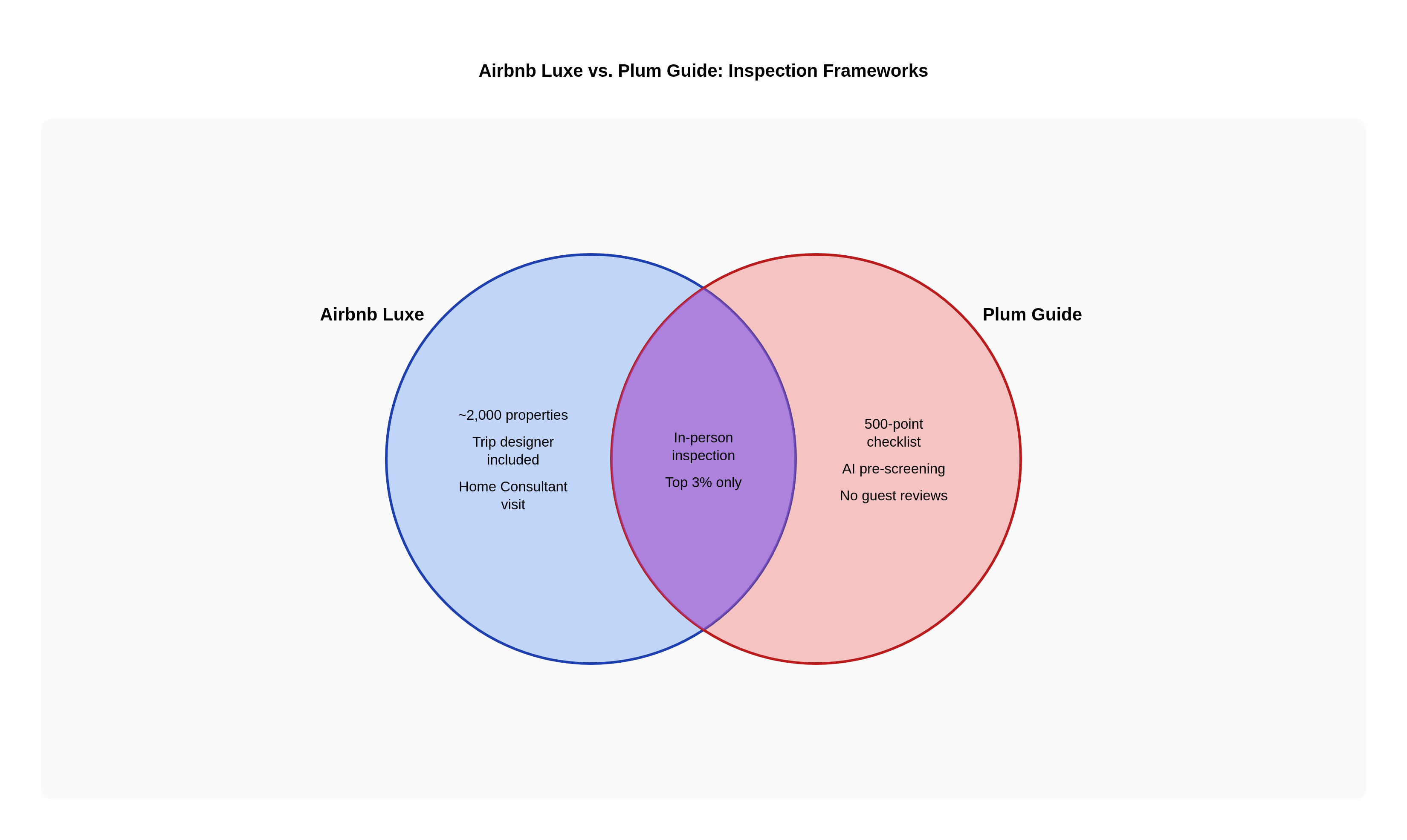
Airbnb Luxe maintains roughly 2,000 properties worldwide, the most restrictive tier in short-term rentals by scale. The process runs in four stages. Curators first review applications scanning for immediate disqualifiers: poor location, mismatched furniture, anything signaling the property does not belong in the conversation. A local Home Consultant then visits in person, performs a preliminary walkthrough, and delivers a required-changes checklist before any official evaluation proceeds. Once a property is deemed ready, an official third-party inspection covering more than 300 criteria is conducted. Finally, onboarding assigns professional photographers and copywriters to ensure the listing accurately represents what was inspected.
That fourth stage is not cosmetic. It is quality control. A listing that overstates a property's attributes creates liability. Platforms in this tier cannot afford that exposure.
The Plum Guide process
Plum Guide positions itself as the Michelin star of vacation rentals. A trained Home Critic visits every property and scores it against a 500-point checklist covering more than 150 features. Shower pressure. WiFi speed. Mattress comfort. Noise levels. Pillow quality. Scored line items, not afterthoughts. A soft pillow matters as much as a soft facade.
The process begins with data rather than a site visit. Plum Guide screens available inventory algorithmically, shortlists the strongest candidates, then dispatches a critic. The human visit is the final stage. A proprietary AI model trained on more than 100,000 vetted homes handles early screening, matching human judgment with 91% accuracy and cutting onboarding costs by 85%. That is not a replacement for human assessment. It is a precision instrument for identifying which properties deserve a professional evaluator's time.
Plum Guide also rejects guest reviews entirely as a quality signal, which tells you something about what they think of crowdsourced judgment in this context. User reviews are biased, inconsistent, and often misleading. Only editorial assessments appear on listing pages, keeping quality judgment in professional hands rather than distributing it across a self-selecting audience with widely varying standards.
What both frameworks share is the essential thing: the inspection requires a trained evaluator physically present, verifying claims against reality. An owner cannot self-report their way through this process. The whole architecture is designed to prevent that.
Architecture and design cohesion as make-or-break gatekeepers
Architectural significance is the first interior gatekeeper. A property without it does not reach the stage where individual design elements are assessed, which eliminates properties that are beautifully appointed but architecturally unremarkable. That is a larger category than most owners expect.
Assuming a property clears that bar, design cohesion becomes the next test, and it is where many otherwise strong applicants wash out. Mismatched furniture is an immediate disqualifier. Off-the-shelf décor packages are an immediate disqualifier. Every piece of furniture must feel curated, bespoke or designer, assembled with intention rather than convenience. Artwork must resonate with the architectural style. A mid-century Palm Springs property must feel distinct from a Haussmann building in Paris; evaluators know the difference, and they look for owners who do too.
Luxury rental operator Fieldtrip requires a minimum of ten experiential features per home: some inherent, like panoramic views or ocean frontage; others intentionally designed, like pools, outdoor kitchens, or yoga decks. Their framing cuts to the point. The home must feel special and genuinely inspirational, not aspirationally priced. Those are different things. The gap is visible the moment a trained eye walks through.
Communal space capacity is a concrete, testable requirement. If a property sleeps twelve but the dining table seats only eight, it fails Luxe standards. That is a functional requirement, not an aesthetic one, and it reveals how seriously an owner has thought through what it means to host at scale.
Functionality operates as what some evaluators call invisible perfection. HVAC systems must be whisper-quiet. Windows in city properties must be triple-glazed. Noise is, accurately, the ultimate luxury-killer in the current market. Design errors sink applications in a different way than most owners anticipate: not one catastrophic flaw, but an accumulation of small ones, mismatched hangers in a closet, one inconsistent room, a single element that breaks coherence.
Amenities that are now entry requirements, not differentiators
The reframe experienced curators apply here is worth sitting with. Luxury amenities today are no longer about standing out. They are about meeting baseline expectations at a higher standard. Many owners still treat them as upgrades, things that give them an edge. That thinking belongs to a different era. It shows up in the applications that fail.
The baseline inspectors verify includes high-quality linens, mattresses, towels, robes, and slippers, with at minimum two towels of each type per guest based on maximum occupancy. Spa-like bathrooms: rain showers, jacuzzi tubs, high-end toiletries. Fiber-backed high-speed WiFi, classified now as a non-negotiable utility. Homes must be fully stocked with cooking supplies, serving essentials, and additional linens. These are the floor, not the ceiling.
Among physical amenities, hot tubs, waterfront features, and pools drive the strongest average daily rate lift. Kitchens maintain competitiveness but rarely move pricing power on their own. At the higher end of the tier, curators increasingly treat private spas, temperature-controlled wine cellars, home theaters, smart home automation, and bespoke art as expected rather than exceptional.
The practical standard is unforgiving in a specific way. A missing or non-functional amenity that was listed as available can derail an application outright. "Probably available" disqualifies. I have seen strong applications collapse over a hot tub that was listed but not operational at the time of inspection. The issue is not the hot tub. It is what the discrepancy signals about the gap between the owner's presentation and the guest's reality.
Smart home technology and sustainability as newer selection criteria gaining weight
Smart home infrastructure has crossed from differentiator to expectation. Automated lighting and climate control, advanced security systems, and robust digital security protocols are prerequisites among high-end renters. The current standard goes further, emphasizing hidden integration rather than visible technology for its own sake: automated circadian lighting, AI climate zoning, systems that respond to occupancy without requiring instruction. A guest should never have to think about the technology. They should simply notice that everything feels right without knowing why.
Sustainability has made a parallel transition, though the mechanism is slightly different. High-end renters treat energy-efficient design, eco-friendly materials, and certifications like LEED as quality signals, not moral ones. There is a distinction worth drawing here. A LEED certification tells a sophisticated guest the property was built with rigor and attention to systems that are invisible but consequential. That is the same underlying logic as triple-glazed windows or a whisper-quiet HVAC system. It is a proxy for care.
Wellness engineering is becoming a structural expectation as well: built-in saunas, advanced air purification, features that address the guest's physical environment as deliberately as the visual one. A property that met the technical bar several years ago does not meet it today. The standard moves forward. Inventory that falls behind drops off the qualifying list, without announcement.
Why service infrastructure is vetted as rigorously as the physical property
The physical property is the stage. Service infrastructure is what actually delivers the experience. Curators treat a failure in either as disqualifying, and this is where many applicants who have invested heavily in the physical product still come up short.
Airbnb Luxe includes a dedicated trip designer with every booking at no additional charge, available around the clock, working with guests from the outset to design their experience. This is a structural requirement, not an optional tier. The distinction matters: it shifts the burden of service from the guest to the platform, precisely where a genuine luxury experience locates it.
Vendor relationships are subjected to the same scrutiny as the property itself. "We can probably find a private chef" does not qualify. Owners must demonstrate established relationships with vetted providers: private chefs, in-house spa treatment teams, VIP access services. At the estate management level, vendor qualification involves background screening, reference verification, insurance validation, licensing confirmation, and ongoing performance assessment. Staff criteria extend beyond technical competence to include professional experience, communication skills, discretion, and cultural alignment, which is a significant hiring and vetting burden that many owners have not seriously undertaken.
Twenty-four-hour support is a fundamental requirement. A property management operation without genuine round-the-clock availability creates liability exposure and guest dissatisfaction that disqualifies the property regardless of its physical quality. The guest who calls at two in the morning with a plumbing issue does not care that it is two in the morning. The inspector who asked about your emergency contact protocol knew that before you did.
What the rejection rate reveals about how few properties actually qualify
Plum Guide lists only the top three percent of properties in any given destination. Airbnb Luxe maintains roughly 2,000 properties worldwide, a vanishingly small fraction of available high-end listings on a platform of its scale. Those numbers are worth holding for a moment, because they are not the result of an overly demanding standard. They are the result of a standard that is accurately calibrated to what the designation is supposed to mean.
The common reasons for rejection frequently have nothing to do with price. Mismatched hangers in closets. Inconsistent design elements. One non-functional amenity. Communal spaces that cannot seat the full guest count. Service providers described as available but unverified. Locations that score well on price comparables but fail on exclusivity and experiential criteria inspectors actually apply. Most of these failures are visible before the inspector arrives. That is what makes them instructive.
Those rejection rates are the direct output of standards enforced rather than marketed, and enforcement has consequences beyond the application itself.
Guests on genuinely curated platforms behave differently. Plum Guide guests stay longer on average and cancel 30% less than guests on other platforms. That is a matching effect: rigorous selection produces better alignment between property and guest, because both the inventory and the guests seeking it are operating with the same understanding of what the designation actually means. When "luxury" is earned rather than self-assigned, it carries information. When it is not, it is noise. The market has more than enough of that already, and it has gotten good at telling the difference.