Fully Staffed Villas and What Full Service Means
The staff roles that make up a genuinely full-service villa, and what each one actually does. The private chef. The chef is the …
The staff roles that make up a genuinely full-service villa, and what each one actually does
The private chef
The chef is the centrepiece of most fully staffed stays. A good one crafts personalized menus, sources ingredients locally, handles dietary restrictions without making them feel like accommodations, and turns the dining table into the most memorable part of the trip. But here is a distinction that almost never appears in a listing: many villas are staffed with a cook rather than a trained chef. A cook is skilled, often genuinely talented at local and family-style cuisine, and a real asset to a stay. A formally trained chef is a different offering. Both are legitimate. Neither is a misrepresentation. They are simply not the same thing, and the gap surfaces around night three or four, when what a guest thought they were getting meets what was actually described in the fine print.
Meal inclusions also vary meaningfully by destination. In Jamaica, the expectation is three meals per day, full stop. In parts of St. Lucia, some properties cover two consecutive meals but not all three. Confirm what the meal plan actually includes before you arrive, not after.
The butler
A butler operating at the highest level of this industry does not wait to be asked. They anticipate. They manage the daily rhythm of service inside the villa: meals and drinks appearing at the right moment, coordination with the chef and housekeeping running quietly in the background, needs addressed before guests have articulated them. The full arc of the role runs from unpacking luggage on arrival to managing the household schedule throughout the stay to coordinating transfers at departure.
Some operations take this seriously enough to invest in formal training. Beach Enclave in Turks and Caicos trains its butlers through the British Butler Institute. That level of investment is not universal, and the difference is immediately legible in the experience. The word "butler" on a listing tells you almost nothing without that context behind it.
The housekeeper
In a genuinely full-service villa, housekeeping runs twice daily: a thorough morning reset and an evening turndown, beds made to hotel standard, bathrooms fully restocked. Many listings describe "daily housekeeping" and mean a fixed block of hours, typically six to eight, or sometimes every other day. These are not equivalent arrangements.
In some destinations, notably Barbados, the housekeeper also functions as the cook, blending roles in a way that is culturally embedded and often excellent. Know that before you arrive with specific culinary expectations.
The villa manager
The villa manager runs the property. Arrivals, departures, staff direction, vendor relationships, the operational continuity of the estate. What makes this role structurally demanding is the reset cadence: unlike a household manager working with one family over years, a villa manager reorients entirely for a new group every week or month, learning preferences from scratch each time without any gap in quality. They are, in effect, the general manager of a small luxury hotel that happens to host exactly one party at a time.
The concierge
A pre-arrival concierge is one of the clearest signals that an operator takes the fully staffed model seriously. The best ones make contact weeks before arrival, not days, to plan provisioning, organize experiences, arrange transportation, pre-stock the villa to specific preferences, and handle the entire logistical architecture of the stay before it begins. A villa that connects you with a concierge only after you have arrived, and only in response to requests, is running a meaningfully different operation.
Additional and optional staff
A fully staffed villa's core team typically includes pool and garden maintenance alongside household roles. At the highest tier, the optional layer extends considerably: nannies, yoga instructors, massage therapists, aestheticians, dedicated bartenders, event teams for corporate retreats and weddings, and in some cases kosher consultants for families with specific dietary requirements.
These additions do not define whether a villa is fully staffed. Their availability, and more importantly the ease with which a good operator arranges them, signals whether personalization is a genuine competency or a marketing claim.
How the team operates together — and why that coordination is the actual product
The butler and villa manager together manage the household's rhythm. When meals are served, when the pool terrace is readied, when the evening's wine should be opened: none of these require a guest to make a request. They are already in motion. That is not a detail. It is the entire structural argument for this category.
A hotel with excellent butler service is still running dozens of rooms simultaneously. Preferences are noted, requests are honored where the operation allows, but the architecture of the experience is standardized across every guest. In a fully staffed villa, the entire operation is oriented around one group. That is not a marginal difference; it is a categorical one.
A long-tenured, on-site team who know the property and each other will produce a materially more seamless experience than staff assembled service by service. A chef who arrives for one dinner, a massage therapist who visits once, a driver arranged through a local agency: these are real services and genuinely useful. They are not an integrated household. The difference becomes most apparent not when something is requested, but when something needs to be anticipated, and anticipation requires familiarity and continuity. You cannot anticipate the needs of guests you have never met, on behalf of a team you are meeting for the first time.
The Haute Retreats 2026 Ultra-Luxury Villa Trends Report identifies this integration as a growing priority among ultra-high-net-worth travelers, noting that private chefs are increasingly treated as the centrepiece of the booking rather than an add-on. Chef-led itineraries, a truffle hunt in the morning followed by a degustation dinner that evening, are becoming a defining feature of how this market selects and evaluates a stay. The meal is no longer incidental. It is the experience.
How staffing standards differ by destination — and what that means when reading a listing
The Caribbean sets the baseline expectation for what "fully staffed" means in the villa market: chef or cook, housekeeping, and a concierge function as standard inclusions. But even within the Caribbean, the variation from island to island is significant enough to matter.
Jamaica
Jamaica has the most structured staffed-villa culture in the region. A typical property includes a chef or cook, a butler, housekeepers, a laundress, and a groundskeeper; larger estates add a house manager above all of them. The Tryall Club is the historical origin point for this tradition, refined over generations in a way that blends genuine privacy with structured service most comparable destinations still aspire to. When people in this industry talk about what "fully staffed" should mean, Jamaica is usually the implicit reference point, whether they name it or not.
Europe: more à la carte by default
Outside of managed villa collections, European villas generally offer services as arranged additions rather than standard inclusions. Chef, concierge, and housekeeping are typically assembled on request rather than built into the rental. Tuscany is the notable exception, and the exception is cultural rather than commercial. A resident chef in Tuscany does not simply feed guests; they organize the week around the region's ingredients, markets, and seasons. The morning shopping trip to a local market is part of what was sold.
Haute Retreats' 2026 Billionaire Villa Index ranks Tuscany first globally, reflecting both the highest average nightly rates and the deepest inventory of fully staffed estates in any single European region. The demand is there because the product is genuinely distinct.
St. Tropez
In St. Tropez, the villa manager plays the central coordinating role rather than the butler. They oversee operations, maintain standards, and manage everything from vendor relationships to the guest experience. The service culture is real; it is simply organized differently from what Caribbean guests expect. Knowing who to direct requests to actually matters in practice.
Mexico and the Riviera Maya
Fully staffed villa collections in Puerto Vallarta and the Riviera Maya have become increasingly competitive with Caribbean standards. Sustained investment in hospitality infrastructure has pushed properties in these markets toward a level of service that would have been rare there a decade ago. This market moved faster than most people in the industry anticipated, and it is still moving.
Turks and Caicos
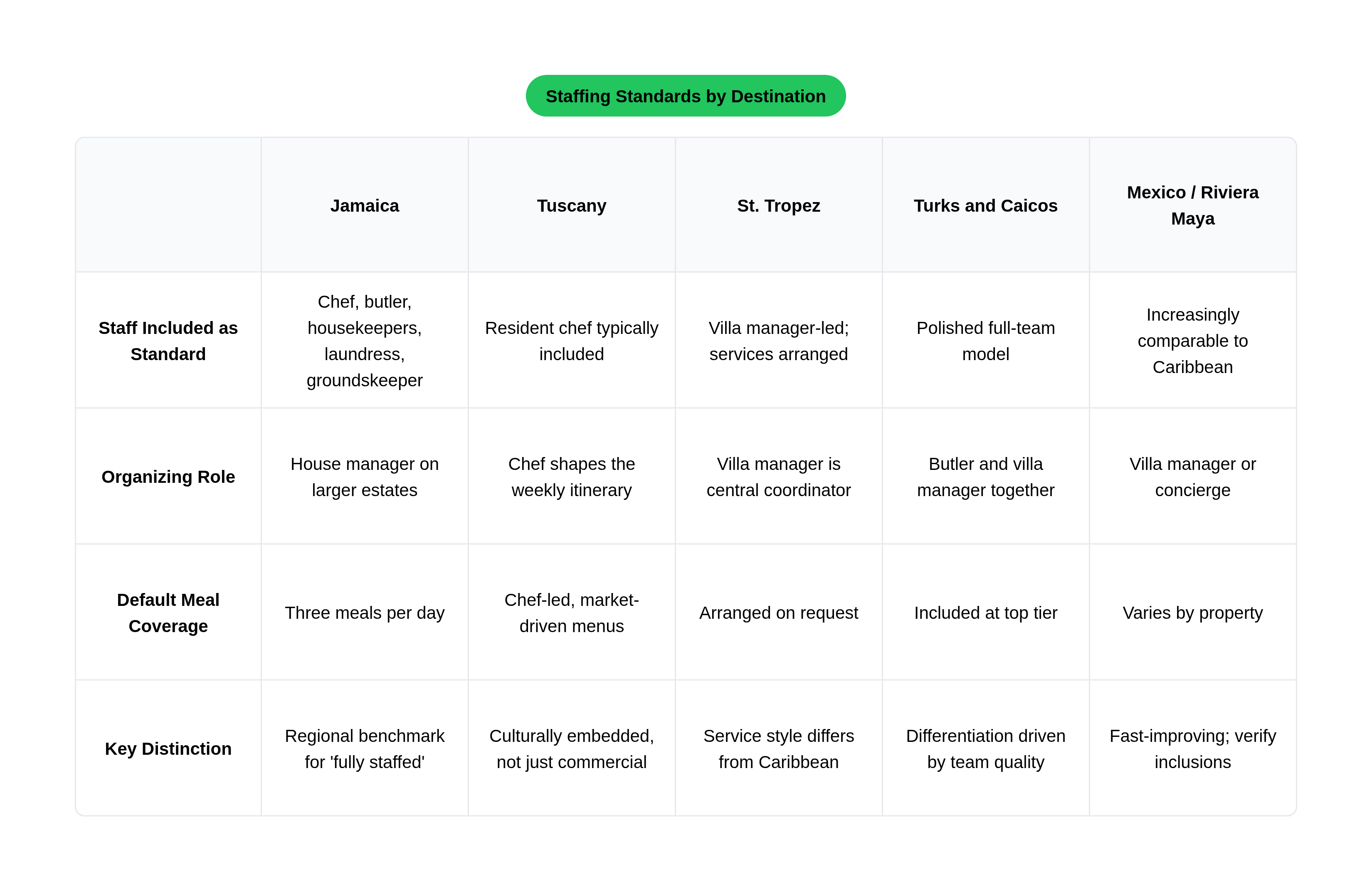
Turks and Caicos ranks second in the Haute Retreats 2026 Billionaire Villa Index, driven by Grace Bay beachfront estates and, at the ultra-luxury end, Ambergris Cay, a private island accessible only by private flight. The staffing model here is among the most polished in the Caribbean, in part because the competition is direct and unforgiving. When every property on the island has the same water and the same sky, you differentiate on the team. There is nothing else left.
The practical takeaway for anyone reading a listing: "fully staffed" in Tuscany describes a structurally different arrangement than "fully staffed" in Jamaica. The phrase carries regional meaning. Always verify what is included as standard versus what is arranged on request, and treat the destination context as essential information, not background detail.
Where a fully staffed villa outperforms a hotel, and where it doesn't
What a hotel structurally cannot replicate
Complete privacy is the most obvious and most consequential advantage. No shared spaces, no lobby, no other guests, no staff divided across dozens of rooms. The property and its team exist solely for one group. For high-profile travelers, multigenerational families, milestone celebrations, and honeymoons where seclusion is the governing requirement, this is not a preference; it is the point.
Personalization at scale follows directly from that exclusivity. A hotel genuinely committed to individualized service is still constrained by the fact that it is simultaneously serving many guests. The structure of the experience is standardized regardless.
The value arithmetic at group scale
The economics of a staffed villa become compelling quickly as group size increases. A luxury villa sleeping eight at seven thousand euros per week represents roughly eight hundred and seventy-five euros per person. A single night in a five-star hotel room in the same destination frequently exceeds that figure. At ten to twelve guests, accounting for multiple hotel rooms, restaurant meals, and added services, the total cost of the hotel option comfortably surpasses the staffed villa in most comparable scenarios. For groups, the villa is not the extravagant choice. It is frequently the rational one.
Where hotels retain the advantage
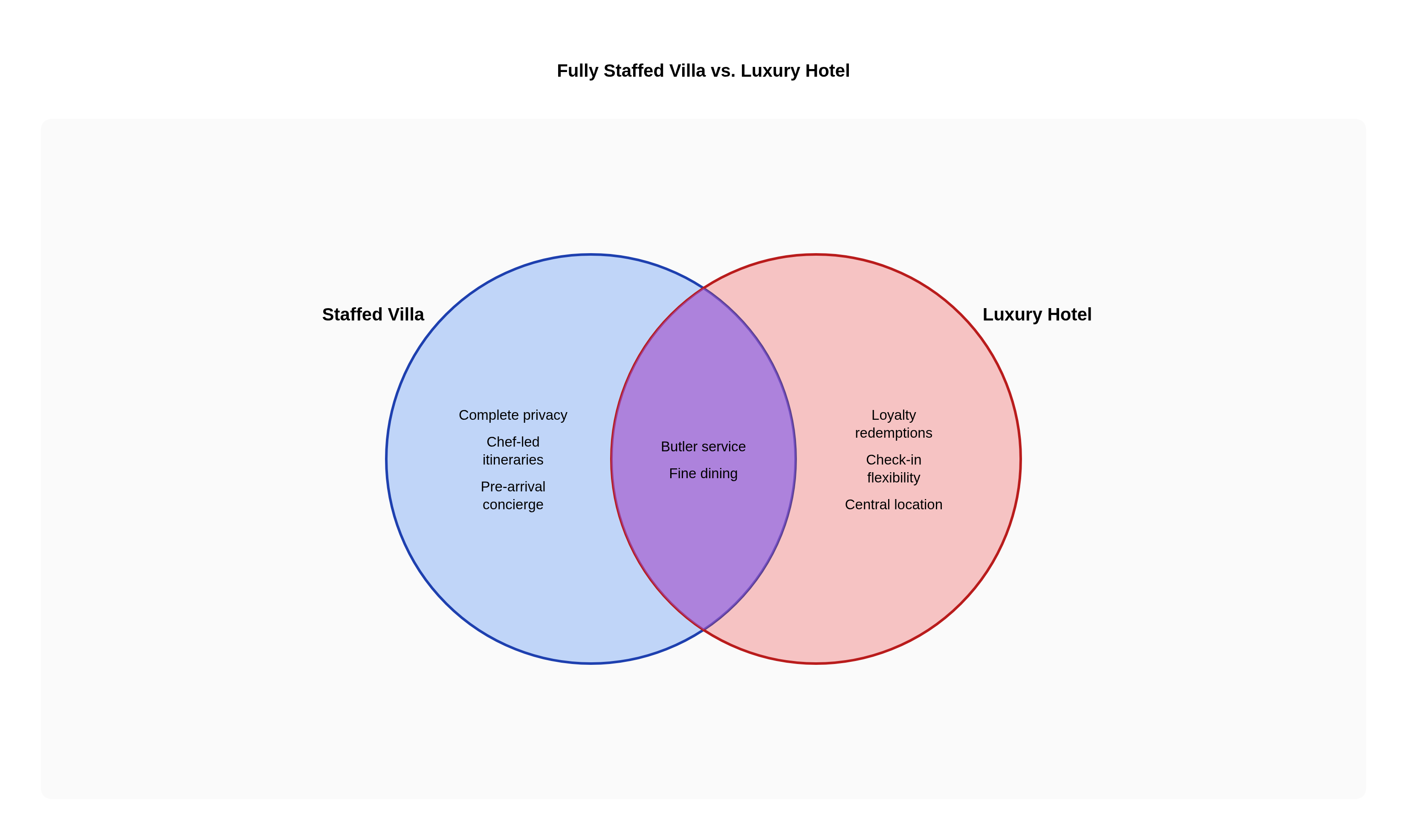
Solo travelers and couples on short stays rarely benefit from villa economics. The per-head cost at low occupancy makes the comparison unfavorable and obvious. Business travelers who need check-in flexibility, central location, and proximity to meetings are better served by hotels. And loyalty program redemptions through Marriott, Hilton, Hyatt, and similar networks represent a genuine financial benefit that villas cannot compete with. For a frequent traveler with a meaningful points balance, a flagship hotel redemption can represent value that no villa operator can match.
A fully staffed villa is the superior choice for groups, longer stays, and guests for whom personalization is the primary metric. A hotel is the superior choice when flexibility, location density, loyalty redemption, or short-duration economics are the governing factors. These two things coexist without contradiction.
The market context behind the growing interest in staffed villas
The global luxury vacation rental market reached an estimated USD 26.5 billion in 2024, with projections placing it at USD 63.7 billion by 2034, a compound annual growth rate of 9.3%. The luxury villas and estates segment accounted for roughly 49% of that market in 2024 and is expected to grow at approximately 10% annually through the same period.
Per the Haute Retreats 2026 Ultra-Luxury Villa Trends Report, billionaires and centi-millionaires are traveling more slowly, staying longer, and consistently choosing fully staffed private villas over exclusive hotel suites. Forward booking lead times reflect this shift: ultra-high-net-worth families are now reserving fully staffed estates six to eight months in advance in top destinations including Costa Rica, Turks and Caicos, Tuscany, Lake Como, and the Dominican Republic's north coast.
Asia Pacific is the fastest-growing region in this market, projected to register a compound annual growth rate of 12.3% from 2025 through 2033, as regional wealth formation accelerates and the villa model gains adoption in markets where it was previously marginal. New demand in new markets creates new inventory fast, and new inventory frequently outpaces new standards. That pattern has played out in every other region before this one.
Which is precisely the problem. As demand rises, the inventory of properties describing themselves as fully staffed grows faster than the inventory of properties that genuinely are. The definitional ambiguity that runs through this entire piece becomes more consequential as that gap widens. Travelers entering this market now are doing so at the moment when the terminology is least reliable.
The questions to ask before booking a villa described as fully staffed
Ask these questions before you sign anything. A genuinely full-service operator will answer all of them specifically and without hesitation. Vagueness is not a communication style. It is information about the property.
Is the staff exclusive to your group for the duration of the stay, or are they shared across the property or neighboring villas? Which staff are included in the rental rate, and which are arranged and billed separately? Is there a private chef or a cook, and what does the meal plan actually include: how many meals per day, which meals specifically, and are ingredients included or billed at cost?
What are the housekeeping hours? Twice daily with turndown, once daily, or something less? Is there a pre-arrival concierge, and at what point before arrival do they make contact? Is the villa manager on-site during the stay, or available remotely?
What is the tipping norm for this destination and property? In Jamaica, industry convention suggests 10 to 15% of the villa rental rate, paid to the head of house at the end of the stay for distribution among the team. Norms vary elsewhere and are worth clarifying in advance, both as a financial planning matter and as a signal of how professionally the operator manages the guest relationship overall. An operator who fumbles this question tends to fumble others.
Finally: has the property been professionally managed and inspected, or is the staffing description self-reported by the owner? The difference between a managed villa collection with accountability structures and an owner-listed property on a rental platform is significant. It matters most precisely when things are not going according to plan, which is exactly when you want the answer to already be clear.