Interior Design Standards in Five Star Rentals
How Spatial Generosity and Layout Logic Distinguish Five-Star Interiors Before a Guest Touches Anything. The first thing a guest …
How Spatial Generosity and Layout Logic Distinguish Five-Star Interiors Before a Guest Touches Anything
The first thing a guest registers is not the furniture, not the art, not the view. It is whether the space feels proportionate to what was promised. That single perception, formed in the first ten seconds, does more work than almost any decorative decision an owner will ever make.
I've walked through hundreds of properties. The ones that disappoint do so immediately, before you've opened a cabinet or sat on a sofa. You feel the ceiling pressing down. You notice the furniture crowding the circulation path. You sense that someone designed this space without ever imagining a family of six sharing a morning in it.
Good hospitality design starts with activity mapping, not square footage. The real question is always "what will people actually do here?" A five-star bedroom needs zones: sleeping, seating, maybe a desk, and enough room between them that the space reads as deliberate. A room that fits a bed and two nightstands and nothing else fails this test regardless of what the mattress cost. The same logic applies to living areas. An open plan with no clear seating anchor doesn't feel expansive; it feels unresolved, and guests who can't name that feeling will still describe it as something being "off."
Kitchens and dining spaces need to read as intentional. A dining table shoved into a corner because the kitchen claimed the better light signals that no one programmed the layout with guests in mind. This kind of spatial afterthought is invisible to the owner who designed around their own habits and completely legible to the guest who didn't.
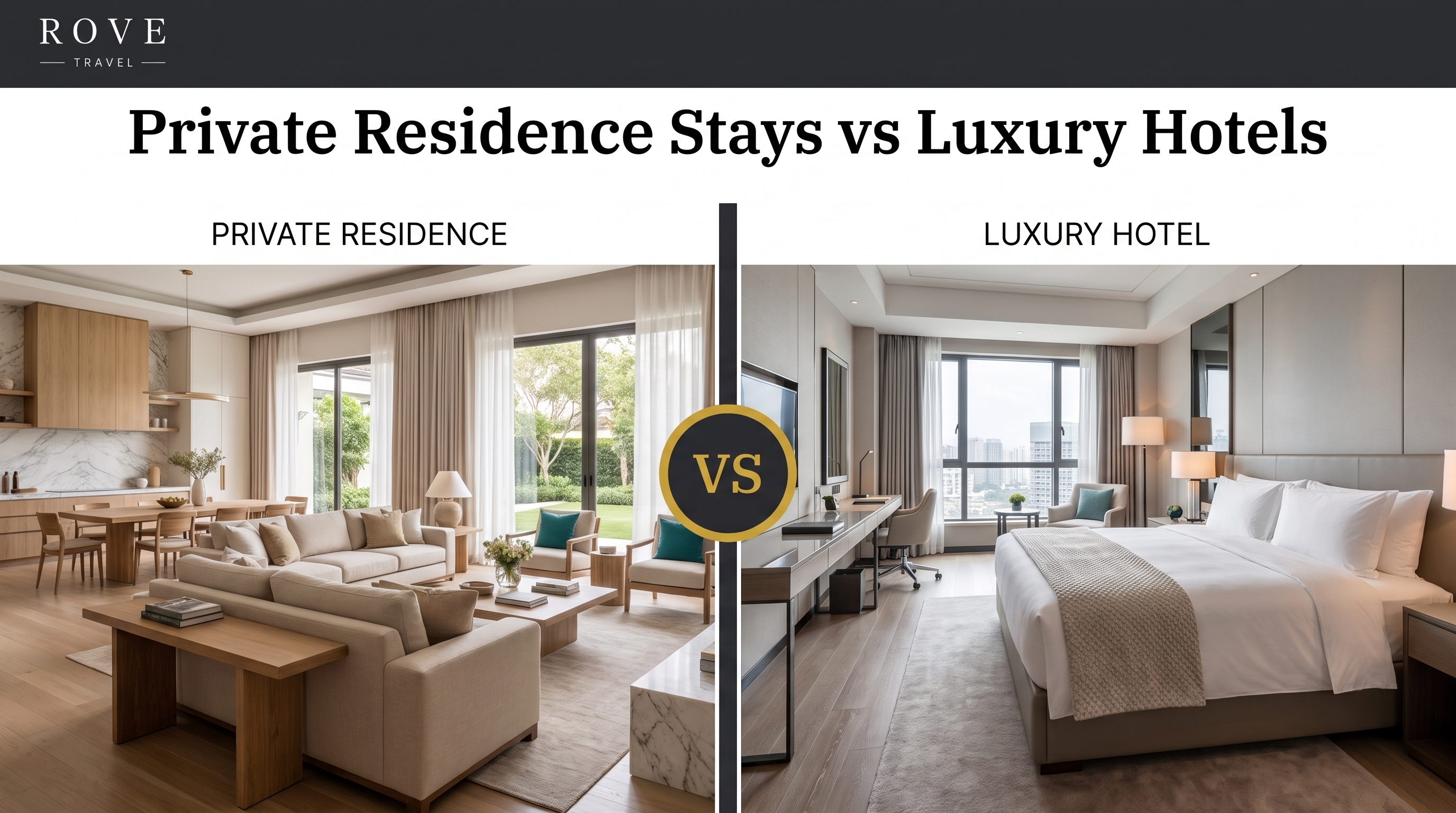
The private rental format has one genuine structural advantage over hotels: scale. Eight people in a well-considered villa can actually coexist across a day. Eight people in eight hotel rooms cannot replicate that. But this advantage only materializes when the layout was programmed for how guests use the space, not inherited from whatever the previous residential occupants needed. A lot of owners miss this transition entirely.
Outdoor spaces extend the same logic. Properties that photograph well and book consistently treat outdoor areas as rooms: outdoor kitchens, fire pit lounges, covered seating chosen rather than dragged from storage. A continuation of the interior, not a footnote.
The Material Palette That Reads as Luxury and Why It Works
Contemporary five-star hotel design has converged on a recognizable material language: stone, timber, linen, cotton, color drawn from the natural world. Warm neutrals, soft greens, earth tones that shift slightly depending on geography. That convergence is not a trend. It is a conclusion.
Natural materials carry sensory qualities synthetics cannot approximate. Stone has thermal mass, cool to the touch in a way that feels deliberate, not accidental. Linen has texture you notice without looking. Raw timber carries a faint smell that registers before conscious thought. Spend twenty minutes in a room of these materials, then twenty minutes in laminate and polyester. The difference is not subtle.
Natural palettes also age differently, which matters more than most owners initially appreciate. A property decorated to a seasonal trend looks dated in three years. A property built on stone, timber, and linen looks considered indefinitely. For a capital investment meant to perform across a decade of bookings, "ages well" is a specification requirement, not a design preference.
Biophilic design has moved from differentiator to baseline expectation. The properties worth studying go further, mirroring local geography in their material selections: volcanic stone in coastal retreats, reclaimed timber in mountain escapes. This is the difference between a property with character and one delivering generic luxury. Generic luxury can be replicated anywhere. A home that feels geographically specific cannot.
Art belongs in this conversation. The gap between a five-star property and a well-furnished one often comes down to whether the art was chosen for a reason. A piece with genuine artistic merit, one that reinforces the design concept and carries cultural or emotional weight, functions as a focal point. A wall-filler is evidence of an obligation acknowledged and minimally discharged. Guests make this distinction without the vocabulary to articulate it, which means they express it in reviews instead.
The point is not to spend more. The point is to choose with intention and consistency, and to hold that logic throughout every room. One beautifully specified room surrounded by mediocrity isn't a partial success. It is a partial effort.
Why Durability Specifications Are Inseparable from High-End Design
This is where owners lose ground they thought they'd secured. A beautiful specification that degrades within eighteen months was never five-star. It was a five-star aesthetic on residential-grade bones.
Durability is not a secondary specification made after the aesthetic decisions are done. It is the same decision, made at the same time, with equal weight. Stone surfaces need to be evaluated for stain resistance alongside visual quality. Upholstery needs rub-test ratings that meet commercial thresholds, not residential ones. Joinery should be selected with repairability in mind, because something will eventually need to be repaired, and the question is whether it can be repaired or must be replaced.
Bedding is where this principle is most legible: sensory and operational requirements overlap completely, and the failure mode is visible. The five-star hospitality standard runs 300 to 400 thread count, single-ply long-staple cotton, in the 150 to 200 GSM weight range for sheets and 600 to 900 GSM for bath towels. Both must survive more than 300 high-temperature commercial wash cycles without degrading. I didn't arrive at those figures from a spec sheet. I arrived at them by watching properties that ignored them fail, season after season, in entirely predictable ways. Four Seasons works with approximately 300 thread count Supima cotton. Frette, Sferra, and Matouk supply major luxury hotel programs. A rental owner using those names as a benchmark is working from the right reference point.
Percale dominates luxury hotel bedding for two reasons that reinforce each other: the tight weave produces a cool, matte, crisply pressed surface that reads as fresh on arrival, and it withstands industrial laundering that softer weaves cannot sustain across a full season.
The failure mode shows up in reviews in a recognizable form. The phrase is usually something like "not quite as nice as it looked in the photos." That gap is almost always a durability specification problem. The property was designed for the arrival photograph, not the seventh consecutive stay.
The Bathroom as a Design Statement in Its Own Right
The five-star hotel bathroom is not a functional room with upgraded fixtures. It is a focal feature of the accommodation, designed with the same intentionality as the principal living space. Waterfall and steam showers, freestanding or deep-soak tubs, toiletries presented as part of the design concept rather than lined up on a ledge. Storage that is considered rather than improvised. And, where the property allows it, a view worth encountering at six in the morning.
Guests now filter specifically for bathroom quality when booking high-end rentals. Circadian lighting, biophilic materials, and spa-quality water features have shifted from premium amenities to baseline expectations at this tier. The cultural driver is real: wellness has become central to how travelers justify premium expenditure, and the bathroom is where that investment is most tangible and most photographed.
The specifics that signal quality are concrete. Natural stone surfaces, not tile engineered to approximate stone. A fixed rainfall head, not a handheld converter bolted onto an existing shower arm. Towels at the 600 to 900 GSM hospitality weight. Toiletries chosen for brand coherence and packaging, contributing to the sensory environment, not merely confirming that soap is present.
A sauna with cedar finishes, considered lighting, and thoughtful placement earns reviews. One retrofitted into a garage corner with a bare bulb does not. The feature itself is not the point. The integration is.
How Lighting and Scent Complete the Sensory Environment Guests Actually Remember
Guests almost never mention lighting in reviews. What they write instead is that the property "felt warm," that they "relaxed immediately," or that it "didn't feel like a rental." Lighting is usually why. It does more perceptual work than almost any other design element, and remains one of the most chronically underspecified.
The hospitality standard is layered ambient, task, and accent sources operating independently, not a single overhead circuit on one switch. Warm color temperature, in the 2700 to 3000 Kelvin range, is standard for living and sleeping spaces. Dimmability is not optional in bedrooms and bathrooms at this level. A guest who cannot modulate the light in the room they're sleeping in does not have a five-star experience regardless of what the mattress cost. I have watched owners spend forty thousand dollars on furniture and then install a single overhead fixture with a cool-white bulb. The room felt like a waiting area.
Scent is addressed with even less intentionality by most owners. It is a significant omission. Natural stone, raw timber, linen, warm light, and a coherent ambient scent working together establish a mood that guests register on arrival without knowing what produced it. Cedar in a timber property. Sea grass in a coastal one. The goal is not fragrance as a product; it is coherence as an environment. The scent should reinforce the material palette, not compete with it or overpower it.
Neither element is structurally expensive. For an owner who has done the harder, costlier work of getting layout and materials right, lighting and scent represent the highest-leverage remaining investment.
Where Technology Belongs in a Five-Star Rental Interior — and Where It Doesn't
Smart locks and self-check-in are standard. What top-performing properties have moved toward is something more specific: technological invisibility. Integrated systems that enhance convenience without announcing themselves or requiring a tutorial.
Lighting, temperature, and audio should be controllable from a single interface, but that interface should not be a plastic panel mounted on a linen wall. Screens belong in cabinetry, not dominating the bedroom. The hardware must be designed into the space from the beginning, not retrofitted into a space never built for it. That distinction is immediately visible and impossible to fake with cable management.
The failure mode is not having too little technology. It is having technology that is visible, complicated, or unreliable. A guest who cannot operate the blinds, or who arrives to find a router on the kitchen counter with cables trailing behind the television, feels less comfortable, not more capable. The gap between the convenience a property promises and the convenience it actually delivers is one of the most corrosive experiences in luxury hospitality.
Technology that is genuinely integrated, that functions invisibly and consistently, does produce measurable satisfaction returns. The condition: the integration must be real, not aspirational.
The Distinction Between a Well-Decorated Rental and a Professionally Managed One
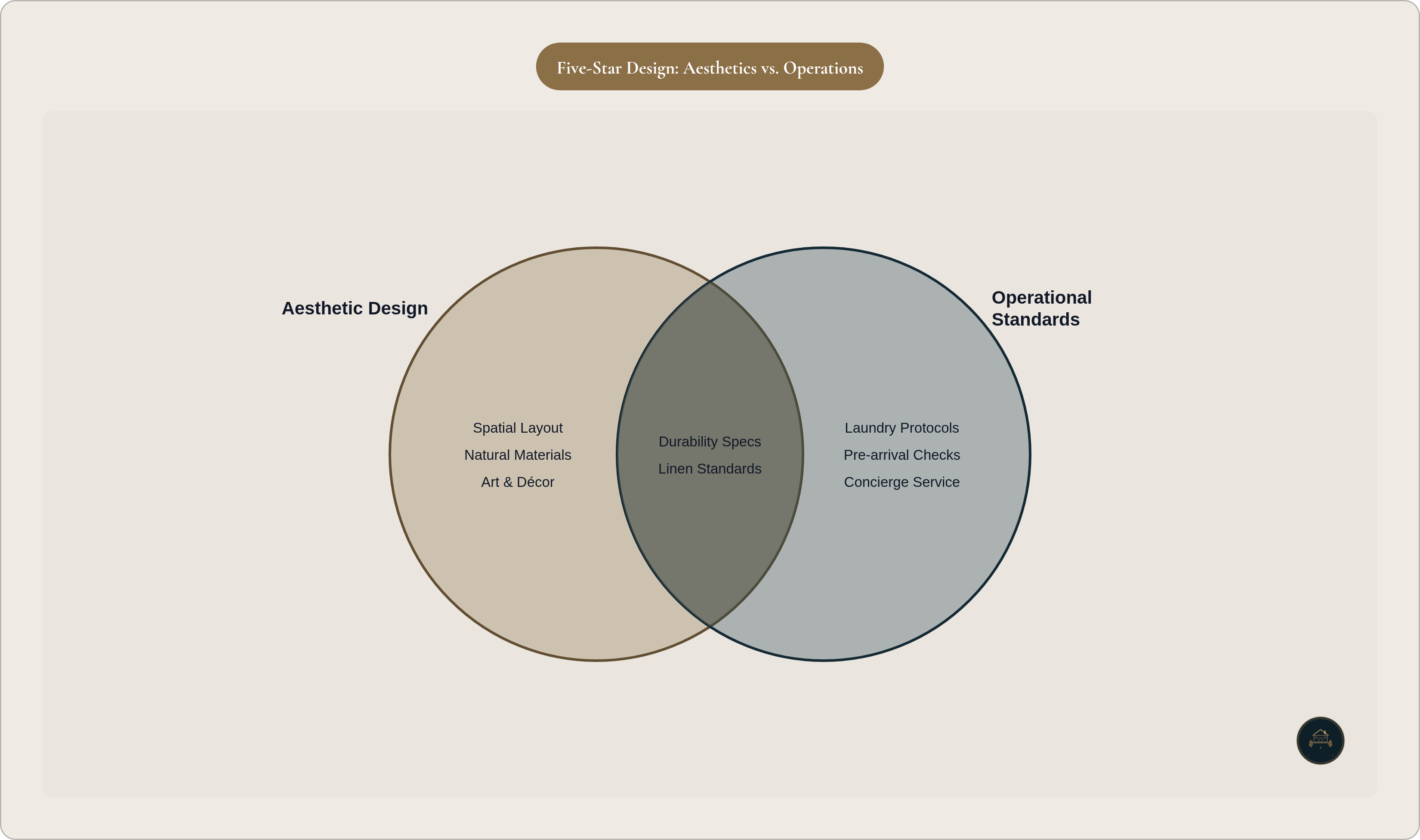
Everything above is a specification. A specification is an intention. Operations convert that intention into a consistent guest experience. The two are not interchangeable.
A five-star hotel holds its standard because every element is delivered to specification on every stay. The linen meets spec because laundry protocols are followed every time, not because someone bought good linen once. The bathroom is correct because someone checked it before arrival, not because it was set up well on opening day. Consumables, flowers, kitchen provisions: present, replenished, arranged with the same care on the fourteenth stay as on the first. That consistency doesn't happen without systems, and systems don't maintain themselves.
Professional management delivers what design alone cannot: pre-arrival inspections that catch the gap between the designed state and the current one, a responsive point of contact when something isn't right, and concierge capability that treats a guest's request as the priority it actually is. The Michelin Keys evaluation criteria include service quality alongside architecture and design for precisely this reason.
The photograph shows you the designed state. The questions that reveal whether a property actually performs at its positioning are different: who manages it, what their protocols look like, what happens when something goes wrong. Those answers predict the experience far more accurately than the listing images do.