Luxury Concierge Service Explained for Rental Guests

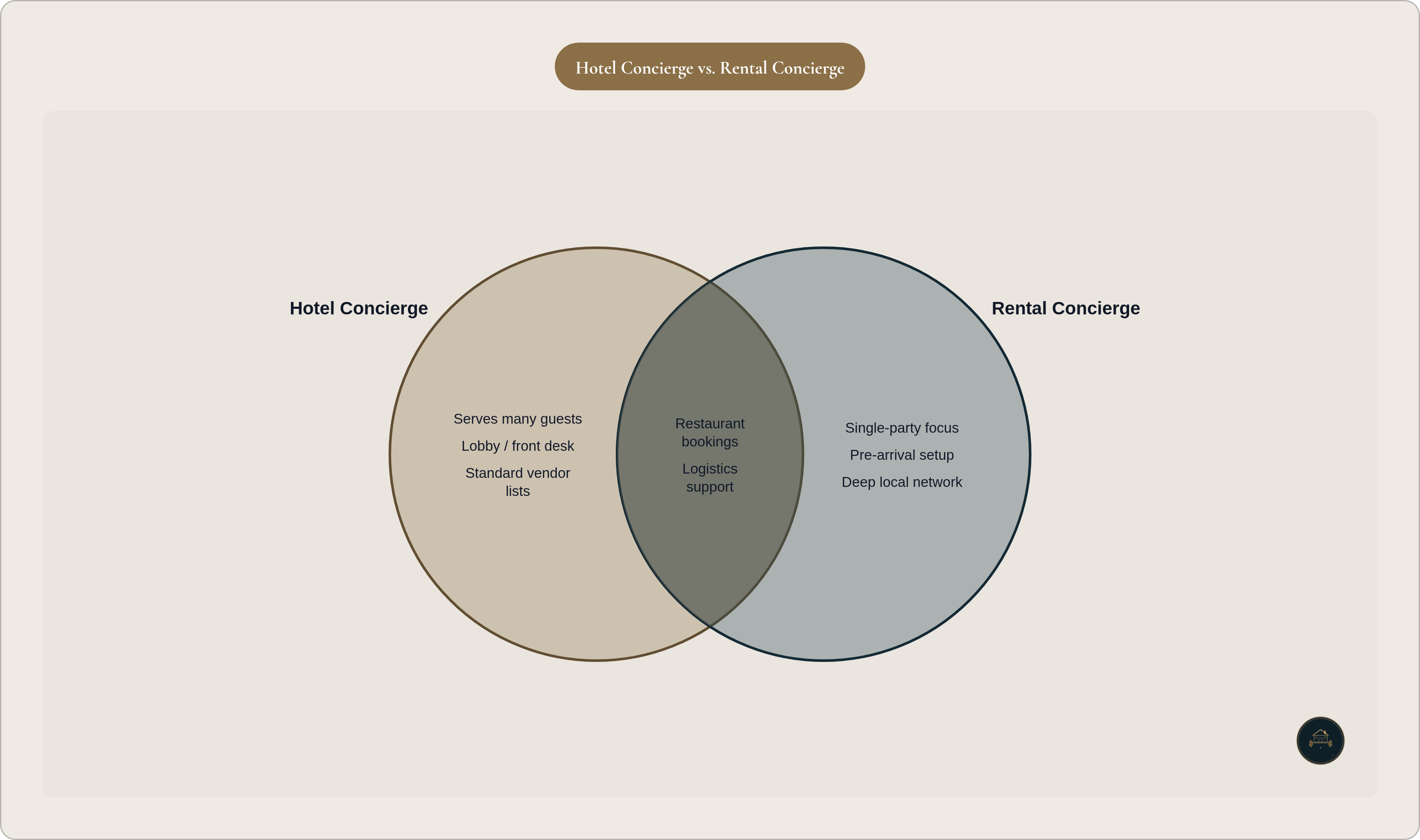
A hotel concierge manages dozens of guests at once, sometimes hundreds. The rental concierge serves one party, one stay. Everything flows from that.
In a serious rental program, your preferences, dietary restrictions, and anticipated itinerary are reviewed before you land, not after you've checked in and asked. There is no lobby queue. No front-desk theater. Contact runs through a dedicated line, a named individual, sometimes a branded app. The interaction model is closer to a trusted fixer than a service counter. It rewards guests who know the difference.
Discretion works differently here, too. High-profile guests benefit from private entrances, gated access, and a concierge handling sensitive logistics without the exposure of a shared hotel environment. The concierge knows you are the only guest they are thinking about that week. That specificity of attention is, genuinely, the product.
Local knowledge is where the gap becomes most visible. A hotel desk can recommend a restaurant; it can pull up the same Zagat-adjacent list it's been pulling up for years. A rental concierge with real roots in a destination has working relationships with restaurateurs, guides, vendors, and fixers that rotating hotel staff cannot replicate. There is a meaningful difference between a directory and a person who gets their calls returned.
The Core Services Guests Can Actually Expect
Most requests cluster around three categories: arrival logistics, in-home provisions, and mid-stay support.
On the logistics side: airport transfers, personal drivers, car or boat charters, and luggage coordination. On the provisions side: a kitchen stocked to your household's specifications before you walk in the door. That single touch, a refrigerator that already knows you, ranks among the highest-satisfaction elements in any luxury rental stay. I have watched guests who have stayed in extraordinary properties say, almost sheepishly, that the groceries were their favorite part. It is not a small thing to feel expected. Mid-stay support covers housekeeping, turndown service, and additional cleaning on request.
Dining goes well beyond restaurant recommendations. Private chef bookings, reservations at venues that don't accept public bookings, wine tastings, and in-villa cooking lessons: these are standard offerings in a well-staffed program. Wellness and leisure fill the rest of the picture. In-villa spa treatments, private fitness sessions, golf, water sports, fishing, and guided safaris. The concierge coordinates these; the guest does not have to assemble them independently in an unfamiliar place.
For special occasions, the concierge connects you with local event planners, photographers, caterers, and live music. The practical implication is this: the concierge's value is highest when you engage it before you need something. Proactive requests get better results than last-minute ones. That's not a hedge. It's how the logistics actually work.
What "Bespoke" Actually Means at the High End of the Service
Private aviation is no longer exotic in this segment. Jet and helicopter charters to bypass traffic or reach remote locations are routine asks for a well-resourced concierge. Yacht rentals, personal security arrangements, and access to things that require genuine relationships rather than a Google search: these are similarly within scope for the top-tier providers.
A story circulates in this industry: a concierge firm arranged a vow renewal ceremony with the Pope for a client. I bring it up not to imply it's on anyone's standard menu, but because it illustrates something real. A concierge with genuine relational capital opens doors that money alone will not. The ceiling is higher than most guests realize.
The principle beneath the papal anecdote matters more than the anecdote itself. Whether the request is a table at a fully booked restaurant, access to a private collection, or a charter to a remote island, the answer depends on who the concierge knows. Not willingness. Not volume of emails. Relationships. The depth of that network varies substantially by provider and destination, which is why asking what the concierge covers in your specific location is a productive conversation to have before you arrive.
How Concierge Service Handles Problems, Not Just Plans
Guests consistently underuse the concierge as a crisis resource. They think of it as a planning tool and forget it functions equally as a buffer against disruption. A well-run concierge absorbs these without drama.
A lockout at two in the morning: the concierge coordinates with key holders so your group is not stranded outside a property in an unfamiliar city. A sick child: the concierge locates a pediatrician who makes house calls, bypassing an emergency room where no one knows the local system and you know no one. A weather cancellation that wipes out a planned water excursion: the concierge pivots to an alternative that fits your group's composition and preferences without requiring you to rebuild an itinerary under stress. These feel like edge cases until they happen. Then they feel like everything.
What this requires operationally is a concierge who is reachable outside standard business hours. Research in this space shows that luxury rental guests expect rapid response, most within an hour, a meaningful segment expecting something closer to immediate. A quality provider has a system for meeting that standard. Confirm availability windows and after-hours contact protocol before you need them. Asking "what happens if something goes wrong at midnight?" is not a strange question; it is a useful one. A good operation will have a clear answer without hesitation.
How Pricing Works: What's Included, What Costs Extra, and Why
The most common model is this: standard coordination, meaning recommendations, reservations, logistics, is included in the rental rate. Guests pay the actual cost of goods and third-party services: the groceries, the chef, the charter.
Where margin appears varies by provider. Some operations add a coordination fee of ten to twenty percent on vendor costs to cover the concierge's time. Transparent operations disclose this upfront; ask if it hasn't been volunteered. Others earn a referral commission from vendors, typically around ten percent, so the guest pays the standard market rate and the concierge is compensated through the vendor relationship rather than directly. Both models are functional. Knowing which model applies removes ambiguity. Ambiguity in pricing is the source of nearly every post-trip grievance.
At the full-service property management level, fees are embedded in the overall structure, with premium services priced on top. At the highest end of the market, where nightly rates regularly exceed several thousand dollars, the economics support a deeper service infrastructure. That is why the concierge offering at that tier is qualitatively different, not just incrementally better, than what's available at more modest price points.
The concierge service itself rarely appears as a line item. The cost is either embedded in the nightly rate or surfaced when you request a specific add-on. The useful habit before arrival is asking for a clear breakdown of what's included and what's priced separately. Nothing should surface as a surprise mid-trip.
How Technology Has Changed What Concierge Service Looks and Feels Like
The technology adoption curve in luxury short-term rental operations has been steep and fast. A 2025 Hostaway survey of over 300 operators across more than fifty countries found that AI adoption among short-term rental operators rose from sixty percent to eighty-four percent in a single year. That rate of change is significant, and it's visible from the guest side.
Routine requests, grocery lists, restaurant recommendations, and activity bookings, move through chat-based interfaces, a branded app or SMS, without a phone call. Some systems now process photos, interpret ambiguous requests, and use sentiment analysis to anticipate what a guest might want next. Automated prompts surface relevant experiences at contextually appropriate moments during a stay.
Online channels accounted for a majority of luxury concierge interactions globally by 2024, surpassing offline channels for the first time. But the highest-value requests, private aviation, bespoke event production, anything requiring genuine judgment or discretion, still run through human relationship managers. The technology has not replaced that layer. It has insulated it from the transactional volume that once consumed it. That is a better outcome for guests who have complex needs.
The emerging model is hybrid: AI handles routine asks efficiently, and a named person handles anything requiring relationships, nuanced judgment, or sensitive logistics. AvantStay is a useful example of what this looks like in practice. Guests open an app to chat a live concierge for requests ranging from a private chef to a late-night delivery. The technology is the interface; a person drives the consequential decisions.
Know which channel to use. App or chat for quick, routine asks. A direct call for anything urgent, complex, or sensitive. Getting that routing right reduces friction on both ends.
What to Do Before Arrival to Get the Most from a Concierge
The single largest missed opportunity in luxury rental stays is guests who wait until they're on-site to start using the concierge. Most high-value arrangements require lead time that evaporates once you've landed.
Before booking is confirmed, ask three things: which services are included versus priced separately, what the concierge's coverage hours and after-hours protocol look like, and what the concierge's actual network covers in that specific destination. That last question matters more than most guests realize. Depth of local relationships varies significantly by property and market. A concierge who is exceptional in one city can have surprisingly thin connections two hours away.
After booking, before you travel, share everything useful: dietary preferences, arrival times, group composition, any celebrations or special occasions. The earlier this information reaches the concierge, the more they can pre-configure the stay to fit your party rather than react to it. Request grocery provisioning with enough lead time for the concierge to actually execute it well. Confirm restaurant reservations and experience bookings early, particularly in high-season destinations where availability closes weeks in advance.
During the stay, use the right channel for the right request, and do not self-censor. Guests frequently assume a request is too unusual or too demanding to voice. It rarely is. The concierge's job is to know what is possible in their market, and the answer to a seemingly unusual request is often yes. Even a no usually comes with an alternative. Guests who extract real value treat the concierge as a planning partner from the start, not a rescue service when something is already missing.