Technology and Smart Home Features in Luxury Rentals
Integrated smart systems separate luxury rentals from gimmicky upgrades within seconds of arrival.
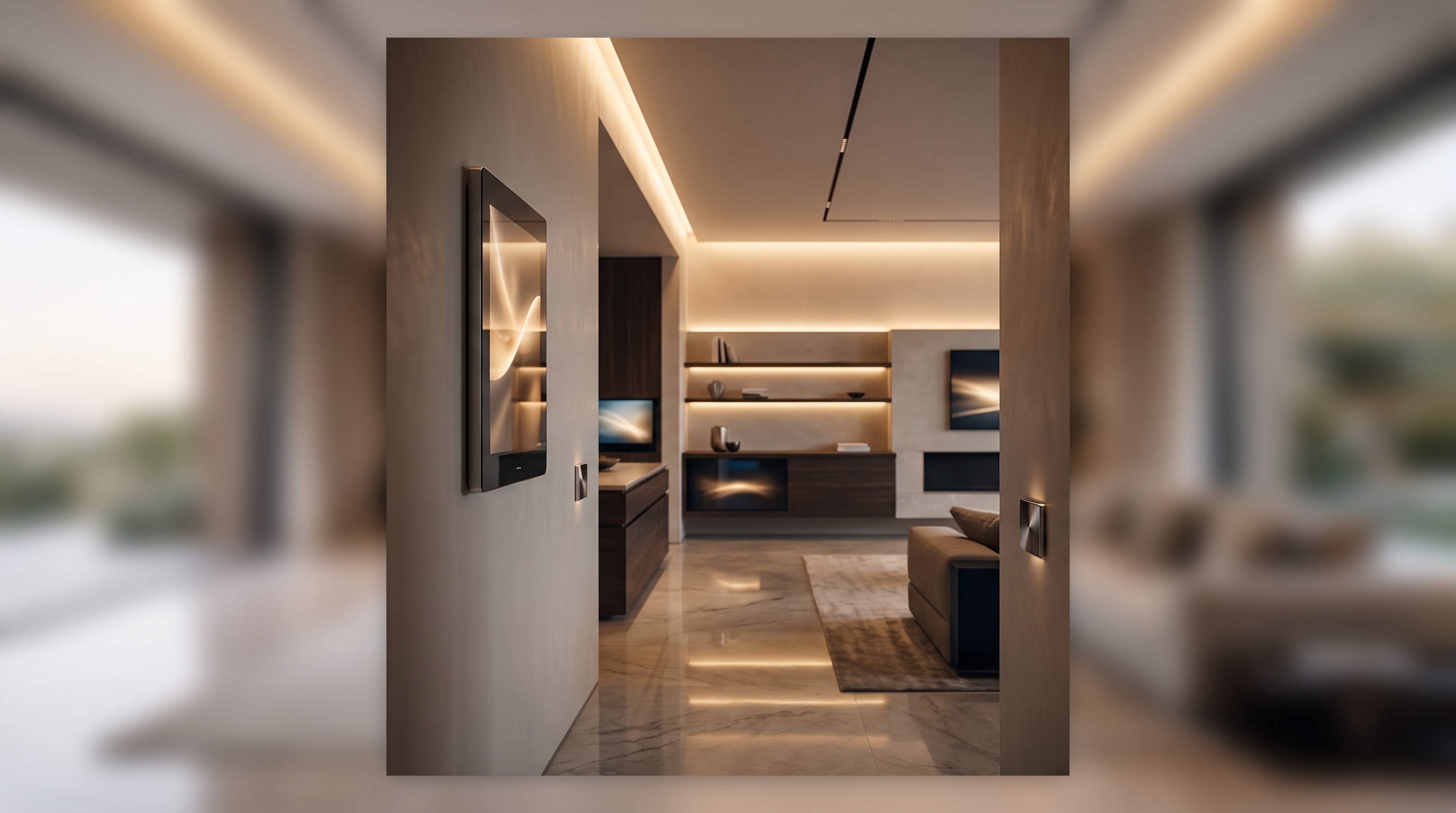
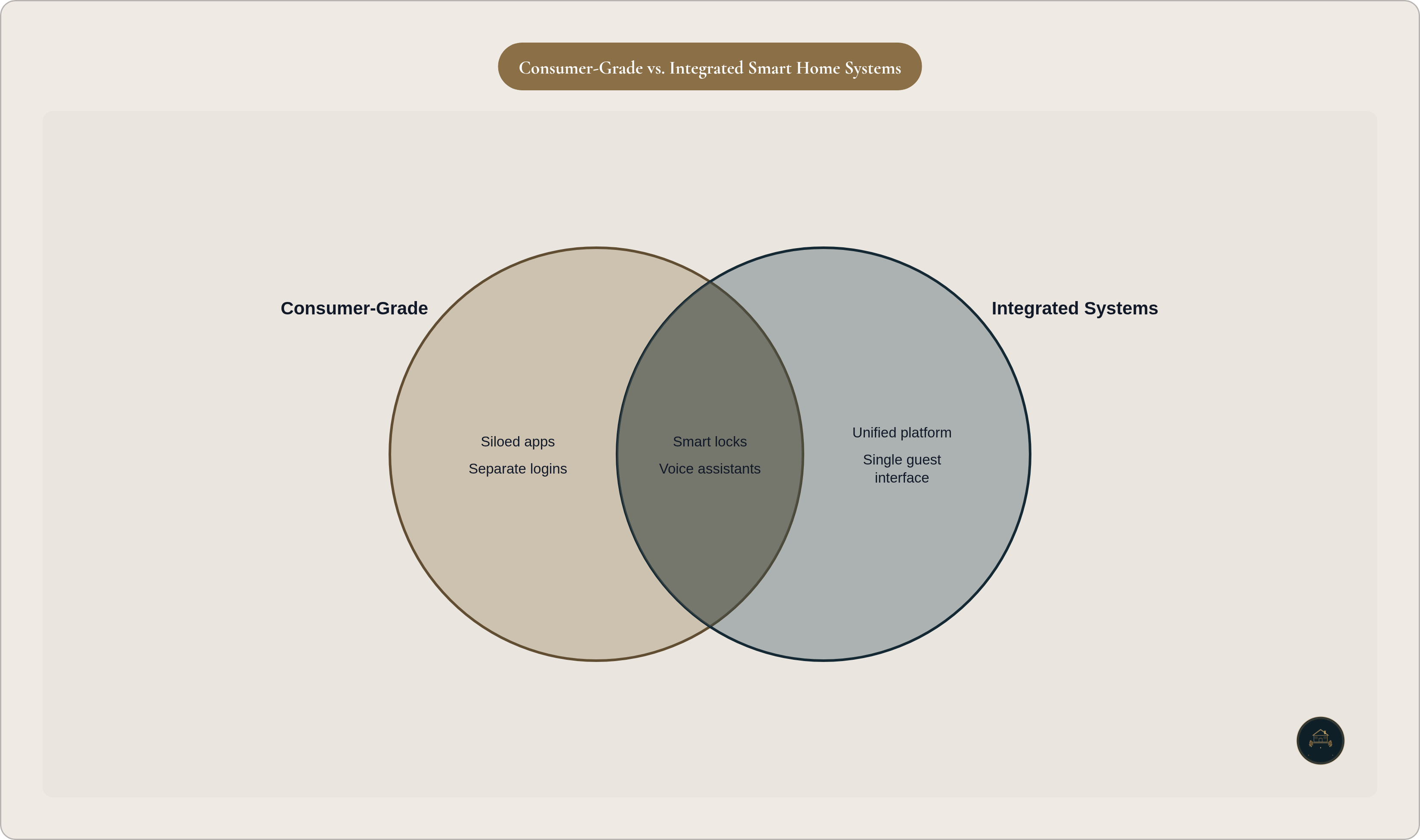
Two tiers exist in this market. They are not comparable. The first is consumer-grade hardware added opportunistically: a smart lock here, a voice assistant there, each living in its own app, each requiring its own login. The second is an integrated system designed from the ground up, where every component communicates through a single platform and the guest encounters one coherent interface. A luxury rental worth its nightly rate belongs to the second category, and you can tell within about ninety seconds of walking in which one you're dealing with.
The platform stack in a serious installation starts with structured wiring and high-capacity connectivity. Nothing else works without it. The 86% of renters in the 2024 NMHC/Grace Hill Survey who rated high-speed internet as very important or absolutely essential weren't being demanding. They were describing the foundation everything else depends on. The stack extends to audio and video distribution, lighting control, motorized shades, and climate management, unified through a centralized control platform. Control4, Crestron, Savant: these names appear in serious installations because they exist specifically to solve the fragmentation problem that plagues consumer-grade setups.
The Matter standard, increasingly adopted across devices in 2025, adds practical interoperability, allowing a guest's own phone or preferred voice assistant to integrate natively without a learning curve. For a week-long stay, that matters more than it sounds. Nobody wants to spend their first evening reading setup instructions when they could be on the terrace.
What a guest actually encounters in a well-specified property is a home that was configured before they arrived, a single interface for every system, and technology that recedes into the background rather than demanding attention. That invisibility is the design goal. It is also the hardest thing to execute well, and the thing most properties get wrong, even when the hardware is right.
How Smart Access and Security Deliver the Safety and Privacy Guests Actually Care About
Forty-one percent of renters in the 2025 Rently report cite feeling safer as their primary reason for wanting smart technology in a rental, outranking energy savings and convenience by a significant margin. That makes sense. A private luxury rental has no front desk, no lobby staff, none of the implicit security infrastructure a hotel provides without anyone thinking about it. Smart access fills that gap, but only when it's implemented thoughtfully rather than just checked off a list.
Smart locks are the entry point, in every sense. Keyless access via app, personal code, or biometric means no physical key to lose, no lockout at midnight, and access a property manager can grant or revoke remotely. At the high end, the hardware gets considerably more sophisticated. Lockly's Visage combines facial recognition, a fingerprint reader, a digital keypad, and a traditional keyed cylinder in a single unit. Philips' Palm Recognition Smart Deadbolt stores vein patterns for up to fifty individuals, which becomes genuinely practical when you have a larger travel party where multiple guests need independent, simultaneous access without coordinating who holds the one key. These are not novelties engineered for press coverage. They solve logistical problems a conventional key handles clumsily or not at all.
Exterior-facing security cameras are expected by 54% of renters surveyed, and 51% say they'd pay extra for properties that include them. The interior privacy boundary, however, is absolute: cameras inside a luxury rental are never appropriate, and a well-managed property discloses all camera placement transparently, unprompted, every time. Thirty-five percent of renters in the same survey worry about unauthorized monitoring; 32% worry about smart lock malfunctions. Both concerns are legitimate. Both have the same solution: professional management with a named human contact available when something goes wrong. Technology without human accountability isn't a luxury product. It's a liability dressed up in nice hardware.
Climate Control and How Smart Thermostats Quietly Shape the Comfort of a Stay
A hotel room is a single zone. A luxury villa or large private residence is five, eight, sometimes twelve zones, each with different sun exposure, occupancy patterns, and thermal characteristics. Managing that space so it feels uniformly comfortable requires active intelligence that a static thermostat cannot provide, and that most guests should not have to think about at all. When climate management is working correctly, it disappears completely from the guest's awareness. When it isn't, it's all they can think about.
The most practically meaningful capability of a smart thermostat is remote pre-conditioning. A property manager configures the arrival state before the guest lands: a specific temperature, humidity level, and airflow waiting when they walk in. After a long travel day, that is not a small thing. The energy savings framing, roughly 10 to 15% on heating and cooling, matters primarily to the property owner's operating economics. The guest's concern is a home that feels right without requiring them to find the thermostat, decipher the interface, and experiment for an hour before the first drink is poured.
Multi-zone control becomes especially relevant for group and family travel, where sleeping temperature preferences diverge sharply. The ability to set the primary bedroom cooler while keeping a child's room warmer is the kind of granular control a luxury rental can provide and a hotel room structurally cannot. A 2024 Parks Associates study found that multifamily properties using integrated smart HVAC, lighting, and water sensors saw 18 to 19% reductions in combined energy and water utility costs; for the property owner, that data point makes premium hardware easier to justify. For the guest, it signals a well-maintained, thoughtfully specified system rather than aging infrastructure running at whatever setting the last occupant left it.
Smart Lighting as the Feature That Most Directly Shapes How a Space Feels to Live In
Lighting is the element guests interact with continuously but consciously register only when it's wrong. Harsh overhead light undermines expensive furnishings. Warm, layered light elevates a modest space. I've stood in properties with genuinely extraordinary architecture and felt immediately uncomfortable because whoever configured the lighting hadn't thought past the factory defaults. It's a bit like a great band with a terrible sound mix: the talent is there, the room is right, and none of it lands anyway.
In a luxury rental, lighting is not a secondary system. It is the system that makes everything else perform. Motorized shades and automated lighting scenes translate a space across the day without requiring anything from the guest. Sunrise wake settings, evening ambiance, film mode, dining mode: these are configurations that an attentive human concierge would once have managed manually. In a well-specified smart rental, they are already built in and accessible with a single tap or voice command.
Circadian lighting is the genuine differentiator at the top of the luxury tier right now. Systems like Ketra, a Lutron brand, dynamically adjust both brightness and color temperature across the day to support the body's natural rhythms. For travelers managing jet lag or irregular schedules, this has direct physiological relevance: warmer, dimmer light in the evening supports melatonin production and sleep onset; cooler, brighter light in the morning supports alertness. A thoughtfully designed luxury rental assists with recovery in ways that static lighting, regardless of its quality, simply cannot replicate.
Smart lighting reduces energy consumption by approximately 30% in residential settings, which signals a well-engineered installation and helps operating economics. The guest-facing argument is simpler: a space that performs differently at 7 a.m., noon, and 10 p.m. is a living space. One that doesn't is an expensive photograph.
Wellness-Oriented Smart Features and Why They Matter More in a Private Residence Than in a Hotel
Hotels can standardize. They control the minibar, the thread count, the spa menu. What they cannot provide at scale is environmental personalization: your air quality, your water, your temperature, and your light, configured around your body and your sleep. That structural advantage belongs to the curated luxury rental, and it's where the best properties in the category are actively competing heading into 2025.
Air purification capable of removing allergens and particulates is now a baseline expectation at the premium tier, not an upgrade. Whole-home water filtration that delivers mineral-enhanced hydration from the tap is the next level. These address what the guest is actually breathing and drinking for the duration of the stay, which compounds over a week in ways a single-night hotel visit doesn't expose.
Smart bathroom technology is evolving toward the genuinely sophisticated. Intelligent showers with pre-set temperature and flow preferences mean a guest steps in at exactly the conditions they prefer, starting the first morning, without fiddling with handles. Voice-controlled aromatherapy, smart mirrors with integrated health monitoring, ambient lighting tuned for morning preparation: these transform a utility space into one that actually functions as a wellness environment, not just one that reads as wellness in listing photographs.
I'll be direct about what is well-documented versus what is still emerging. The granular consumer preference data that exists for access control or climate doesn't yet exist for this category in the same depth. What I can say from watching extended-stay guests is that these features compound across a week-long visit in ways that matter cumulatively. Sleep quality, recovery, daily routine: the benefit accumulates quietly. Guests rarely articulate it until you ask them why they're rebooking.
Digital Concierge, Entertainment, and Whole-Home Audio: The Technology of Hospitality at Scale
In a hotel, the concierge is a person available around the clock. In a luxury rental, technology handles the equivalent functions, and in certain respects handles them better: reservation coordination, delivery management, housekeeping scheduling, local recommendations, and service requests, all available through a single interface without requiring anyone to be physically present. The guest gets responsiveness. The property manager gets leverage.
Whole-home audio distribution is one of the features that most immediately signals a property's tier. Music that follows a guest through the home, from kitchen to terrace to bedroom, pre-loaded with curated playlists and controllable by voice or from a single app, is the kind of ambient luxury most travelers have not encountered outside hotels with serious hospitality budgets. When it's done well, the guest doesn't register it as a feature. They simply experience an environment that has atmosphere, which is the point entirely.
Streaming integration matters more than it sounds. Pre-authenticated smart televisions that surface a guest's Netflix or Spotify account are a small detail with outsized psychological effect. That signal tells the guest someone thought about the experience at the level of daily routine, not just at the level of architectural photography, and that distinction is what separates a thoughtfully prepared home from one that merely photographs well.
For guests who travel with work or who take extended stays, smart package management and app-based delivery coordination are increasingly expected rather than impressive. EV charging is moving in the same direction, from notable amenity to near-requirement for a meaningful and growing segment of high-value travelers. A property without charging provision is not a neutral omission; it actively disadvantages itself with that segment, and that gap widens every year.
All of these features cohere only through a unified control interface. Crestron, Savant, and Control4 present the entire home through one panel or one application, so a guest never has to think about what's running underneath. The interface is the product. Everything else is infrastructure.
What to Look For When Evaluating Whether a Luxury Rental's Smart Features Are Genuinely Good
The gap between "smart-enabled" and "smart-managed" is where most properties fall short. The distinction is not subtle. Devices installed without professional configuration, without ongoing maintenance, and without accountable management deliver friction rather than convenience. A listing that enumerates smart features is not a property where those features reliably work.
A discerning guest evaluating a luxury rental should expect clear answers to a specific set of questions. Is access keyless from the moment of arrival, without requiring a physical handoff or a scheduled meeting? Is the climate already configured for check-in, or does the guest walk into an unconditioned home and hunt for the thermostat? Do the property's devices operate through a single integrated platform or through a collection of disconnected applications that each require setup? Is there a named contact or digital concierge available when something doesn't work? Are exterior security cameras disclosed, and is the assurance that there are none inside backed by transparent documentation rather than a vague verbal promise?
Reliability matters more than feature count, and that hierarchy is worth keeping clear. The 32% of renters in the Rently survey who worry about smart lock malfunctions are not being unreasonable. A failed smart lock at midnight, in an unfamiliar city, at the end of a long travel day, is not an inconvenience. It is a crisis. A luxury stay without a smart lock beats one with a smart lock that fails. A shorter list of features that work consistently beats an impressive list that doesn't.
Professional management is the variable that determines whether the same technology delights or frustrates. The hardware is identical either way. What differs is whether someone is responsible for maintaining it, testing it between stays, and responding when it fails. The standard is not whether a luxury rental lists smart features, but whether those features perform consistently, for every guest, regardless of technical fluency. That is a management and maintenance commitment, not a hardware specification, and it is what separates a property worth the price from one that merely looks the part.