Sustainability Practices in Luxury Rental Properties
Luxury rentals claim to be green, but guests struggle to tell marketing from measurable impact.

The luxury vacation rental market has a credibility problem, and it is not the one most operators think it is. The problem is not that guests don't care about sustainability. It's that guests who do care have learned, often through experience, that the gap between what a property claims and what it actually does can be wide enough to drive a Range Rover through. Think of it this way: a greenwashed rental is like a salad with a side of fries — the optics say healthy, but the details tell a different story. This piece is a framework, not a ranking. It is built for travelers who want to read a listing, walk through a property, and know the difference between a well-managed residence and a well-marketed one.
Some context first, because the scale of the sector's choices is genuinely consequential. Buildings account for roughly 39% of global carbon emissions, and tourism contributes about 8% of global greenhouse gas emissions. These are not marginal numbers. They mean that the decisions made inside a luxury rental property, from the energy system powering its heated pool to the shampoo bottle in its shower, participate in something larger than a single vacation. For most of the past decade, "eco-friendly" in vacation rentals meant a recycling bin and a laminated card asking guests to reuse their towels. That era is over, at least for properties serious about quality.
What Travelers Are Actually Asking For, and How Often They Follow Through
The intention numbers are striking. Per Booking.com's 2023 Sustainable Travel Report, 80% of travelers say they want sustainable options, and 78% intend to book sustainable properties. Those figures would suggest that the sustainable luxury rental market should be thriving on demand alone.
It isn't that simple. A 2024 YouGov study of British consumers found only 21% are willing to spend more on green products, even as 60% describe climate change as civilization's greatest threat. The gap between those two numbers is not hypocrisy. It is, in large part, confusion. When sustainability information is dense, inconsistent, or contradictory, guests disengage. A study published in the Journal of Hospitality and Tourism Management, drawing on over 800 users of hotel search platforms in the UK and Germany, found that 48% described sustainability information as an "overload," 47% found it not easily interpretable, and 41% deemed it unnecessary. Those are not the responses of people who don't care. Those are the responses of people who have given up on the communication, not the concept.
The generational split sharpens the picture further. Per a 2025 Inman analysis, 50% of Gen Z renters now expect genuine ESG commitments from property managers, not as a preference but as a baseline expectation. Among younger ultra-high-net-worth individuals — founders, next-generation wealth holders — sustainability is increasingly framed as a hedge against regulatory risk and asset obsolescence, not as a moral position. That pragmatic framing matters, because it means the travelers most likely to book luxury rentals at the top of the market are also the most likely to scrutinize green claims with the same rigor they apply to financial ones.
The practical implication: how a property communicates its practices is nearly as important as the practices themselves. A genuinely sustainable property that buries its evidence in a PDF attached to a listing confirmation is failing a communication test it didn't have to fail.
The Financial Case for Sustainable Features in High-End Rentals
The luxury vacation rental market was estimated at USD 26.5 billion in 2024, projected to reach USD 63.7 billion by 2034 at a 9.3% CAGR. In a market growing at that pace, differentiation on quality signals — including sustainability — becomes increasingly valuable rather than merely reputational.
The premium is measurable. LEED-certified buildings command an average 11.1% rent premium and lower vacancy rates compared to non-certified properties. More broadly, properties with documented green features can price 5–10% above comparable listings. These are not marginal gains in a market where nightly rates already carry significant margins.
Operating cost savings reinforce the investment case from the supply side. A 2024 Parks Associates study found that multifamily owners using integrated smart HVAC, lighting, and water sensors saw 18–19% reductions in combined energy and water utility costs. The U.S. Department of Energy has found that properly programmed smart thermostats alone cut energy consumption by 10% annually. These savings are not theoretical; they are the kind of numbers that appear on utility statements.
The counterargument deserves acknowledgment: retrofitting existing buildings carries real upfront costs. A 2024 Urban Land Institute survey of more than 200 real estate executives identified this as a genuine friction point, not a solved problem. But the trajectory is clear enough that a growing share of investors are treating sustainability positioning as a business decision with a documented return, not an ethical gesture with an uncertain one. A JLL survey found 50% of UK investors now prioritize ESG criteria in real estate purchasing decisions. When capital allocation shifts, property development follows.
Energy Systems: The Most Visible and Measurable Sustainability Layer
Net-Zero Energy Buildings, designed to produce as much energy as they consume annually, have moved from architectural experiment to an identifiable category in luxury development as of 2025. This is worth pausing on, because the shift happened faster than most of the industry expected.
The core technologies now appearing in high-end rental properties include solar arrays (both rooftop and architecturally integrated), geothermal heating and cooling systems, advanced HVAC with AI-driven optimization, and smart energy grids that balance generation and consumption in real time. These are not boutique installations; they are increasingly standard features in new high-end construction and premium retrofits in major markets including Los Angeles, New York, and Austin.
A concrete benchmark that illustrates what documented, measurable energy impact looks like at the property level: Soneva Maldives cut diesel use by two million liters annually in April 2025 through renewable energy integration. That is a specific number attached to a specific intervention. It is the kind of claim that can be audited and verified, which is exactly the point.
Smart home integration amplifies the gains. Smart thermostats deliver 10–15% savings on heating and cooling costs. Smart lighting with daylight harvesting and adaptive control can reduce lighting energy use by up to 30% in residential settings. EV chargers have moved from amenity to expectation among higher-income eco-minded travelers and are now a practical booking criterion for a meaningful segment of the market.
For guests, the things worth looking for are straightforward: documented energy source (what percentage is solar, what is the grid mix), smart controls that are visible and accessible in the property, and whether any third-party audit has verified the energy performance claims. A solar panel on the roof that no one has measured is better than nothing, but not by much.
Materials, Water, and the Supply Chain Inside a Well-Managed Residence
Construction materials carry significant embedded carbon. Approximately 11% of global building emissions come from construction and materials alone, separate from the operational emissions that come from running a building once it exists. This is why material choices in a luxury property are a sustainability issue, not just an aesthetic one.
Cross-laminated timber has emerged as a structurally viable alternative to concrete and steel in high-end construction, offering significant reductions in embodied carbon without sacrificing the structural integrity that high-value properties require. Recycled steel and carbon-neutral concrete are appearing in new builds. Reclaimed and locally sourced stone and wood in interior finishes serve both an environmental and a provenance function; they carry a traceable story, which is consistent with the broader positioning of luxury as something that can be explained and justified rather than merely displayed.
Water management is a distinct category that the market consistently underweights relative to energy. Rainwater harvesting systems are now appearing in high-end properties in drought-affected markets, not as a novelty but as a practical response to resource constraints. Greywater recycling for irrigation and low-flow fixtures that maintain pressure and feel without the waste are both technically mature and widely available. Six Senses Zighy Bay in Oman is a frequently cited example of water conservation at luxury scale, including organic gardens that close part of the loop between water use and food production.
Operational materials are where many otherwise credible properties lose coherence. A property with reclaimed wood floors and plastic shampoo bottles in the shower is sending two different signals simultaneously, and educated guests will notice. The 2024 Green Lodging Trends U.S. Market Report found that 43.9% of luxury hotels emphasize organic and locally sourced food and beverage items, and the elimination of single-use plastics has become a baseline expectation rather than a differentiator in that segment. Private rentals are slower on this curve, but the standard exists, and the gap is visible to guests who know where to look.
Consistency across categories is itself a quality signal. It indicates that someone has thought about the property as a system rather than assembled a list of green features for marketing purposes.
Certifications That Carry Weight and How to Read Them
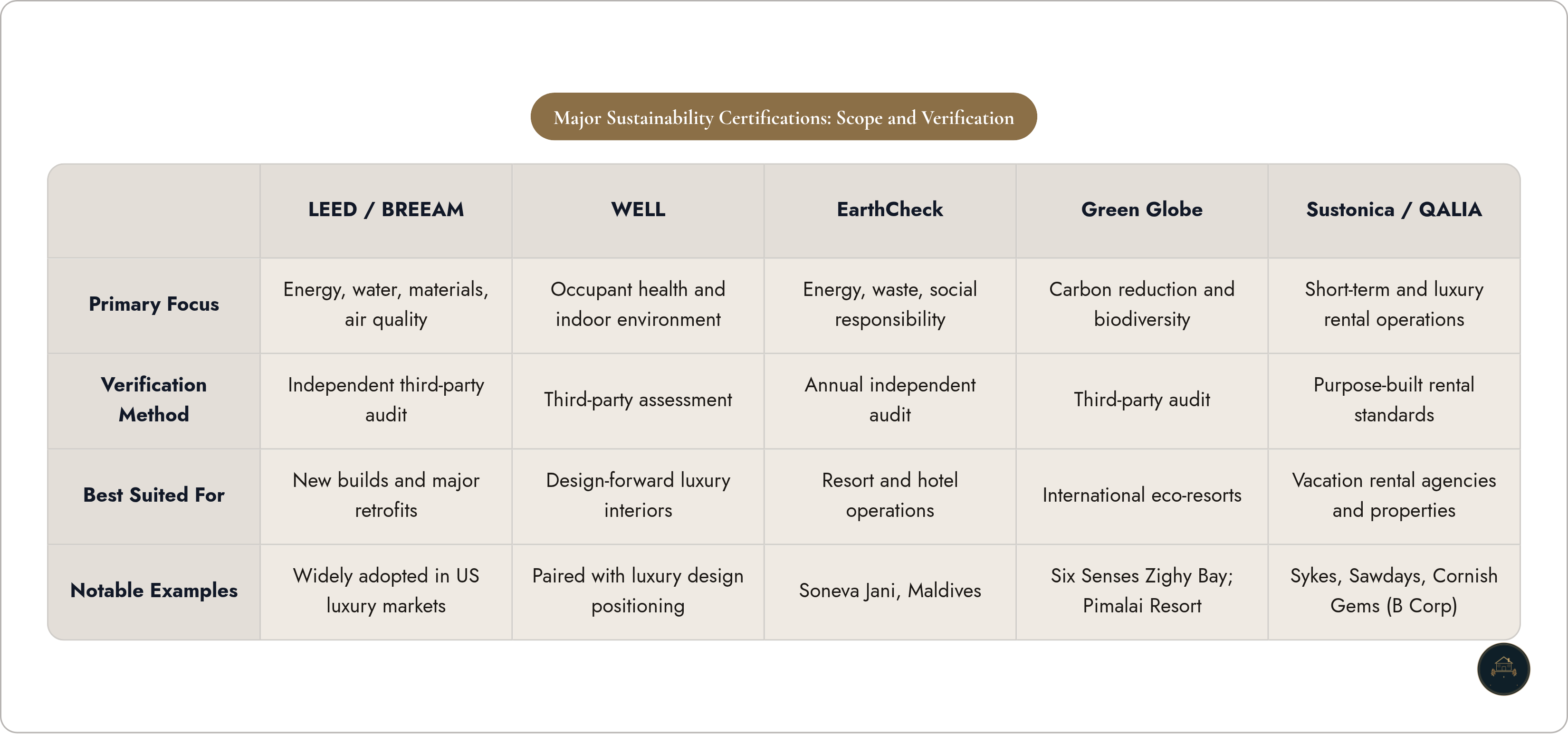
Certifications exist on a spectrum from rigorous to superficial. The distinction that matters is whether a certification requires independent auditing and measurable outcomes, or whether it accepts self-reported documentation and stops there. This is not a minor procedural difference; it is the difference between a credential and a label.
LEED and BREEAM are the most widely recognized building-level certifications, covering energy, water, materials, and indoor air quality. Both require third-party verification. WELL focuses on occupant health and indoor environment quality, which maps particularly well onto the design-forward positioning of luxury rentals where the physical experience of the space is central to the value proposition. Green Key Global covers operational eco-practices and guest experience. EarthCheck conducts annual audits of energy, waste, and social responsibility; Soneva Jani in the Maldives holds this certification, known for its zero-waste and marine conservation commitments. Green Globe covers carbon reduction and biodiversity frameworks, and properties like Six Senses Zighy Bay and Pimalai Resort and Spa in Thailand operate under it.
B Corp certification has entered the short-term rental sector through agencies rather than individual properties; Sykes, Sawdays, and Cornish Gems have all obtained it, which extends a layer of verified governance to the properties in their portfolios. Two certifications purpose-built for the rental context deserve specific attention: Sustonica, the first dedicated sustainability certification designed for the short-term rental market rather than adapted from hotel standards, and QALIA, designed specifically for luxury vacation rentals and built on the premise that sustainability and luxury are compatible rather than in tension.
An oversight layer worth knowing: Travalyst vets sustainability certifications on major booking platforms, adding a check on the self-certification problem. In the opposite direction, Booking.com's "Travel Sustainable" label was removed in March 2024 following criticism from the Netherlands' Consumers and Markets Authority, a clear illustration of what happens when platform-level labels operate without rigorous backing. The label collapsed precisely because it couldn't survive scrutiny.
For travelers, the practical reading guide is three questions: Who issued the certification? When was the most recent audit? Which specific categories — energy, water, waste, social practices — are actually covered? A property that can answer all three in its listing or through its manager is operating at a different standard than one that uses the word "certified" without elaboration.
Greenwashing and Greenhushing: The Two Failure Modes That Undermine Trust
Greenwashing in luxury hospitality is often unintentional, which doesn't make it less damaging. Operators believe their practices are meaningful but haven't done the measurement or documentation work to substantiate the claims. The commercial consequence is real: Washington State University hospitality researchers found that guests misled by greenwashing will boycott the property after checkout, eroding the repeat bookings that sustain premium pricing at any scale.
There is also an inherent tension that honest luxury properties need to acknowledge rather than paper over. Heated private pools, extensive food and beverage operations, and high guest-to-staff ratios are structurally at odds with low-footprint ideals. Pretending otherwise is its own form of greenwashing. Acknowledging the tension, explaining the tradeoffs, and documenting what the property has done to reduce impact within those constraints is a more credible and ultimately more defensible position.
Regulatory pressure is sharpening the stakes. The EU's Green Claims Directive, in force as of 2024, prohibits unsubstantiated environmental claims in hospitality. The U.S. FTC is actively updating its Green Guides for environmental marketing. What was previously a reputational risk — using words like "eco-friendly" or "sustainable" without evidence — is becoming a legal one. Properties operating in international markets, which describes most of the luxury rental sector, are navigating multiple overlapping regulatory environments simultaneously.
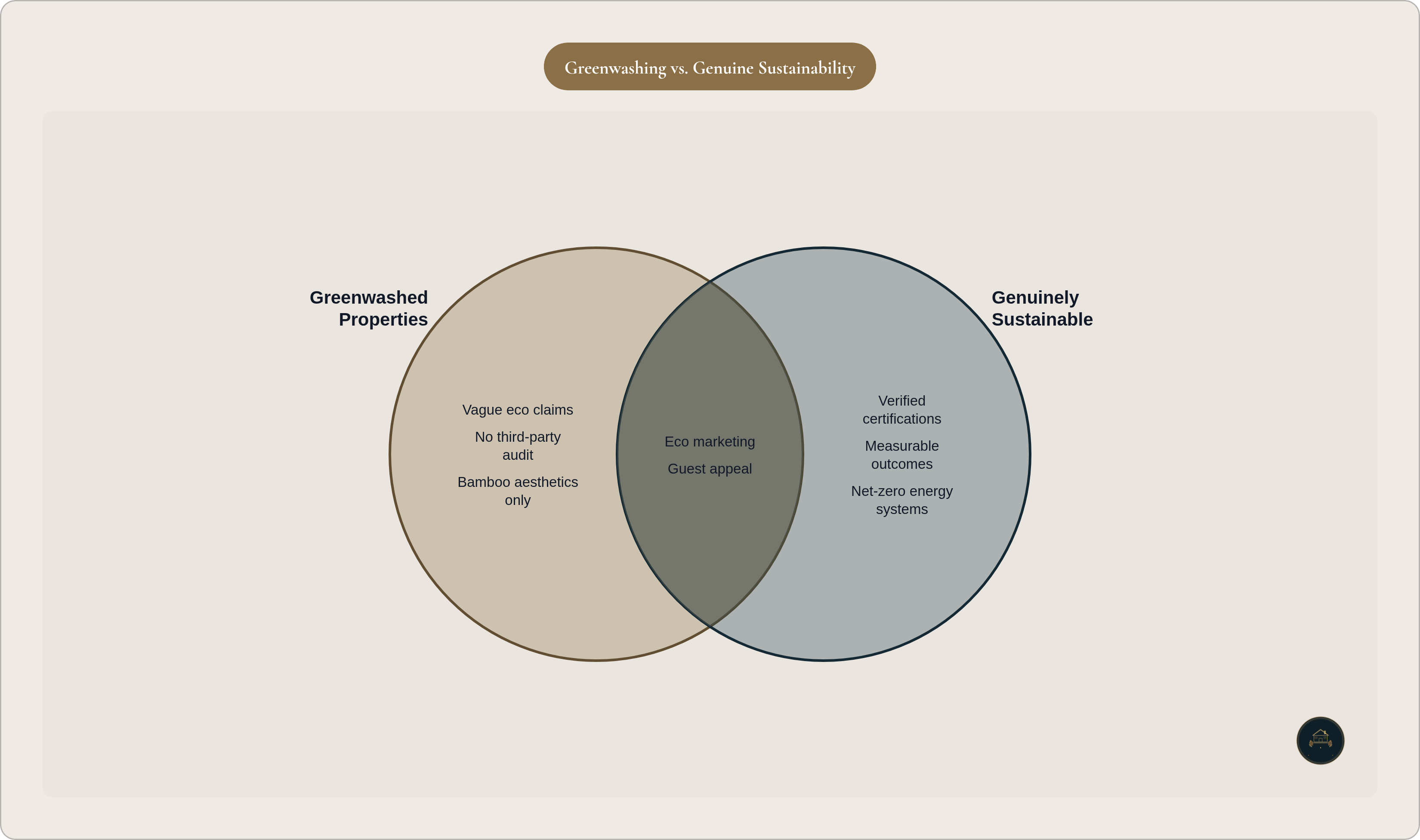
Greenhushing is the opposite failure, and it is nearly as consequential for the market. Properties that have earned real certifications, completed genuine retrofits, and built documented sustainability practices sometimes choose not to communicate them clearly, either to avoid scrutiny or because they don't want to invite comparisons. The result is that greenwashing properties capture bookings that should flow to genuinely sustainable ones. The traveler who wants to make an informed choice can't do so if the information isn't there. By 2025, the standard in the sector's leading tier is measurable, documented outcomes — verified energy reduction, confirmed air quality data, resilience engineering that can be explained. A bamboo towel rack without a supporting system is not a sustainability program; it is decoration. You could say that a property relying on a bamboo towel rack to carry its green credentials has put all its eggs in one very small, very wooden basket.
What a Genuinely Sustainable Luxury Rental Actually Looks and Feels Like
No single feature defines a sustainable luxury rental. The signal is coherence: energy source, materials, water management, waste operations, and procurement all pointing in the same direction, all managed with the same attention given to the furniture and the thread count.
The physical experience of a well-executed property has specific characteristics. Visible renewable energy infrastructure, with documented output rather than a solar panel that no one has measured. Smart controls for climate and lighting that guests can actually engage with, not a system that requires calling the property manager to adjust. Interiors built from materials with traceable provenance: reclaimed, recycled, or locally sourced, and a house manual that explains the choices without lecturing. No single-use plastics in the bathroom or kitchen; refillable dispensers, reusable equipment, and the absence of a small plastic garbage bag inside the larger plastic garbage bag. Food provisions sourced locally where possible, organic where certified. An EV charger on site or clearly arranged nearby.
The booking and management experience carries equal weight. Named certifications with the issuing body and audit year in the listing, not buried and not vague. A property manager who can answer specific questions from knowledge rather than a script; someone who can say which percentage of energy comes from solar, how the greywater system works, and why they chose that specific supplier for the kitchen provisions. Transparency about what the property doesn't yet do, not only about what it does. That last point is a particularly reliable marker of credibility, because it requires enough self-awareness to know the difference between progress and completion.
The luxury hotel sector is ahead of the private rental market on institutional adoption. The 2024 Green Lodging Trends U.S. Market Report found that luxury hotels have the highest sustainability adoption rate at 83.9% in procurement and the highest proportion of properties with a dedicated sustainability champion at 40.1%. The private rental market is closing that gap, but the gap is real and visible to travelers who have stayed in both contexts.
The frame that works for guests is this: a sustainable luxury rental is one where the environmental commitments are managed with the same rigor as every other quality claim the property makes. Verifiable. Consistent. Explained without being overwhelming. When those conditions are met, the property has done something genuinely difficult, and it shows.