Vacation Rental Damage Protection Insurance for High-Value Homes
Standard homeowners policies deny short-term rental claims due to business use exclusions.

The homeowners policy was never designed for what you're doing with that property. It was priced for an owner-occupant, maybe a long-term tenant, and the underwriting reflects exactly that assumption. The Insurance Information Institute is explicit: homeowners policies don't cover the full range of risks associated with operating a business. That's an intentional feature of the policy language, not an oversight. It's the policy language working correctly.
Once a host creates a listing and takes payment from a stranger, the property has crossed into commercial activity. The business activity exclusion exists for this situation, and here's the part that surprises people: it doesn't require a guest to be present when something goes wrong. It applies based on what the property is doing operationally. A tree falls on the roof during a storm, no guest in sight, purely a weather event, and a claim can still be denied because the property was listed as a short-term rental when it happened. Whether the exclusion applies in such a scenario depends on specific policy language and the insurer's interpretation; hosts should confirm with their carrier how commercial use affects weather-related claims.
The categories left uncovered go beyond the obvious. Guest-caused property damage runs into property entrustment exclusions. Amenity liability for pools and hot tubs is typically absent. Lost rental income when a property is uninhabitable after a loss isn't addressed. Liquor liability and privacy liability are absent as well. None of these are exotic edge cases; they're the scenarios that actually show up in claims.
Per data cited at the 2024 STR Wealth Conference by Proper Insurance, 95% of short-term rental owners are misinsured. The policy document exists. The premium clears every month. And when a material claim arrives, the coverage isn't there.
Why Landlord Policies Don't Solve the Problem Either
Switching to a landlord policy feels logical. The property generates income, it's not a primary residence, and landlord policies are built for rental situations. The problem is that "rental" is doing a lot of work in that reasoning, and the underwriting behind a landlord policy is built for a completely different version of it.
Landlord policies are priced for long-term tenants, not transient guests rotating every few nights. Those are categorically different risk profiles, and insurers price them accordingly. Guest-caused damage is excluded because the coverage model addresses structural loss and income interruption tied to lease defaults, not property entrustment situations with someone staying for a long weekend. Premises liability for a revolving population of guests using a hot tub is not what these policies are built to handle.
For secondary properties, the underwriting problem compounds in a way that's easy to miss. Standard policies either exclude the secondary location entirely or require a separate policy, which means no single carrier has visibility into the owner's total exposure. Liability coordination gaps follow naturally from that. Per Insurance Brokers of Arizona, this is a known structural problem with conventional coverage stacking for owners with multiple locations.
There's also a baseline underinsurance problem that exists before rental activity adds any complexity at all. A 2025 University of Colorado study examining homeowners affected by the 2021 Marshall Fire found that 74% were underinsured, with an average coverage gap of $139,000. Those were primary residences on conventional policies. A high-value rental property with specialty materials, custom finishes, and higher per-square-foot rebuild costs starts from a worse position before the first guest books.
What Platform Protection Programs Actually Cover, and What They Structurally Cannot
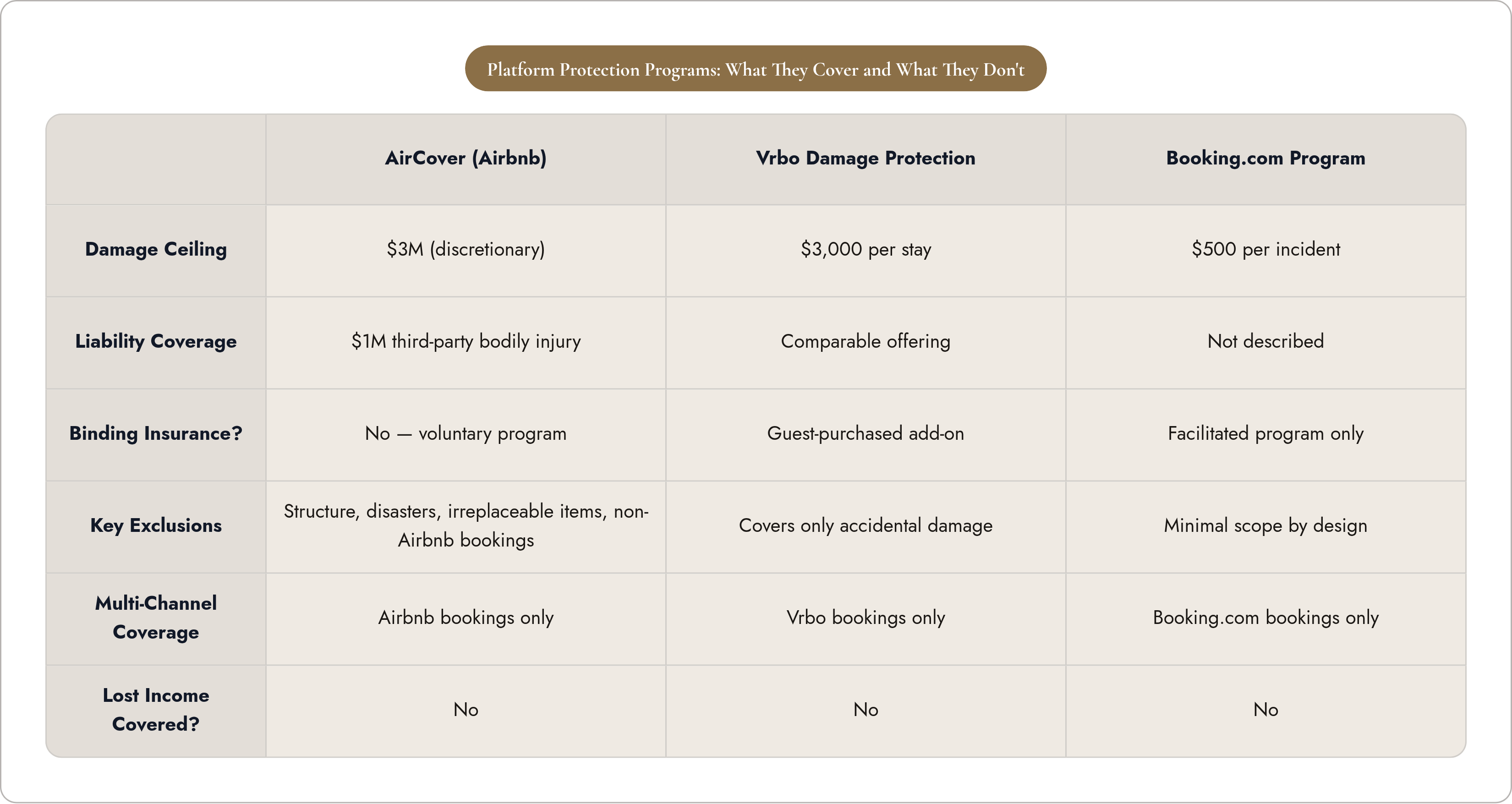
Airbnb's AirCover is the most visible piece of platform protection in the market, and the headline numbers are genuinely significant: $3 million Host Damage Protection, $1 million Host Liability Insurance. For a host running a modest property on a single platform, those figures can feel comprehensive. The structural details are where the picture changes.
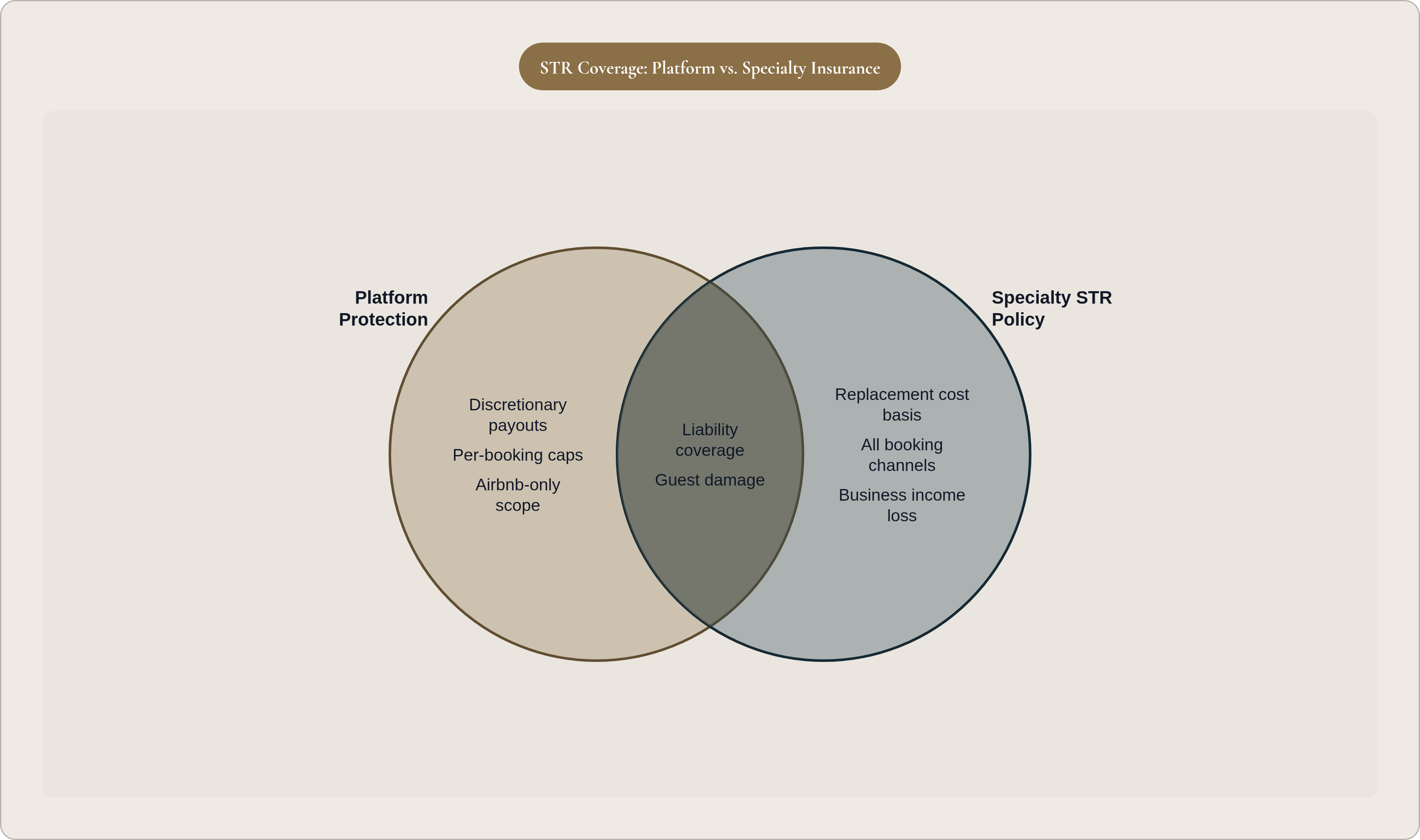
The damage protection component is not an insurance policy. It is a voluntary protection program. Airbnb has sole discretion over whether and how much to pay. There is no independent adjuster working on the host's behalf, no binding arbitration process, no legal obligation to pay replacement cost.
AirCover excludes, regardless of claim merit: the structure itself, natural disasters including hurricanes and flooding, fine arts and valuables that cannot be replaced with items of like kind and quality, wear and tear, cash theft, and any booking not made through Airbnb. That last exclusion is worth noting carefully. A direct booking or a Vrbo stay creates a complete coverage gap, regardless of how long the host has been on the platform.
The "like kind and quality" exclusion targets exactly the category of contents that defines a luxury property. A commissioned piece of art, a one-of-a-kind furnishing, a curated collection: these are precisely what a high-end rental features to justify its nightly rate, and precisely what AirCover cannot address. The platform covers the rental but not what makes the rental worth renting.
Airbnb updated its evidence standards in April 2026, now requiring submitted photos and documents to be unaltered and not AI-generated, a reasonable response to reports of hosts submitting synthetically modified images. The practical implication for legitimate hosts is that documentation requirements are now more stringent, and claims that can't meet that standard face additional scrutiny. Separately, as of March 2025, hosts operating six or more active listings at the time of a loss find AirCover applies only as excess coverage, meaning other insurance must respond first.
On other platforms, the ceiling is considerably lower. Vrbo's guest-purchased accidental damage protection tops out at $3,000 per stay. Booking.com's facilitated damage program caps at $500 per incident. Neither figure is materially relevant to a high-value home's actual contents exposure.
The platform liability insurance, Airbnb's $1 million and Vrbo's comparable offering, covers third-party bodily injury and property damage claims against the owner. It does not cover the owner's property. When a guest is injured using an amenity, the coverage addresses the guest's claim, not the owner's asset loss.
Where the Coverage Math Breaks Down on a Luxury Property's Actual Contents
The sub-limit problem is where standard policy math most visibly fails high-value properties, and the numbers are stark. Per Insurance Brokers of Arizona, a client with a $200,000 art collection and a standard policy would recover $5,000 in a total loss. A high-net-worth policy with proper scheduling pays the full amount. That's not a rounding error. That's the entire claim.
AirCover's exclusion for items that cannot be replaced with others of like kind and quality makes the platform useless for this category. The sub-limit problem and the platform exclusion converge on exactly the same assets, the objects that give a high-value rental its character and justify its pricing.
Replacement cost versus actual cash value is the second place the math breaks down. Platform protection programs depreciate furnishings. A couch purchased for $2,500 three years ago costs the same or more to replace today, but under a depreciated valuation model, the payout is a fraction of that figure. Specialty STR policies that pay claims on a replacement cost basis close this gap directly.
Custom finishes and specialized labor add a third layer of structural underinsurance. High-value properties cost more per square foot to rebuild than standard residential construction. A policy priced on typical rebuild costs underinsures a luxury property before any claim occurs, and that gap compounds when specialty materials or craftwork are involved.
The amenity liability exposure ties these threads together. Pools, hot tubs, paddleboards, bicycles: these are the amenities guests cite when choosing a premium property. They're also the amenities most commonly excluded or sublimited in standard policies and platform programs. Owners are pricing these features into the nightly rate and carrying the liability personally.
How Damage Claims Actually Play Out When Guests Cause Serious Losses
Party damage is the highest-frequency severe-loss scenario in the vacation rental market. A Lodgify survey of more than 170 hosts managing over 2,200 properties found that unauthorized parties average $1,560 in damages per incident, with some hosts reporting losses between $5,000 and $25,000, excluding legal fees or lost revenue. Some insurance carriers report average damage claims from party bookings exceeding $4,000 per incident, though this figure varies by carrier and property type. At a luxury property with custom finishes and curated furnishings, the same event scales considerably higher.
The documentation burden in the platform claim process is something most hosts don't anticipate until they're in the middle of it. You're gathering evidence, organizing it to platform standards, and waiting on a discretionary decision from someone you've never spoken to. No independent adjuster is working on your behalf. You're simultaneously managing the property, coordinating repairs, fielding future guests, and constructing a case for a voluntary program that may or may not pay.
Lost income during repair is a separate, material loss that standard homeowners policies and platform programs leave unaddressed. A high-value rental commanding premium nightly rates that sits uninhabitable for weeks after serious damage generates real revenue loss. Without business income protection, that loss is simply gone.
The claim that falls through every layer reveals the structural problem most clearly. A guest is injured using a pool feature. The homeowners policy denies on the business activity exclusion. AirCover's liability coverage applies, but only to Airbnb bookings. The guest booked through Vrbo or directly. There is no platform backstop. There is no homeowners coverage. The owner faces a liability claim with nothing behind it. That scenario illustrates the predictable outcome of a coverage stack that was never designed to work together.
What Purpose-Built STR Insurance Actually Covers That the Other Layers Don't
A specialty short-term rental policy is designed to replace the homeowners or landlord policy entirely, not to stack on top of it. That distinction matters because the design logic is different. It prices commercial risk correctly from the start, which is the only way to make the coverage actually function.
A purpose-built STR policy covers buildings and contents on a replacement cost basis, guest-caused damage without a platform cap or discretionary payout, lost bookings during repairs through actual loss sustained business revenue protection, amenity liability including pools and hot tubs as a covered peril rather than an exclusion, and all booking channels. That last item is the one that simplifies everything: the policy covers the business, not a specific platform relationship.
Cost context from available data puts vacation rental insurance at roughly $2,130 per year, approximately 20% more than a standard homeowners policy. For a property generating meaningful revenue at premium rates, that differential is not a significant line item against the coverage gap it closes.
The leading specialty providers as of 2026 differ in ways that matter for high-value properties. Proper Insurance, backed by Lloyd's of London, covers all booking platforms and offers up to $1 million in commercial general liability with an optional $2 million additional; it's Vrbo's exclusive endorsed provider. Truvi's Damage Protection Plan covers up to $5 million for verified guest-caused damage across all booking channels, a ceiling that is directly relevant to high-value home exposure. Safely provides up to $1 million for injury and damage with an average claim payout of four business days and includes guest screening. Guesty Damage Protection is cross-channel and pays 85% of claims within four days, per Guesty's December 2025 published data. CBIZ offers $2 million in general aggregate liability across all 50 states and U.S. territories.
For properties containing art, jewelry, or collectibles, scheduling individual items under a specialty policy is the only mechanism that guarantees full replacement value. Platform programs cannot cover these assets by their own explicit terms. Standard policies sub-limit them into irrelevance. There is no third option.
How to Evaluate Whether a Property's Current Coverage Actually Matches Its Risk
Start with the most clarifying question available: does the current policy know the property is operating as a short-term rental? If the answer is no, every claim scenario described above begins from a likely denial. The part that catches owners off guard is that no one sends a letter warning them. The coverage simply isn't there when they need it.
If the property is a secondary residence, the next check is whether the homeowners carrier covers it at all, and whether liability coordinates across both locations. Disconnected underwriting across two properties means no single carrier has visibility into total exposure, and liability gaps between the two locations don't resolve themselves.
A contents inventory is the most concrete diagnostic available. Walk the property and identify every item that a standard sub-limit would under-cover: art, designed furnishings, electronics, collectibles, specialty appliances. Compare that aggregate value against current policy limits. Whatever the gap is between those two numbers, that's the uninsured exposure the owner is carrying personally.
The amenity audit follows the same logic. Pool, hot tub, watercraft, sports equipment: each one should be explicitly confirmed as covered for liability under the current policy. Any amenity that is excluded is excluded from the exact activity guests are paying to use.
The platform coverage reality check should account for every booking channel the property uses. AirCover applies only to Airbnb bookings. Vrbo's damage protection caps at $3,000 per stay. Direct bookings have no platform backstop at all. An owner running a multi-channel property and relying on platform protection has, at best, partial coverage on some bookings and nothing on others.
The replacement cost question is straightforward: is the current policy paying claims on replacement cost or actual cash value? For high-value furnishings in an active rental, the difference between those two figures is not marginal.
The lost income question closes it out. If a serious damage event made the property uninhabitable for a month during peak season, does any current policy replace that revenue? Confirm each coverage layer individually, against each specific risk, and verify the combination leaves no material gap. That verification process is the coverage audit. It takes an afternoon. A denied claim on a luxury property costs considerably more than that.