Luxury Vacation Rentals in the Hamptons vs Nantucket
The Hamptons floods the market with inventory; Nantucket keeps supply tight and prices high.
If you are deciding between the Hamptons and Nantucket, the first thing to understand is that you are not choosing between two price tiers. You are choosing between two value systems. Both destinations operate at the apex of the American summer rental market. Both attract serious money. They express that money in fundamentally opposite ways. Booking the wrong one costs more than most renters anticipate.
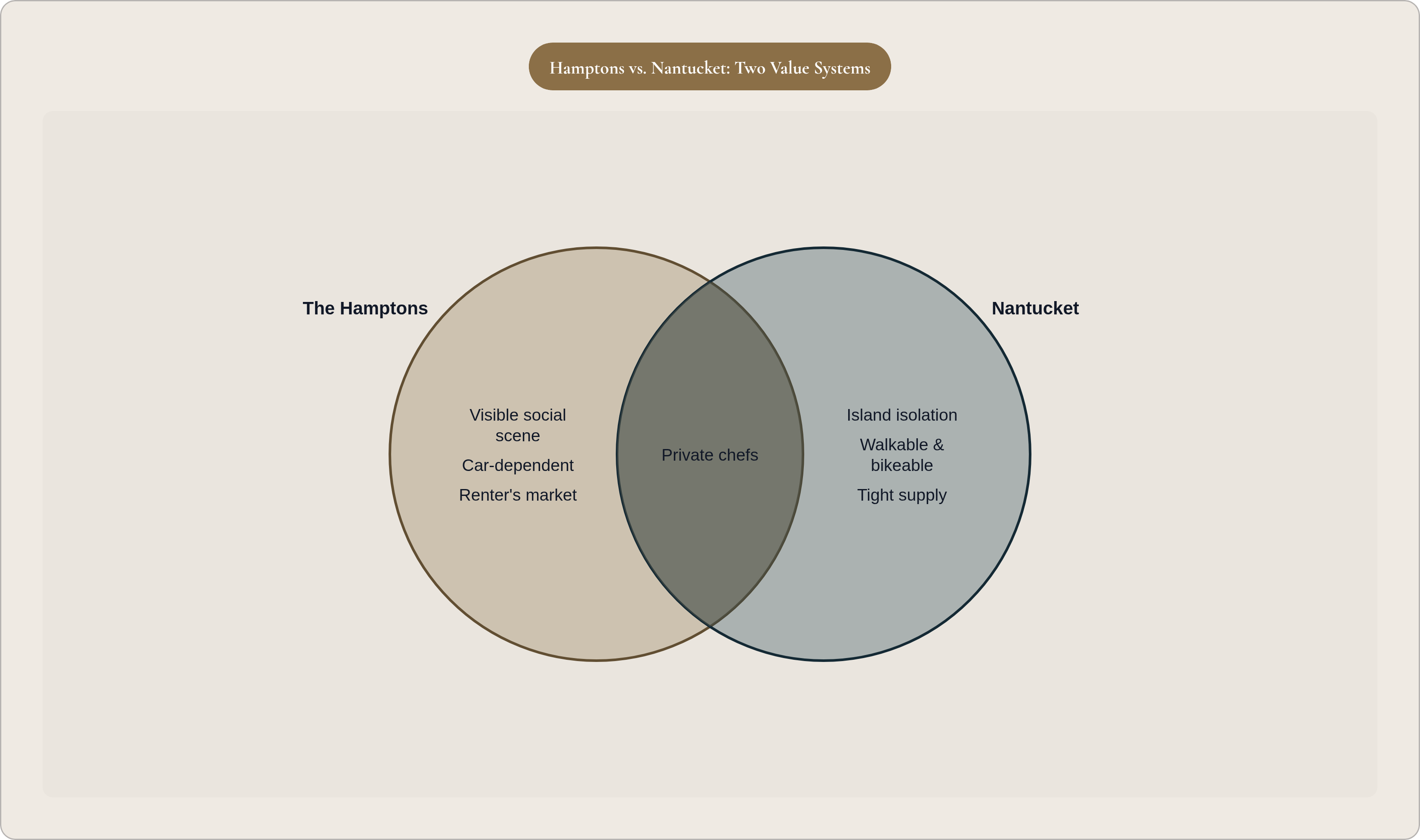
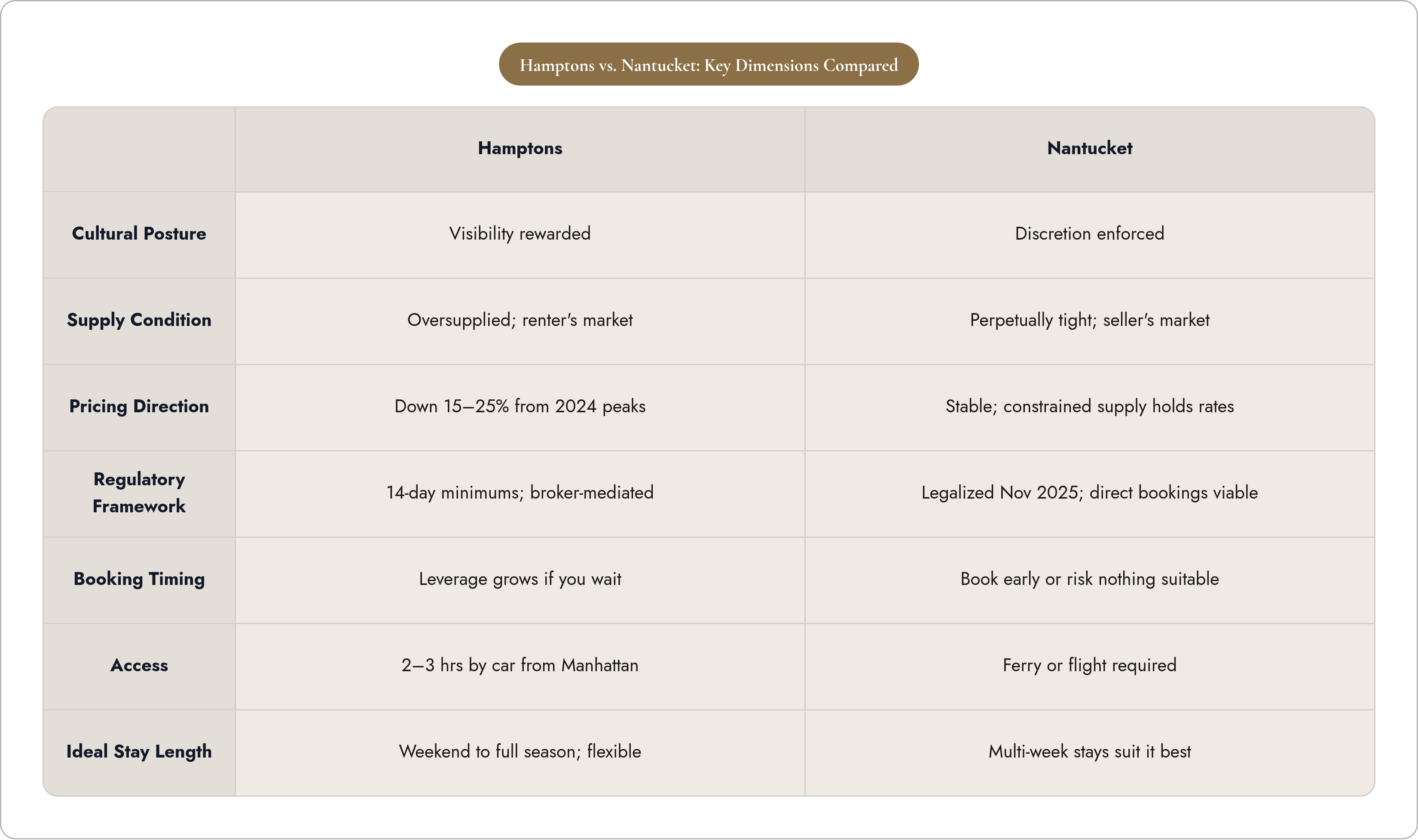
The shorthand that holds up: the Hamptons is the Upper East Side, Nantucket is Greenwich. Same net worth, different posture. The Hamptons rewards visibility; Nantucket penalizes it. Once you internalize that distinction, every other variable in this comparison, from inventory to pricing to lifestyle, falls into place.
What the Rental Inventory Actually Looks Like in Each Market Right Now
The Hamptons is not a single place. It is a ninety-mile stretch of Long Island's South Fork organized into distinct villages and hamlets, each with its own character, price tier, and social identity. Southampton and East Hampton townships anchor the core market. Southampton's Estate Section sits at the formal, traditional end: private ocean beach access, lots exceeding five acres, and properties that rarely come to market and rarely need to be advertised when they do. East Hampton Village draws creative and media-industry renters; estate rentals there typically run $75,000 to $250,000 for a full season. Farther east, Amagansett and Montauk attract a younger, more outdoors-focused demographic and carry lower price points. The breadth of inventory is considerable. Around 75% of pandemic-era buyers, Douglas Elliman agents estimate, chose to rent rather than sell, expanding supply across all tiers.
What commands a premium in the Hamptons is specific and largely hardware-driven. A heated pool is effectively non-negotiable at the luxury tier; an unheated pool is nearly disqualifying. New construction post-2020 carries a 20 to 30 percent premium. En-suite bathrooms, deeded beach access, and smart home systems are standard above $25,000 per week. Pickleball and paddle tennis courts have largely replaced traditional tennis as the amenity signal; properties that haven't caught up stand out for the wrong reasons.
Nantucket operates on a different logic entirely. The island is 48 square miles in the Atlantic, accessible only by ferry or a short flight into ACK. Its inventory is organized around neighborhoods rather than townships: the Cliff area, proximate to Steps Beach and downtown, claims premium positioning; Brant Point is walkable to town and Jetties Beach; Sconset sits farther out, quieter and more insular, an enclave within an already insular island; Tom Nevers and Surfside are beach-focused and relatively more accessible in price.
The critical structural fact about Nantucket is that there are no large hotel developments on the island. The rental home market absorbs essentially all demand, which keeps supply perpetually tight. The amenity premium here is not about hardware; it is experiential and service-oriented. Private chefs, yacht charters, concierge services, and in-home spa arrangements are increasingly standard at the top tier. Multi-week stays by high-net-worth visitors are common. The island rewards guests who settle in rather than sample.
The supply dynamic between the two markets is inverted. The Hamptons is a renter's market. Nantucket is not.
How Pricing Compares Across Equivalent Rental Tiers in 2025 and 2026
In the Hamptons, the decline is real and measurable. Average nightly rates have dropped from $1,080 in 2022 to approximately $970 in 2025. Overall rental prices are down 15 to 25 percent versus 2024. In some ultra-luxury segments, prices have declined 50 to 75 percent from their pandemic peaks. A full season runs from roughly $50,000 for a modest three-bedroom cottage to well over $900,000 for oceanfront estates. A typical four-bedroom with pool falls in the $150,000 to $225,000 range for the full season. Monthly, a Southampton Village four-bedroom with pool averages around $70,000; East Hampton Village equivalents run approximately $60,000 per month, meaning Southampton commands a 14 to 32 percent premium over comparable East Hampton properties. At the extreme top of the market, a nine-bedroom, 11,000-square-foot oceanfront home in Bridgehampton was listed at $700,000 for any two-week period in summer 2026. Peak July week average rates run around $753 per night, with luxury properties reaching $5,000 to $15,000 per night.
Nantucket does not apologize for its price structure. Well-located properties run $10,000 to $50,000 or more per week during peak season. Real-world examples from the active market: a six-bedroom compound with heated saltwater pool and oceanfront access listed at $45,000 per week at peak; a newly completed custom-designed home listed at $55,000 per week. Median short-term rental host earnings sit at $68,188 per year, with an average daily rate of $1,003 and 54 percent occupancy; top-performing properties pull north of $128,000 annually. Those figures reflect constrained supply sustaining rates that the Hamptons, in its current oversupplied condition, cannot match.
The 2026 Nantucket summer market has been described by market observers as the most balanced in years, with harbor-front prices stabilized and some modest inventory increase. "Balanced" on Nantucket, however, still means tight by most markets' standards.
For renters working with a fixed budget, the arithmetic is clear: the Hamptons glut delivers materially more house for the money right now. But that is only the right trade if the Hamptons is the right destination, and budget optimization is a poor substitute for cultural fit.
The Regulatory Frameworks That Shape What You Can Actually Book and How
This is the section most renters skip and then regret. Both destinations have regulatory environments that directly determine how you book, what you can book, and what happens if you get it wrong.
In the Hamptons, the regulatory regime is among the strictest in New York State. East Hampton limits properties to a maximum of two short-term rentals of under two weeks each per six-month period. All rental properties must be registered in the town's Rental Registry; violations carry penalties ranging from $3,000 to over $200,000. Southampton amended its rental law in September 2025 to establish a 14-day minimum rental period, mirroring East Hampton's framework, a direct response to party and noise disturbance concerns. The practical effect of both municipalities requiring 14-day minimums is that nightly and weekend Airbnb-style rentals are effectively barred. The market runs on two-week leases and full-season leases brokered by established real estate firms.
Enforcement is active, not theoretical. East Hampton has deployed tracking software to surface illegal short-term rentals; analysis found that only about half of the listings identified via short-term rental analytics platforms were properly registered under the town's rental registry law. For renters, this matters directly: an unregistered listing carries real risk of cancellation or owner penalties that fall backward on the transaction.
Nantucket recently resolved a five-year regulatory stalemate with meaningful clarity. In November 2025, a ballot measure legalizing short-term rentals by right across the island passed 1,045 to 421, achieving the two-thirds threshold required for adoption. The island now has a settled legal foundation for short-term rentals that it lacked for years. The tax structure is 11.7 percent, comprising a 5.7 percent state levy and a 6 percent town component, rising to 14.7 percent for professionally managed properties that opt into the 3 percent community impact fee adopted at a prior town meeting. Owners are required to carry at least $1 million in liability insurance and must hold an annual local permit, renewed by October 31.
The regulatory clarity is genuinely new. Some owners had been operating in a gray area for years before the vote. That foundation may bring more inventory to market and ease supply constraints, but not in 2025 or 2026.
For renters, the operational takeaway is straightforward. The Hamptons is a broker-mediated market by regulatory design; verifying that a property is properly registered is a legitimate due-diligence step, not a paranoid one. Nantucket, with its newly clarified legal framework, is more amenable to both direct and platform-mediated bookings, but the premium properties are still transacted through established local channels.
How Booking Timing and Seasonality Differ Between the Two Destinations
The Hamptons has a traditional booking calendar, and the current market conditions are modifying it in ways that favor renters who understand the dynamics. January and February are the conventional prime booking window; top-tier oceanfront and turnkey luxury properties are historically spoken for by February. That pattern holds. What has shifted is the leverage available to renters who wait. Landlords with unrented properties approaching summer have been dropping prices 10 to 20 percent in recent seasons. Properties listed at $200,000 for the season in February were negotiable to meaningfully lower figures by late spring in 2025. The best properties still go early, but the middle and upper-middle of the market has real negotiating room for patient renters.
One seasonality shift: July now outperforms August in rental activity. For renters who want the most active social season, August is no longer the apex.
Nantucket operates under more compressed pressure. Constrained supply means the window for prime properties is genuinely narrower, and late booking carries more than a price penalty: there may simply be nothing suitable at the top tier. The ferry and flight logistics compound this. Car ferries from Hyannis book out in peak season; flights into ACK are limited and seasonal; last-minute planning on Nantucket is structurally harder than in the Hamptons, where you can drive from Manhattan in two to three hours on a clear road. Multi-week stays by high-net-worth visitors are common, which means premium properties are often committed for full weeks or multiple consecutive weeks early in the planning cycle.
The net comparison is clean. If flexibility and negotiating power are priorities, Hamptons 2025 and 2026 conditions favor the renter in ways that haven't existed for several years. If certainty and access to a specific property are the priority, booking Nantucket early is not optional; it is the price of admission.
The Lifestyle Each Destination Actually Delivers Week to Week
The Hamptons is social and visible by design. The culture rewards showing up, moving between restaurants, being seen on the right beach, and participating in the ambient spectacle. A rotating cast of recognizable faces is part of the atmospheric texture, not an incidental side effect. The food and nightlife infrastructure is sophisticated and dense; multiple Michelin-caliber restaurants, wine bars, and beach clubs sit within easy driving distance of most rental zones. The experience requires a car. The Hamptons is designed around movement between its villages, and without one, the destination contracts considerably. The energy peaks in July, the social calendar has a recognizable rhythm, and the whole apparatus hums with New York money in its most unguarded state.
Nantucket is none of those things, deliberately. The island's geography is the product: once you arrive, there is nowhere else to go and no particular reason to leave. Walking and biking replace the car culture. The town center is compact, walkable from most rental zones. The fog, the cobblestones, the gray-shingled architecture, the strict historic preservation codes that keep the 18th-century whaling-era streetscape intact, these are not aesthetic accidents. They are enforced cultural choices that communicate something specific about who belongs there and what behavior is appropriate.
Conspicuous consumption on Nantucket is the social violation, not the aspiration. The canvas tote, not the status bag, is the correct accessory. The service culture has quietly upgraded to match the clientele: private chefs, yacht charters, and in-home spa services are increasingly standard at the top tier, but they are experienced privately, not performed publicly.
Dining on Nantucket is excellent but limited in breadth. The island has a handful of destination restaurants and nothing approaching the density of the Hamptons. The experience is intimate rather than varied. For some renters, that's the point; for others, it becomes constraining by week two.
The access barrier is a genuine filter. Nantucket's ferry and flight requirement creates natural population control. The Hamptons' ease of access from Manhattan, two to three hours by car, the LIRR, or bus, means a much larger, more varied, and considerably more transient crowd. If you value the curation that comes with inconvenience, Nantucket delivers it structurally. If proximity and spontaneity matter, the Hamptons delivers those.
How to Make the Call Based on What You Actually Want From the Trip
Choose the Hamptons if maximum house for your budget is the objective right now. The supply glut is real, the price declines are real, and the negotiating leverage available to renters in 2025 and 2026 is genuinely unusual by the market's own historical standards. If you are driving from the New York metro area and want to avoid air travel logistics, the Hamptons is the correct answer on friction alone. If the social season, restaurants, beach clubs, and the spectacle of summer in New York money's natural habitat are part of the point rather than background noise, the Hamptons delivers that infrastructure at a scale Nantucket cannot match. Village-to-village flexibility matters too: Montauk for the younger, outdoors-focused crowd; Southampton Village for the formal estate experience; Amagansett for a quieter middle ground that splits the difference. If you're renting with a group that benefits from proximity to a large service infrastructure, catering, staffing, event support, the Hamptons has the density for it.
Choose Nantucket if the visual and cultural consistency of the environment matters to you. The architecture, the social norms, and the ambient aesthetic all reinforce the same proposition: discretion, continuity, and genuine remove from the mainland. If the physical isolation is a feature rather than an inconvenience, Nantucket delivers something the Hamptons structurally cannot, the experience of having actually left. If you are staying for multiple weeks, Nantucket's contained geography and quieter rhythm suit the cadence of a longer stay in ways the Hamptons' more transient energy does not. If you are traveling with family and want a self-contained environment where the entertainment is the place itself rather than the social calendar, Nantucket is the correct calibration.
The one thing neither destination rewards is the wrong expectation. Go to the Hamptons expecting Nantucket's quiet and you'll find it loud and car-dependent. Go to Nantucket expecting the Hamptons' breadth and you'll find it limiting by design. The decision is not about prestige; both are prestige markets. It is about which version of summer you are actually trying to have.