Luxury Vacation Rentals in Manhattan for Extended Stays
Open Airbnb in Manhattan today and search for a month-long whole-home luxury rental. What you find is close to nothing. Two years ago, that same search returned thousands of options. The difference is not an algorithm update. It is Local Law 18, and understanding what it did is the only way to understand why this market looks the way it does.
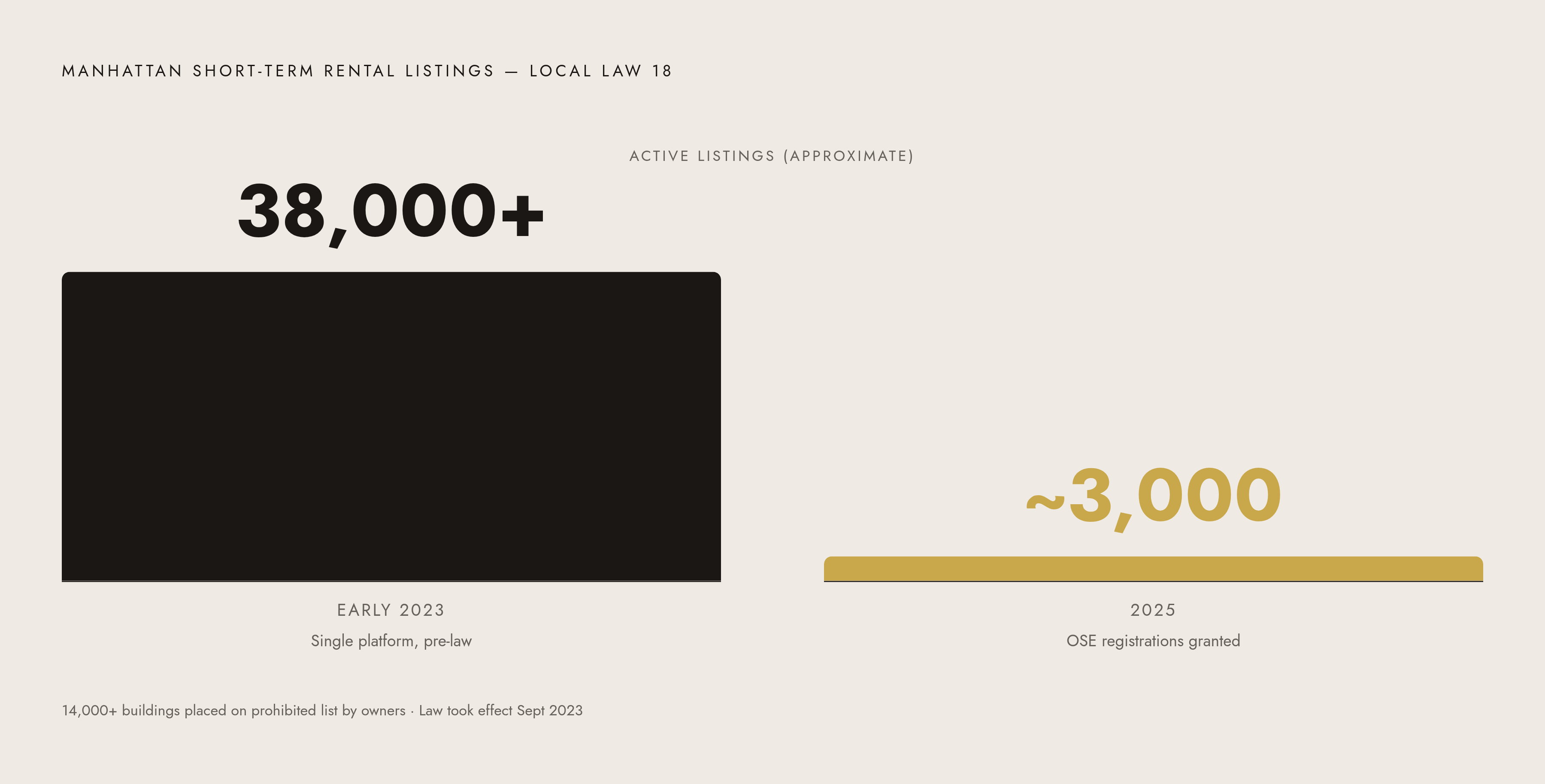
Passed in 2022, Local Law 18 established a host-registration program administered by the Mayor's Office of Special Enforcement. Before any booking platform can process a stay under 30 nights, it must verify that the host holds a valid OSE registration. The pre-law inventory was vast: roughly 60,000 estimated illegal listings citywide in 2018, more than 38,000 active listings on a single platform at the start of 2023. By 2025, OSE had granted somewhere north of 3,000 host registrations, while more than 14,000 property owners had placed their buildings on a prohibited list. Those listings did not migrate to compliant platforms. They simply ceased to exist as bookable inventory.
Enforcement has only sharpened since. In 2025, OSE filed its first lawsuit under Local Law 18's penalty framework, targeting 10 apartments in the West Village. Civil penalties can reach $5,000 per violation, and hosts still skirting compliance are carrying real financial and legal exposure. Guests often discover, too late, that they are inside that exposure alongside the host.
As of March 1, 2025, New York State applies sales tax to short-term rental occupancy, plus a $1.50 per-unit-per-day fee within the five boroughs.
A reform bill, Intro 1107, backed by Airbnb and aimed at raising the hosted-stay guest cap from two to four, was still sitting in committee as of early 2026 after hearings in late 2025. The Mamdani Administration has not signaled a direction. For anyone booking a luxury extended stay right now, none of that pending movement changes anything.
The general-purpose platforms built their Manhattan inventory on short-term whole-home listings. That inventory is gone. For 30-day-plus luxury stays, searching there wastes time you probably cannot afford to waste.
The Tight Rental Market That Surrounds and Pressures This Inventory
Here is what catches people off guard: furnished and short-term do not mean flexible or abundant in Manhattan. The furnished luxury rental market draws from the same constrained pool as the permanent rental market, and that pool is historically, stubbornly tight.
New York City's rental vacancy rate fell to approximately 1.4% in 2023, the lowest figure ever recorded according to the state comptroller. Manhattan's median rent hit $4,995 in July 2025, up 7% year over year. Luxury doorman rentals reached a record median of $5,295 per month in 2026. The supply side is not closing that gap: roughly 15,000 units were under construction citywide as of 2026, the lowest development pipeline in a decade. The 421-a tax incentive that once drove residential construction expired after 2022 and has not been meaningfully replaced. Within the luxury segment specifically, inventory fell 16.1% during a stretch when the broader market was growing.
Vacancy is forecast to reach only 2.4% in 2026, which would extend New York City's streak of sub-3% vacancy to 11 consecutive years. The market does not reset between busy seasons. There is no slow period where things open up and you can take your time.
Approaching a luxury extended-stay search the way you would approach finding a hotel room in a mid-sized American city is a reliable path to frustration. The best properties move fast, rarely sit, and do not wait for a leisurely decision process. I have watched guests miss the right apartment by 48 hours because they assumed they had more time. They did not.
What a Luxury Extended Stay in Manhattan Actually Costs
Studios and one-bedrooms in well-located buildings run roughly $5,000 to $10,000 per month. Two-bedrooms in prime neighborhoods range from $10,000 to $25,000. Three- and four-bedrooms start around $35,000 and climb meaningfully from there, depending on building, finishes, and view.
The hotel comparison holds up at certain tiers. Comparable hotel accommodations often exceed $9,000 per month, while furnished apartments in the $4,500 to $7,500 range can represent 30 to 50 percent savings for equivalent-quality stays, according to 2025 data from Urban Furnished. That math is most compelling in the one-bedroom category. At the three-bedroom level, it depends heavily on what you are comparing and where.
What catches most guests unprepared is the broker fee threshold. For stays under six months, no broker fee applies. Extend to six months or beyond, and a commission equivalent to one month's rent, or 15 percent of annual rent, becomes payable at signing. On a $15,000-per-month apartment, that is a five-figure line item appearing nowhere in the listing headline.
Stack occupancy taxes, the $1.50 per-day city fee, utilities, parking, and cleaning frequency on top of that, and the gap between headline price and actual monthly outlay becomes significant. Every one of those components belongs in the calculation before any comparison between options carries weight.
The Three Types of Property That Legally Serve This Market
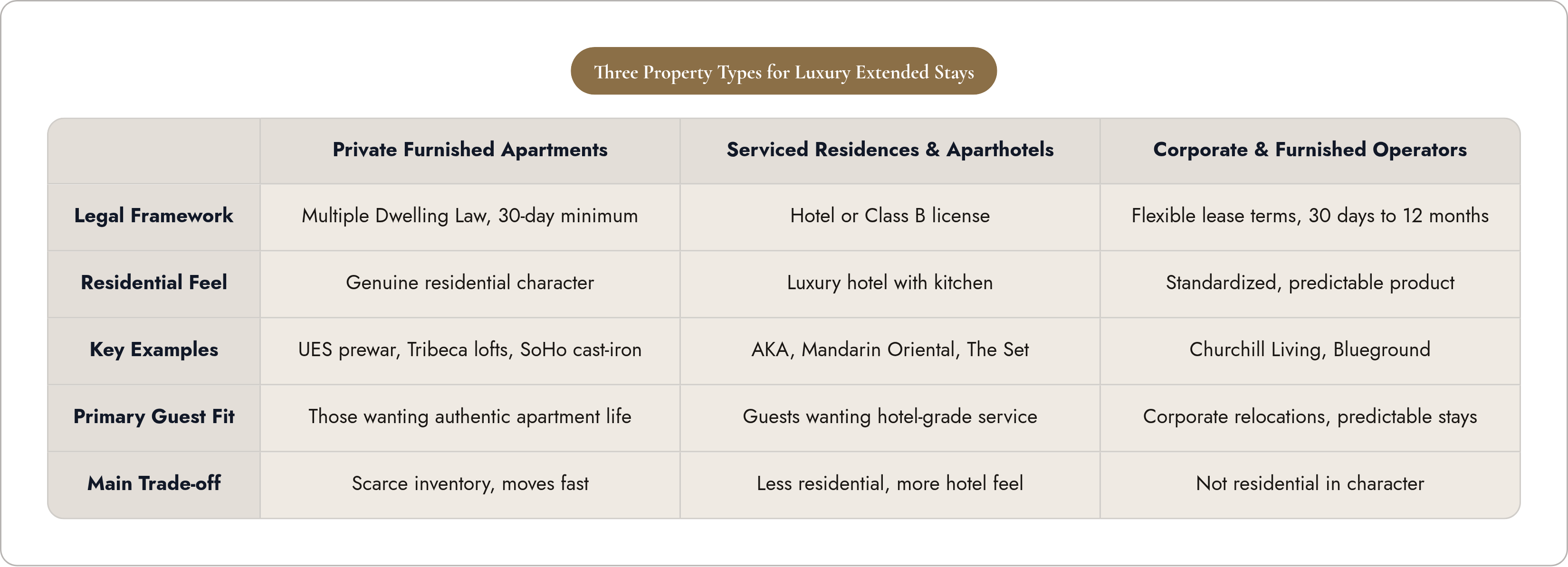
This distinction matters more than most guests anticipate. Which category a property falls into determines the legal standing of the stay, the amenity profile, the booking logistics, and the actual texture of daily life inside it.
Private Furnished Apartments
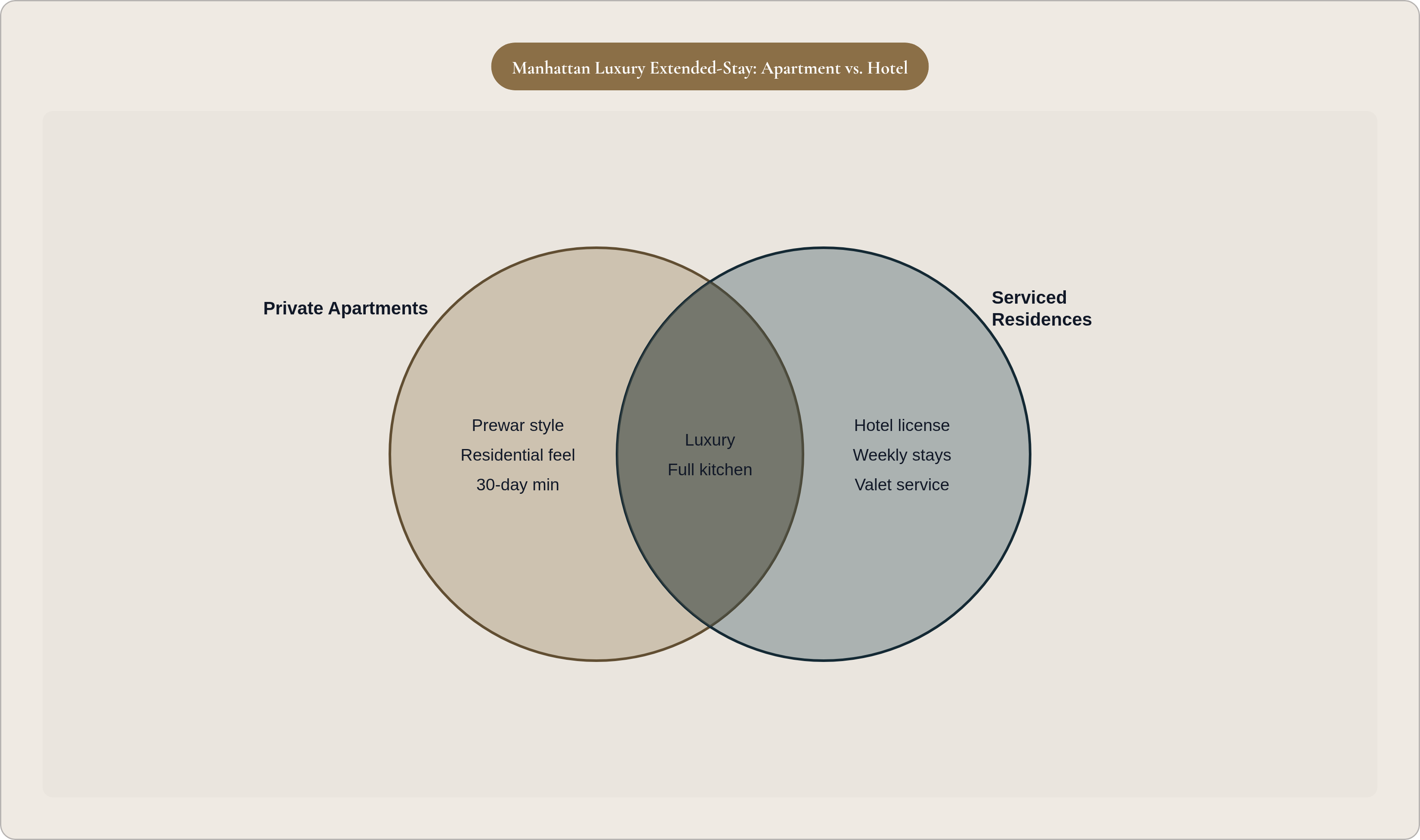
This is what most people picture: a whole apartment in a real residential building, on a 30-day minimum, under the state's Multiple Dwelling Law framework. Upper East Side prewar classics, Tribeca loft conversions, SoHo cast-iron buildings. The residential character is genuine because these are, in fact, residences. Tribeca condo prices were hovering around $3.6 million in 2025, which tells you something about what the private stock available for furnished rent actually looks like.
Inventory here is constrained by definition. Buildings with explicit policies permitting 30-day rentals are a subset of an already tight market. The most desirable ones move quickly, and the idea that you can window-shop this category is mostly fantasy.
Serviced Residences and Aparthotels
These operate under hotel or Class B licenses. The Multiple Dwelling Law restrictions that govern private apartments do not apply in the same way, which makes them the most legally frictionless path to whole-home luxury in Manhattan.
AKA Central Park and AKA Times Square offer weekly, monthly, and extended stays with valet laundry, housekeeping, and grocery delivery. The Mandarin Oriental Residences run 24-hour concierge, valet, and security. The Set at Hudson Yards, designed by Handel Architects and featuring Wolf appliances throughout, anchors the newer development corridor with full-service residential infrastructure.
The trade-off is real. Hotel-grade legal clarity and service come at the cost of residential character, and residential character is often the whole point of choosing an apartment over a hotel. These properties feel like luxury hotels with kitchens. That is not a criticism; it is a description. Some guests want exactly that. Others arrive expecting an apartment and find themselves in a very nice hotel room, and the experience suffers for the mismatch.
Corporate and Furnished Housing Operators
These are companies running furnished rental portfolios at scale, with standardized furnishings, bundled utilities, and flexible terms typically ranging from 30 days to 12 months. Churchill Living has more than 30 years of operations across 12 luxury buildings in Midtown and Lower Manhattan. Blueground runs a technology-forward booking process across a standardized portfolio. Both built their businesses serving corporate relocations for banking, consulting, and diplomatic clients, and both have expanded meaningfully into families in transition, visiting patients, and international travelers.
The product is reliable. High-speed internet, in-unit laundry, fully equipped kitchens, 24-hour building attendants. It is not, by design, residential in feel. You know roughly what you are getting before you arrive, and for many stays, that predictability is precisely the point.
Guests who conflate these three categories tend to end up either legally exposed or experientially mismatched from what they actually wanted. Knowing which one you need before you start looking saves considerable time and grief.
Which Manhattan Neighborhoods Offer the Best Extended-Stay Inventory by Use Case
No single neighborhood dominates, and anyone who tells you otherwise is selling something. The right answer depends entirely on why you are here.
Midtown has the highest concentration of corporate furnished housing. Subway access is unmatched, proximity to Midtown offices is obvious, and the buildings in this corridor are calibrated to working professionals: business lounges, fitness centers, conference rooms. If you are here on assignment, this is the natural fit.
The Upper East Side and Upper West Side serve families and longer-stay guests well. Central Park access, leading medical facilities, major cultural institutions, and buildings that frequently include children's playrooms and services oriented toward residents with extended timelines. The Sonesta ES Suites Upper East Side operates specifically in this corridor.
Tribeca and SoHo are where guests go when they want genuine Manhattan residential character: designer kitchens, cast-iron architecture, walkable luxury retail. Demand is persistent and prices reflect that persistently. If you want a specific building in Tribeca, you need to be early.
Central Park South is prestige-driven. Immediate park access, proximity to the city's finest restaurants and hotels, and pricing that sits at the top of the range across all three property types. Guests here are typically paying for the address as much as the apartment, and there is nothing wrong with that if the address is the point.
The Financial District is the story worth paying attention to right now. StreetEasy searches for FiDi apartments climbed nearly 47 percent from 2024 to 2025, driven partly by residential conversions including 25 Water Street. Brick Underground flagged it as a neighborhood to watch for 2026. Pricing for equivalent square footage often runs below Midtown or the Upper East Side, and the conversion stock carries architectural character that newer construction corridors simply cannot replicate.
Hudson Yards and West Chelsea attract guests who prefer modern construction over prewar character: high ceilings, contemporary finishes, new building infrastructure. The Set at Hudson Yards anchors the extended-stay offering here. The neighborhood lacks the layered urban texture of older Manhattan, but for guests who want a clean, modern residential experience, the product fits.
What to Look For, and Demand, Before Booking
Start with the legal basis of the specific property. For a private apartment, ask whether the building's governing documents explicitly permit 30-day rentals. Buildings routinely have internal rules stricter than state law, and a host offering a 30-day rental in a building that prohibits them hands that legal exposure directly to you. For a serviced residence, confirm the hotel or Class B license. Any legitimate operator answers these questions immediately. Hesitation or deflection tells you what you need to know.
Get the full cost picture before comparing anything. Headline rent, occupancy taxes, the $1.50 per-day city fee, utilities, parking, cleaning frequency, and for stays beyond six months, the broker fee equivalent to one month's rent or 15 percent of annual rent: all of it belongs in the calculation.
At $15,000 to $35,000 per month, an informal dispute resolution process is not adequate coverage. Ask specifically what the damage protection structure is. Ask for it in writing. Vague or evasive responses to that question are not a minor inconvenience; they are a preview of how disputes will actually get resolved.
Luxury Manhattan buildings have their own guest approval processes. Confirm that the operator has successfully navigated building approval for prior guests before you are the one submitting financial documents without clear sponsorship from someone who knows the building.
Do not accept general amenity language. In a market where median luxury doorman rents exceed $5,000 per month, the word "luxury" carries an enormous amount of imprecise freight. Ask specifically about doorman and concierge hours, in-unit laundry, workspace configuration, and housekeeping frequency. Vague listing copy and concrete operational reality diverge more often than they should.
Peak demand runs May through August and November through December. Three months of lead time is the minimum for meaningful selection at the top of the market. January through early March offers the widest availability and the strongest negotiating position, which is worth knowing if you have any flexibility on start date.
Post-Local Law 18, the general-purpose listing platforms have limited legal inventory for sub-30-night whole-home stays, and their 30-day-plus inventory was largely built without the vetting infrastructure that specialized operators maintain. The platform that worked for a long weekend somewhere else was not designed for this transaction. For a luxury extended stay in Manhattan, the more reliable path runs through operators and curated marketplaces that have established building relationships, verified legal frameworks for every property they represent, and a track record in the specific buildings they are putting in front of you.