Luxury Ski Chalet Rentals in Aspen for Families
Aspen runs four distinct ski mountains under one lift pass. Buttermilk, Snowmass, Ajax, and Highlands together cover more than 5,000 acres. Treating them as interchangeable is a mistake families make once, usually on the first trip, occasionally on the second. Think of the four mountains as chapters in a ski education. You don't start with the last chapter. You don't spend the whole week rereading the first.
Buttermilk
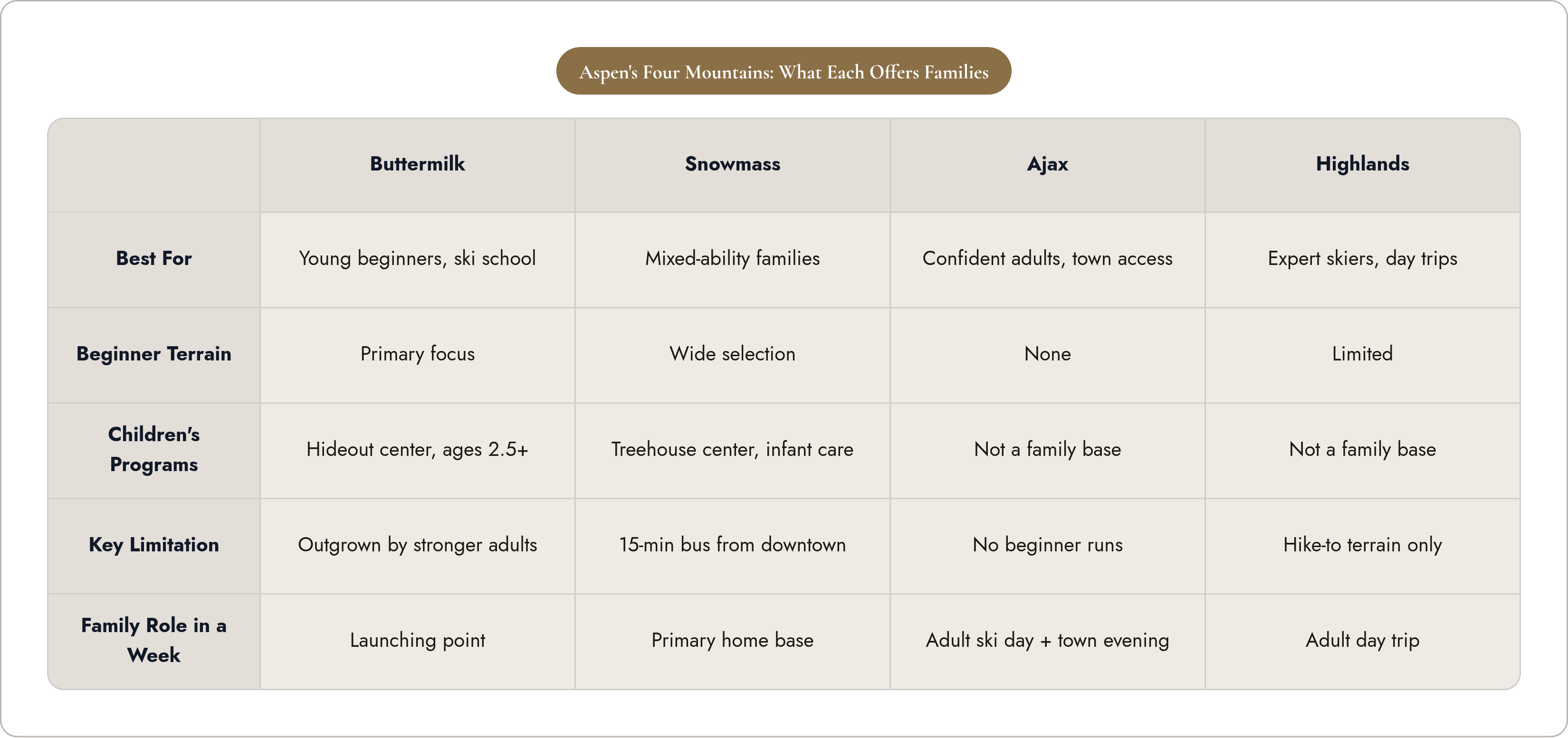
Buttermilk is where the youngest skiers start. The Hideout children's center is built for first experiences: gentle learning slopes, lunch facilities, interactive play areas that make the mountain feel approachable rather than punishing. Ski and snowboard school programs begin at age 2.5, and children 6 and under ski free at Aspen Snowmass. The S3 Park handles older kids and teens ready to progress past groomed runs.
X Games week is a legitimate draw on its own terms. A teenager who wants to watch world-class freestyle competition in person has a real reason to be there, one that has nothing to do with skiing.
Here is the honest constraint: Buttermilk has real terrain limits for stronger adult skiers. It is essential for learning, but a family spending every day there because the youngest is in ski school will have at least one parent who has finished lunch by 11 am and is staring at their phone wondering what the snow is like on Snowmass. Buttermilk is a launching point. Not a full-week mountain for a mixed-ability group.
Snowmass
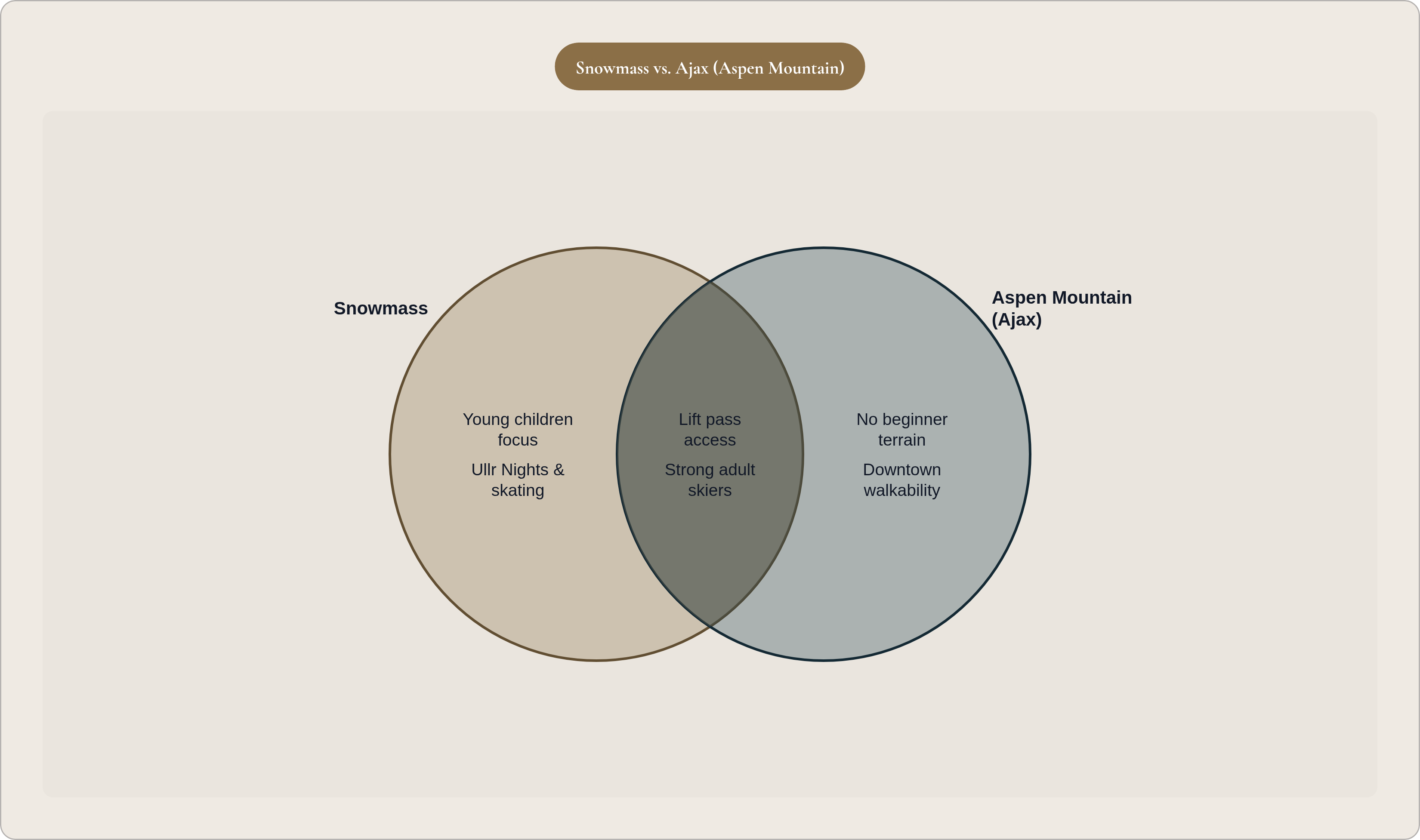
Snowmass solves the most problems for the most families. At over 3,300 acres, it is larger than the other three mountains combined. North America's longest intermediate run, 5.3 miles from summit to base, is less a statistic than a practical fact: a confident 10-year-old can do that run four times before lunch and feel like they actually skied something. The terrain range is wide enough that a beginner, an intermediate, and an expert can leave the same base, ski all day, and each come back having worked.
The Treehouse Kids Adventure Center manages ski school, and childcare accepts children from 8 weeks old. Elk Camp runs weekly Ullr Nights: bonfires, s'mores, live music, night tubing. The sort of thing that sounds like a tourism brochure item until your kids spend three days talking about it. The Village Base Plaza has a free skating rink, noon to 9 pm. For families where the hours between 3 pm and bedtime matter as much as the ski day, Snowmass has thought about that window in a way the other mountains have not.
Aspen Mountain (Ajax)
Ajax has no beginner terrain. That is a design fact, not a limitation to work around, and it defines exactly what Ajax is for in a family week. It is for confident intermediates and experts, typically the adults skiing while younger children are in school elsewhere. Its family value is primarily positional: the gondola loads at the base of downtown Aspen, which means after a day on the hill you walk directly into a town. Restaurants, shops, après activity. The mountain and the town function as one continuous experience in a way that Snowmass, a 15-minute bus ride away, simply cannot replicate.
Aspen Highlands
Highlands answers one question: where do the strong skiers go when they want Highland Bowl? The Bowl requires a hike and rewards it. For families with young children, Highlands is best treated as a day trip for the adults rather than a home base. That framing keeps expectations accurate and prevents the mountain from carrying a logistical role it was never designed to fill.
The synthesis
Most families with children under 12 will spend the majority of their days rotating between Buttermilk and Snowmass. As the children advance, the axis shifts toward Snowmass and Ajax. Planning the chalet's location around that rotation, rather than around the idealized plan to hit all four mountains in a week, is the difference between a trip that found its rhythm and one that spent its time in transit.
Why chalet location relative to mountain access is the first decision, not the last
The gear-up process with young children is not trivial. Boots, helmets, gloves, layers, snacks, and the inevitable last-minute bathroom run add 30 to 45 minutes to any morning before a single shuttle is involved. A ski-in/ski-out property eliminates that transit step entirely and compresses the morning in a way that changes the texture of the whole day. This is why location gets settled before any other feature of a chalet is considered.
Two location archetypes serve families in this market, and they imply genuinely different trips.
A Snowmass-based chalet is the right choice for families where skiing is the primary activity, children are young and in active ski school, and the on-mountain amenities are actually going to be used. Snowmass offers the widest selection of ski-in/ski-out homes of the four mountains. The ability to walk out the door and onto the snow is worth a real premium when you are managing children's logistics every single morning. Anyone who has stood in a parking lot at 8:45 am searching a backpack for a missing glove while a 5-year-old cries about cold feet understands this immediately.
A downtown Aspen property is the right choice when the adults are strong skiers who want Ajax proximity, the teenagers are old enough to navigate the resort with some independence, and the town's restaurant scene is part of the trip's identity rather than background noise. The trade-off is a shuttle to Buttermilk or Snowmass for the younger skiers. The RFTA shuttle works well for adults traveling light. For a family managing a 4-year-old in ski boots, a stroller, and rental equipment, the calculation shifts considerably.
Red Mountain and comparable residential areas offer seclusion, estate-scale properties, and views that Snowmass and downtown properties rarely match. Every mountain day requires a car or car service. For a family that prioritizes the property experience and is comfortable with that arrangement, it is a legitimate choice. But it should be named as a choice, not discovered on day two when someone realizes the shuttle does not come here.
One practical constraint: the best ski-in/ski-out properties at Snowmass go early. Per AirROI 2025 data, guests booking February stays commit an average of 91 days in advance. The properties that make location most advantageous are not available to anyone who starts planning in January.
The property types available and what they mean for different family configurations
The Aspen luxury rental market has oriented itself around family and group travel in ways that are legible in the inventory. Properties accommodating 4 to 6 guests account for more than half of all short-term rental listings. Properties accommodating 6 or more make up nearly half the overall market, according to AirROI 2025 data. The supply is shaped by who books it.
Ski-in/ski-out estates at Snowmass
These are the benchmark properties for family functionality. Private ski storage, hot tubs positioned for post-ski use, bedroom configurations for multigenerational parties, slopeside access that makes the morning manageable. One Snowmass six-bedroom chalet with a private lift, slopeside hot tub, and fire pit is representative of this tier. The Snow Chalet at Snowmass, also six bedrooms with a private lift, starts at $7,150 per night and is a useful anchor for what this segment costs.
Downtown Aspen estates
These properties trade ski-in access for Ajax gondola proximity and full immersion in downtown Aspen's walkable life. A seven-suite property with a rooftop hot tub, media room, game area, wine cave, and private elevator captures what this tier offers: slope proximity combined with in-property amenities that keep a large family comfortable between mountain days. These suit groups where the adults are strong skiers and the evening matters as much as the run count.
Acreage estates and Red Mountain properties
For large multigenerational groups where the property itself is a destination, this tier provides maximum privacy and an amenity stack the other categories cannot match. A 35-acre Aspen property with a private pond, heated outdoor pool, tennis and basketball courts, and 360-degree mountain views is representative. The Riverbend House, a 15,000-square-foot riverside estate, is another reference point. These properties do not compensate for mountain distance with ski-in access. They compensate with a property experience substantial enough that people want to come back.
Luxury condos and ski apartments
The entry point for this market sits around $1,200 per night for a two-bedroom unit. Fewer bedrooms, less square footage, simpler amenities. Appropriately scaled for a couple with one or two young children who want proximity and access without paying for six bedrooms they will not use.
What the amenity list means in practice
At the estate tier, fireplaces, hot tubs, open-plan communal living, and fully equipped kitchens are expected, not exceptional. The kitchen deserves particular attention. Being able to feed a 6-year-old at 5 pm without coordinating a restaurant reservation for nine people is a functional advantage that appears nowhere in any listing but is felt every single day of the trip. Anyone who has tried to seat a large family at a good Aspen restaurant without a reservation on a Saturday in February knows exactly what I mean.
For multigenerational groups, en-suite bedrooms matter more than they do for adult-only travel parties. Grandparents and parents need bathroom autonomy. State that requirement explicitly when searching rather than assuming it from bedroom count.
What concierge services actually handle for families and why it changes the trip
The logistical load of a family ski vacation is disproportionately concentrated before arrival. Ski school enrollment during peak weeks at Treehouse or Hideout is not something to sort out upon landing. Both programs book out during peak weeks, and arriving without confirmed reservations means the children are not in ski school on the days you planned. That failure propagates through the whole trip in ways that are genuinely unpleasant.
A full-service concierge at this level handles the pre-arrival coordination: lift ticket procurement, ski school enrollment confirmed well ahead of travel, premium gear rental delivered directly to the property to eliminate rental shop lines entirely, grocery provisioning completed before the family arrives. Walking into a fully stocked kitchen at 9 pm after a full day of travel is not a luxury distinction; it is a functional one.
What else a properly engaged concierge handles: private chef arrangements briefed in advance on dietary requirements and the children's eating patterns; childcare coordination for non-ski hours; car service and private SUV for mountain transfers; helicopter transfers from Denver or Eagle/Vail for arrivals that cannot afford a lost evening. Last-minute restaurant reservations in a market where every relevant venue operates at capacity during peak weeks, a logistical fact, not a figure of speech.
The private chef is not primarily an indulgence at this scale. It solves the concrete problem of feeding children on irregular schedules in an expensive restaurant market without requiring the family to coordinate dining logistics on top of everything else. At $10,000 a night, the marginal cost of a chef is a smaller percentage of the trip than it appears as a line item.
Some properties now deliver hotel-style services under private branding: in-residence sommeliers, wellness practitioners, mobile concierge platforms that keep the household running. The hotel experience inside a private home is an accurate description of what the top tier of this market now offers.
The distinction that actually matters at booking: a property that lists concierge as an amenity is not the same as a property where a team actively coordinates logistics before arrival. One handles the unexpected. The other removes the expected friction before it arrives. Those are different products. Conflating them is how families end up standing in a rental shop line on day one wondering why they paid what they paid.
What Aspen costs and when to book to get the trip you want
The price range is wide. The floor is real. Entry-level luxury condos begin around $1,200 per night for two-bedroom units. Peak-week ski-in/ski-out estates exceed $10,000 per night. The Snow Chalet at $7,150 per night represents a practical midpoint for the six-bedroom ski-in/ski-out tier. The Aspen short-term rental average daily rate across all property types sits at $1,025, per AirROI 2025 data.
Peak weeks, Christmas and New Year's, Presidents' Week, late February, are the most constrained period in the Aspen calendar. The best chalets are reserved up to a year ahead. The average booking lead time across all Aspen stays is 75 days, but for February specifically it rises to 91 days. The planning clock for peak family ski weeks starts in November at the latest. Families who understand this book in October. Families who do not find out the hard way in January.
January and early March are the practical sweet spot for families with scheduling flexibility. Snow conditions are strong, the mountain is operating fully, the crowds are meaningfully reduced, and premium properties are actually available. The skiing in mid-January is the same skiing as Presidents' Week. The experience of the resort is different.
Shoulder season, late April in particular, runs 30 to 40 percent below peak rates. The savings are real for families whose school calendars allow it, though late April skiing is a different experience in character and snowpack than midwinter.
The per-night cost of a six-bedroom estate divided across two or three families frequently compares favorably to the equivalent in hotel suites, particularly when factoring in communal living space, the kitchen, and the elimination of restaurant spend for several meals. Run the math before concluding the chalet is the more expensive option. A property sleeping twelve for $10,000 a night looks different when the alternative is twelve separate hotel rooms plus every meal out plus no place to put the ski gear.
Navigating Aspen's short-term rental permit system before you book
Any residential property rented for fewer than 30 consecutive days in Aspen requires a city short-term rental permit. That is the baseline verification every family should complete before booking.
The 2022 ordinance established three permit categories. STR-Classic covers non-owner-occupied properties with no cap on rental nights, though some residential zones have hit permit caps at the district level. STR-Owner-Occupied applies to primary residences and caps at 120 nights per year. STR-Lodging Exempt covers lodges and condo-hotels under unified management, where one permit covers multiple units.
The supply constraint this system creates is material. More than 50 properties sit on a city waitlist for permits, and eight of fourteen residential zoning districts have hit or exceeded their caps. The compliant inventory is genuinely limited, which affects availability independently of price or preference. This is not a bureaucratic footnote; it directly narrows the pool of bookable properties.
November 2025 amendments streamlined permit applications and added compliance enforcement with a practical consequence: platforms are now required to display permit numbers in listings and remove non-compliant ads. A listing without a visible permit number after late 2025 warrants a direct question before booking, not after. A curated booking process handles that verification automatically. A direct platform search puts the responsibility on the guest, where it tends to go unnoticed until something goes wrong.
Lodge Zone properties, exempt from residential caps, have outperformed the broader condo market in terms of regulatory certainty. For families considering condos across different neighborhoods, knowing whether a specific property sits in a capped zone is a relevant part of due diligence, not a technicality.
How to match the chalet to the family's actual ski week
The most useful planning exercise is an honest accounting of the family's actual ski week, not the aspirational one. How old are the youngest children? Are they in ski school every day, or only some days? Do the adults have meaningfully different ability levels? Are the teenagers independent enough to navigate a shuttle alone? Is the town's restaurant scene part of the trip, or is the mountain the whole point? Answer those questions first, then search for the chalet.
Families with children under 7 in active ski school should center their search on ski-in/ski-out properties at Snowmass. The logistical compression that slopeside access provides at that age is significant, and Snowmass's on-mountain infrastructure for children is deeper than any of the other three mountains. The morning routine alone justifies the location priority.
Families where the oldest children are capable intermediates and the adults are strong skiers have more flexibility. A downtown Aspen property works if the shuttle to Snowmass or Buttermilk for younger children is manageable and the adults intend to ski Ajax regularly. The location trade-off becomes a genuine choice rather than an obvious answer.
Multigenerational groups spanning grandparents, parents, and children across a wide age range are best served by large estate properties at Snowmass or acreage estates with car service, where the property can absorb the natural fragmentation of a group that is not all skiing the same runs at the same time. The property needs to function as a gathering point, and scale is the mechanism that makes that possible.
The sequencing matters: confirm ski school enrollment and lift tickets before finalizing the chalet search, not after. Book the chalet with location determined by which mountain the family will actually use most heavily. Concierge coordination, chef arrangements, and grocery provisioning follow from there, handled in the weeks before departure through whoever manages the property. Get those things in the right order and the trip has a chance to be what it was supposed to be.