Investment Property vs Primary Residence Tax and Financial Tradeoffs
Section 121 exclusion thresholds haven't kept pace with housing appreciation in hot markets.

No other provision in the tax code does what Section 121 does. Sell your primary residence at a gain: up to $250,000 of that profit is excluded from federal tax entirely. Married couples filing jointly get $500,000. Own the property for two of the last five years, use it as your primary residence for two of those same years, and you qualify. You can use it repeatedly, just not more than once every two years.
Here is what nobody talked about for a long time: those thresholds were set in 1998. Adjusted for what housing has actually done since then, they would be roughly $720,000 and $1,440,000 today. I have watched sellers in Manhattan, South Florida, and Aspen stare at closing statements and realize they have outgrown an exclusion they assumed would cover them. A couple who bought a New York apartment in 2010 and sells it now can easily carry gains north of $500,000. The exclusion that once functioned as a blanket now has real holes, particularly in markets where appreciation has been most aggressive.
There is a 2025 legislative proposal that would eliminate the dollar caps on Section 121 entirely. It has not passed. Congress sees the problem. That is about all it tells you.
Investment property gets none of this. No exclusion. Full capital gains exposure on every dollar at sale. That asymmetry is the central tax fact of this entire comparison, and everything else follows from it.
What Investment Property Owners Pay in Capital Gains, and How Holding Period and Income Bracket Change That Number
The capital gains tax on an investment property sale is not a fixed number. It is the product of two variables: how long you held the asset and what your income looks like in the year you sell.
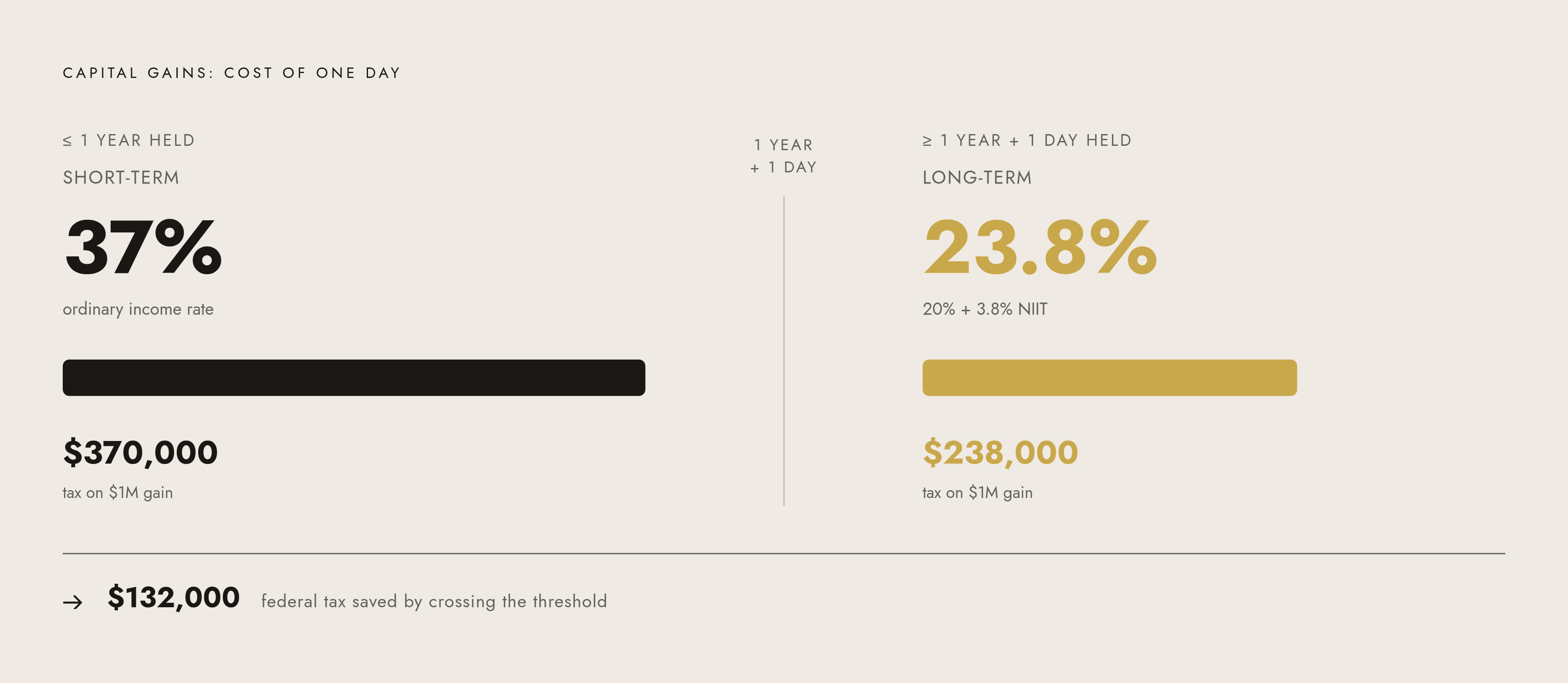
Hold one year or less, and the gain is taxed as ordinary income, up to 37% at the top bracket. Hold more than one year, and you qualify for long-term rates: 0%, 15%, or 20%, depending on adjusted gross income. For 2025, the 15% rate begins at $96,700 AGI for joint filers. The 20% rate kicks in at $600,050.
High-income investors add another layer. If your modified adjusted gross income exceeds $200,000 single or $250,000 married, the 3.8% Net Investment Income Tax applies, pushing the effective top federal rate to 23.8%.
In most luxury markets, that is not the exception. It is the default. The gap between short-term and long-term treatment, separated by one year and one day, is the difference between a 37% rate and a 23.8% rate. On a $1 million gain, that spread exceeds $130,000. Holding past the one-year mark is not a liquidity sacrifice. It is $130,000 recovered. Holding period discipline is among the highest-leverage decisions in the investment property lifecycle, and it costs nothing to implement.
Depreciation: The Annual Non-Cash Deduction Investment Properties Earn That Primary Residences Cannot Touch
Depreciation genuinely feels like something for nothing. In a meaningful sense, it is. The IRS permits you to deduct the cost of the building over its useful life: 27.5 years for residential rentals, roughly 3.6% of the building's value each year. No money leaves your account. The property climbs in market value. On your tax return, you record a loss tied to the structure's theoretical deterioration, and that loss offsets real taxable income.
Primary residences cannot touch this deduction.
In 2025, the One Big Beautiful Bill Act permanently restored 100% bonus depreciation for qualifying property placed in service after January 19, 2025. Under the right structure, an investor can deduct the full depreciable cost of a qualifying asset in year one rather than amortizing it across 27.5 years. For investors with both the capital to deploy and sufficient taxable income to absorb a large first-year deduction, that is a material advantage.
The more advanced version is cost segregation. Rather than treating the entire building as a single 27.5-year asset, a cost segregation study breaks the property into components: appliances, flooring, fixtures, and other elements that qualify for 5- to 7-year depreciation schedules. On a $500,000 property, a study costing $3,000 to $15,000 can accelerate $50,000 to $80,000 in additional deductions into the first few years of ownership.
The complication that trips people up is depreciation recapture. At sale, every dollar of depreciation claimed gets taxed as ordinary income at rates up to 25%. That liability accumulates invisibly across your holding period and surfaces at exit. The detail investors miss most often: recapture applies whether or not you actually took the deduction. Skipping depreciation to sidestep recapture is one of the more persistent misconceptions in this space. The IRS recaptures it regardless. Take the deductions. Invest the tax savings. Plan around the recapture. That is the correct sequence.
The Full Deduction Landscape for Each Property Type, Including What the 2025 SALT Change Means for Investors
The deduction comparison is not close. It was not designed to be. Investment property converts nearly every cost of ownership into a tax offset: mortgage interest, property taxes, insurance, repairs, management fees, cleaning, professional services, and depreciation. If money is leaving your account in the operation of the property, it is almost certainly deductible.
Primary residence deductions are far narrower. Mortgage interest on up to $750,000 in debt is deductible under current law, a cap expected to revert to $1 million after 2025 under TCJA sunset provisions. Property taxes qualify, subject to the SALT cap. Repairs, maintenance, utilities, operating costs: none of it qualifies. The mortgage interest deduction still delivers real value for owners carrying large balances, but the structural difference between the two categories is wide.
The SALT cap has generated genuine friction in high-tax states since 2017. The One Big Beautiful Bill Act raised it to $40,000 for 2025, up from $10,000, with a 1% annual increase through 2029 before reverting to $10,000 in 2030. For investment property owners in New York, New Jersey, and California, more of their state and local tax burden now flows through to a federal deduction. For primary residence owners, the effect is more limited. A higher ceiling does not alter the fundamental narrowness of what residential owners can deduct in the first place.
Passive Activity Loss Rules and Who They Actually Let Deduct Rental Losses Against Regular Income
The IRS classifies most rental real estate as a passive activity. Under the default rules, passive losses offset only passive income. They cannot touch wages, salaries, or business income. The high-earning professional who buys a rental property expecting depreciation losses to reduce their W-2 bill is going to have a frustrating conversation with their accountant.
Two exceptions exist in practice. The first is the $25,000 special allowance for active participants with modified adjusted gross income below $100,000, phasing out entirely at $150,000. If you are a high-income investor, this path is not available to you. The second is real estate professional status. To qualify, you must spend more than 750 hours per year on real estate activities, and those hours must represent more than half of your total working time. Meet both thresholds and rental losses offset W-2 income freely. I have seen this designation change the entire first-year economics of an investment property purchase for people who can legitimately claim it. It is a genuine and powerful benefit. It is also a genuine legal standard, not something you acquire simply by owning property.
Losses disallowed in a given year do not disappear. They carry forward as suspended losses, fully deductible at sale. Deferred, not eliminated. But timing matters enormously to an investor who built a cash flow model around annual loss offsets and instead finds themselves sitting on a deduction they cannot deploy until exit.
How the 1031 Exchange Lets Investment Property Owners Defer Capital Gains Indefinitely, and What Happens to Those Gains at Death
A 1031 exchange rolls capital gains forward. Sell an investment property, reinvest the proceeds into a like-kind replacement property of equal or greater value, and the tax on the gain is deferred. The mechanics in 2025 are specific: the replacement property must be identified within 45 days of the sale and closed within 180 days. A qualified intermediary holds the proceeds throughout. The seller cannot touch the money during that window, not briefly, not for any reason.
The deferred gain does not disappear. It attaches to the new property's cost basis and travels with the asset through each subsequent exchange. Investors who chain exchanges across decades, a strategy called "swap until you drop", carry that deferred tax liability for life and never pay it. At death, heirs receive a stepped-up basis equal to fair market value, and all accumulated deferred gains are forgiven.
This is not a loophole in the pejorative sense. It is a feature of the tax code that has existed for decades, and it is the primary reason sophisticated investors think of their portfolios as long-duration assets from the moment they buy. You build the exit strategy into the entry.
After TCJA, 1031 exchanges apply only to real property. Personal and intangible property no longer qualify. Primary residences are excluded from 1031 eligibility entirely, meaning the two property types exit through fundamentally different tax structures.
One timing restriction worth internalizing: if a property was acquired through a 1031 exchange and you later want to convert it to a primary residence to claim the Section 121 exclusion, you must wait five years from the exchange date before that exclusion becomes available. Anyone planning to eventually move into an investment property needs to build that window into their original timeline, not discover it at closing.
Financing Terms Side by Side: Down Payments, Rate Premiums, and Which Loan Programs Each Property Type Can Access
For most buyers, financing terms settle the question before the tax analysis begins. Primary residence buyers can access a suite of government-backed programs built to lower barriers to entry. Conventional loans allow down payments as low as 3%. FHA requires as little as 3.5%. VA loans allow eligible buyers to purchase with no down payment at all. These programs exist because the federal government has a stated policy interest in homeownership.
Investment property buyers access none of them. Conventional lenders typically require 15% to 25% down. FHA, VA, and USDA programs are off the table. Qualification criteria are stricter: higher credit score expectations, lower acceptable debt-to-income ratios. The interest rate carries a premium, generally 0.5% to 1% above primary residence rates, sometimes more depending on credit profile and down payment.
On a $750,000 loan, a 1% rate differential adds meaningfully to carrying cost over a 30-year amortization. The investment case has to absorb a larger required down payment and higher monthly costs before generating a dollar of return. Investor home purchases ticked up modestly in late 2025, but the broader purchasing environment has been largely flat for two years. The financing conditions are not hospitable, and they are not accidental. The structural subsidy in primary residence lending is a deliberate policy choice. Investment property buyers start from a higher capital requirement and a higher cost of funds.
What Happens to Tax Benefits When You Convert a Property From One Type to the Other
People buy properties with one intention and change their minds. The IRS does not penalize the change itself. It recalculates everything based on the full history of the asset, and that recalculation rarely favors someone who was not deliberate at the outset.
Convert a rental to a primary residence and then sell: the Section 121 exclusion applies only on a prorated basis. The IRS examines the total ownership period and calculates what percentage was spent as a primary residence. Rent a property for eight years, live in it for two years before selling, and only 20% of the gain qualifies for the exclusion. The remaining 80% is fully taxable.
Convert a primary residence to a rental and then sell: gains allocated to periods of nonqualified use, including any time the property was rented or held as a second home, are not excludable under Section 121. Only the portion of gain that accrued during qualifying primary residence use receives shelter.
The 1031-to-primary-residence path adds a five-year waiting period before Section 121 becomes available at all.
The pattern is consistent across all three scenarios. The IRS does not permit seamless reclassification. Every conversion triggers a retroactive accounting of the property's full history. Buyers who purchase with vague optionality, not fully committing to living there and not fully committing to renting it, should treat that ambiguity as expensive. Pivoting later is legally permitted. The tax consequence of doing so is almost always underestimated when the original strategy is set, and I have yet to see it go the other way.
The Wealth-Building Math: Homeowner Equity Versus Investment Returns, and Why the Comparison Is Less Straightforward Than Either Side Claims
The headline homeownership statistic is striking. Per NAR data, the typical homeowner in 2025 holds a net worth of approximately $430,000, compared to roughly $10,000 for the typical renter. U.S. home equity collectively reached $17.8 trillion in Q3 2025, an all-time record, per ICE Mortgage Technology. These numbers get cited as proof that homeownership is the wealth-building vehicle.
The counterargument has real merit too. Owning is on average more expensive than renting in many markets. The S&P 500 has historically returned roughly 7.7% annually, while home appreciation has averaged closer to 4.5% to 5% since 2000. On paper, the renter who invests the monthly cost differential into equities comes out ahead.
That argument works in a spreadsheet. It falls apart in real life, for three reasons. First, homeowners use leverage. A $100,000 down payment on a $500,000 asset means even modest appreciation generates outsized equity returns on deployed capital. Second, Section 121 shelters that appreciation from tax in a way almost no alternative investment can replicate. Third, the mortgage is forced savings. Equity accretes with each payment, regardless of financial discipline. That last point is not glamorous, but it explains most of the 43-to-1 net worth gap between homeowners and renters. Most renters do not invest the difference. Most homeowners have no choice but to build equity.
Investment property adds a third layer: rental income, depreciation offsets, 1031 deferral, and professional tax treatment can produce returns that exceed either alternative. But they require higher upfront capital, operational engagement, and a genuine tolerance for complexity. Not every investor who thinks they have that tolerance actually does.
A Decision Framework: Matching Property Type to Financial Situation, Time Horizon, and What You Actually Want the Asset to Do
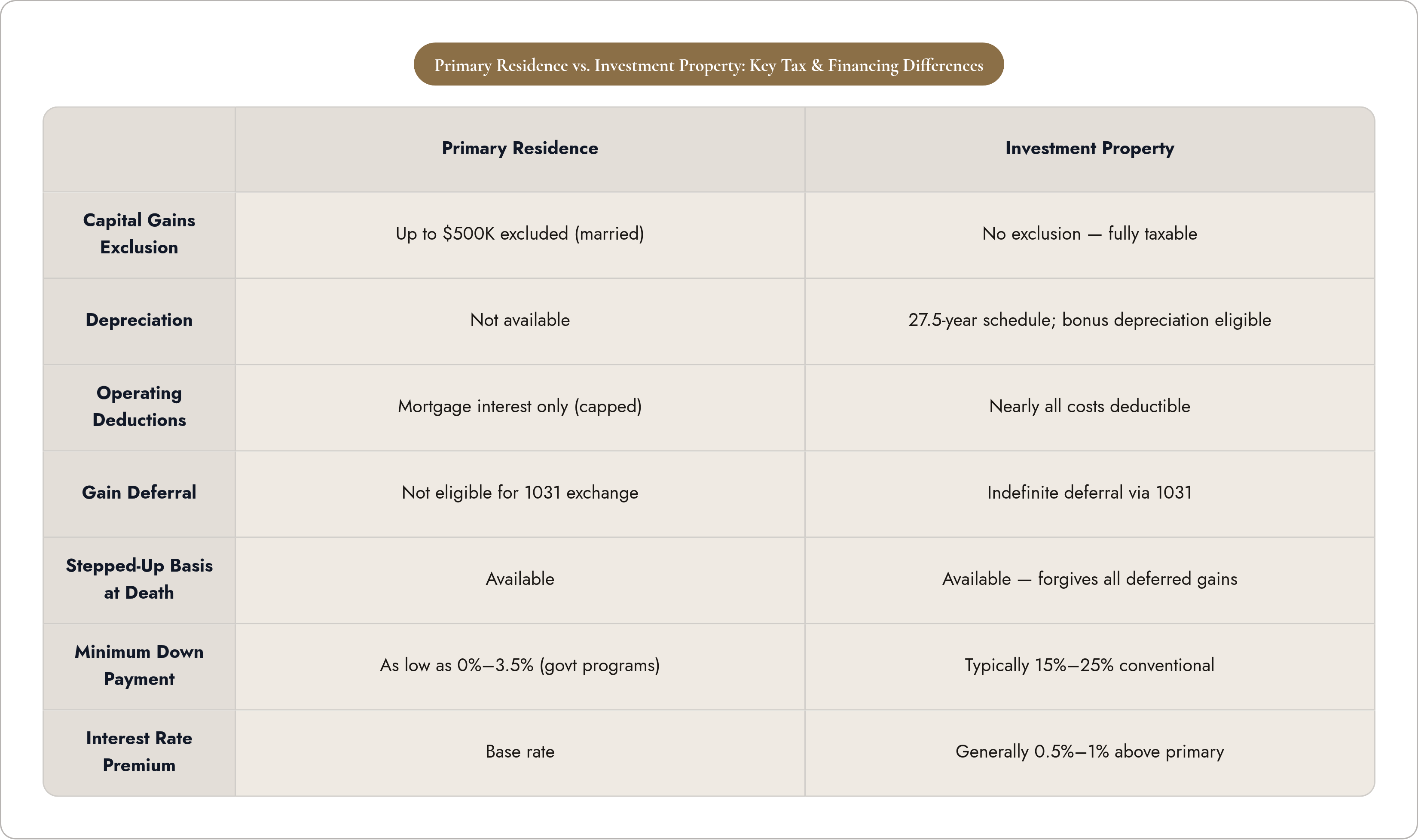
Neither property type is categorically superior. The honest answer is that the right choice depends on your capital position, your time horizon, and what you need the asset to actually do.
Primary residence makes the stronger case when you plan to own for at least five years, because transaction costs need time to amortize before the math works in your favor. If you expect meaningful appreciation and your gains are likely to stay within Section 121 exclusion limits, you hold a tax-sheltered appreciating asset with government-subsidized financing. That is a structurally advantaged position. Primary residence also makes more sense when your income and liquidity do not support the larger down payment and stricter qualification requirements of investment lending, or when you genuinely cannot absorb the operational demands of managing a rental responsibly.
Investment property makes the stronger case when you have capital beyond the primary residence down payment, can absorb the financing premium, have or can realistically develop the income and time to qualify for real estate professional status, and sit in a bracket where depreciation offsets and 1031 deferral have maximum impact. The stepped-up basis exit is one of the most effective intergenerational wealth transfer tools in the tax code. It only works if you stay in the structure long enough for deferred gains to reach a size worth deferring.
For most people, the progression is sequential rather than a single binary choice. Establish the primary residence, build equity, use the Section 121 exclusion at exit, and redeploy proceeds into investment property once the capital base justifies the structure. The two property types are not competing answers to the same question. They are successive stages. Understanding the tax treatment of each prevents you from arriving at each transition underprepared.