Best Short-Term Rental Management Companies for Vacation Homes
Choosing the right manager can compound your returns as the rental market grows toward $97 billion.

The U.S. short-term rental market sits at $35.75 billion in 2025 and is projected to reach $97.70 billion by 2035, growing at a compound annual rate of 10.58%, per Precedence Research. Your slice of that growth depends almost entirely on who manages your property.
Supply is expanding fast. Global STR listings and total guest capacity rose 9% from December 2023 to December 2024, per Lighthouse data, meaning more homes are chasing the same pool of travelers. The encouraging counterpoint: AirDNA reported that 2024 marked the first RevPAR gains since 2021, up 3.4%, with occupancy projected to return to pre-pandemic levels of 54.9% by end of 2025. Demand is forecast to grow 6.8% in 2025, with average daily rates rising 2.1% and RevPAR growing 2.9%.
A growing market rewards operators who price and distribute well. A management company that underperforms on dynamic pricing or channel reach doesn't just leave money on the table in a given week; it falls behind a compounding trend, and the distance accumulates.
One more structural fact worth knowing: roughly 25,000 vacation rental management companies operate in the U.S., managing close to 2 million professionally managed properties. Seventy percent of those companies manage fewer than 20 units. That concentration of small operators explains why market specialization and local depth vary so dramatically across the industry, and why "national scale" and "better performance" are not the same thing.
The criteria that separate a good management company from a costly one
Fee percentage gets most of the attention, but it's a poor basis for comparison on its own. A 25% all-in commission nets you more income than a 15% rate with itemized charges for photography, maintenance coordination, onboarding, and supply restocking. The only number that matters is net owner income.
Beyond fees, four criteria genuinely determine how an owner comes out:
- Service scope: Full-service operators handle everything from guest screening to tax filing; half-service models cover marketing and bookings while leaving cleaning, maintenance, and vendor coordination to the owner. The right tier depends on your proximity to the property and how much of your own time you're trying to buy back.
- Market specialization: A company with deep roots in one market, including local pricing intelligence, trusted vendor relationships, and fluency with local STR regulations, consistently outperforms a generic national operator in that same market. This shows up directly in RevPAR.
- Listing and review ownership: If a manager lists your property under its own brand, you don't own the review history. Switching companies means starting from zero on Airbnb, a real switching cost that rarely gets discussed upfront.
- Owner protections: Damage coverage limits, guest screening protocols, insurance backstops, and tax compliance handling matter enormously in high-value markets where a single incident carries serious financial exposure.
Contract structure is the dimension owners most often overlook until it's too late. Length of commitment, notice periods, and early-exit penalties vary widely. Ninety-day exit notice is a meaningful constraint when a company is underperforming; month-to-month flexibility is worth something real, even if it doesn't appear as a line item.
Your property tier and location filter everything else. A mid-range mountain cabin has fundamentally different management needs than a high-value Hamptons estate, and the right company for one is almost never right for the other.
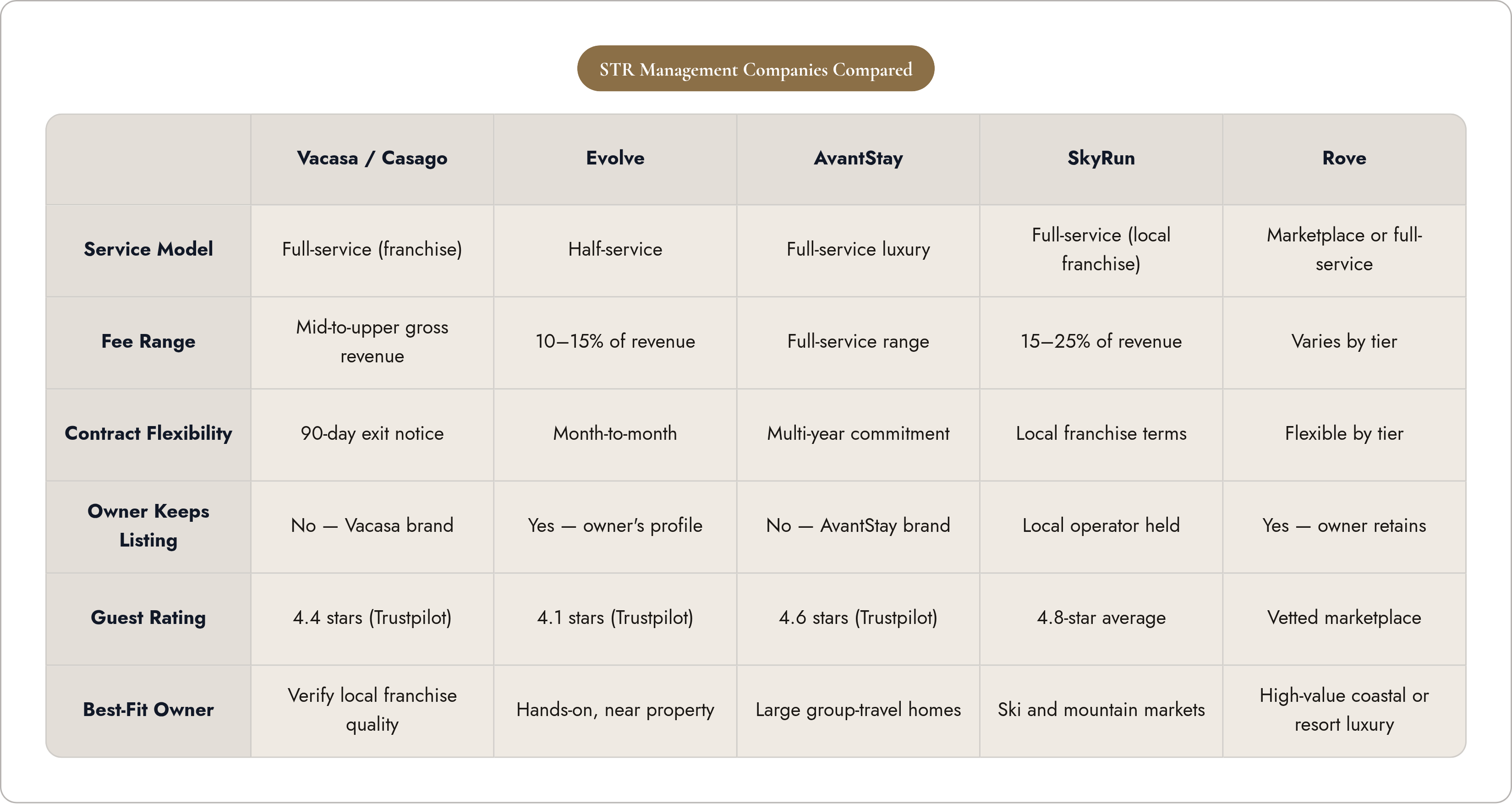
Vacasa / Casago (what happened to the largest operator and what it means for owners considering them)
Vacasa was, at its peak, the largest STR management company in North America, managing over 40,000 properties across 35 U.S. states. Casago acquired it in a deal completed April 30, 2025, valued at approximately $128.6 million. Compare that to Vacasa's former $4.5 billion valuation and you get a sense of how far things fell.
The restructuring that followed was sweeping. Per Skift's reporting, Casago sold all but roughly 600 of approximately 32,000 units to local operators, converting most of the portfolio to franchises. Franchise partners rehired around 89% of former Vacasa field staff, which provided some continuity at the local level. Vacasa itself is being repositioned as a consumer-facing booking platform rather than a first-party operator, with supply flowing through third-party property management software integrations.
What this means for an owner signing up today: the "Vacasa" on your contract is functionally a local franchise operator. Quality and service continuity vary by market, and recently transitioned markets have reported staff turnover and service gaps during handover periods.
The owner satisfaction signal here is stark. As of early 2026, Vacasa carries a 2.1/5 owner rating on Trustpilot, against a guest-facing TrustScore of 4.4 stars from over 16,000 reviews. Guests are happy with the product. Owners are not happy with the experience of being an owner. That gap is the central tension any prospective owner needs to sit with before signing anything.
Fees run in the mid-to-upper range of gross revenue and are quoted per property rather than published. Listings are held under Vacasa's brand, so you don't retain your review history if you exit, and exit requires 90 days' notice per Vacasa's own FAQ.
Evolve (the low-fee half-service model and who it actually works for)
Evolve is currently North America's second-largest STR management company, overseeing around 16,000 rentals. The model is deliberately lean: Evolve handles marketing, booking management, and guest support; cleaning and maintenance stay with the owner. Evolve Core charges 10% of revenue and Evolve Plus charges a modest premium above that, among the lowest rates in the industry at this scale.
The trade-off is real. Evolve reports its owners earn 18% more revenue than the market average, and AirDNA data show that professionally managed listings in ski markets average 12% higher RevPAR than self-managed peers. But "professionally managed" in Evolve's case still means you're coordinating your own cleaning crews, fielding maintenance calls, and managing local vendor relationships. If you're remote or time-constrained, that operational burden doesn't disappear because the fee is low.
Two things Evolve gets right that deserve real credit. Agreements are month-to-month with no onboarding fee, and listings stay under the owner's Airbnb profile, so you keep your review history if you leave. In an industry where listing ownership rarely favors the owner, both of those are genuine differentiators. A 4.1-star average on Trustpilot from over thousands of reviews, with owners consistently citing clear communication, backs up the operational reputation.
Evolve works for owners who live near their property, have an established local vendor network, and want best-in-class listing and booking management at minimum cost. For remote owners, luxury-property owners who need on-the-ground service and serious damage protection, or anyone whose primary goal is buying back their time, it's the wrong tool.
AvantStay (full-service luxury group travel management and what selectivity costs owners)
AvantStay was founded in 2015 and built around a specific travel occasion: group stays. Reunions, bachelorette trips, corporate retreats, multi-family vacations. The company currently manages over 2,500 properties focused on villas and chalets in leisure markets, accepting roughly 10% of applicants after a style and location review.
That selectivity is the model, not a side effect of it. AvantStay's in-house design studio adds physical amenities. fire-pit lounges, game rooms, bar-cart-ready kitchens. that raise nightly rates and sharpen the property's position in the specific demand segment they're chasing. The company often covers furnishing costs upfront, which explains why contracts run multi-year rather than month-to-month. The investment needs a recovery window.
Fees fall in the full-service range, comparable to other full-service luxury operators. One independent study cited a 56% revenue uplift for AvantStay luxury properties over self-managed comparables, the highest claim among the companies in this piece, and partly attributable to design-driven rate premium rather than distribution alone. Guest satisfaction is strong: 4.6 stars on Trustpilot from nearly 1,900 reviews, the highest guest-facing score among companies covered here.
The owner trade-offs are straightforward. Multi-year contracts limit flexibility. The best-fit property is narrow: four or more bedrooms, in an AvantStay active destination, suited to group travel by size and layout. Smaller properties, urban apartments, and owners who want the option to exit quickly are not well served here.
SkyRun (local franchise depth in ski and mountain markets)
SkyRun was founded in Keystone, Colorado in 2004. As of mid-2025, the company franchises across 28 markets in 10 states and three countries, managing a substantial number of homes across 40 markets. The structural model pairs centralized technology with locally owned-and-operated franchise partners. Central tech handles dynamic pricing; local operators know the vendors, the seasonal demand patterns, and the regulatory environment.
SkyRun adopted PriceLabs' AI-powered revenue platform in 2024, applying daily dynamic pricing at the local level. Fees run 15–25% under the local franchise and co-management model. Owners who switch to SkyRun reportedly see roughly 30% more booked nights in the first year, per Realty Times, a specific occupancy uplift tied to daily pricing adjustments and local operational responsiveness. In Estes Park specifically, AirROI data show SkyRun ranked as the top host: 89 listings, $4.57 million in gross bookings, and a 4.8-star guest average over the trailing 12 months.
The franchise model carries an accountability that corporate account management rarely does. When a locally owned operator holds your contract, the business relationship is direct. You are not a line item in a national portfolio; you are a named property that a named person answers for personally.
SkyRun's limitation is geographic. Coverage concentrates in ski and mountain resort markets, making it a poor match for coastal, urban, or non-mountain vacation properties.
What luxury market owners need that national platforms consistently underdeliver
National platforms were built for volume. Thousands of properties, dozens of markets, standardized processes, centralized support. That model works at scale precisely because it flattens variation, which is exactly why it breaks down in premium markets where variation is the whole point.
Luxury vacation homes in markets like the Hamptons, Aspen, and South Florida present needs that the generalist model doesn't address well:
- Guest screening rigorous enough to protect a $5M–$15M asset, not just a standard damage deposit
- Hyperlocal pricing intelligence, because a Bridgehampton home in peak August occupies a fundamentally different demand market than a Montauk home in the same week
- Tax compliance and STR licensing fluency in markets that actively restrict or regulate short-term rentals
- Damage protection calibrated to the actual asset value, not a mid-market coverage program applied uniformly across a national portfolio
There's also a structural friction in coastal luxury markets worth naming directly. Traditional rental brokers charge fees that come directly out of either the owner's or the guest's pocket. Direct-booking and curated marketplace platforms eliminate that friction entirely, which matters for price competitiveness and for keeping guests coming back.
Rove Travel operates directly in this gap. It's a curated marketplace focused on New York City, the Hamptons, South Florida, and Aspen, where every property is vetted before it lists. For owners, Rove offers two service tiers. RoveCore provides listing access and curated marketplace distribution while the owner retains operational control. Rove+ is full property management: dynamic pricing, guest screening, turnover coordination, tax handling, and $5M in damage protection. No broker fees for guests means pricing is transparent and competitive with direct-booking alternatives, a structural advantage in markets where brokerage friction is the norm.
The Rove model is deliberately narrow, choosing depth in a small number of premium markets over national reach. Large national platforms are structurally incapable of replicating that depth, because the whole machine runs on standardization.
How to match your property to the right type of manager
Three variables determine the right fit: property tier, how much operational involvement you're willing and able to take on, and your market location.
If you own a mid-market property, want to stay hands-on, and live near the home, Evolve's half-service model at 10–15% is hard to beat on cost, and the month-to-month structure keeps your options open. If you own a mountain or ski-market property and want a local operator with serious pricing infrastructure, SkyRun's franchise model delivers local depth that national platforms at the same fee range simply don't.
If you own a large-format luxury home suited to group travel in a market where AvantStay actively operates, the design investment and revenue uplift justify the multi-year commitment for most owners who qualify. The selectivity cuts both ways: if AvantStay accepts your property, they're invested in performing.
For owners whose property sits in a high-value coastal or resort luxury market, a company managing thousands of properties across the country is not built to serve a high-value Hamptons estate with the specificity that asset requires. A curated model focused on New York, the Hamptons, Aspen, and South Florida is built for exactly that owner. The $5M damage protection, vetted guest pool, and broker-fee-free pricing structure reflect the actual risk and revenue profile of a luxury property, not a mid-market approximation of it.
Post-Casago Vacasa requires the most due diligence of any company on this list. Franchise quality varies by market, and the transition is recent enough that service consistency is still settling. If you're evaluating a Vacasa franchise in your market, ask directly: when did the transition happen, who is the local operator, and what was the staff continuity? The answers will tell you more than any published rating.
Fee is the last thing to optimize, not the first. The company that fills more nights at higher rates, protects your asset, and keeps you out of operational firefighting almost always generates better net income than the cheapest option, even at a higher commission rate.