Guest Screening Practices for Luxury Short-Term Rentals
Platform screening stops short of luxury risk—owners must build their own.

Most hosts start with whatever their booking platform provides. That's a reasonable starting point and an insufficient endpoint.
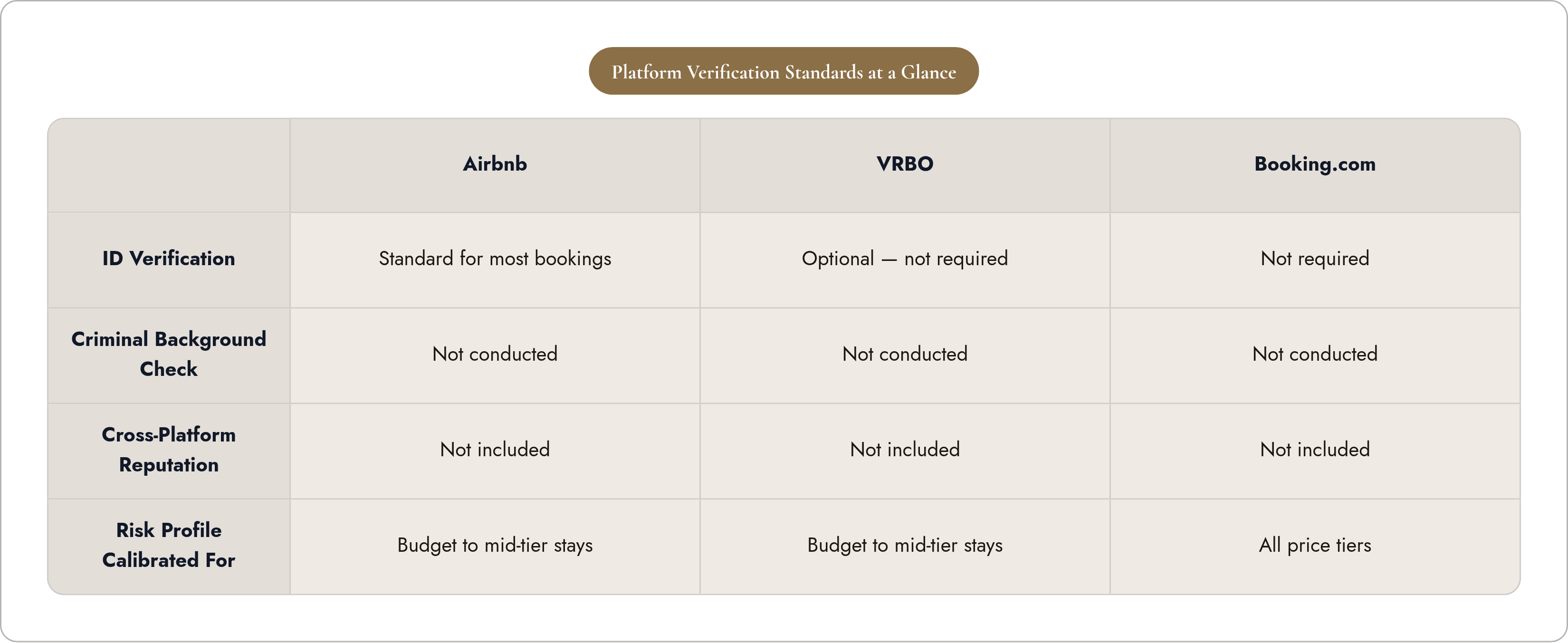
Airbnb runs more verification than VRBO, but neither platform conducts criminal background checks, credit history reviews, or cross-platform reputation checks as standard practice. VRBO's ID verification is optional: a guest can complete a booking without submitting to any meaningful identity check. Booking.com requires no verified ID at all. These aren't indictments. These platforms are built for scale across every price tier, and their verification systems are calibrated accordingly.
A guest who clears Airbnb's verification has cleared a bar designed for a $150-a-night cabin rental, not a home worth several million dollars. Those are genuinely different risk profiles, and a single screening standard cannot serve both.
"Friendly fraud" chargebacks, where guests dispute a legitimate charge after their stay, are projected to account for nearly 75% of credit card disputes in the travel sector in 2025. Platform-native processes offer little structural protection against this. Fewer than 3% of vacation rental companies use specialized guest screening software, per a 2025 industry survey of more than 600 operators. For an industry carrying this level of financial exposure, that gap is a liability sitting quietly on the balance sheet.
The distance between what platforms offer and what a luxury property actually requires is not a design flaw. It's a design choice, and owners who don't compensate for it with their own process are absorbing the difference, whether they know it or not.
Identity verification as the foundation: what it covers and how it works today
Modern identity verification is faster and more capable than most owners expect.
The strongest workflows pair automated document verification with biometric liveness detection: a real-time selfie matched against a government-issued ID, the whole process completing in under 60 seconds on the guest's end. What it's actually defending against is less routine. Synthetic identities, AI-generated documents, deepfake IDs. These aren't hypothetical threats anymore. The RealPage 2024 Fraud Study found that 1 in 8 applications for luxury properties showed signs of manipulation. Static image matching isn't enough when AI can generate a convincing document photo in minutes. Liveness detection addresses this directly, confirming that the person presenting the document is physically present rather than a generated image or a photograph of a photograph.
There's also a downstream function that owners consistently undervalue. A verified identity ties the guest to the signed rental agreement, to the risk score, and (when a chargeback dispute surfaces) to a documented record that the transaction was authorized and the terms were accepted. Skip it, and you're building the rest of your screening process on a foundation that won't hold up when it's actually tested.
Verification tells you who someone is. What kind of guest they'll be is a separate question entirely.
Background checks, watchlist screening, and what a risk score actually reflects
A serious screening platform checks county and court records, national criminal databases, international watchlists including Europol and Interpol, sex offender registries, and proprietary records of guests who have caused documented damage across other properties. Platforms like Safely have built this infrastructure, and AI-driven tools now deliver results as instant risk scores rather than manual reviews. This cuts human error and the lag time that allows a bad actor to complete a booking before a flag surfaces.
The industry has largely moved away from binary pass/fail outputs toward risk-scoring models that evaluate patterns across identifying information, social and employment history, and behavioral signals during the booking flow. A simple yes or no cannot capture the difference between a guest who is a minor credit risk and one who has caused serious property damage and has, somehow, a clean criminal record.
That last category is exactly where proprietary damage databases do something a standard background check cannot. A guest who has caused tens of thousands of dollars in losses at a comparable property will appear in those cross-platform records and nowhere in public-facing criminal databases.
One compliance gap that manual operators regularly stumble into: platforms like Safely follow Fair Credit Reporting Act protocols when issuing a denial, and that coverage extends to the host. Owners running their own manual screening without that framework carry legal exposure that scales directly with the size of the portfolio.
The FBI has documented that internet-based real estate fraud costs more than $275 million annually across more than 12,000 victims. Watchlist screening is one of the few reliable defenses at the booking stage. It only works if it's actually in place.
Behavioral signals and booking pattern red flags that no database will catch
This is where experienced operators diverge from those who trust the tools and stop there.
Last-minute bookings from accounts with no review history are a documented risk indicator: higher damage incident rates, no behavioral track record to assess. An incomplete profile — no photo, no prior reviews, minimal personal detail — signals either a first-time user or a deliberate effort to avoid reputation tracking. The booking details usually tell you which.
Other patterns worth scrutinizing: a mismatch between the stated purpose of a trip and the specifics of the booking; reluctance to sign a rental agreement or answer direct questions about the group; requests to pay outside the platform, which voids dispute protection and is a textbook fraud setup; vague or inconsistent answers about who is actually staying.
At the luxury tier, these signals carry disproportionate weight. The high value of the booking makes it an attractive target for sophisticated bad actors who can pass automated checks cleanly but reveal themselves in conversation. A direct call or message with a prospective guest is a calibration. Does the person's description of the trip match what they booked? Are the answers specific, or do they feel rehearsed? Do they seem to know what they're renting, or are they indifferent to details that a genuine guest would notice?
No database answers those questions. You have to ask them yourself.
The rental agreement and security deposit as both deterrent and legal instrument
A signed rental agreement capturing the guest's IP address, verified identity, and explicit consent to house rules deters guests who won't sign and produces the documentation banks require to reverse a chargeback. Without it, a host disputing a friendly fraud claim is arguing against a guest who says the transaction was unauthorized, with limited evidence to the contrary and a bank that has little incentive to side with the merchant.
The agreement needs to be specific. Occupancy limits, a no-party clause, noise rules, check-in and check-out windows, a clearly articulated penalty structure for violations. Vague house rules are easy to contest; precise ones are substantially harder to dispute.
Security deposits should scale with the property. A deposit calibrated for a moderate-rate rental provides no real financial protection for a home at several thousand dollars a night. The deposit should be held through a post-stay inspection window, commonly seven days, allowing full assessment before funds are released and giving the host a documented mechanism for charging damage without the dispute escalating to a platform or a bank.
A signed agreement, a verified identity, and a held deposit together form an evidentiary package that is meaningfully harder to contest than any single piece of it.
How the right platform or management structure changes what screening is possible
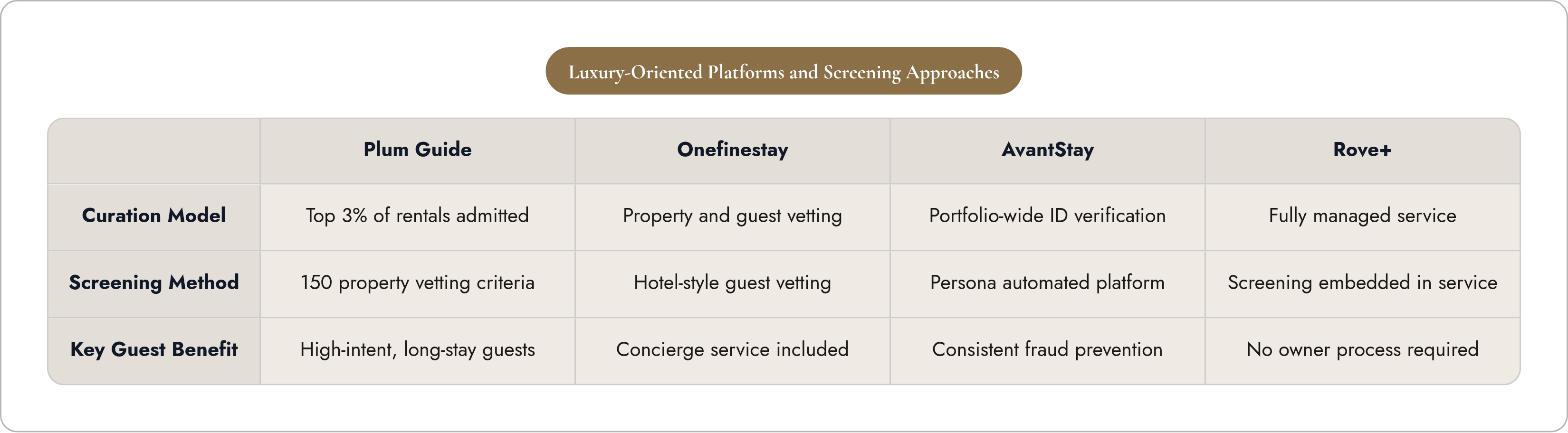
The platform a host chooses shapes the guest pool before any individual screening decision is made.
Luxury-specific platforms apply curation at the property level and, by design, attract a narrower, higher-intent guest. Plum Guide admits only the top 3% of rentals after applying 150 vetting criteria. Guests there book stays averaging more than twice the typical length, cancel at under 0.5%, and half book outside peak season. That behavioral profile reduces adverse selection before individual guest screening even begins. Onefinestay, operating under Accor, layers hotel-style concierge service and full guest vetting on top of property curation, embedding screening in the service model rather than adding it afterward.
For scaled operators, standardized screening across a portfolio is achievable without reinventing the process for each property. AvantStay uses Persona, an automated ID verification and fraud prevention platform, across all incoming guests. Rove+ handles guest screening, damage protection, and guest communication as part of its managed service, giving owners professional-grade screening without running the process themselves.
For owners listing independently, the technology stack worth evaluating includes Autohost, Safely, SUPERHOG, Truvi, and Authenticate. These platforms verify identity, analyze booking behavior, check cross-platform reputation, and in some cases provide damage protection reaching $1 million per stay.
A Findigs case study found that a portfolio of 1,000 units implementing automated screening saw a 5% occupancy increase translating to more than $1 million in additional annual income. At the luxury tier, where average daily rates rose in early 2026 even as occupancy softened in some markets, protecting occupancy through trusted guest relationships compounds that upside considerably.
In-stay monitoring tools that extend protection past the screening moment
Screening tells you who a guest is at the moment of booking. It tells you nothing about what happens at 11pm on a Saturday two weeks later.
Smart lock systems that provision access codes valid only for the duration of the booking eliminate unauthorized pre- or post-stay entry, a documented vulnerability on properties where traditional key handoffs create persistent access risk. The code expires at checkout.
Noise monitoring devices (Minut, NoiseAware, and Alertify among them) measure decibel levels without recording audio. They flag sustained high-noise events to a property manager in real time, without compromising guest privacy. PriceLabs 2025 data found that properties actively managing noise with monitoring technology see markedly more positive guest reviews and substantially reduce property damage risk.
Smart home features also command meaningfully higher rental rates and shorter vacancy periods than non-smart properties, making the technology spend a revenue decision alongside a risk management one.
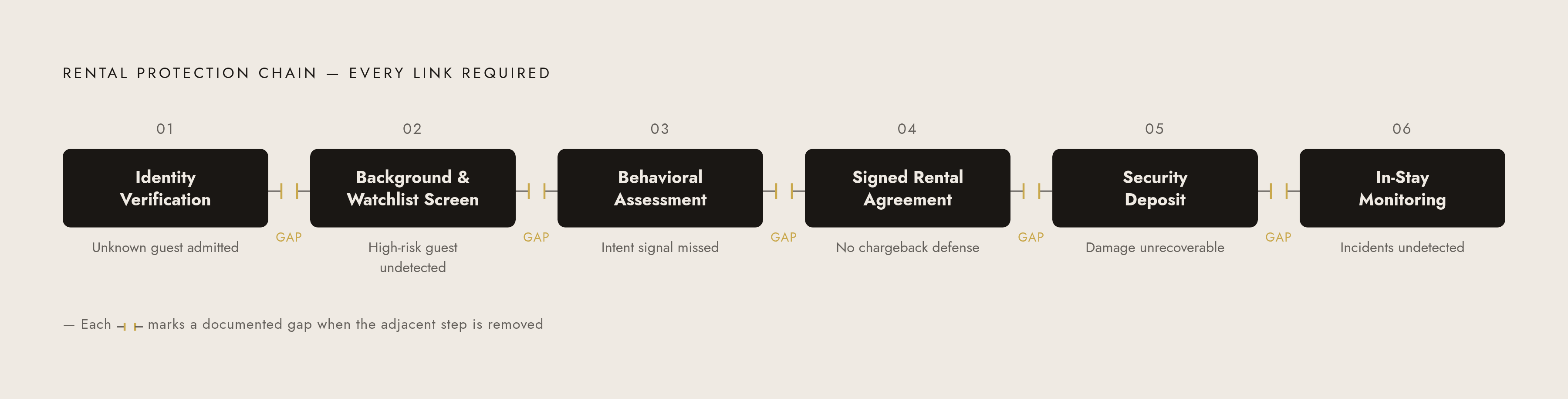
What you're building across all of this is a documented chain from the moment a booking is initiated to the moment a guest checks out: identity verification, background screening, behavioral assessment, a signed agreement, an adequate deposit, in-stay monitoring. Each link connects to the next. Remove one and you've created a gap. At the luxury level, the cost of that gap is real, and it rarely announces itself before it arrives.