VRBO vs Airbnb for Luxury Property Owners
VRBO's guest base and fee structure now favor luxury property owners more than Airbnb's do.

Airbnb holds roughly 44% of the global short-term rental market as of 2024. VRBO sits at approximately 9% globally. On raw numbers, that looks like a foregone conclusion. It isn't.
In North America, VRBO commands closer to 29% of the market, and that's the number that actually matters for most luxury vacation home owners. VRBO's concentration is precisely where luxury vacation homes exist: beach towns, ski resorts, mountain communities. About 41% of VRBO's listings are in rural markets; another third sit in beach or lakefront settings. This isn't an accident of growth. VRBO was built as a whole-home platform from day one. It doesn't list spare rooms or urban studios. The inventory reflects a deliberate structural choice, not an afterthought.
Airbnb's audience is genuinely broader, which helps certain property types and quietly dilutes others. Millennials and Gen Z dominate its user base. Solo travel is surging on the platform, with average stay length pushing toward 17 nights. That's a compelling story for a walkable urban apartment. It's a much harder sell for a $15,000-a-week beachfront compound. The guest most likely to book your luxury property represents a smaller fraction of Airbnb's total traffic than they do of VRBO's, and that's the fraction your occupancy actually depends on.
VRBO's guest base skews toward the 45-plus, family-travel demographic. These guests book earlier, cancel less frequently, and book larger properties. VRBO captures roughly 45% of bookings for large coastal homes with four or more bedrooms. For a luxury owner managing real carrying costs, earlier booking windows and lower cancellation rates aren't soft wins; they're the difference between a predictable season and a reactive one.
The question worth asking is never which platform has more total users. It's which platform's users are actively looking for what you have.
What Each Platform Actually Costs a Luxury Host Per Booking in 2025
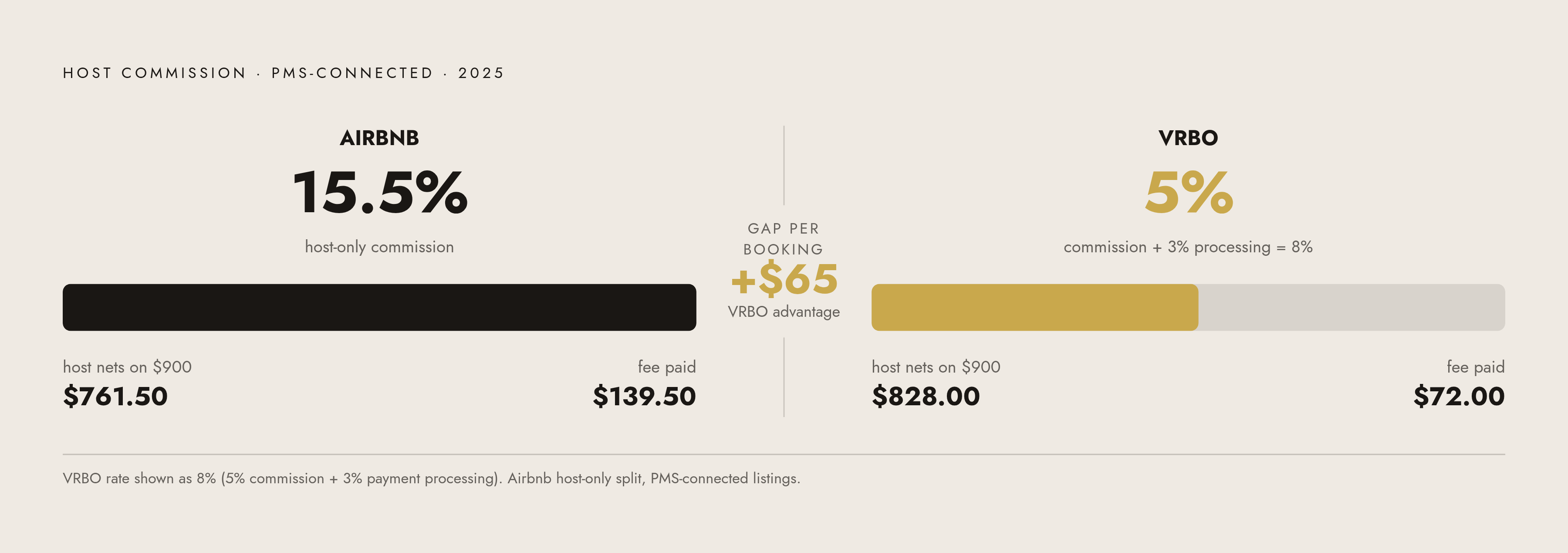
The fee structures diverged sharply in October 2025, and the change tilts the math firmly toward VRBO for professionally managed properties.
Airbnb's old model let hosts choose between a split-fee structure, roughly 3% on the host side and around 14% on the guest side, and a host-only fee of approximately 14 to 16%. That flexibility is gone for any host connected through property management software. PMS-connected hosts now pay a mandatory 15.5% host-only commission. The platform's reasoning is that professional managers should absorb the full fee. The practical outcome is a materially higher cost per booking for anyone running a managed portfolio. Self-managing individual hosts can still access the split-fee model, so the change hits professional operators hardest, which is a curious place to apply pressure if you're trying to attract inventory quality.
VRBO's structure is simpler and cheaper. Hosts pay 5% on the rental amount plus 3% payment processing on the total guest charge, landing at roughly 8% per booking. PMS-connected hosts who handle their own payment processing pay only the 5%. One caveat worth knowing: VRBO bookings generated through expanded distribution partners carry a 10% commission rather than 5%, so if your property management company runs broad channel distribution, that gap closes faster than it looks.
On a $900 rental booking, a PMS-managed owner nets roughly $65 more through VRBO than through Airbnb. At luxury nightly rates, that compounds into thousands across a season. The math isn't close.
There's a real wrinkle on the guest side, though. Airbnb now charges guests nothing; the host absorbs everything. VRBO still adds a guest-facing service fee between 6% and 15%, and that surcharge creates genuine checkout friction. Research consistently shows a meaningful share of VRBO bookers abandon at the fee reveal. For a luxury property where the base rate is already premium, a double-digit guest surcharge pushes the total into territory that suppresses conversion. The net economics favor VRBO, but only when the guest actually finishes the booking.
What Damage Protection Each Platform Actually Provides, and Where the Gaps Are for High-Value Homes
Airbnb's AirCover program provides $3 million in host damage protection and $1 million in liability insurance. It covers fine art, jewelry, collectibles at appraised value, pet damage, and parked vehicles. On paper, it's the more comprehensive program of the two, and not by a small margin.
The caveats are substantial. As of March 2025, hosts with six or more listings have their AirCover liability coverage placed in secondary position behind any existing commercial policy, which matters if you're managing multiple properties under your own insurance. More fundamentally, AirCover is a platform guarantee, not an underwritten insurance contract. Assault, battery, and invasion of privacy are explicitly excluded. The claims process is administered by Airbnb, not an independent insurer, and anyone who has actually filed a dispute through Airbnb's resolution system knows the distance between "covered in principle" and "paid promptly in practice" is considerable.
VRBO's liability coverage is $1 million for third-party incidents during eligible stays. It does not cover damage to the host's own property. Broken furniture, stolen artwork, a ruined antique rug: none of that falls within VRBO's built-in protection. For property damage, VRBO gives hosts three options: require guests to purchase accidental damage insurance capped at $5,000, collect a refundable security deposit, or keep a card on file. You pick one; you can't stack them.
That $5,000 ceiling is where the program stops making sense for a luxury home. A single damaged piece in a well-appointed property can exceed it without much effort. For a home with seven-figure furnishings, $5,000 isn't a safety net; it barely registers as a gesture.
VRBO exclusively endorses Proper Insurance as its preferred third-party provider. Proper replaces homeowner's and landlord coverage entirely rather than layering on top, which is architecturally cleaner than trying to coordinate multiple overlapping policies.
Neither platform's built-in protection was designed for the top of the market. Airbnb's $3 million figure looks serious until you read the exclusions and talk to a host who spent three months fighting a claim. Supplemental, STR-specific insurance is the real answer regardless of which platform you use. Platform protections set a floor, and for luxury properties, the floor is too low to lean on.
Airbnb Luxe and VRBO Premier Host: What the Platforms' Own Premium Tiers Actually Demand
Airbnb Luxe launched in 2019, two years after Airbnb acquired Luxury Retreats. Roughly 2,000 properties worldwide currently qualify. That is a genuinely small, curated global inventory, and the bar to enter it is not decorative.
Entry requires a 300-point inspection across five categories: form, function, feel, location, and services. That last category mandates concierge-level access; it's not a suggestion. Approved properties include dedicated trip designers for every booking, 24/7 concierge support, and coordination of private chefs, in-home experiences, and custom activities. The service layer is embedded in the tier and non-negotiable. Luxe hosts operate under strict cancellation rules, face substantial penalties for host-initiated cancellations, coordinate actively with Airbnb's trip designer team, and go through quarterly eligibility reviews. If your operational infrastructure cannot support a genuinely high-touch service model, Luxe will find the gaps quickly.
VRBO's Premier Host program is something different: a performance designation, not a curated membership. Hosts qualify by holding a 4.6-plus average rating, a 99%-plus booking acceptance rate, zero host-initiated cancellations, and a minimum number of reviews and booked nights. As of 2026, VRBO evaluates listings individually rather than accounts, so each property earns its badge on its own record. Top performers can also compete for a Top 1% visibility tier.
The revenue difference is real. Premier Host listings generate measurably higher revenue per available rental compared to non-Premier listings, and VRBO's "Vacation Rentals of the Year" designation, which requires Premier status, higher guest ratings, multiple bedrooms, and standout amenities, has included a private pool or hot tub in every honoree property.
These two programs reflect genuinely different platform philosophies. Airbnb Luxe is tight, service-intensive curation. VRBO Premier Host is a meritocratic performance track open to any well-run property that holds its numbers. For a luxury owner who wants visible recognition without the operational obligations that Luxe imposes, VRBO's Premier path is more accessible by a wide margin. For properties that can honestly meet the Luxe standard and have the service infrastructure in place to sustain it, Luxe offers differentiation that VRBO doesn't match at the very top. Most luxury owners overestimate their readiness for Luxe and underestimate how much Premier Host actually moves the needle.
Booking Controls, Cancellation Terms, and Guest Screening: Where the Platforms Diverge Operationally
VRBO gives hosts five cancellation policy options ranging from relaxed to no-refund. Even the most permissive allows full refunds only up to 14 days before check-in. For a luxury property where a vacant week represents a significant revenue loss, that baseline provides real protection.
Airbnb's October 2025 updates introduced a mandatory 24-hour cancellation window for shorter stays. Guests can cancel within 24 hours of booking for a full refund, as long as the stay was booked at least seven days out, and this applies regardless of the host's stated cancellation policy. For a luxury owner who needs firm commitment the moment a high-value week closes on the calendar, that mandatory window introduces exposure that wasn't there before. It's not ruinous for most bookings, but it's the kind of structural vulnerability that compounds over a full season.
Guest screening is where the divergence is most consequential. Airbnb includes identity verification and machine-learning-based reservation screening as standard features. VRBO does not run background checks as part of its standard process. Hosts who want guest screening on VRBO must configure it themselves through third-party tools integrated with their property management software.
For a condo, the absence of built-in screening is a manageable inconvenience. For a $3 million home, it's a genuine operational exposure. The tools exist to close it; serious operators use them. But they require active setup and deliberate integration, and none of it arrives automatically.
On listing presentation, the same property needs different visual treatment depending on platform. Airbnb's image-forward search rewards lifestyle and interior hero shots. VRBO's audience responds more to whole-property exterior shots that convey scale, setting, and location. That difference reflects each platform's underlying guest psychology, and overlooking it costs conversion in ways that rarely surface obviously in your analytics.
VRBO also allows hosts to collect security deposits upfront, a tangible financial buffer before anyone arrives. Airbnb's AirCover model is platform-administered rather than host-controlled. For owners who want actual money held before someone walks through the door of a high-value home, VRBO's approach is more direct and, frankly, more reassuring.
How Platform Choice Maps to Property Type, Market, and Owner Situation
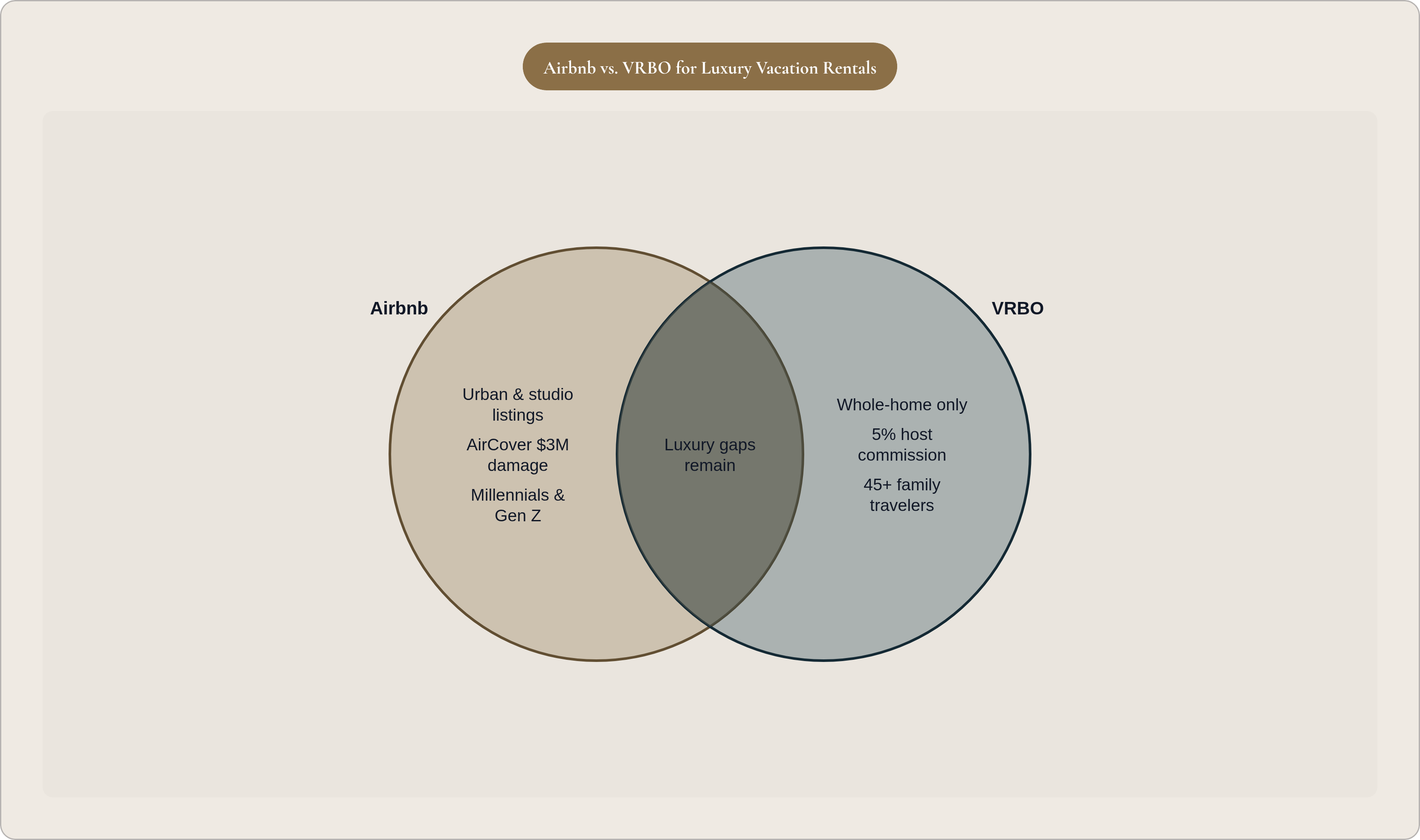
VRBO is the right primary platform when the property is a large whole-home in a beach, mountain, or ski market; when the owner needs strict guest cancellation terms; when the property is PMS-managed and the spread between 5% and 15.5% commission is material to the bottom line; and when the target guest is a family group, older affluent traveler, or multi-generational party booking well in advance.
Airbnb earns primary placement when the property is in a dense urban market where Airbnb has substantially deeper booking volume; when the owner is self-managing and can preserve the split-fee model; or when Luxe qualification is genuinely realistic and the service infrastructure to sustain it is already in place, not aspirational.
One industry measure puts average annual earnings for VRBO hosts roughly double those of Airbnb hosts. That number needs context before it means anything. It reflects the property-type composition of each platform more than anything the platform itself produces. VRBO's inventory skews toward larger, higher-rate vacation homes by design; Airbnb's includes rooms, studios, and urban apartments that pull the average down sharply. Luxury owners on both platforms outperform those averages by a wide margin, so the headline comparison is less useful than it looks.
For professional managers and multi-property operators, Airbnb's 15.5% PMS-connected fee changes the calculus in a way that's hard to argue around. VRBO's 5% for PMS-connected hosts is structurally more favorable by an order of magnitude. In most professionally managed luxury portfolios, VRBO becomes the primary platform and Airbnb fills occupancy gaps, rather than the other way around.
Dual-listing is the professional standard. Most serious operators list on both platforms to blend VRBO's higher revenue-per-booking with Airbnb's occupancy depth. Channel management software handles calendar synchronization and prevents double bookings. Running both is baseline; the real question is which one you build your strategy around.
Neither platform was designed for the top of the market, and both leave luxury owners carrying real risk that platform defaults don't address. VRBO's damage protection gap and absent built-in screening, Airbnb's AirCover limitations and fee structure for managed properties: the vulnerabilities are different, but they're present on both sides. Platform selection is one lever. Guest screening protocols, supplemental insurance, pricing strategy, and property presentation are equally consequential, and all of them live entirely outside what any platform provides by default. That infrastructure is yours to build.