All Inclusive Villas With Private Chef for Vacations
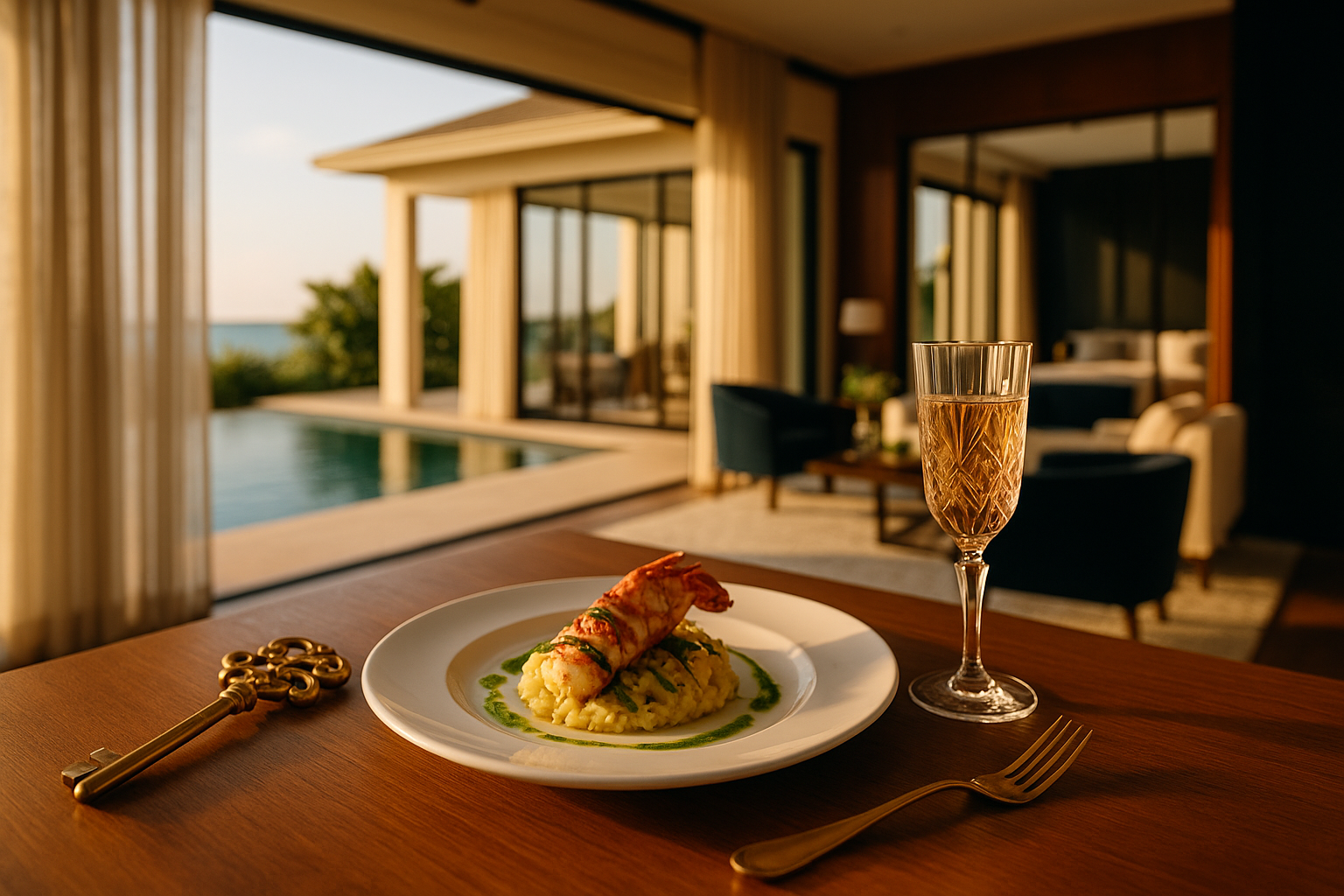
A private chef in a fully staffed villa is not a caterer who shows up for dinner. The role covers menu planning, grocery sourcing, dietary accommodation, service, and kitchen cleanup across the entire stay. The chef is a continuous presence, not an amenity you schedule — think of it less like ordering room service and more like having a culinary compass built into the house.
Meals run on the guests' schedule. Breakfast at ten, an early dinner for the kids at five-thirty, a late supper for the adults at nine: all standard, not a special request. The kitchen bends to the group, not the other way around.
Before arrival, any well-run villa sends a detailed intake: dietary preferences, restrictions, dishes you're hoping to eat that week. The chef builds menus from that brief. The range of requirements routinely handled is broader than most travelers expect. Vegan, halal, coeliac, low FODMAP, athlete nutrition, children's menus, nut-free, diabetic-friendly: these are treated as parameters, not complications. First-timers are usually surprised by how thorough this gets.
In the Caribbean and tropical markets especially, the chef often has direct relationships with local fishermen and farmers. Fresh catch delivered that morning, fruit harvested the same day. A chef who is embedded in a place, not rotating through it, sources through relationships that exist outside any distribution spreadsheet. That provenance shows up on the plate in ways that are hard to manufacture.
More accomplished chefs extend the role further: wine pairing, cooking demonstrations, anniversary dinners, culinary experiences built into the week without the guests having to orchestrate anything. In larger properties, the chef is one node in a wider operation, coordinating with the villa manager and concierge. A special dinner requires nothing from the guests except showing up.
One thing that consistently catches first-time bookers off guard: the grocery bill is almost always a separate line item, passed through at cost. Beverages and gratuity are frequently additional. These are predictable additions, not hidden costs, but they need to be budgeted before arrival rather than rationalized afterward.
How Pricing Is Structured and What the Real Cost Looks Like by Market
There are two distinct cost layers: the villa's nightly rate, which bundles staff services, and the grocery bill, which passes through separately. Understanding which costs live where is the foundation of any honest budget conversation, and conflating them is how people end up surprised at checkout.
Regional pricing differs substantially. In Mediterranean Europe, chef service runs roughly €400 to €600 per day depending on meal coverage, with groceries running around €50 per person per day for quality ingredients. In Los Cabos, chef service ranges from $25 to $40 USD per guest per day covering up to three meals plus snacks, groceries billed at cost. In the U.S. vacation rental market, the numbers spread wider: private chef service runs $85 to $250 or more per guest per meal, with full week-long bookings falling between $600 and $1,400 per guest depending on group size and service scope.
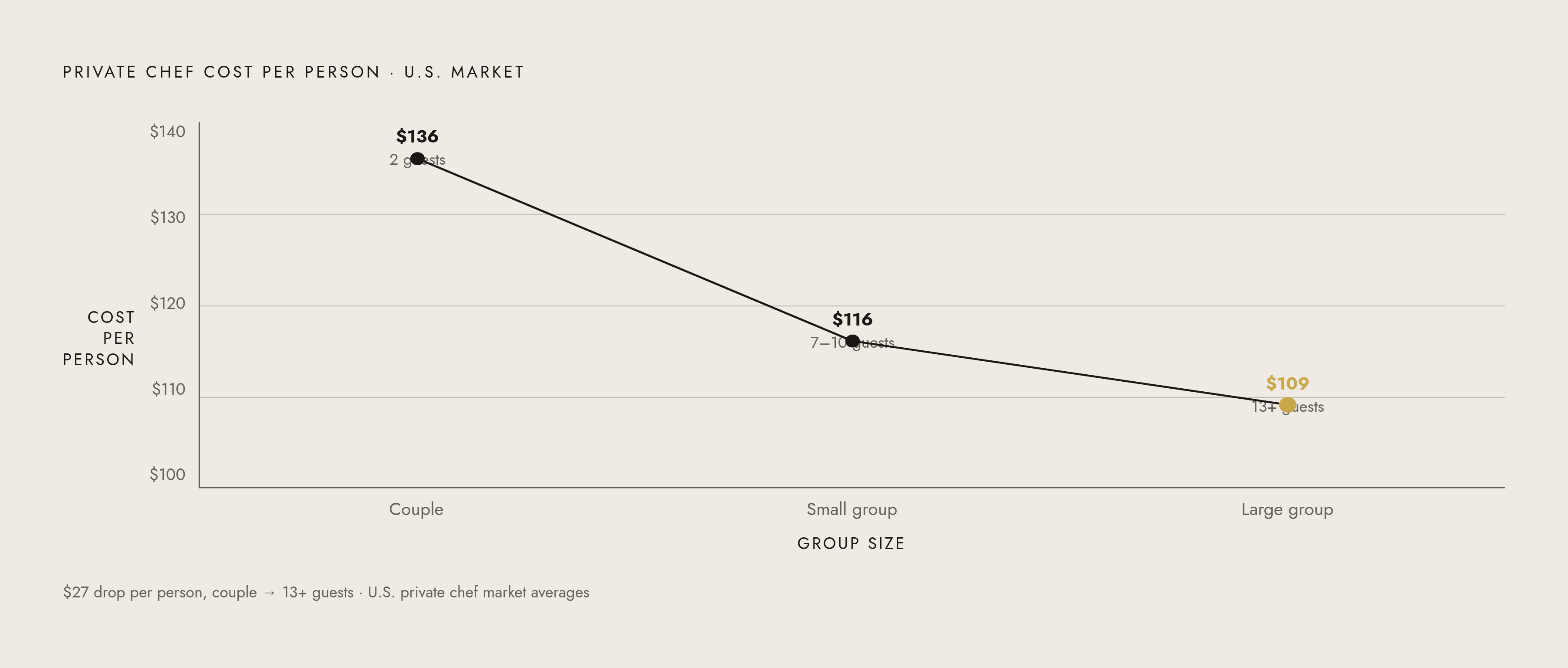
Group size compresses the per-person cost in ways that change the math entirely. In the U.S. market, couples average around $136 per person for chef service; groups of seven to ten average $116; groups of thirteen or more average $109. This compression is one of the structural reasons large groups find the format so financially compelling, and it's the first thing a good advisor will show you.
Pricing in this segment rose approximately 10 to 14 percent between 2024 and 2026, driven by grocery inflation in remote markets and rising demand from the luxury rental segment. Anyone planning multiple years out should factor that trajectory in.
Gratuity convention runs 18 to 22 percent in most markets. When the total service cost isn't readily calculable, $150 to $200 per day is a reasonable working reference. Customs differ by destination; what applies in the U.S. does not automatically translate to Barbados or Tuscany, and it's worth asking.
Many premium villas in Los Cabos and across the Caribbean bundle chef service into the nightly rate. Confirming at booking whether the chef is included or available as an add-on is the single most important clarifying question, and it needs to happen before any deposit is placed.
How the All-Inclusive Villa Compares to a Resort on Value, Not Just Price
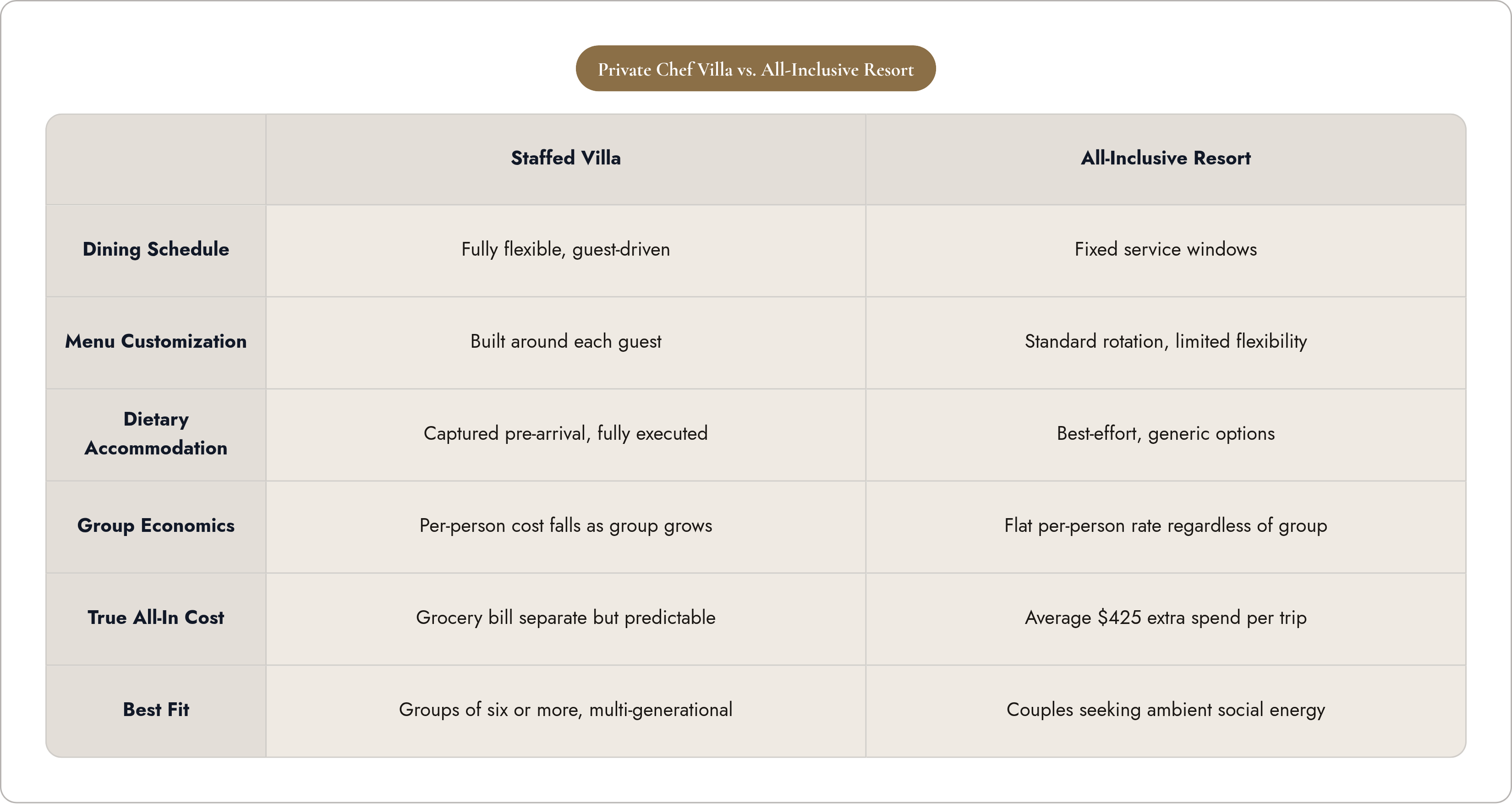
All-inclusive resorts average $300 to $400 per person per night in 2026. A group of eight splitting a well-staffed villa typically pays less per person while gaining private amenities, complete schedule flexibility, and a dining experience that has nothing in common with a hotel buffet. The per-person economics tilt further toward the villa as the group grows past six.
But the price-per-night comparison is actually the least interesting part of this conversation.
Resort all-inclusive packages constrain in ways that don't appear on the booking page: fixed venues, service timed for volume operations, menus that feel repetitive by day three. Research consistently shows that the overwhelming majority of resort guests spend meaningfully beyond the inclusive package, with average extra expenditure reaching $425 per trip. The "all-inclusive" cost is rarely the all-in cost — calling it all-inclusive is a bit like calling an iceberg a swimming platform — and the gap between those two numbers is where the value argument for villas quietly wins.
Villa dining operates on a different logic. Meals are customized, served when the group wants them, built around the specific people in residence. No shared pools, no ambient noise from adjacent guests, no standing in a line for the omelet station at 8 a.m. because that's when service runs.
Resorts retain genuine advantages: built-in social atmosphere, organized entertainment, structured programming. For two people who want ambient social energy and prefer to think about nothing, a resort is probably the right call. But the value calculus shifts decisively for groups of six or more, where per-person economics begin to undercut resort rates while delivering substantially more space and absolute dining autonomy.
Why Multi-Generational Groups Are the Natural Fit for This Format
Virtuoso's 2024 Luxe Report found that 85 percent of luxury travel advisors reported increased demand for multi-generational vacations, making it the largest single demand driver cited. The staffed villa format is, structurally, purpose-built for this.
The core tension in multi-generational travel is scheduling: different ages, different sleep rhythms, different dietary needs, all converging on a single trip. A private chef resolves this in a way no resort can replicate. Kids eat at five-thirty. Adults eat at nine. Nobody manages reservations for twelve across a crowded restaurant district. The chef handles the logistics, and the group reconvenes at a table that already knows what everyone can and cannot eat.
Dietary complexity across generations is captured in the pre-arrival intake and executed without improvisation on the ground. Age-appropriate children's menus, specific allergies, the nutritional considerations of a grandparent managing a health condition: all addressed before anyone boards a plane. Well-staffed villas also pre-arrange baby equipment, vetted babysitters, and age-appropriate snacks as part of the service brief, not as last-minute requests at check-in.
Villa layouts built for multi-generational use feature multiple master suites, children's play areas, private cinemas, and game rooms. The property functions as a private compound. And the shared meal, organized and served by a private chef, becomes the communal anchor of the day: the moment the whole group is in the same room without anyone having organized the logistics of being there. Every other activity tends to radiate outward from that table and return to it.
The appeal isn't primarily extravagance. It's shared memory, built in a setting that feels like home but runs like a hotel.
Where These Villas Are Concentrated and What Each Region Offers Culinarily
The Caribbean has the densest concentration of fully staffed villa inventory. Barbados, Jamaica, Turks and Caicos, Anguilla, St. Barts, and the Dominican Republic all have mature markets. Caribbean chefs typically maintain direct supply relationships with local fishermen and farmers, which means daily sourcing rather than regional distribution. Rio Chico Estate in Ocho Rios, Jamaica illustrates the staffing depth available at the estate level: 14 acres, two private beaches, an executive chef working alongside a sous chef and two butlers. That's not typical, but it's also not rare at the upper tier of this market.
Mediterranean Europe delivers a categorically different culinary experience. Tuscany, Provence, the Sicilian coast, and the Spanish Mediterranean offer access to regional culinary traditions that are genuinely inseparable from the place. Farm-to-table in Tuscany reflects actual supply infrastructure, not a marketing posture. A private chef there is drawing on provenance found nowhere else, and that specificity shows up on the plate in ways that are difficult to explain until you've sat at that table — it's the difference between reading about a place and tasting it.
Mexico's fully staffed villa market, concentrated in Los Cabos, Puerto Vallarta, Punta Mita, and the Mayan Riviera, features strong inventory with chef service frequently bundled into the nightly rate. Central America is developing quickly: Costa Rica's Guanacaste and Jacó/Los Sueños corridor have emerging premium inventory, with some properties accommodating groups of up to 18 guests and culinary teams covering both traditional Costa Rican and international cuisine.
Southeast Asia, particularly Bali, Thailand, and the Philippines, has a long-established staffed villa tradition. Bali has been running fully staffed operations for decades, and the service culture reflects that institutional depth.
The destination shapes the culinary experience as much as the chef does. A private chef in Tuscany and one in Jamaica are delivering fundamentally different stays. Knowing what you want from the food, not just the scenery, is how you match the format to the trip.
What to Verify Before Booking to Avoid Mismatches Between Listing and Reality
The most consequential question to ask is whether chef service is bundled into the nightly rate or available as an add-on. Many listings describe a villa as "with chef" when what they mean is that a chef can be arranged. That is a fundamentally different product from a villa where a resident chef is serving three meals daily as part of the base stay. The distinction lives in the fine print, and the financial and experiential gap between the two is substantial enough to ruin a trip that cost five figures to book.
Staff configuration deserves the same scrutiny. Confirm exactly who is on-site and when. Full-time resident staff is a different proposition from staff who arrive for specific meals, which is different again from a villa manager who facilitates external bookings. Ask explicitly, and get the answer in writing before the deposit clears.
The grocery arrangement needs to be clarified before booking. Is the grocery bill passed through at cost? Is there a markup? Is there a fixed daily food budget built into the rate? For a large group over a week, this line item is meaningful money, and ambiguity around it is a sign that the operational details haven't been worked out.
The pre-arrival dietary intake process is one of the most reliable signals of operational quality available to a prospective guest. Well-run villas have a formal, thorough process for this. If the booking platform skips dietary questions entirely, that gap warrants a direct conversation before committing.
Before finalizing any booking, get clear answers to these: Is the chef on-site daily or available by arrangement? How many meals per day are covered? What is the grocery pass-through process? Has the property been visited and vetted in person by the platform or agent? What happens if a staff member is unavailable during the stay? The answers to those questions tell you almost everything you need to know about whether the listing reflects a real operational product or a well-photographed aspiration.
The difference between a platform that lists any property with "chef" in the description and one that has verified staffing through direct inspection is the difference between getting what you paid for and spending a week navigating a gap between expectation and reality. At these price points, that verification is the whole game.