Short-Term Rental Insurance Options Compared for Vacation Homes
Standard homeowners policies void coverage the moment you list your property for rent.

A standard homeowners policy covers the dwelling and its contents against named perils: fire, wind, theft, plus personal liability. The operative word is personal. Coverage assumes the homeowner is the occupant, or at minimum that no commercial transaction has occurred. A rental booking changes that classification the moment it happens, whether or not you ever told your carrier.
The commercial activity exclusion is not subtle. Most owners have simply never read it. Rental income transforms the transaction from residential to commercial in the insurer's view, and that single reclassification is enough to void coverage. Some carriers offer a homeowners endorsement extending coverage to occasional rental use, typically capped at a limited number of rental days per year. American Family's temporary rental endorsement works for that specific use case: owners renting a handful of weekends annually, primary personal use, no ambitions beyond that. For anyone renting meaningfully beyond that threshold, it does not hold, and the denial arrives after the claim, not before.
Landlord policies, specifically the DP-3 form, are the next step many owners reach for. Designed for long-term tenants: a known occupant, a lease, a stable risk profile. They cover the structure and often loss of rental income, which sounds right. What they exclude is the part that bites. Guest-caused damage, intentional damage from a short-stay visitor, liability claims from a rotating cast of strangers who never signed anything. A guest who slips by the pool during a four-night stay is a categorically different liability scenario than a long-term tenant tripping in a hallway. The DP-3 was priced for the second situation.
The Insurance Information Institute has documented what happens when owners skip this analysis: denied claims, reduced liability payouts, higher deductibles, or outright policy cancellation triggered by undisclosed rental use. Most owners never disclose it. They assume the existing coverage travels with the property. It does not.
For owners relying on a standard homeowners policy or a landlord policy for STR activity, the practical position is this: uninsured for the most probable claim scenarios. Guest damage, guest injury, income loss after an incident. The coverage exists on paper. It just will not pay when called upon.
What Platform Protections Like AirCover and VRBO's Liability Program Actually Provide
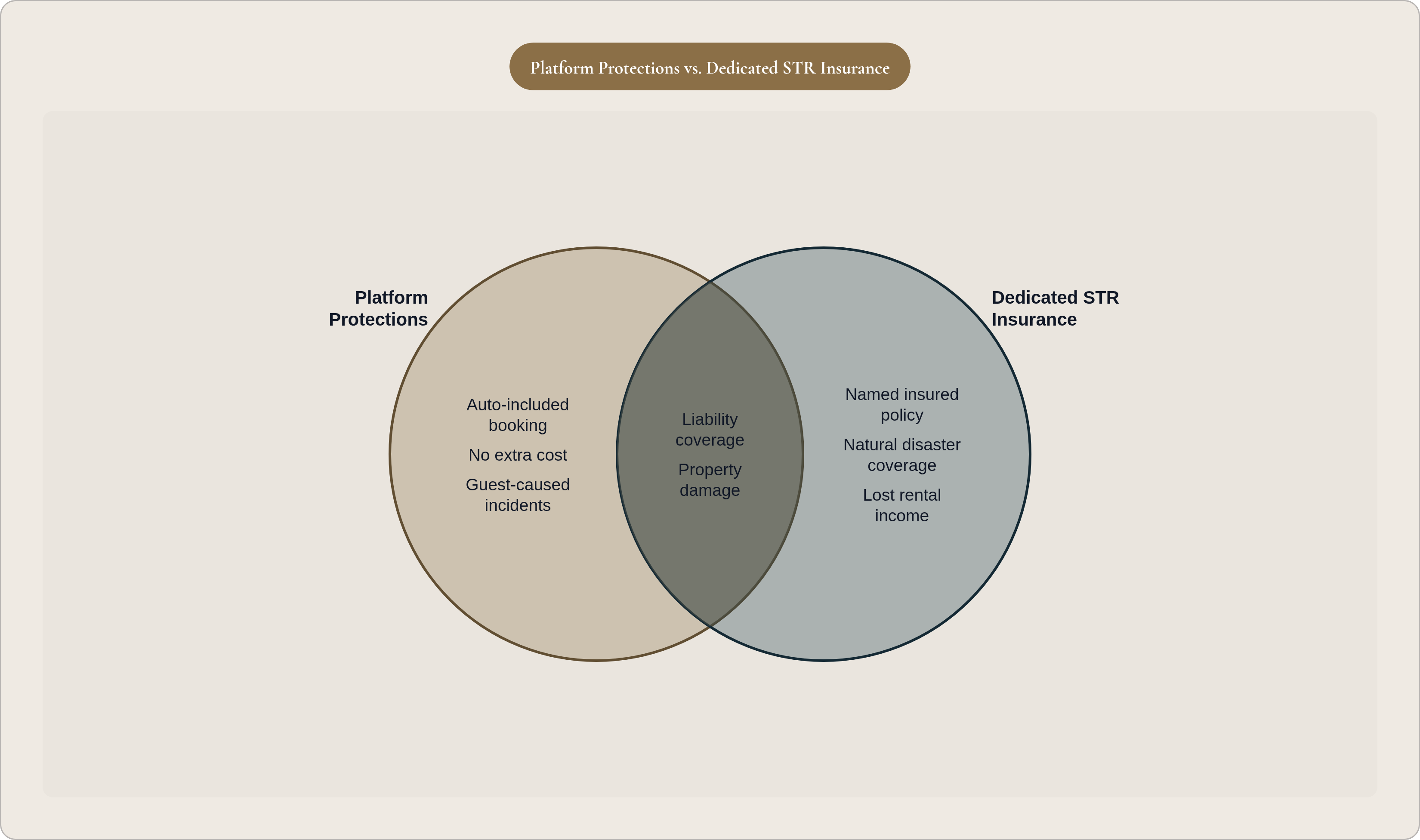
Platform protections are not insurance policies. They function more like discretionary indemnification programs, and understanding that distinction is the entire ballgame when a real claim lands.
Airbnb's AirCover offers host damage protection and liability coverage at no additional cost, automatically included with every booking. Liability extends to co-hosts and cleaners, which is a structural advantage worth acknowledging. The problem: the host is not a named insured. There is no policy. The host has no independent rights and is entirely dependent on Airbnb's willingness to pay, on Airbnb's timeline, using Airbnb's damage assessment methodology, which factors in depreciation. Hosts receive actual cash value, not replacement cost, on damaged items. Clear Creek County in Colorado has explicitly ruled AirCover insufficient as proof of insurance for STR permitting purposes. That ruling is not an anomaly; it reflects the direction municipal regulators are moving.
VRBO's liability program covers third-party injury claims up to a stated limit, automatically included on accepted bookings. Guest-caused property damage falls outside its scope entirely; VRBO routes that to guest-purchased damage protection or direct resolution between host and guest. The program is also secondary coverage, meaning it activates only after any other applicable coverage the host carries is exhausted. In practice, hosts with proper STR insurance will rarely see VRBO's liability program do anything useful at all.
The shared gaps across both platforms are where owners get hurt. Neither covers natural disasters: storms, wildfires, burst pipes, flooding. Neither applies to direct bookings made outside the platform, so hosts listing across multiple channels or taking reservations by phone have protection that evaporates for a meaningful portion of their actual bookings. Neither compensates for lost rental income if the property becomes uninhabitable. Contents, including furniture, electronics, and linens, are partially or entirely excluded.
Platform protections address guest-caused incidents in a narrow, discretionary way. Any owner treating them as a substitute for a property insurance policy is carrying substantially more risk than they realize, and they will find out at the worst possible moment.
The Four Coverage Types That Actually Address STR Risk, and What Each Is Built For
There are four structures worth understanding. Each serves a distinct owner profile, and conflating them leads to either overpaying or under-covering.
Homeowners endorsement. An add-on to an existing homeowners policy extending coverage to rental periods up to the carrier's day limit. Right for owners renting occasionally, a few weekends per year, with primary personal use. Not designed for full-time or near-full-time rental activity, does not provide commercial-grade liability, and does not satisfy most STR permit requirements that demand a named-insured policy.
Standalone dedicated STR insurance. The appropriate baseline for anyone renting regularly. A purpose-built commercial package written from the ground up for short-term rental use, typically bundling dwelling coverage, contents, commercial liability, and lost business income in a single policy. Strong standalone STR policies also cover intentional or malicious guest damage, a gap left open by both homeowners and landlord policies. Additional coverages can include guest medical payments, liquor liability, amenity liability for pools and hot tubs and docks, equipment breakdown, and bedbug remediation. This type of policy often replaces the homeowners policy entirely rather than sitting on top of it. That matters: owners making that switch are exchanging a policy that would likely deny their claim for one designed to pay it.
Landlord or dwelling policy. The DP-3 can serve as a reasonable interim solution for owners transitioning between use types who want structural and income coverage consolidated. Its limitation is consistent: not written for guest-facing liability or intentional damage scenarios. If used for short-term guests, it needs supplementing with an STR endorsement and an umbrella policy. Even then, it is a workaround rather than a solution.
Umbrella policy. A supplemental liability layer, not a standalone. Requires an underlying policy and covers claims exceeding that policy's limits. Insurance advisers working with rental property owners regularly recommend substantial umbrella limits given the exposure of hosting strangers overnight. The cost is low relative to what it adds; often the most efficient dollar spent once the primary policy is in place.
How the Major Dedicated STR Insurers Differ From Each Other in Practice
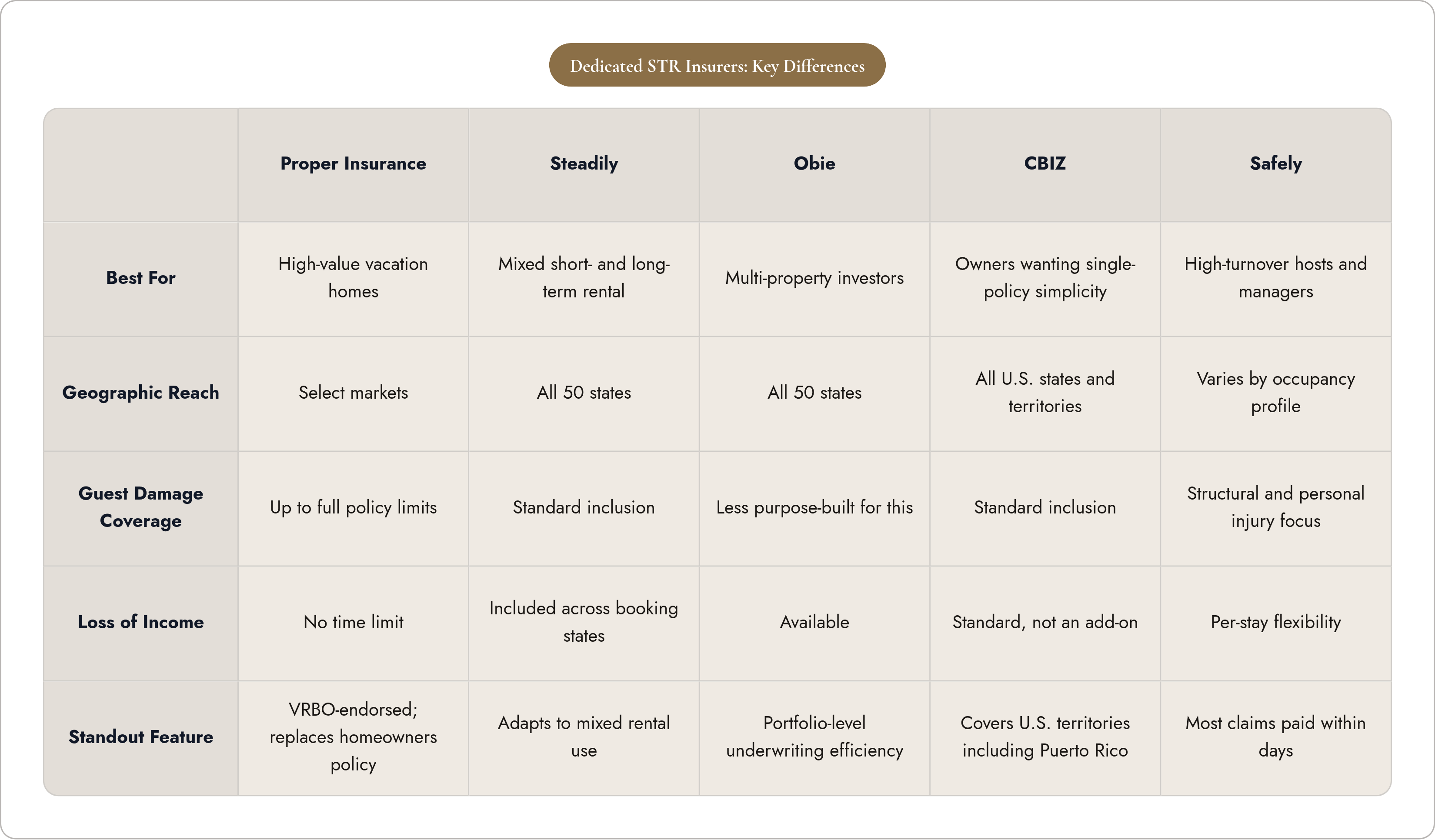
The dedicated STR insurance market has matured, but the major players differ in ways that matter depending on property type, location, and how the owner actually operates.
Proper Insurance. Underwritten by Lloyd's of London, structured as a true commercial package that replaces the homeowners policy rather than supplementing it. Coverage for guest-caused damage runs up to policy limits with no separate sub-limit cap. Loss of business income has no time limit. The policy includes liquor liability, bedbug and flea coverage, squatter protection, and amenity liability. VRBO has explicitly endorsed Proper Insurance as meeting their coverage standards, the only major platform to make that specific endorsement. It is among the higher-priced dedicated STR options. For high-value vacation homes in premium markets where comprehensive coverage and strong liability limits matter more than monthly premium, that price is usually justified.
Steadily. Covers the dwelling on named perils, liability, and loss of rental income, whether guests are present, the property is between bookings, or it sits vacant. Available in all fifty states, which matters because many specialty STR insurers have gaps in high-risk coastal and mountain markets. Flexible across property types: single-family homes, condos, cabins, multi-family. CNBC has included Steadily among its recommended landlord insurers in its most recent review of the category. Steadily fits well for owners with a mix of short-term and longer-term rental use, or accidental landlords who want one policy that adapts to how they actually use the property rather than how they envisioned it when they bought it.
Obie. Skews toward real estate investors: owners holding property in an LLC, managing multiple properties, fitting insurance into a financing or portfolio context. Available in all fifty states with instant online quoting, typically producing meaningful savings versus standard carriers for experienced landlords. Multi-property investors who want efficiency and portfolio-level underwriting will find Obie worth quoting. It is less purpose-built for high-volume STR situations where amenity liability and guest damage coverage need to be the primary focus.
CBIZ Vacation Rental Insurance. Structures a single policy that can replace both a dwelling and a landlord policy, with commercial general liability and a substantial aggregate limit built in. Loss of income is standard coverage, not an add-on. Bedbug remediation is available as an endorsement with no deductible. Available across all U.S. states and territories, including Puerto Rico and the U.S. Virgin Islands, which is directly relevant for owners in Caribbean-adjacent markets where other carriers stop short. For owners who want a clean, single-policy solution without assembling multiple endorsements, CBIZ is a serious option.
Safely. Specializes in on-site incidents: structural damage, personal injury to guests, homeowners, and property managers, and valuables coverage. Claims processing speed is a genuine differentiator; the large majority of claims are paid within days rather than weeks, which matters for hosts managing continuous guest turnover who cannot afford to wait for resolution before the next booking begins. Pricing is customized based on occupancy, number of properties, and chosen deductible. Property managers and hosts running high-turnover operations, where claims velocity and per-stay flexibility are operational priorities, are Safely's natural market.
For owners using a high-end furnished-residence rental service that also provides property management in premium destinations, the insurance obligation still sits with the owner. Owners who want their management structure and their protection structure to cohere rather than conflict will find that context relevant when choosing a policy.
Allstate and American Family. Both offer STR coverage for qualifying properties, including liability, property damage, loss of income, and natural disaster damage. American Family's endorsement is a legitimate option for genuinely occasional rental use. For owners already holding a policy with one of these carriers who rent infrequently, consolidation is often simpler than adding a specialist policy. The consistent limitation: these carriers' STR products are not as feature-rich as dedicated specialists for full-time rental properties, particularly on guest damage coverage and amenity liability.
How Market Location Shapes Coverage Decisions in Ways Most Owners Underestimate
Location does not just affect premium. It determines what coverage is available, which carriers will write a policy at all, and in some cases whether any policy exists for a specific property in a specific county.
Coastal markets concentrate vacation rentals precisely where natural disaster exposure is highest. In South Florida and the Hamptons, wind and storm coverage is often the highest-cost line item, and some carriers sub-limit or exclude it entirely. The premium difference between a policy with full wind coverage and one without is not marginal; it can represent a substantial portion of total annual cost. Owners need to read their declarations pages, not just the marketing summary they received when they bound coverage.
Mountain markets carry a different but equally serious risk profile. Wildfire, pipe-freeze, and heavy snow load create loss scenarios that standard policies handle inconsistently. Aspen, Lake Tahoe, and similar markets require explicit confirmation that these perils are covered, not assumed.
California is a category unto itself. Carriers have materially pulled back from wildfire-exposed areas. The state FAIR Plan, which functions as an insurer of last resort, provides narrower coverage than most owners assume. In exposed zones, quotes for comparable properties vary dramatically depending on the carrier's current appetite for California wildfire risk, and that appetite shifts year to year. Owners in California should expect a specialized search, not a standard quoting process with predictable outcomes.
Geographic gaps in specialty carrier availability are real and consequential. A carrier with an otherwise strong product will decline to write policies in a high-risk coastal county. Steadily's fifty-state footprint and CBIZ's territorial breadth across U.S. territories are specifically relevant for owners in markets where other carriers simply stop writing.
Urban markets add a different layer. Co-op and condo master policies, building-level liability, and local STR regulations all affect what a private policy needs to cover. In New York City specifically, the master policy's terms can conflict with or overlap a private STR policy in ways that require careful coordination before binding coverage.
Finally, permitting. An increasing number of municipalities require proof of insurance as a condition of the STR license. Platform protections typically fail to satisfy these requirements because the host is not a named insured. In these markets, a named-insured policy is not just a financial consideration; it is a regulatory prerequisite. Without it, the operation is illegal.
Matching Coverage Type to Owner Situation: A Practical Decision Framework
The right coverage follows from four variables: rental frequency, property value, location risk profile, and whether the owner also uses the property personally. None of these operates in isolation.
Occasional renter, personal use primary. A homeowners endorsement from the existing carrier is sufficient. Confirm the annual day cap and verify explicitly that liability is extended during rental periods. Add an umbrella regardless; the liability exposure of any overnight guest justifies it, and the cost is low relative to the protection.
Regular STR operator, property rented most of the year. A dedicated STR policy replacing the homeowners policy is the baseline. For high-value properties in premium markets, Proper Insurance's commercial package provides the broadest coverage ceiling. CBIZ is a strong single-policy alternative for owners who want simplicity without assembling endorsements. Steadily fits well where the rental mix includes both short-term and longer stays, or where the property type requires flexibility.
Multi-property investor. Obie's portfolio-oriented approach makes it worth quoting alongside the STR specialists. At this scale, a commercial property policy is required regardless of insurer, and the efficiency of portfolio-level underwriting becomes a practical advantage.
Owner using a professional property manager. The manager handles guest screening, turnovers, and incident response. The insurance obligation still sits with the owner. Confirm the manager's own liability coverage and whether it coordinates with or requires a specific type of owner policy. The management layer does not transfer risk; it manages operations around risk. Coverage decisions remain the owner's responsibility.
Most owners in this category make one of three assumptions: that a homeowners policy covers rental activity, that platform protection is equivalent to a named-insured policy, or that a landlord policy handles guest liability. Each of those assumptions is wrong, and none of them gets corrected until there is a claim. The landscape is not that complicated to understand. It just requires someone actually looking at it before something goes wrong.