Short-Term Rental Depreciation Loophole Explained
Investors can offset W-2 income with rental losses if average guest stays stay under seven days.

The strategy lives in IRC Section 469 and Treasury Regulation 1.469-1T(e)(3)(ii). The rule is precise: if the average period of customer use across all bookings is seven days or fewer, the IRS does not classify the activity as a rental activity. That reclassification is everything.
Once it happens, losses offset ordinary income in the current year. No passive income pool required, no waiting for a sale. For a W-2 earner who has been watching rental depreciation pile up as suspended losses on paper, useful as wallpaper, this is the distinction that actually changes the tax bill.
The word "loophole" implies something engineered around the code. That framing is wrong. The seven-day exception was originally written to cover hotels and motels, which share the operational profile of short-term rentals: frequent turnover, active management, guest services. STR investors fit an existing statutory category. They did not manufacture a workaround; they fit a pre-existing statutory slot.
This strategy is also distinct from Real Estate Professional Status, and conflating the two is a common error. REPS requires more than 750 hours annually in real estate activities, and real estate must constitute the majority of the taxpayer's working hours across all professions. Most full-time employees cannot get there. The STR seven-day rule is a parallel pathway, not a lesser version of REPS. A W-2 employee can qualify for the STR exception without touching REPS. They are not sequential steps.
Two adjacent exceptions exist in the code worth knowing. If the average guest stay is 30 days or fewer and the owner provides significant personal services, the activity also escapes rental classification. Extraordinary personal services can trigger reclassification regardless of stay length. In practice, most STR owners use the seven-day rule, and that is where the analysis belongs.
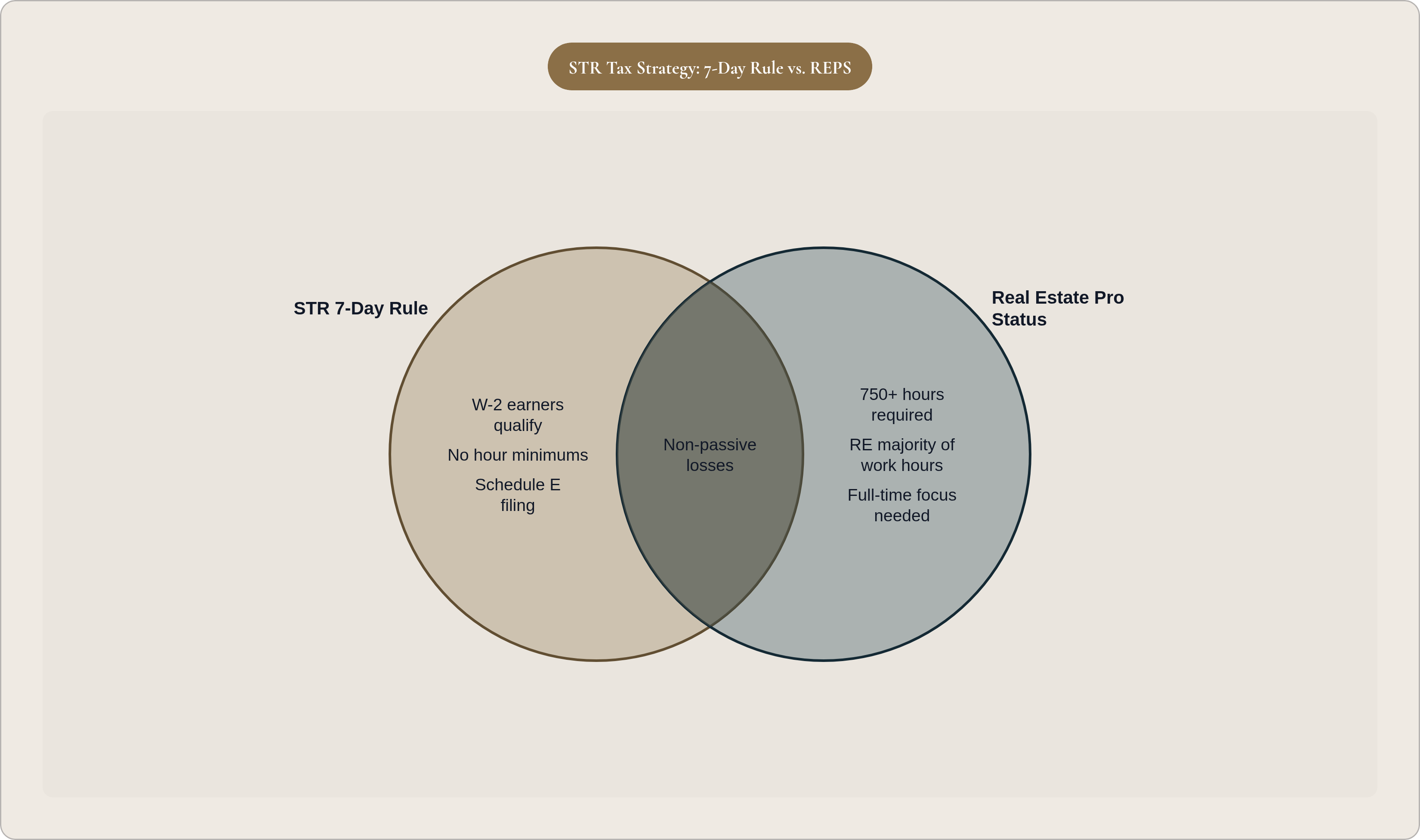
The Two Gates an Owner Must Pass: The 7-Day Rule and Material Participation
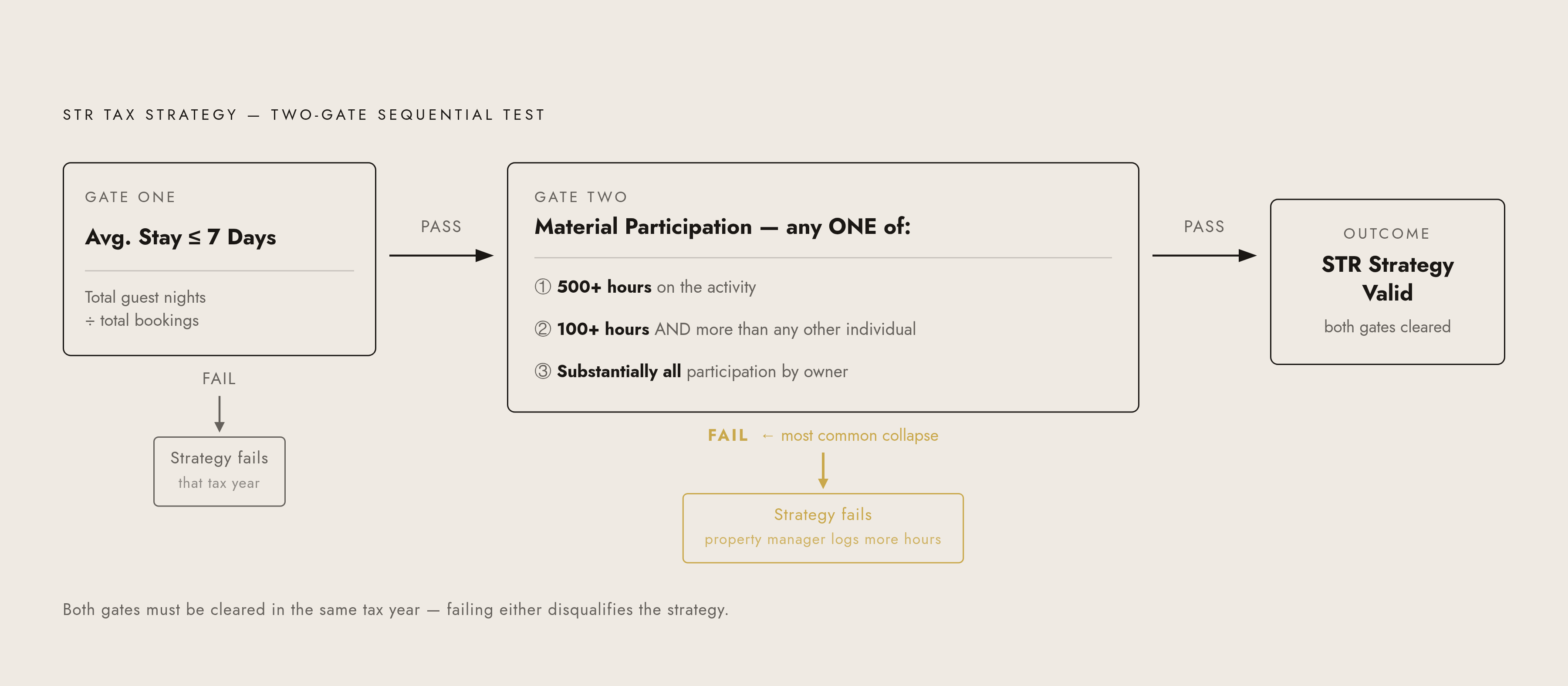
Both conditions must be satisfied in the same tax year. One without the other and the strategy fails for that year entirely.
Gate One: The Seven-Day Average Stay
The calculation is simple: total guest nights divided by total number of bookings. Seven or below, the first condition is met. What the IRS examines is the actual booking record, not the listing description, not the owner's stated intent, not the marketing copy. A property advertised as a weekly rental that books in five-day blocks qualifies on the math. A property marketed as short-stay that routinely runs eight or ten-day reservations does not. Records control. Tracking every booking with exact check-in and check-out dates is a documentation requirement with real consequences, not administrative tidiness.
Gate Two: Material Participation
The IRS provides seven tests for material participation; any one satisfies the requirement. STR owners most commonly qualify through three: more than 500 hours spent on the activity during the tax year; more than 100 hours combined with the owner spending more time on the activity than any other individual, including cleaning crews and property managers; or substantially all participation in the activity performed by the owner.
Qualifying hours include guest communication, pricing decisions, maintenance coordination, listing management, and capital improvement planning. Passive oversight and reviewing financial statements do not count.
The most consequential mistake owners make is hiring a full-service property manager and then claiming material participation anyway. If the property manager logs more operational hours on the property than the owner, the owner fails the test. Non-passive treatment disappears, losses revert to passive status, and the strategy collapses for that year. An owner who genuinely wants this treatment must either stay actively involved or ensure the hour comparison is documented and clearly favorable.
A property with a three-day average stay can still fail this strategy completely if the owner delegates operations and cannot demonstrate meaningful personal involvement. The first gate means nothing without the second.
How Depreciation Is Calculated on a Short-Term Rental, and Why the Base Schedule Matters Less Than It Seems
The base depreciation schedule for most short-term rentals is 39 years, the nonresidential real property rate, rather than the 27.5-year schedule available to long-term residential landlords. On the surface that looks like a penalty for operating in a higher-friction asset class.
It largely isn't. STR owners who qualify under the loophole have access to cost segregation and bonus depreciation, two mechanisms that allow them to front-load the majority of their depreciation into the acquisition year. The 39-year schedule governs what remains after reclassification. For high-value properties, the base schedule becomes almost incidental. The real action happens in year one, not spread across four decades.
What a Cost Segregation Study Does and What It Typically Produces
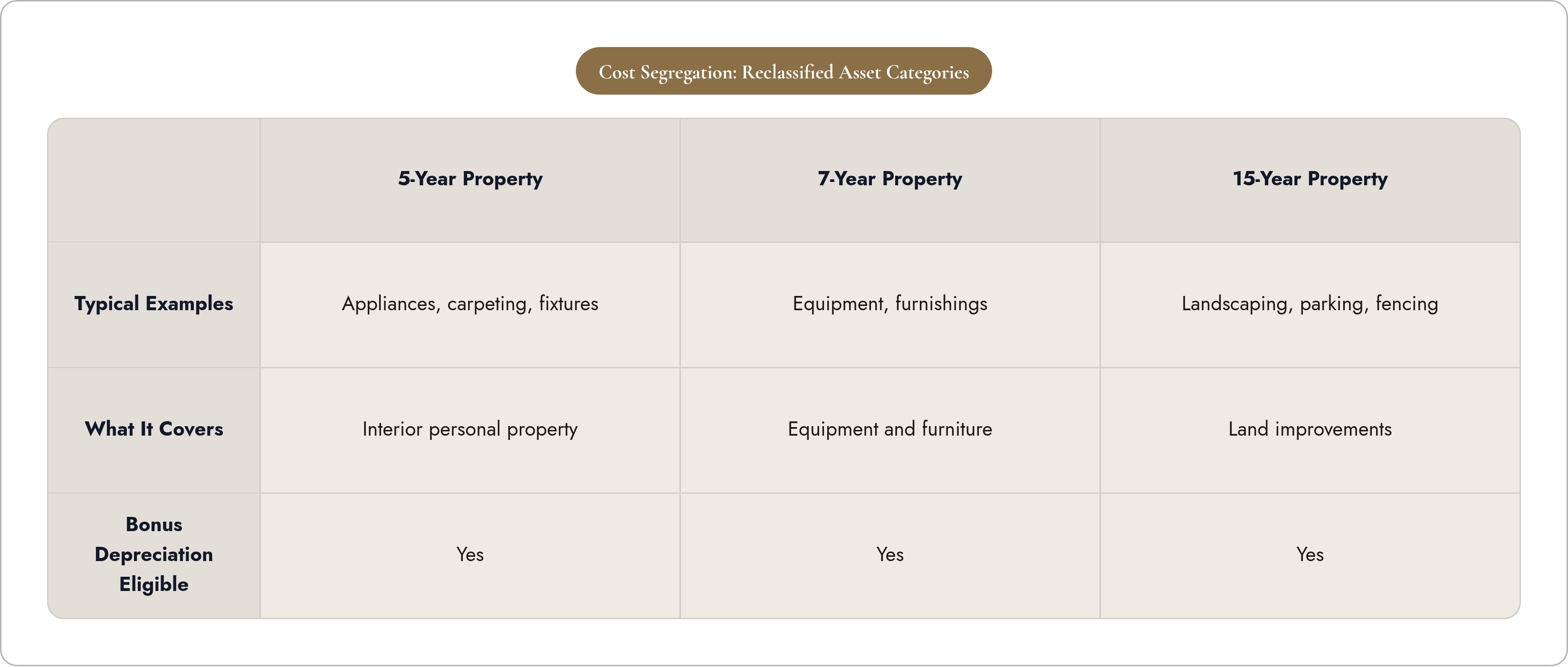
A cost segregation study is an engineering-based analysis that disaggregates a property's components and reclassifies them into shorter depreciation categories under IRS guidelines. Instead of depreciating everything over 39 years, the study identifies which components qualify for five-year, seven-year, or fifteen-year treatment.
Five-year property typically includes appliances, carpeting, and certain fixtures. Seven-year property covers equipment and some furnishings. Fifteen-year property captures land improvements: landscaping, parking areas, fencing. Across a well-executed study, twenty to forty percent of a property's value typically gets reclassified into these accelerated categories. On a $1 million vacation rental, that represents $200,000 to $400,000 in assets eligible for accelerated treatment rather than 39-year straight-line depreciation. When 100% bonus depreciation applies to those reclassified components, they can be fully expensed in the year the property is placed in service.
Study costs typically run $2,000 to $5,000 for smaller properties and up to $15,000 or more for larger or more complex assets. For any qualifying STR owner on a property above roughly $250,000 in value, the expense pays for itself many times over in the first year.
Owners who did not run a study in prior years can commission a retroactive one. The missed accelerated depreciation is claimed on the current-year return via Form 3115, Application for Change in Accounting Method, using an IRC Section 481(a) adjustment. All catch-up depreciation for prior years collapses into a single current-year deduction. This is particularly effective in a high-income year when the owner also satisfies both STR gates simultaneously, because the deduction lands exactly when it does the most work.
Bonus Depreciation in 2025 and What the One Big Beautiful Bill Act Changed
Bonus depreciation under the Tax Cuts and Jobs Act of 2017 was set at 100% through 2022, then scheduled to phase down: 80% in 2023, 60% in 2024, 40% in 2025, 20% in 2026, and zero by 2027. For STR owners running the numbers after 2022, that trajectory meaningfully reduced the strategy's first-year impact. The math still worked, but with less force each year.
The One Big Beautiful Bill Act, signed on July 4, 2025, reversed that. The legislation makes 100% bonus depreciation permanent for qualified property placed in service after January 19, 2025. The phase-down schedule is eliminated. IRS Notice 2026-11 provides guidance on the permanent 100% first-year deduction.
The eligibility line matters. Property placed in service on or before January 19, 2025, or acquired on or before that date and placed in service afterward, remains governed by prior law: 40% for 2025, 20% for 2026, and zero after that. For property placed in service after January 19, 2025, the 100% rate applies. Get the timing wrong and you're on the old schedule.
The legislation also raised the Section 179 expensing limit to $2.5 million, up from $1.22 million in 2024, with the phase-out threshold increased to $4 million in qualifying purchases, indexed for inflation going forward. For a qualifying STR owner who acquired property after the eligibility date, these changes restore the full first-year power of the strategy.
What the Numbers Look Like in Practice Across Several Property Types and Income Levels
On a $1 million property where a cost segregation study recharacterizes 25% of the purchase price into accelerated categories, the resulting deduction approaches $250,000. At a 35% federal marginal rate, the immediate tax savings from that single deduction approach $87,500. In one year, on one property.
A $600,000 property with 30% of its value reclassified produces roughly $180,000 in first-year deductions when 100% bonus depreciation applies. A W-2 employee earning $180,000 annually who meets both material participation gates on a $450,000 vacation rental can offset a meaningful portion of that salary with accelerated depreciation losses; published practitioner case studies document first-year savings in the range of $60,000 in scenarios like this. Practitioner-cited examples also show qualifying owners generating non-passive losses exceeding $250,000 on single properties, translating to federal income tax savings approaching $80,000 in the acquisition year alone.
The strategy scales with property value and marginal rate. The investor who captures the largest absolute benefit is, almost exactly, the investor with access to premium short-term rental inventory in high-cost markets. That alignment is not coincidental. This mechanism was not designed to be egalitarian.
Schedule E vs. Schedule C: Which Form Applies and When Self-Employment Tax Enters
Most STR owners report on Schedule E, even with short average stays and even with the loophole in effect. A short average stay alone does not push rental activity onto Schedule C.
Schedule C applies when the owner provides substantial services to guests during their stay, the kind that make the operation more analogous to a hotel than a rental: daily housekeeping, concierge services, prepared meals. The IRS draws the line between services provided during the stay and services provided between stays. Turnover cleaning, restocking, standard guest communication, those happen between stays. They are operational, not hospitality-oriented. Owners performing those tasks stay on Schedule E.
This distinction carries real cost. Schedule C classification triggers self-employment tax on net income, an additional burden most STR owners can legally avoid. The practical rule: if the services make the property feel like a hotel during the guest's visit, Schedule C is appropriate. If the services keep the property functional and clean between visitors, Schedule E applies. Most owners, even attentive and responsive ones, land on Schedule E.
Depreciation Recapture at Sale: What the Deductions Cost on Exit
Every dollar of depreciation taken today creates a recapture obligation at sale. This is not a risk unique to the STR loophole; it applies to all depreciation across all real property. Understanding it as a structural feature of the code, not a consequence of the strategy, changes how you plan for it.
Two regimes apply depending on asset class. For Section 1245 property, the five-year and seven-year assets reclassified through cost segregation, recapture is treated as ordinary income and taxed at the owner's marginal rate. For Section 1250 property, the building and structural components, recapture is capped at 25% under current law.
The IRS "allowed or allowable" doctrine closes the obvious workaround. Recapture applies to depreciation that was either taken or available to be taken. An owner who deliberately skips depreciation to sidestep recapture still owes the tax on sale, calculated as if the deduction had been claimed. The basis adjusts regardless. Skipping the deduction forfeits the current-year benefit while leaving the future recapture intact. You absorb the downside without collecting the upside.
The standard mitigation tool is the 1031 exchange, which defers recapture liability by rolling proceeds into a qualifying replacement property. The obligation defers rather than disappears, but deferral compounds across multiple transaction cycles and is genuinely valuable. The time value of large deductions today versus recapture tax in a future sale year typically favors taking the depreciation, particularly at high marginal rates. Model the numbers for each specific situation, but for most high-income owners in high-tax years, the answer is to take the deduction and plan the exit, not to forgo a benefit the IRS will assess anyway.
Where IRS Scrutiny Focuses and What Documentation Holds Up Under Examination
Large depreciation losses on short-term rental properties draw IRS attention. The dollar amounts are significant, the qualification conditions are specific, and errors tend to surface during review because the thresholds are defined clearly enough to test against actual records.
Examiners start with the average guest-stay calculation, reconstructed from actual booking records. Discrepancies between a property's marketing descriptions and its real booking patterns are a red flag. The math controls, not the listing.
Material participation time logs receive close examination. Vague hour estimates reconstructed months after the fact do not hold up. Contemporaneous records with specific dates, specific activities, and a reasonable accounting of time are what survives. A spreadsheet maintained throughout the year, updated in real time, is the standard to meet. Reconstruct it after the fact and you are working from memory, which is not what auditors find persuasive.
The hour comparison between the owner and any third-party service providers is a frequent point of failure. If an examiner can demonstrate that a property manager, cleaning service, or other operator logged more hours on the property than the owner, the material participation claim collapses. The owner's documentation must be specific enough to be credible, and the total must demonstrably exceed the third party's. This is where the strategy falls apart most often in practice: owners who believe they were involved enough but cannot prove it on paper.
Cost segregation study quality is also reviewed. The IRS challenges studies that lack adequate engineering documentation or where component categorizations are superficial and unsupported. The quality of the firm conducting the study matters. A well-documented study from a credentialed engineering firm is substantially more defensible than a low-cost alternative that treats the analysis as a spreadsheet exercise.
The strategy itself is not what creates examination problems. What creates problems is execution: owners who estimate rather than document, who claim hours they cannot reconstruct, who delegate operations to a management company and then assert they were more involved than the manager. The code rewards active, engaged owners who keep real records. That is a narrow enough description to separate the owners who actually belong in this strategy from the ones who are claiming a benefit the facts do not support.