Airbnb Arbitrage for Luxury Rental Properties
Luxury rentals buck the market downturn, but arbitrage requires deep capital and flawless execution.

The overall short-term rental market is growing, but aggregate growth numbers are actively misleading right now. The market is splitting by tier, and the tiers are moving in genuinely opposite directions.
Nationwide STR occupancy cooled notably in 2025, down from a higher level the prior year, as supply keeps outrunning demand. AirDNA's 2026 outlook projects available listings growing at more than three times the pace of average daily rate growth, with revenue per available rental rising less than one percent. If your inventory is undifferentiated, you already feel this.
Luxury is doing something else. Average daily rates for luxury-tier rentals rose meaningfully year-over-year in 2025 while budget listings saw rates fall. Demand for large-format properties, five, six, seven bedrooms, grew by double digits. The global luxury vacation rental market was estimated at tens of billions of dollars in 2024 and is projected to roughly double by 2034, a strong compound annual growth rate, with the United States holding the dominant share. These figures are drawn from market research projections and carry the uncertainty inherent in long-range forecasts.
Here is what that divergence means for someone trying to build an arbitrage operation: the generic market's margin compression is, paradoxically, part of the argument for going upmarket. Pricing power at the top is holding while everything else softens. The product luxury arbitrage offers, a premium residential experience that no hotel can replicate, has structural tailwinds that current data supports. Whether a given operator can execute well enough to capture them is a different question, and the answer depends on a lot more than market data.
How the Arithmetic Changes When the Asset Is a Luxury Property
The working rule in STR arbitrage is that monthly revenue needs to reach at least two and a half to three times monthly rent before you have a workable margin after costs. Below two times, operators are frequently losing money without knowing it, because they are not fully accounting for variable costs against gross revenue. At luxury price points, that ratio needs stress-testing against realistic occupancy scenarios — not the ones you hope for, the ones that actually happen.
Higher nightly rates do shift the break-even math in the operator's favor. A unit priced at several hundred dollars per night needs fewer booked nights to cover several thousand dollars in monthly fixed costs than a budget unit at a low nightly rate needs to cover its fixed costs. The required occupancy percentage is lower. But the absolute cost structure is also heavier, and that is exactly where operators get into trouble: they model the revenue side carefully, then estimate the expense side loosely.
Platform fees are not small and they are not negotiable. Airbnb's host service fee runs in the mid-teens percentage range, deducted from payout. At a high nightly rate, that amounts to a significant fee on a single booking. Across a full month of real occupancy, that dollar figure becomes a significant line item. Management fees, cleaning costs, linen replacement, consumables, damage protection: all of it scales with the asset tier. Furnishings at the luxury level are not a one-time sunk cost; they depreciate, they get damaged, and they need periodic replacement. Owners who treat that last point as an abstraction eventually encounter it as a cash crisis.
The break-even occupancy benchmark for a typical arbitrage unit sits around 62%. At the national average of roughly 50%, many units are operating below that threshold. Well-run operations in strong markets can produce net margins in the 15% to 35% range, but that performance demands the right market, the right property, and a level of cost management that borders on obsessive. Austin illustrates the downside: average monthly STR revenue there runs close enough to average long-term rent that once operating costs are applied, the unit frequently produces a loss. The luxury arbitrage case rests entirely on finding markets where long-term lease costs stay moderate relative to achievable nightly rates. The spread has to be wide enough to carry a heavier cost structure and still leave something worth doing.
What It Actually Costs to Stand Up a Luxury Arbitrage Unit
Standard arbitrage startup costs, security deposit, first month's rent, basic furnishings, smart locks, photography, initial platform fees, run several thousand to tens of thousands of dollars. That number does not apply at the luxury tier.
Furnishings are where the cost structure diverges most sharply. A property commanding high nightly rates requires high-quality furniture, premium linens, artwork, high-end appliances, and staging that communicates quality in the first photograph. Furnishings typically represent the large majority of total startup spend, and at the luxury tier that line alone can run many thousands of dollars. That estimate is conservative for a genuinely high-end property.
An honest all-in startup figure for a luxury arbitrage unit is tens of thousands of dollars or more, before the cash reserve. That reserve needs to cover at least two months of rent before the unit ever goes live. At luxury lease rates, that is real capital sitting idle.
Photography deserves direct treatment because operators consistently underinvest here. Listings with professional photography book more often than those with amateur images. At $500 to $1,000 per night, a weak photo set costs bookings, and each missed booking at that rate is a meaningful revenue loss. Cutting photography spend to save a few hundred dollars is the kind of false economy that looks rational in a spreadsheet and costs thousands in practice.
Landlord negotiations carry their own cost implications. Many arbitrage operators offer above-market rent, larger security deposits, or scheduled quarterly inspections to secure written subletting consent. A meaningful rent premium above an already-elevated lease rate adds meaningful fixed monthly cost. That premium needs to be modeled into the break-even analysis before the negotiation, not treated as an afterthought after the lease is signed.
Dynamic pricing software is a practical necessity at this tier. At luxury ADRs, the dollar impact of pricing optimization across demand fluctuations is large enough to materially change unit economics. It is a recurring operating cost with a measurable return.
Why Execution Requirements Are More Demanding at the Luxury Tier
At $500 to $1,000 per night, guests arrive with expectations calibrated precisely to that price point. A communication delay that earns a four-star review on a budget listing is more likely to earn a two-star review, a refund demand, and a public complaint at the luxury tier. The margin for execution error is categorically different, not just proportionally different.
Turnover operations require specialized staff, more time per turn, and more rigorous inspection than standard cleaning crews deliver. A guest who arrives at a high-nightly-rate property to find an incomplete cleanup does not accept an apology graciously. The reputational and financial fallout from a single event like that can exceed weeks of cumulative net income, and unlike a lower-tier property, there is no volume of budget bookings to absorb the loss.
Guest screening is more consequential here, not less. A high-end property contains furnishings and appliances worth substantial sums, and that exposure exists from the moment of check-in. Platform-level identity verification provides a baseline; it is not sufficient for assets at this value. Operators who rely solely on Airbnb's screening layer and discover its limitations after an incident have paid an expensive tuition. A supplemental vetting process is proportionate risk management.
Damage protection requires deliberate attention before any guest arrives. Airbnb's AirCover provides some coverage, but it has documented limitations and gaps. At the luxury tier, a single incident without adequate supplemental coverage can erase months of cumulative profit. Operators need to understand exactly what is and is not covered, then close the gaps explicitly.
Platform selection is a strategic decision, not a default. Airbnb Luxe held a leading market share in the luxury vacation rental segment in 2024, making it the dominant platform by reach. But its listing standards, fee structures, and guest demographics differ from standard Airbnb inventory, and operators who list a genuinely luxury property as standard inventory are underpricing the asset and pulling in guests whose expectations do not match what they are walking into. Curated platforms with stricter listing requirements generate lower booking volume but attract guests whose behavior aligns with the asset tier, which reduces damage risk and supports rate integrity. Multi-platform distribution, when pursued, requires airtight calendar coordination. A double-booking at a luxury property is not a minor administrative inconvenience.
The gap between competent standard arbitrage execution and what is required at the luxury tier is wider than most operators expect before they are inside it.
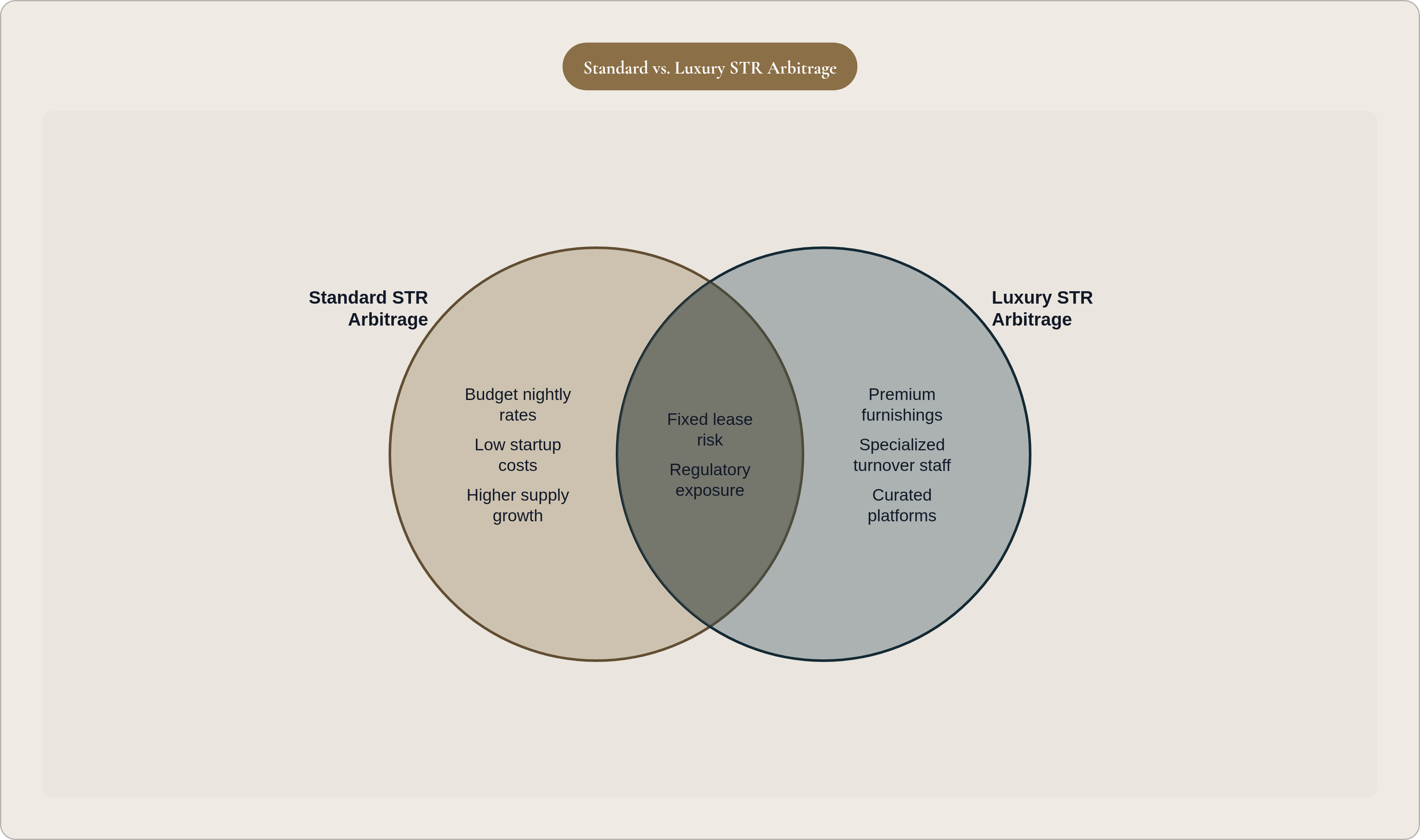
Which Markets Actually Support the Luxury Arbitrage Model in 2025–2026
Market selection is where the luxury arbitrage model is won or lost. The operational framework can be sound, the property well-appointed, and the unit can still hemorrhage money if the underlying market does not support the spread.
Resort and destination markets are where the arbitrage math is currently working. Gatlinburg, Gulf Shores, and Destin represent positive-margin environments in current data. San Diego and Scottsdale also rank among the leaders on median annual STR revenue. Of a broader set of major markets analyzed for arbitrage viability, only a minority show positive margins once operating costs are fully applied.
Resort and destination markets offer structural conditions that suit luxury arbitrage specifically. Demand is seasonal and concentrated, which allows operators to set premium rates during peak periods and model conservatively against off-peak minimums. Large-format properties with pools, multiple bedrooms, and proximity to destination amenities command genuine premiums over hotel alternatives. Suburban and secondary markets have been outpacing urban STR growth broadly, and the directional shift toward destination properties from dense urban inventory favors the luxury format.
Austin and Nashville warrant caution given elevated regulatory uncertainty. Los Angeles presents a more fundamental problem: a primary residence requirement effectively disqualifies the arbitrage model outright. New York City, for practical purposes, ended non-owner arbitrage through registration requirements mandating host presence during guest stays.
The Hamptons and coastal South Florida present a different kind of challenge. Achievable rates are among the highest in the country, but long-term lease costs in those submarkets are correspondingly high. The spread analysis must be run against actual comparable lease rates in those specific submarkets, not national averages. These markets can work, but they require more capital, tighter operating discipline, and a narrower margin for error than resort markets where long-term rents stay low relative to achievable nightly rates.
The Regulatory Layer That Can Eliminate a Unit's Viability Entirely
Regulatory risk is asymmetric in a way operators consistently underestimate until they have experienced it directly. Favorable regulations allow you to pursue a market. Unfavorable regulations can terminate an operation entirely, with no recovery of setup costs, furnishings, or foregone revenue. Due diligence on the regulatory environment is not a step somewhere in the middle of the process. It is the first step.
Three independent veto points exist, each capable of killing a unit on its own. City and county STR ordinances impose permit requirements, night caps, primary residence restrictions, and density limits. HOA and condo board rules operate entirely independently of city regulations; a building that prohibits short-term rentals makes a unit non-viable regardless of what the city permits or the landlord allows. And the lease itself must explicitly authorize subletting as an STR. Operating without written consent creates eviction exposure, not just regulatory exposure.
New York City is the sharpest illustration of what aggressive local regulation does to arbitrage economics. When the city implemented registration requirements mandating host presence during guest stays, active short-stay listings dropped precipitously. Median minimum-night requirements shifted to nearly 26 nights, which functionally ends the arbitrage model for virtually every unit in the city. Operators who had built cost structures around the prior regulatory environment had no viable path to recovery.
Other markets have implemented restrictions that meaningfully constrain the model: primary residence requirements, permit caps that limit new entrants, density restrictions that create geographic exclusion zones. Markets including Gatlinburg, Gulf Shores, and Scottsdale currently operate under state preemption frameworks that limit local governments' ability to restrict STR activity aggressively, making them among the more permissive regulatory environments for arbitrage.
Luxury markets are not safer by default. In many cases they are more vulnerable. The highest-nightly-rate markets have attracted the most politically visible STR activity, which has attracted the most aggressive regulatory responses. And compliance is not a one-time task completed at lease signing. Regulations have tightened in most markets over the past three years and continue to evolve. An operator who is not actively monitoring the regulatory environment in their market is exposed in ways they will not recognize until the exposure has already become a loss.
What Sonder's Collapse Reveals About Scaling Luxury Arbitrage Without Operational Discipline
Sonder built an institutional version of the arbitrage model: leasing apartments and hotel rooms by the thousands and relisting them for short stays, with venture backing and eventually a public market valuation. The mechanics were operationally identical to individual arbitrage, just executed across thousands of units simultaneously. The outcome was Chapter 7 bankruptcy and court-supervised liquidation, announced in November 2025 following the termination of its Marriott partnership.
The financial numbers are worth looking at plainly. Operations consumed hundreds of millions of dollars more in cash than they generated across 2023 and 2024 combined. Cumulative deficit reached well over a billion dollars by end of 2024. The company had raised hundreds of millions of dollars across nine funding rounds and gone public via SPAC in early 2022. None of it was enough to overcome unit economics that did not work at scale.
Sonder's approach, from early growth through its public market phase, was to solve operational problems with capital. Lease more units, raise more money, assume that scale would eventually produce the efficiency that execution was not generating. It never did. Scale compounded the gaps rather than closing them, because the underlying problem was not resources. It was discipline.
What the failure actually demonstrates is not that the arbitrage model is structurally broken. It demonstrates what happens when the model is scaled faster than operational discipline can follow. At the individual unit level, a failed execution event or a market misjudgment costs an operator several thousand dollars and a few months of losses. At Sonder's scale, the same gaps, replicated across thousands of leases in dozens of markets, compounded into a deficit measured in billions.
The specific ways Sonder broke are the same ways individual luxury arbitrage operators break: fixed lease obligations that could not flex with occupancy downturns, cost structures built on revenue assumptions the market did not consistently deliver, insufficient differentiation between what was being offered and what guests were actually willing to pay for, and an inability to exit lease commitments quickly when a market turned or a regulatory environment shifted. For an individual operator, Sonder is not a warning against the model. It is an unusually expensive, unusually well-documented illustration of what the model's failure modes look like when they go unmanaged. The lease obligation is fixed. The revenue is variable. Sonder closed that gap with capital until the capital was gone. Individual operators close it with discipline, and discipline is less forgiving, but it is the only version of this business that actually works.