LLC vs S Corp Structure for Short-Term Rental Owners

Most short-term rental owners choose a business structure the same way they chose their property management software: they pick what sounds most professional and figure out the details later. That instinct is expensive. The decision between an LLC and an S Corp election is not about prestige or progression; it comes down to a few concrete variables, and once you understand them, the right answer for your situation becomes obvious. According to a TurboTax survey, 36% of DIY rental property owners use LLCs, making it the most common formal structure, yet many of those owners chose it without fully understanding what it does and doesn't protect against. The structure question and the tax election question are separable, and for short-term rental owners specifically, that separation is everything.
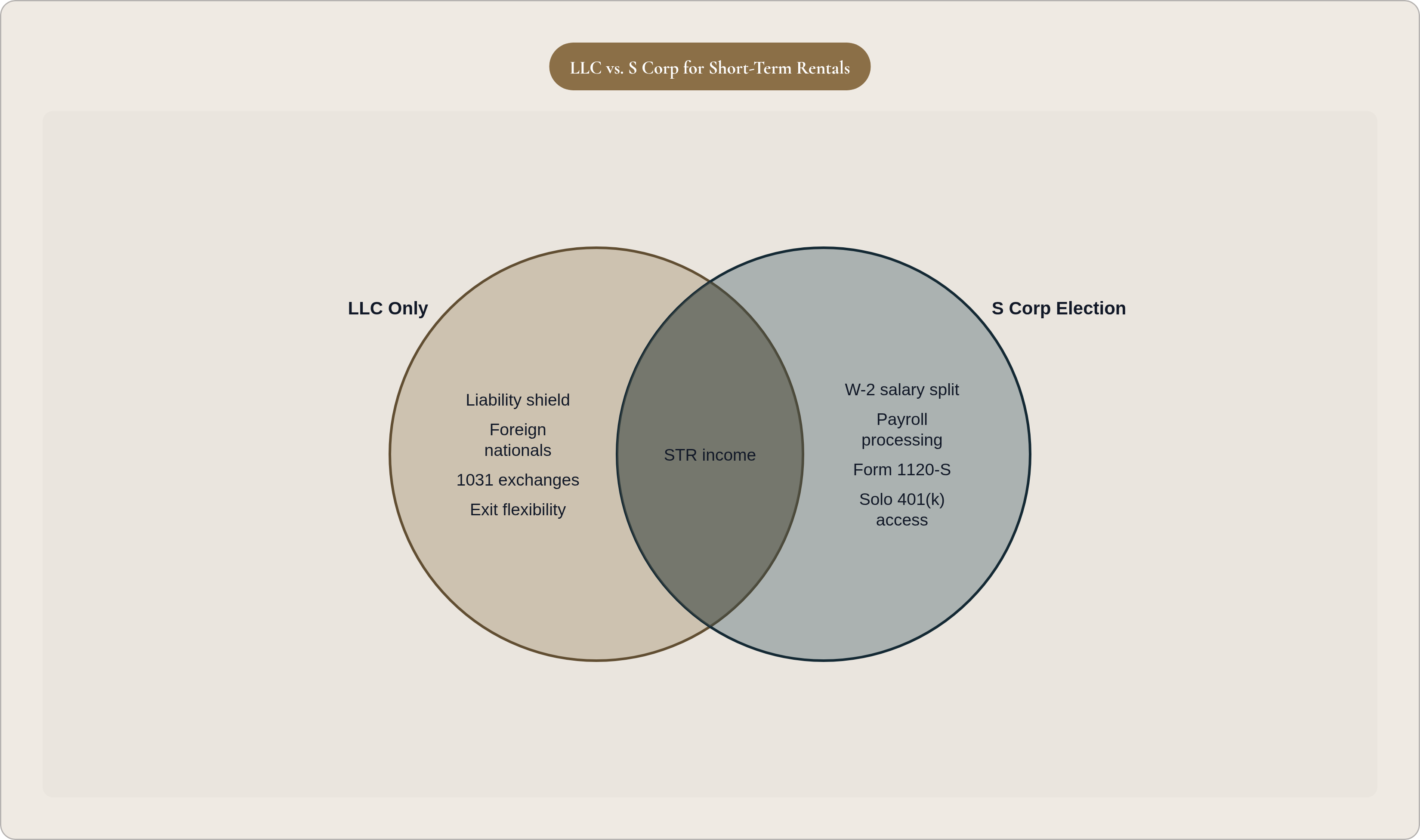
What an LLC Actually Is, and What an S Corp Actually Is
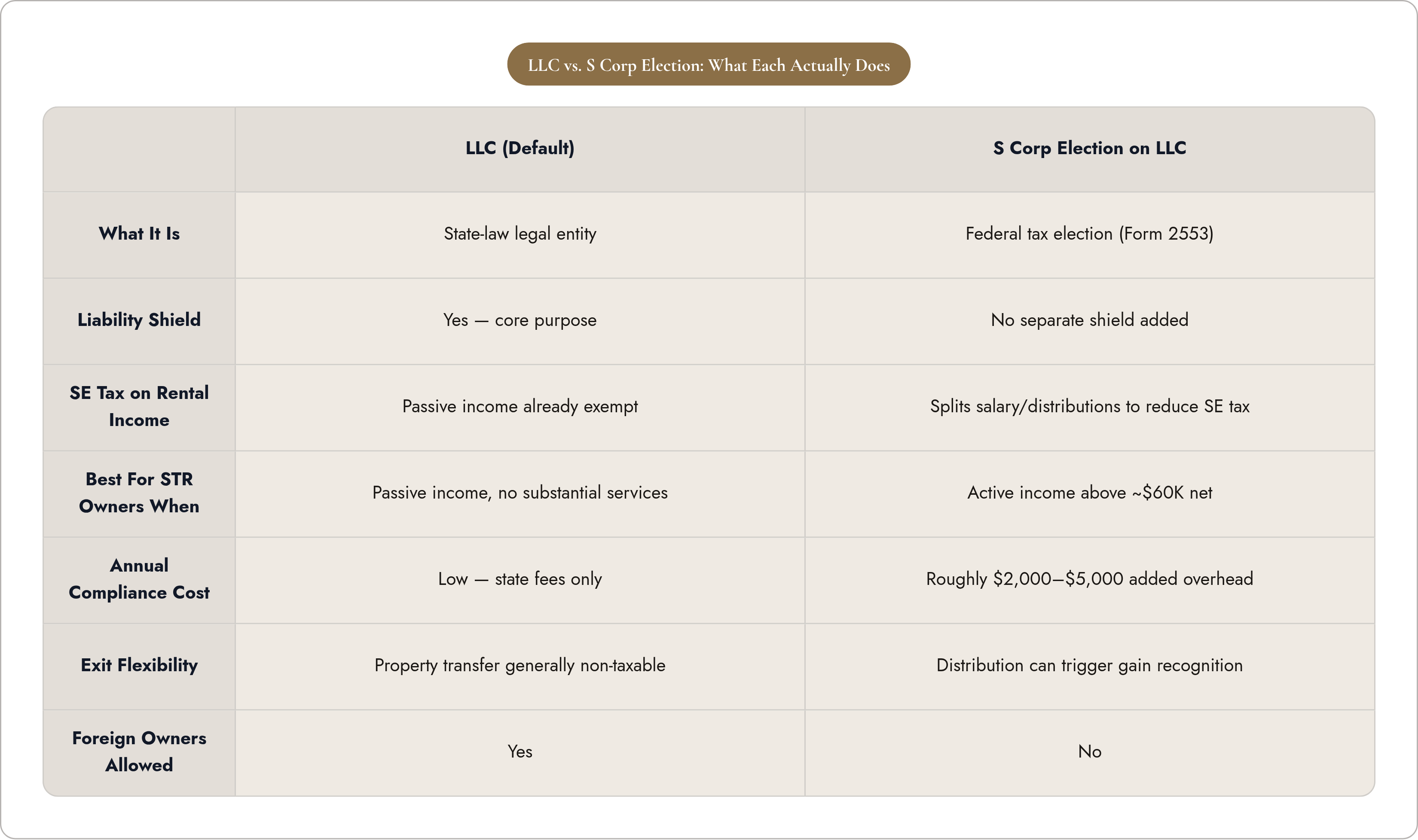
An LLC is a legal entity created under state law. It separates your personal assets from the business, owns property in its own name, can enter contracts, and can be sued independently of you. That last part matters more than most people appreciate. The entity is the wall between a guest's lawsuit and your personal bank account.
An S Corp is not a separate legal entity. It is a federal tax election, filed on IRS Form 2553, that changes how an existing LLC or corporation is taxed. Your LLC can elect S Corp status and remain an LLC under state law while being treated as an S Corporation for federal tax purposes. These are two different things operating on two different layers.
When someone asks, "should I form an S Corp," they almost always mean, "should my LLC elect S Corp tax treatment." Different question. Different answer.
The mechanical difference in taxation matters enormously. A default single-member LLC passes income through to your personal return, typically on Schedule E or Schedule C, with no separate business tax return required. An S Corp election requires the owner to split income into a W-2 salary, which is subject to payroll taxes, and shareholder distributions, which are not subject to self-employment tax. It also requires Form 1120-S, payroll processing, and W-2 filings. The point of all that complexity is to reduce self-employment tax. Whether it actually accomplishes that for an STR owner depends entirely on how your income is classified.
What an LLC Gives STR Owners That No Tax Election Can Replicate
The liability shield is the core product. Claims arising from your property, a guest injury, a pool accident, a dispute over damages, are directed at the LLC, not your personal assets. STR-specific liability is genuinely elevated compared to long-term rentals: short-term guests are less familiar with the property, more likely to use pools, hot tubs, and waterfront access, and more likely to arrive in large groups or with children. The risk profile is materially different, and the LLC addresses it directly.
Multi-property owners should think in terms of an egg carton. Separate LLCs per property mean a lawsuit targeting one asset cannot reach assets held in other entities. In more than 20 states, including Texas, Delaware, Nevada, and Wyoming, owners can hold multiple properties under a single master LLC in separate "series," each with its own liability protection, without paying formation fees for multiple standalone entities. The Series LLC is an underused tool that solves the multi-property liability problem efficiently.
The liability shield only holds if you operate the LLC properly. Mixing personal and business funds, skipping state filings, or ignoring operating formalities can pierce the veil and expose you personally regardless of your structure. The entity is only as strong as the discipline behind it.
Beyond liability, the LLC offers structural flexibility that an S Corp simply cannot match. Foreign nationals can be LLC members; they cannot be S Corp shareholders. Profit-sharing can be customized in the operating agreement rather than tied to ownership percentage. Cost segregation and accelerated depreciation can be allocated to tax-sensitive partners under IRC Section 704(b) and 704(c), which is a significant advantage for deals with multiple investors at different tax rates. None of that flexibility exists inside an S Corp, where all items flow strictly per share.
The exit flexibility alone justifies the preference for LLC structure in real estate. Transferring property out of an LLC is generally non-taxable. Transferring it out of an S Corp triggers gain recognition. That asymmetry compounds over time in ways that are easy to ignore at formation and painful to confront at exit. Formation costs are accessible, ranging from $35 to $500 depending on the state, with average first-year costs around $224 including annual report fees.
The Passive Income Question That Makes or Breaks the S Corp Argument for STR Owners
Here is the pivot point that most of the LLC vs. S Corp conversation misses entirely.
Self-employment tax runs at 15.3% on net active business income: 12.4% for Social Security up to the annual wage base in 2026, plus 2.9% Medicare on all earnings, plus an additional 0.9% on income above $200,000 single or $250,000 married. The S Corp election's entire value proposition is reducing that SE tax by shifting income from W-2 salary to distributions. But that only matters if SE tax applied in the first place.
Passive rental income is already exempt from self-employment tax under IRC Section 1402(a)(1). This is a statutory exemption, not a planning strategy. If your STR income is passive, the S Corp election eliminates a tax that was never owed. You are paying compliance costs to solve a problem you do not have.
So the crucial question is: what makes STR income passive versus active?
Income is passive when the owner provides only the use of the property, furnished or unfurnished, without substantial services. It reports on Schedule E and is not considered a trade or business for SE tax purposes. Income tips into active territory, flowing to Schedule C and triggering SE tax, when substantial services are provided to guests: daily cleaning during a stay, daily linen changes, concierge services, guest transportation, meals, or other hotel-like amenities provided throughout the rental period.
The seven-day rule is frequently misunderstood here. When average rental periods are seven days or fewer, the IRS does not classify the activity as a rental under the passive activity rules. But this affects passive activity loss treatment, not self-employment tax. SE tax only enters the picture if substantial services are also provided. The two analyses run on separate tracks.
The IRS has not issued court decisions, Revenue Rulings, or Treasury Regulations specifically defining "substantial" in the STR context. Owners operating in the gray zone, say, someone who provides a weekly cleaning but not daily service, need a qualified tax advisor before making any election.
The cost of getting this wrong runs in both directions. A passive STR owner who elects S Corp spends $2,000 to $5,000 per year in compliance costs to save zero in SE tax. Over a ten-year hold, that is potentially $20,000 to $50,000 in pure, unnecessary overhead. An active STR owner who does not elect S Corp pays the full 15.3% SE tax rate on every dollar of net profit, and in a strong income year, that avoidable tax bill can be substantial.
When the S Corp Election Genuinely Helps STR Owners
For STR owners who provide substantial services, the S Corp election is a legitimate and meaningful tax reduction tool. The active income triggers SE tax, and splitting that income between a reasonable salary and distributions creates real savings. The general consensus among practitioners is that net active business income above roughly $60,000 is the threshold at which S Corp tax savings begin to exceed the added compliance costs.
The right implementation for an active STR owner is not to hold the property inside an S Corp. It is to keep the property in an LLC and elect S Corp status for a separate management entity. The management company earns service fees, which are subject to SE tax, and benefits from the election. The property LLC earns passive rental income, which is not subject to SE tax, and needs no election. The segregation protects the real asset from both the liability exposure and the tax complications of the S Corp wrapper.
Active STR owners who elect S Corp also gain access to retirement plan opportunities that are otherwise unavailable. As both employer and employee, the owner can make substantial contributions to a Solo 401(k), including employer matching, that a sole proprietor or plain LLC member could not structure in the same way.
Before electing, check state-level treatment. New York City and Tennessee impose additional taxes on S Corps that can partially or entirely consume the federal benefit. New Hampshire and Portland, Oregon carry their own complications. The federal savings look compelling in isolation; the picture changes when state treatment is modeled alongside them.
The compliance cost stack is real and recurring: payroll processing runs $1,200 to $3,000 per year; additional CPA fees for Form 1120-S run $500 to $2,000; state franchise fees, registered agent fees, and accounting software add another $350 to $1,600. Total added overhead typically falls in the $2,000 to $5,000 range annually. That number needs to clear the SE tax savings before the election makes financial sense.
The Exit Traps and Long-Term Risks of Holding Real Estate Inside an S Corp
The compliance cost is the visible risk. The exit traps are the ones that cost real money.
If more than 25% of an S Corp's gross receipts are passive income, including rent, for three consecutive years, and the corporation also has accumulated earnings and profits, the S Corp election is terminated by operation of law. Income becomes subject to corporate-level tax. For an STR owner who pivots from active service provision to a more passive model, or who simply expands the portfolio and tips the revenue mix, this is a structural landmine that can activate without warning.
Distributing real estate out of an S Corp triggers gain recognition. Under the relevant IRC provisions governing S Corp pass-through treatment, distributing a property out of the entity is treated as a sale at fair market value. If the property has appreciated, the gain is recognized even if no cash changes hands. A property with $150,000 of basis distributed when it is worth $300,000 generates a $150,000 taxable gain. That applies whether the owner is refinancing, restructuring for asset protection, or simply trying to move the property to a more favorable entity. The transaction that looks like housekeeping is actually a taxable event.
The 1031 exchange problem is equally consequential for owners with multiple investors. S Corp shareholders cannot run separate 1031 exchanges using their share of sale proceeds; the entity-level same-taxpayer rule applies. If one investor wants to cash out and another wants to exchange into a new property, the S Corp structure makes it structurally difficult or impossible to accommodate both simultaneously.
Moving a mortgaged property into an S Corp mid-hold can trigger gain recognition under IRC Section 357, a trap that surprises owners who assume a simple transfer is neutral.
Finally, S Corp ownership does not provide a step-up in basis for underlying assets when ownership transfers at death, unlike certain other structures. For appreciated assets held over a long time horizon, that is a meaningful estate planning cost.
None of these risks exist in the same form when the property stays in an LLC. This is exactly why the split-entity approach, LLC for the property, S Corp election for the management layer, captures the tax benefit without the exit cost. You get the savings on the active income without putting the asset at structural risk.
How to Think Through the Decision for Your Own STR Operation
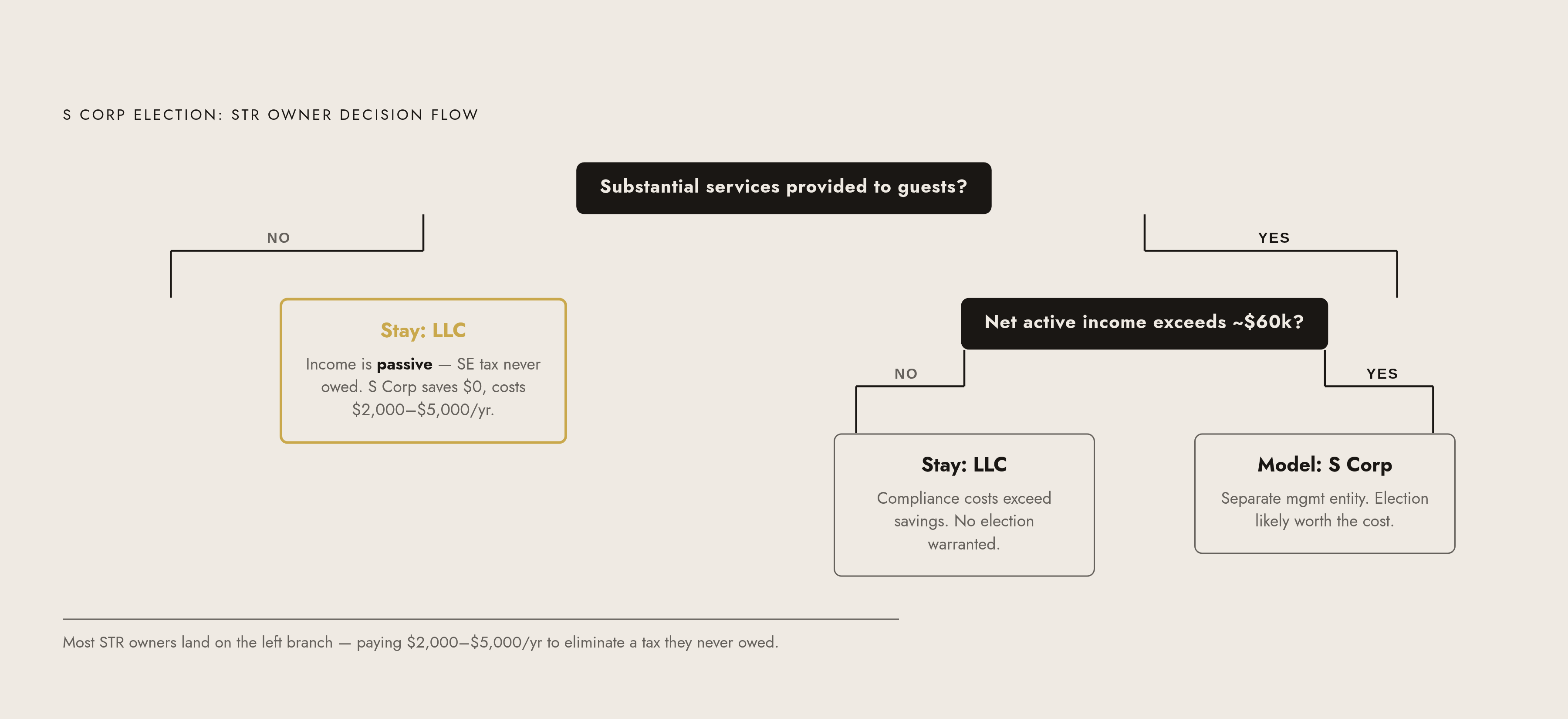
The decision tree starts with one question: does your STR operation provide substantial services to guests?
If the answer is no, meaning you provide the space and guests manage themselves, your income is passive, SE tax does not apply, and the S Corp election adds cost with zero tax benefit. An LLC is the right and sufficient structure. Stop there.
If the answer is yes, meaning daily cleaning, meals, concierge, hotel-like amenities, your income is likely active, SE tax applies, and the S Corp election on a management entity is worth modeling. Move to the second question.
If the answer is uncertain, the gray area is real and the stakes are high enough to warrant a tax advisor who knows STR classification specifically, before any election is filed.
For active STR owners who clear the first question: does net active income exceed roughly $60,000? Below that threshold, compliance costs likely exceed the SE tax savings, and an LLC without the S Corp election is still the right call. Above that threshold, run the numbers with a CPA who can account for your state's tax treatment and the full compliance cost stack.
Third question: what state are you operating in? States with punitive S Corp treatment can eliminate the federal savings entirely. States that recognize the Series LLC may offer a multi-property liability solution that makes a separate S Corp layer unnecessary.
Multi-property owners should prioritize liability isolation regardless of tax election. Separate LLCs per property, or a Series LLC where available, is the standard approach. Each additional property is another liability exposure, and the egg carton structure addresses that directly.
If you are electing S Corp for an active operation, structure it as a separate management LLC that elects S Corp status, and keep the property itself in a plain LLC. Never hold real property directly in the S Corp. That configuration captures the SE tax savings, preserves exit flexibility, and protects the asset from the structural risks discussed above.
These decisions have long compounding consequences. The structure chosen at formation affects your exit strategy, 1031 exchange eligibility, cost segregation flexibility, and estate planning. A one-time consultation with a CPA and attorney who specialize in real estate is the highest-return step most STR owners can take. The complexity is real, but it is finite. You only need to understand it once to get the decision right.