Short-Term Rental Tax Loophole Income Limits
Qualify for the seven-day rule and material participation to escape passive loss limits.

Nothing downstream matters if you don't clear these two gates first. They are threshold conditions, and conflating them with optional optimization steps is how owners end up with suspended losses and a confused CPA staring at them across a desk.
Average Rental Period of Seven Days or Fewer
The IRS determines whether a property qualifies as a short-term rental, for purposes of IRC Section 469, by calculating the weighted average rental period across all bookings in the year. That average must be seven days or fewer. A handful of longer stays won't necessarily disqualify you; the weighted average is what matters. If some bookings run ten or twelve days but the overall weighted average stays at or below seven, you're inside the line.
There is an alternative path: if your average stays run thirty days or fewer and you provide substantial services comparable to hotel operations, including daily housekeeping, meals, or transportation, the property can also escape passive classification. Most STR owners are operating well below that service level, so the seven-day weighted average is the operative standard in the vast majority of cases.
The procedural consequence of clearing this threshold is the entire point of the strategy. Properties meeting either criterion are not classified as rental activities under IRC Section 469. They are removed from the passive loss framework entirely. That removal is the mechanism; the income offset is the result.
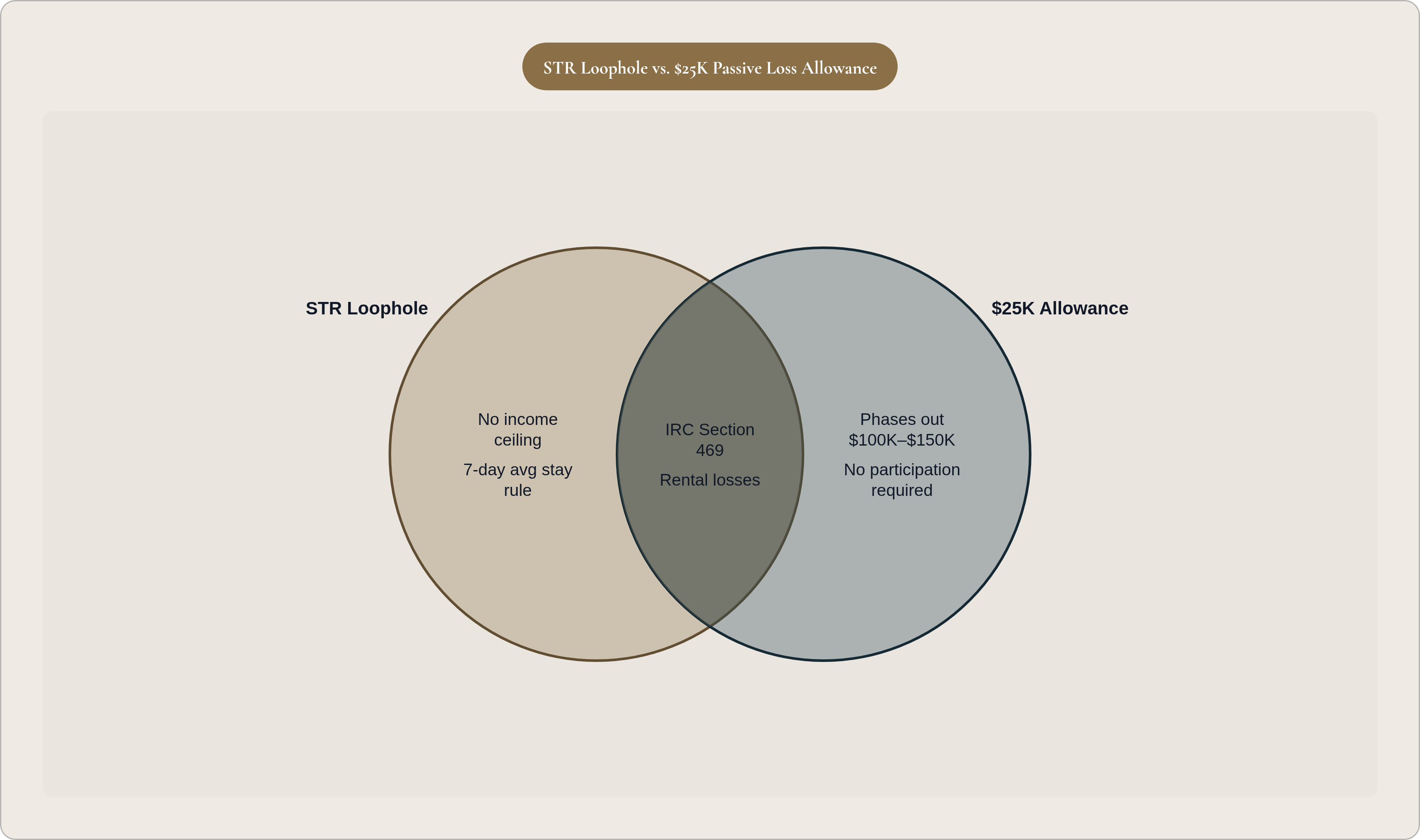
Worth flagging clearly: because qualifying STRs are excluded from the rental activity definition, the $25,000 passive loss allowance does not apply to them, and hours spent managing them do not count toward Real Estate Professional Status. The STR path is structurally separate from both of those regimes, which surprises people who spent years tracking hours for REPS.
Material Participation
Clearing the average-stay threshold is necessary but not sufficient. The owner must also materially participate in operating the property. This is where the IRS applies one of seven tests, and in the STR context, two dominate.
The 100-hour test is the most commonly used: the owner spends more than 100 hours on the activity during the year, and no one else, including a property manager, spends more time than the owner. The 500-hour test is cleaner but harder; 500 hours in the activity qualifies on its own, without the comparative element.
What the STR loophole does not require is Real Estate Professional Status. REPS demands 750 or more hours in real estate activities annually, plus more time in real estate than in any other profession. For a physician working fifty-hour weeks, that bar is functionally inaccessible. The STR material participation standard is a lower, more achievable threshold, which is precisely why it extends the benefit to full-time professionals who cannot achieve REPS.
One detail that catches portfolio owners off guard: material participation is assessed property by property, not across a portfolio in aggregate. If you own three STRs, you need to demonstrate qualifying hours for each one separately. Owners who document two properties meticulously and assume hours are fungible across the portfolio lose the deduction on the third entirely. That assumption is wrong.
Both gates must be cleared. Failing either routes you back into the standard passive loss rules, and there is no partial credit for effort.
The $25,000 Allowance That Phases Out Between $100,000 and $150,000 — and Why STR Owners Should Understand It Even If They Bypass It
For owners who participate in a rental activity but do not meet material participation, IRC Section 469(i) offers a limited exception. Up to $25,000 in net passive rental losses can offset other income each year. This is the fallback provision for engaged but not materially participating landlords, and most people in the STR space either outgrow it quickly or never had access to it in the first place.
The allowance begins phasing out once adjusted gross income reaches $100,000, reduced by fifty cents for every dollar of AGI above that threshold. At $150,000, it is gone entirely. A taxpayer at $130,000 AGI loses a substantial portion of the allowance: thirty thousand dollars above the floor, multiplied by fifty percent, leaving only a fraction of it in currently deductible losses. Married taxpayers filing separately face a halved allowance of $12,500, with phase-out running from $50,000 to $75,000 of modified AGI.
That $150,000 ceiling has not been adjusted for inflation since Congress set it in 1986. In real purchasing power, a substantially larger share of the taxpayer population now sits above it than the original drafters contemplated, and the political will to update that number has never materialized. It is a relic that has quietly rendered the provision irrelevant for most professionals who would otherwise rely on it.
Why does this matter to an STR-focused reader? Because it clarifies exactly what is at stake when you qualify for the loophole. The $25,000 allowance is the regime you escape. Once you're above $150,000 in income and fail to qualify for the loophole, there is no current-year deduction available at all. Losses are suspended until the property is sold or passive income materializes. Understanding the cap frames the size of the benefit you're protecting when you pursue qualification.
Why the STR Loophole Itself Carries No Upper Income Ceiling
Once a taxpayer qualifies, seven-day average stay plus material participation, the $25,000 cap and its phase-out band are bypassed entirely. There is no income ceiling written into the loophole. It is a structural exclusion from passive loss classification, not an income-tested allowance. The statute does not ask how much you earn; it asks how long your guests stay and how involved you are.
This is why the STR strategy gets discussed so consistently in the context of high-income professionals. Their income has long since phased out the $25,000 allowance. REPS is inaccessible given their primary occupation. The STR loophole is the only viable current-year deduction mechanism left standing, and it scales with the quality of the underlying depreciation strategy. A large depreciation deduction is simply worth more to someone in a higher bracket than to someone in a lower bracket. The math is linear; the marginal rate does the work.
Practitioners regularly work with clients earning well above $500,000 annually, financial planners, executives, surgeons, who use the STR loophole to offset W-2 income. The strategy is explicitly accessible to high earners, and it is most commercially significant for them precisely because of that scaling dynamic.
Either the activity is non-passive and losses flow through, or it isn't and you're capped. That binary nature is exactly why precise compliance with the seven-day rule and rigorous hour-tracking are not administrative afterthoughts. They are the entire predicate.
The Excess Business Loss Ceiling That Caps Even Qualifying STR Owners at $313,000 / $626,000
Clearing the passive loss hurdle does not mean every dollar of loss flows into the current year without limit. IRC Section 461(l) imposes an additional constraint: the excess business loss limitation. Even after an STR owner qualifies for the loophole, this ceiling applies, and it catches people who failed to see it coming.
The EBL caps the net business losses a noncorporate taxpayer can deduct against non-business income in a single tax year. For 2025, that limit is $313,000 for single filers and $626,000 for married couples filing jointly. Losses above the threshold are not permanently disallowed; they convert to a net operating loss carryforward into subsequent years. C corporations are exempt. The limitation falls on individuals, trusts, and estates.
Consider a married couple who generated a $1,000,000 loss through a cost segregation study in 2025 against $1,000,000 in long-term capital gains from stock sales. Because of the EBL limitation, $374,000 of that loss could not offset current-year income and was converted to an NOL carryforward. The strategy worked, but the timing of the benefit spread across years rather than concentrating in one. That distinction matters enormously to someone who came into the year expecting a specific tax outcome and built financial decisions around it.
Owners planning around the One Big Beautiful Bill Act should update their assumptions now: the EBL limitation has been made permanent starting in 2025. If you anticipated the provision expiring, that planning needs to be recalibrated before year-end.
The practical effect is most pronounced for owners using aggressive cost segregation to generate large first-year losses. The strategy remains effective; the timing simply spans multiple tax years in many high-loss scenarios, which is a feature, not a failure, as long as you planned for it.
How Bonus Depreciation and Cost Segregation Create the Losses That Run Into These Limits
The tax savings in the STR loophole are not generated by operating losses from low occupancy or thin margins. They are engineered through depreciation strategy. Specifically, cost segregation accelerates deductions into the first year rather than spreading them across 39 years, the depreciation schedule that applies to STRs classified as nonresidential property.
A cost segregation study is an engineering-based analysis that reclassifies components of a property into shorter depreciation lives. Certain components qualify for five-year or fifteen-year depreciation rather than 39 years, and those shorter-lived assets are eligible for bonus depreciation.
Under current 2025 law, shaped by the One Big Beautiful Bill Act, 100% first-year bonus depreciation is now permanent for eligible property acquired after January 19, 2025, per IRS Notice 2026-11. For property acquired before January 20, 2025, the prior phase-down schedule applies, with bonus depreciation at 40% in 2025. Owners also have the option to elect a 40% deduction instead of 100% for the first tax year ending after January 19, 2025, a useful lever for keeping losses below the EBL ceiling when managing multi-year planning.
At typical scale, a $500,000 property generates somewhere between $150,000 and $200,000 in first-year depreciation through cost segregation. A single property can approach or exceed the $313,000 single-filer EBL threshold when combined with losses from additional properties. That is exactly why the carryforward mechanics deserve serious attention before you pull the trigger on the study.
Owners working within a professionally managed arrangement, where operational responsibilities are clearly delineated between owner and manager, can document their 100-plus hours more cleanly. Professional management and material participation are not mutually exclusive. The owner's hour log reflects real engagement in oversight, coordination, and strategic decision-making, even when day-to-day turnovers are handled by a management team.
Personal Use Days — The Quiet Disqualifier That Sits Outside the Income Framework
Income thresholds and depreciation strategy get most of the attention. Personal use tracking gets far less, and that is where owners routinely get tripped up.
The IRS treats a property as a personal residence rather than a business if the owner uses it for more than the greater of 14 days or 10% of total days rented at fair market price during the year. Tipping into personal-residence status limits expense deductions and can disqualify the property from business loss treatment entirely.
Keep personal use at or below 14 days per year. It preserves the full deduction pool and keeps the property firmly in business territory.
The 14-day figure also intersects with a separate provision worth understanding: the Augusta Rule under IRC Section 280A(g). This rule allows owners to rent their home for up to 14 days per year and exclude that rental income from federal taxes entirely. It requires no material participation analysis and no average-stay calculation. It is a distinct strategy. Renting for 15 days or more eliminates the exclusion and brings the full rental income into taxable income under standard rules. The tradeoff is precise: no income tax on the rental income, but also no deduction for related rental expenses.
A business-owner variant adds a layer of planning complexity. A separate legal entity, structured as an S-corp, C-corp, or partnership, pays the owner rent for legitimate business use of the home. The business deducts the payment; the owner excludes it from personal income under the Augusta Rule. Sole proprietors and single-member LLCs typically cannot use this structure because the owner and entity are treated as the same taxpayer for these purposes.
The 10%-of-rental-days rule deserves specific attention for heavily booked properties. A property rented 200 days in a year has a personal use budget of 20 days under the 10% standard, which sounds permissive, but the 14-day absolute limit is the more conservative and legally defensible threshold in most situations. Track these days with the same rigor you apply to hour logs. They are equally consequential, and they are far easier to violate by accident.
Putting the Three Thresholds Together — Where an Owner's Income Position Actually Lands Them
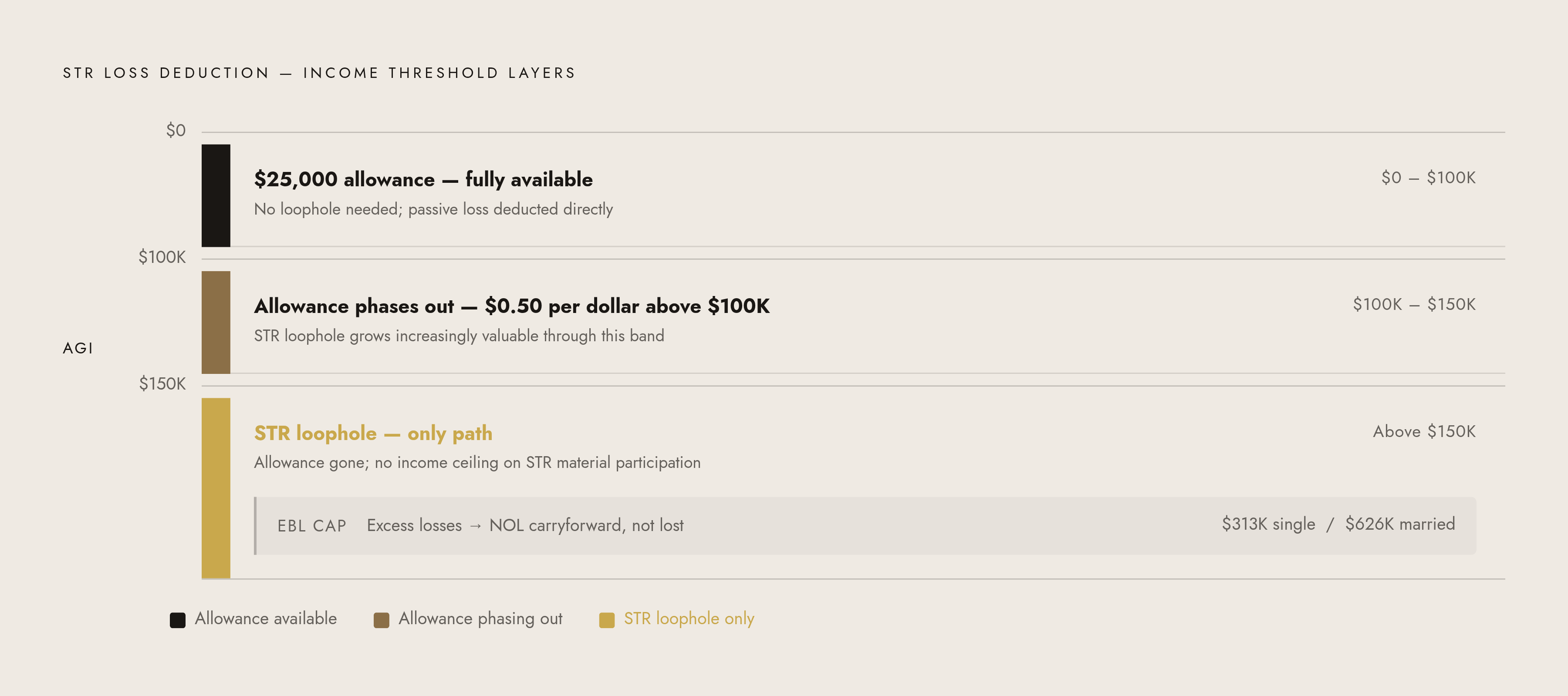
Three layers, stacked in order of application. Each one determines what the next one means.
The first layer is the $100,000 to $150,000 AGI phase-out zone for the $25,000 passive loss allowance. This layer is relevant only to owners who do not clear the seven-day average and material participation tests. Above $150,000, this path is closed entirely.
The second layer is the STR loophole itself, which carries no income ceiling. For owners who qualify, losses flow through regardless of AGI. The benefit is structurally available to six-figure and seven-figure earners alike, which is what makes this strategy genuinely different from most passive loss provisions in the code.
The third layer is the $313,000 and $626,000 EBL ceiling. It applies after the passive loss rules are cleared. Losses above the threshold carry forward as NOLs rather than offsetting current-year income. It does not eliminate the benefit; it spreads it across time.
Under $100,000 AGI, the $25,000 allowance is fully available without qualifying for the loophole at all. Between $100,000 and $150,000, the standard allowance phases out, and the loophole becomes increasingly valuable as income climbs through that band. Above $150,000, the standard allowance is gone; the loophole is the only current-year deduction mechanism available, and qualifying is both binary and high-stakes. For very high earners generating large paper losses, the EBL ceiling becomes the binding constraint, and the 40% bonus depreciation election alongside multi-year NOL carryforward planning become the active tools.
The administrative requirements, average stay tracking, hour logs, personal use records, are not optional compliance details. They are what separates a current-year deduction from a suspended loss. For owners listing through a professionally managed service, where pricing, guest screening, and property turnovers are handled by a management team, the material participation documentation remains the owner's responsibility. Professional management and active owner involvement are not in conflict; the hour record simply must reflect real engagement.
The loophole follows directly from the statutory definition of rental activity under IRC Section 469. It is not aggressive; it is structural. But these thresholds are sensitive enough to individual circumstances that no amount of general guidance substitutes for a CPA who has actually run this analysis before.