Luxury OTA Platforms Compared: Airbnb Luxe, Vrbo, Booking.com, and Curated Alternatives
Airbnb Luxe dominates scale, but luxury rentals remain fragmented across five major platforms.

How the three dominant OTAs divide the market among themselves
How the three dominant OTAs divide the market among themselves
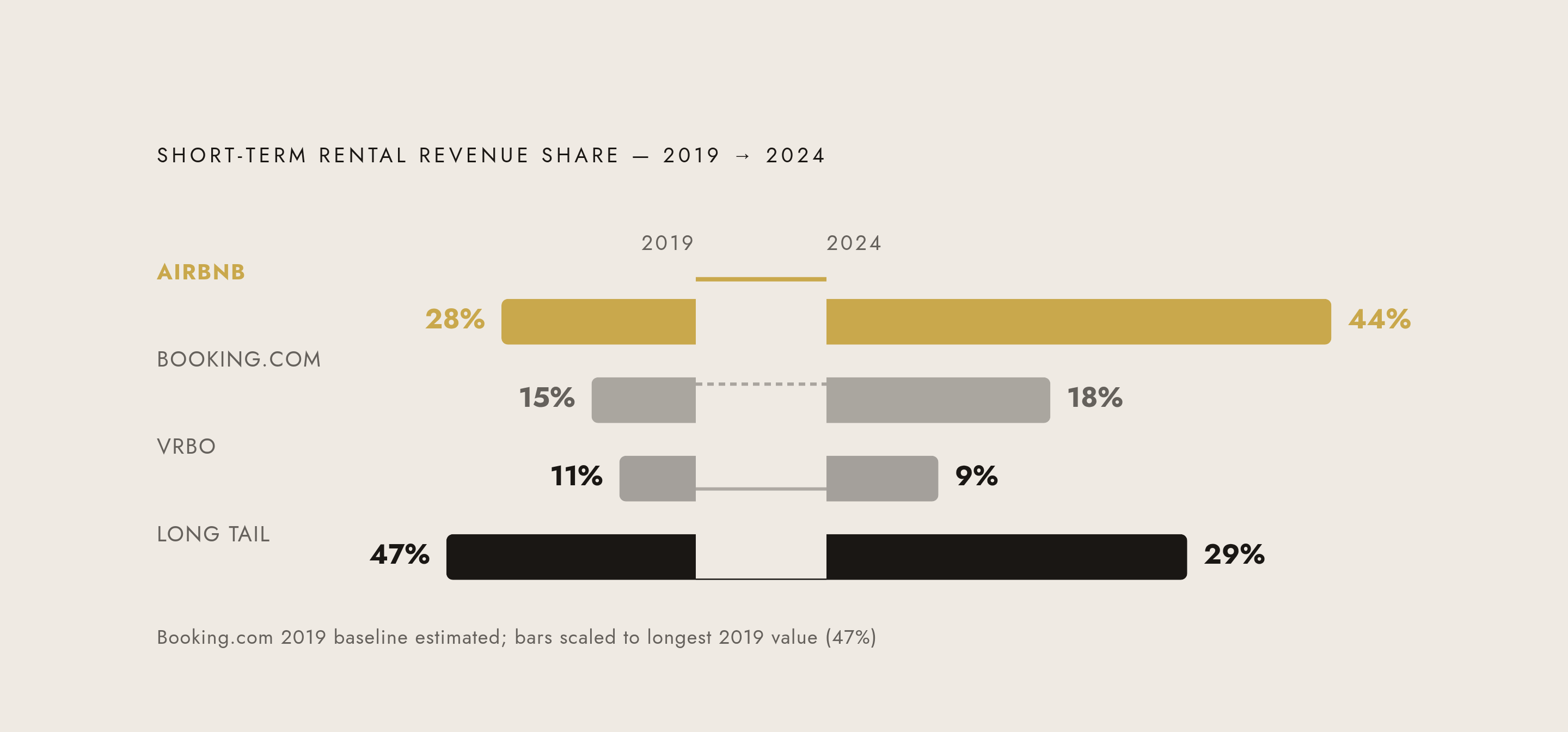
Airbnb won the scale race outright, with its global share of short-term rental revenue climbing from 28% in 2019 to 44% in 2024, and the company logged 492 million booked nights and experiences last year. That's a headline about breadth, though, and it tells you nothing about how a $15,000-a-week villa gets treated versus a $90 city apartment.
Booking.com posted the fastest growth of the three coming out of the pandemic, moving from 15% share in 2022 to 18% in 2024, a real trajectory even starting from behind. Vrbo went the other way, sliding from 11% in 2019 to 9% in 2024, despite solid footing in North America and an inventory that skews toward bigger properties.
The long tail, meaning all the smaller platforms and regional operators, shrank from 47% of global revenue in 2019 to 29% in 2024, and consolidation is real and shows no sign of slowing. That remaining 29% happens to be exactly where the best curated luxury options tend to live, though. Market share numbers blend a $60 budget stay with a $6,000 villa into one figure, so a platform can dominate overall volume while doing a mediocre job with its priciest listings.
The five biggest luxury-specific players, Airbnb Luxe and Vrbo included, held only 39% of the luxury niche combined in 2024, according to GM Insights. I keep coming back to that number because it says the top of this market stays unusually fragmented even as the middle consolidates. That's good news if you're willing to look past the biggest logo.
What Airbnb Luxe actually requires — and what it delivers
Airbnb Luxe came from an acquisition, when Airbnb bought an established luxury rental business back in 2017 and built the tier on top of it, launching with more than 2,000 hand-picked homes measured against over 300 separate criteria covering design, function, and upkeep.
Those criteria have teeth. Villas, estates, and penthouses qualify, but a condo doesn't, no matter how nice the finishes are. Interiors need professional design work and hotel-grade linens, kitchens have to be outfitted for a private chef, and the bathroom-to-bedroom ratio gets checked against something more than a host's own judgment. Most Luxe properties run five or more bedrooms and price above $1,000 a night.
An Airbnb Home Consultant physically walks the property before it goes live and flags what needs fixing. Airbnb then runs quarterly reviews to confirm the property still qualifies, so this isn't a one-time stamp. Every Luxe booking comes with a trip designer on call, folded into the nightly rate rather than sold separately, and hosts have to keep a vetted bench of private chefs, trainers, and event staff ready to go.
Here's the gap nobody advertises: dedicated premium support for Luxe bookings is not clearly defined or guaranteed. That's a genuine problem when something goes wrong on a high-five-figure booking and you're routed into the resolution center, a system built for the whole platform, not calibrated for the kind of escalation a Luxe guest expects. Airbnb has shared little public detail on the Luxe tier's performance metrics, so you're taking the quality claims somewhat on faith.
On fees: as of late 2025, Airbnb moved to a flat 15.5% host-only charge, replacing the old split-fee model where hosts and guests each paid separate portions. The guest-facing line item disappeared, though the cost simply moved into the nightly rate.
Vrbo's approach to luxury — whole-home inventory without a dedicated tier
Vrbo skipped the whole exercise. There's no named luxury tier, no Luxe equivalent, no separate vetting layer for premium properties, and they sit inside the general inventory, leaving it on you to filter for quality.
What Vrbo does have is a whole-home-only model: book a property and the entire place is yours, no shared spaces, no single rooms rented off to strangers. That structure has always fit families and groups, and it's still Vrbo's core audience.
Geography does a lot of the work here. Vrbo's inventory skews heavily toward North America and Oceania, with comparatively thin presence in Asia and South America. Rural properties make up its biggest category, with seaside and lakefront homes close behind. At heart this is a lake-house-and-mountain-cabin platform, with less presence in the urban penthouse space.
One number stands out: The inventory naturally skews toward bigger, pricier properties even with no formal gate keeping the small stuff out. But without vetting criteria, a $2,000-a-night listing sits right next to another $2,000-a-night listing of very different quality, and reviews plus photos are the only thing separating them.
Fee-wise, Vrbo's host fees are structured to run meaningfully less than Airbnb's 15.5%, which can translate into sharper nightly pricing for the guest. That can translate into sharper nightly pricing for the guest. Between the fee structure changes and the share decline since 2019, this reads like a platform still figuring out what it wants to be.
What Booking.com brings to vacation rentals — and what it was actually built for
Booking.com's growth is real, with share rising from 15% in 2022 to 18% in 2024, the fastest climb among the big three, built on a foundation that's almost entirely hotels. That hotel DNA shapes everything else about how the platform handles rentals.
The scale is enormous. Hotels, apartments, villas, and short-term rentals all live under one search bar, which is convenient and a little chaotic depending on what you're hunting for. Search a villa in a premium destination and you'll get managed hotel properties mixed with independent rentals and everything between, no luxury curation layer sorting one from the other.
There's no Booking.com equivalent to a dedicated luxury sub-tier with defined vetting standards for private homes. What it offers instead: broad geographic reach, transparent pricing right in the search results, and easy bundling with flights and transfers, genuinely useful if you're juggling a complicated multi-leg trip.
But the underlying architecture, review systems, cancellation rules, customer service protocols, all of it, was built around a hotel room, and none of it translates cleanly to a private villa. Guest protections for rental properties are less clearly spelled out than for hotel bookings on the same site. Booking.com's strength sits with luxury hotels; for luxury vacation rentals, its rental listings still carry a lot of hotel-shaped assumptions underneath.
What curated alternatives do differently — and where their tradeoffs are
Curated platforms run the opposite play. Instead of aggregating everything and filtering down after the fact, they start small with a vetted set of properties and build outward. That's a big reason the five biggest luxury players held only 39% of the niche in 2024: real fragmentation at the top, and real room for alternatives to the giants.
Some of these platforms send an actual person, a home critic, to physically visit and score each property before it's allowed to list, and only a carefully limited share of submitted homes are accepted. That's a different kind of vetting than a checklist a host fills out alone, and it comes with an obvious tradeoff: inventory stays limited on purpose, so a specific market or date range can come up nearly empty.
Other operators function more like a full-service luxury travel agency wearing a listing site's clothes: dedicated trip planners, pre-selected inventory concentrated in resort markets, concierge work built into the booking relationship rather than bolted on afterward. Human curation stands in for algorithmic filtering here.
Then you've got market-specific marketplaces covering a handful of premium destinations instead of trying to be everywhere at once. Rove, a high-end furnished-residence rental service operating in places like the Hamptons, Aspen, and South Florida, fits this model, keeping its footprint deliberately tight. Because the footprint stays narrow, they can personally vet every property, keep an actual relationship with each owner, and offer real price transparency, no broker fees, no surprise line items at checkout. The tradeoff is coverage: if your destination isn't one of their markets, the platform simply isn't an option. But where they do operate, the depth of vetting tends to beat what a broad OTA offers at the same price point.
And 96% of ultra-luxury travelers still use a human travel agent for their high-end trips, according to research from Colorwhistle. At the very top of this market, the old model never left, and it runs alongside the apps now.
Fee structures and guest protections compared across platforms
Airbnb Luxe charges hosts a flat 15.5% under the late-2025 model, no separate guest fee on top. That cost still lands on the guest indirectly, since hosts price it into the nightly rate. On a high-four-figure weekly rental, 15.5% is a real number shaping what you pay before you even open the listing.
Vrbo's meaningfully lower effective host rate runs meaningfully lower, which can mean better nightly pricing for comparable quality. The all-in price isn't always obvious from the search results, so confirming the total before booking is worth the extra step.
Booking.com's commission structure for rental hosts is not publicly standardized in the same way as its hotel model. The host cost is still baked into the rate somewhere, tucked further out of view.
Curated platforms lean on fee transparency as part of the pitch: best-price guarantees, no broker fees, a number you can trust the first time you see it. Damage protection varies a lot across this group, though some market-specific operators back stays with damage protection that can exceed what a standard OTA typically offers. Guest screening on these platforms tends to run stricter too, which matters to owners and to guests who'd rather not share a property pool with just anyone.
Nearly half of U.S. luxury travel, 49% according to Colorwhistle, gets booked direct rather than through any OTA. At the top of the market, a huge share of travelers have already decided the middleman isn't worth keeping around. Fee structures aren't standardized across this industry, and the platform cheapest for hosts isn't automatically the one that gets guests the best outcome. It comes down to what's bundled into the rate, what gets tacked on later, and what protection actually stands behind the stay if something breaks.
How to match a specific trip to the right platform
Three questions decide this, not brand recognition: does the platform actually cover your destination, what level of service does the trip demand, and how much risk are you willing to carry if something goes wrong.
Airbnb Luxe makes sense for international destinations where curated alternatives simply don't have inventory yet, and for travelers who want a concierge relationship built into the price rather than negotiated as an extra. Luxe listings have racked up enough guest history at this point that review volume carries real signal. One thing worth checking before you book: confirm round-the-clock support genuinely exists in your specific market, since Airbnb's broader customer service setup wasn't built with the Luxe tier in mind, and that gap doesn't close itself just because the listing photos look expensive.
For a group trip in a whole home, especially somewhere Vrbo runs deep like North America or a lake and coastal market, the lower host fees usually translate to sharper pricing, as long as you're comfortable doing your own quality diligence since nobody's vetting the listing for you. Booking.com earns its keep when the trip mixes a luxury hotel stay with flights and transfers under one itinerary, less so when the plan centers on a private villa where its hotel-built plumbing starts to show. And when your destination falls inside a curated platform's footprint, that's usually the strongest play on the table: tighter vetting, clearer pricing, and protection that actually matches what's on the line for a trip this size.