Short-Term Rental Profitability in High-Price Markets During Shoulder Season
Active pricing and flexible minimums protect margins when shoulder-season demand softens.

Shoulder season in high-price short-term rental markets is a margin structure owners can build on purpose. The gap between operators who manage revenue actively and ones who set a rate in June and check back in September has been widening for years, and it shows up clearest in the numbers from the priciest markets. Three levers close that gap: dynamic pricing discipline, minimum-stay flexibility, and a positioning strategy that makes rate cuts unnecessary. Get those three right, and October stops looking like a gap in the calendar.
How high-price markets trade occupancy for rate when demand softens
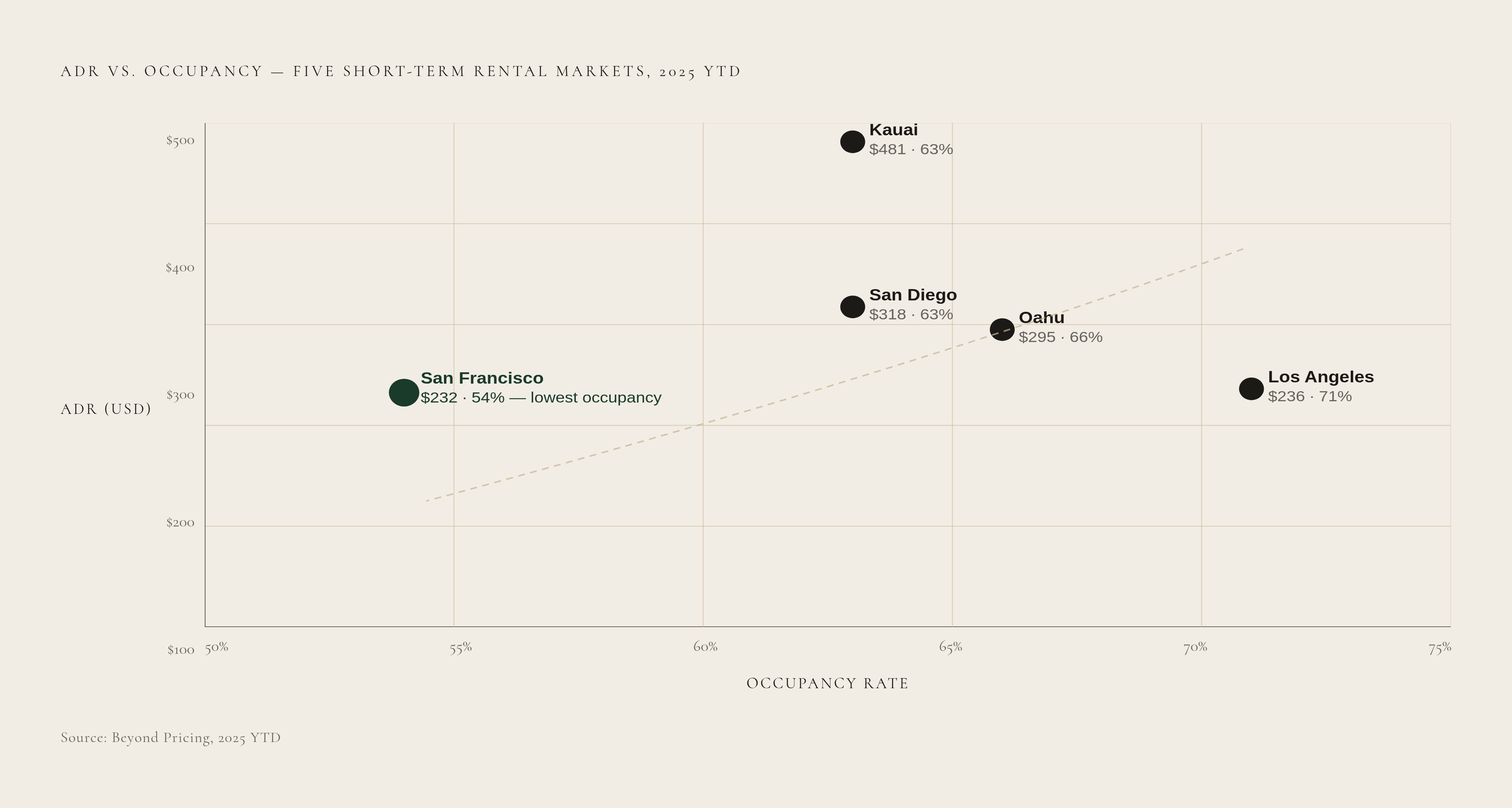
Markets like the Hamptons, Aspen, and coastal California don't chase full calendars. They chase rate, and they accept lower occupancy as the cost of doing it. Beyond Pricing's 2025 year-to-date numbers lay out the pattern: Kauai leads at $481 average daily rate with 63% occupancy, Oahu runs $295 ADR at 66% occupancy, San Diego is $318 ADR and 63% occupancy, Los Angeles is $236 ADR with 71% occupancy. San Francisco breaks the pattern: $232 ADR, but only 54% occupancy, second-lowest among the major markets in that dataset.
That San Francisco number is the one to sit with, because it shows what happens once rate alone stops carrying the market. Command a high price all you want. If supply grows or demand cools, occupancy can still collapse underneath you, and that's the exact mechanism that plays out on a smaller scale in every high-price market's shoulder season.
Cap rates make the stakes concrete. Most advisors treat 5% to 10% as the healthy range, and gateway cities routinely fall short of it, leaving barely any cushion for a slow stretch. One dense downtown submarket runs cap rates around negative 1.76%, while a residential borough in the same metro averages 1.54%. A "high-price market" is really a patchwork of very different micro-markets, and shoulder-season strategy has to be tuned block by block, not city by city.
A property that runs a strong ADR but only decent occupancy at peak has almost no buffer if the owner holds that same rate straight into October. The pricing has to move with the season, or the math breaks underneath it.
The demand signals that make shoulder season more workable than it used to be
Shoulder season today isn't the dead zone it was five years back. A few real shifts in how people travel have stretched the calendar out, and none of them are theoretical.
Bleisure travel is the biggest piece. Remote work lets business travelers bolt a few vacation days onto a work trip, and that routes more midweek, off-peak nights into the rental market. Longer stays are growing for the same reason: remote work stretches the average trip well past the old long-weekend pattern.
RedAwning's 2026 forecast points to travelers spreading trips more evenly across the calendar instead of clustering around July and August. Market data increasingly supports this pattern: peak demand appears to be redistributing into windows that used to be shoulder, not shrinking overall.
Event calendars add another layer. Concerts, festivals, sporting events, and in 2026 a major international tournament spanning multiple host cities, all create pockets of near-peak demand sitting inside an otherwise slow month. Owners in or near those markets can price specifically around them instead of averaging the whole month down.
There's also a shift in what travelers want out of a stay. AirDNA counted a 123% jump in unique accommodation listings from 2020 to 2024, as guests chasing a distinctive property rather than a commodity room grow less locked into peak-season timing. That's a real advantage for differentiated luxury properties, and it means shoulder season now has an actual demand base to sell into. Whether an owner's pricing and availability are built to catch it is the only open question left.
Reactive discounting as the wrong response to a softer calendar
The instinct when bookings slow down is to cut the rate. It feels responsible. In a luxury market, it's usually the worst move on the table, because price does more than cover costs there: it signals quality and identity to the guest before they ever walk in the door.
This instinct tends to backfire in luxury markets. Short-term price cuts can shift the guest's perception of what a property is worth, The more often a property discounts, the more that lower number becomes the expected baseline going forward. A luxury listing that trains guests to expect 40% off every October is quietly eroding its own peak-season pricing power for next summer.
Discounting also tends to solve the wrong problem. What's actually broken is often the minimum-stay structure or the booking window. Cutting price without fixing either of those just gives away margin without moving any more inventory.
Kyle Driskell, Senior Solutions Consultant at PriceLabs, put it this way: "In peak periods like Christmas or New Year's, you can take risks by holding prices high until the last minute. But in shoulder season, being behind pace is dangerous. Discounts and tactics need to come earlier to protect occupancy." He adds: "You can't apply a peak season strategy to a shoulder season calendar. The market behaves differently, and being proactive instead of reactive is what protects revenue."
Better occupancy and training guests to expect low rates are two separate problems, and they call for two separate fixes. Static pricing fails in both directions at once: overpriced nights sit empty during the slow stretch, while underpriced nights during an event-driven spike leave money on the table. FutureStay's 2026 research found properties running dynamic pricing see a meaningful RevPAR lift over static approaches, exactly where static pricing has no way to adjust to lower, less predictable demand.
Dynamic pricing as the primary revenue management tool for shoulder-season periods
Dynamic pricing pulls in local demand signals, booking pace, lead time, seasonality, and nearby events, and adjusts the rate based on all of it together. That combination separates real shoulder-season pricing from holding the peak rate out of habit or slashing it out of fear.
FutureStay's 2026 figures put a number on the gap: properties using dynamic pricing see annual revenue gains in the 10% to 40% range, with a 10.7% average RevPAR lift. The mechanism is simple: catch demand at the right rate at the right moment, instead of setting a number once and forgetting about it.
For shoulder season specifically, that means pulling rates down meaningfully from peak, but stopping well above the actual cost floor, and targeting local fall events with rate bumps rather than applying one blanket adjustment across the whole calendar.
Booking pace behaves differently outside peak, too. The lead-time window is shorter, so a listing sitting empty two weeks out needs a different response than one that filled up eight weeks ahead back in July. Dynamic tools track that pace in real time. A fixed rate can't.
Event-driven demand deserves special handling. Concerts, festivals, and major sporting events create stretches inside shoulder season where rates can climb close to peak levels. Static pricing misses all of it, because nothing is watching for it.
None of this runs on autopilot. Dynamic pricing software is a tool, not a strategy on its own, and it needs daily attention to competitor rates, local booking pace, and demand shifts. Owners who hand the whole thing off without understanding the pricing logic that produces each rate are letting mis-calibrated automation make decisions nobody's actually checking.
Minimum-stay policy as a shoulder-season occupancy lever that does not sacrifice rate
Seven-night minimums make sense at peak in markets like the Hamptons or Aspen. They cut down on turnover costs and stop the calendar from fragmenting into unbookable gaps. Carry that same seven-night rule into shoulder season, though, and an entire class of guest gets locked out before they even see the listing.
Shoulder demand runs shorter, usually 3 to 5 nights: bleisure trips, long weekends, event attendees passing through for a festival or a game. A 7-night minimum blocks every one of them, regardless of what the nightly rate is.
The fix is straightforward: drop the 7-night minimum during shoulder windows and open the calendar to 3-to-5-night stays. That widens the pool of possible guests without touching the nightly rate.
The math backs this up. A month filled with two 4-night stays and one 5-night stay at $350 a night beats a month with zero 7-night bookings at any price, because the mortgage, utilities, and management fees run whether the property is occupied or not. Truvi's 2026 research frames it well: "A property with consistent 65% occupancy across twelve months is often a safer bet than one chasing 95% occupancy for eight weeks to break even." That's the whole argument for shoulder-season flexibility, and it holds beyond peak season too.
Shorter stays do raise turnover costs: more cleanings, more restocking, more guest screening cycles. That tradeoff only pencils out with a management system built to handle higher turnover without bleeding margin on labor. Mid-term stays, 30 to 90 nights, extend the same logic further. In markets with tight STR rules, like NYC under Local Law 18 or San Francisco's annual night caps, mid-term rentals often sit under different regulatory treatment. They fill shoulder-season gaps at a lower per-night rate, but with close to zero vacancy cost.
Premium positioning as a revenue strategy, not just a marketing choice
The properties that hold their rate through shoulder season aren't the ones cutting price the hardest. They're the ones guests genuinely believe are worth the money at that rate, in that specific month.
Premium positioning is operational. It means the amenities match the listing photos, the design holds up in person, the description is accurate down to the details, and the guest gets a fast response when something needs attention. Pet-friendly listings alone increase rental income by 10% to 20%, and features like a pool, real outdoor space, or distinctive design command a rate premium regardless of the calendar.
The unique-stay trend feeds directly into this. That 123% jump in unique listings from 2020 to 2024 points to a guest segment that isn't comparison-shopping on rate the way a commodity-hotel booker does. Those guests make better shoulder-season targets precisely because price sensitivity isn't what decides their booking.
Sustainability plays into this too. iGMS reported that roughly 90% of consumers look for sustainable options, and about half say they'll pay more for them. A property with visible sustainability credentials, solar, water-saving fixtures, real green certifications, can hold a rate premium even in a slow month, especially with Gen Z and millennial travelers projected to make up around 75% of Airbnb's traveler base by the end of 2025.
Trust is the real competitor here, and it rarely gets named directly. In luxury markets, a high shoulder-season rate isn't competing against a cheaper listing down the street so much as against guest doubt: will the place match the photos, who shows up if something breaks. Properties backed by professional management, clear pricing, and real damage protection can price above competitors offering none of that. Reducing dependence on algorithm-driven platforms helps too. A guest who books direct, or through a curated luxury channel, has already decided on quality before price enters the conversation.
How regulation shapes shoulder-season strategy differently across high-price markets
Regulation doesn't hit every market the same way. In some cases it actually works in a compliant operator's favor, thinning out competition year-round, shoulder season included.
One city stands out as the strictest case by far. Under Local Law 18, active listings dropped sharply after the law took effect, leaving a fraction of previous supply in the registered pool. That scarcity carries real value for the operators still legally in the game, though a $1.50 per unit per day city occupancy fee took effect in March 2025 and has to be baked into the cost floor before setting any dynamic price.
California's rules vary city by city. Los Angeles caps home-sharing at 120 nights a year across all stay types. San Francisco caps unhosted nights at 90 annually, with no cap on hosted stays. Owners nearing their annual cap need to plan shoulder-season availability carefully, so they don't burn nights that peak season would have paid far more for.
Hawaii's pressure comes from taxes rather than caps. Hawaii's accommodation taxes are among the highest in the country, cutting directly into shoulder-season net revenue and requiring careful inclusion in any pricing floor calculation.
Supply caps cut both ways, though. In cities that limit listing counts or restrict rentals to primary residences, reduced competition can push occupancy up meaningfully for the properties still operating legally. Shoulder season in a capped market like San Francisco behaves nothing like shoulder season in an open-registration market such as Phoenix or Austin.
Mid-term rentals offer a workaround in some of these markets. Stays of 30 nights or more get treated differently from short-term rentals under San Francisco's rules and several others, so routing shoulder-season gaps into mid-term bookings can sidestep night caps entirely while keeping revenue flowing. There's no single national playbook here. The pricing logic and the minimum-stay flexibility apply everywhere, but the legal boundaries around them shift sharply from one market to the next, sometimes from one neighborhood to the next inside the same city.
Building a shoulder-season operating plan that holds margin across the calendar
None of these three levers work alone. Dynamic pricing sets the ceiling and floor for what a night is actually worth on a given date. Minimum-stay flexibility decides how many guests can reach that price in the first place, since a great rate means nothing if the booking window is too rigid to fill. Premium positioning keeps the rate itself from eroding, because a property guests trust doesn't need a discount to compete for their business.
Running all three together makes shoulder season stop being a gap to survive. It starts looking like a second, smaller peak, one built on 3-to-5-night stays, event-driven rate spikes, and a guest base that was never going to book at full peak pricing but is willing to pay real money for a property that delivers. The owners pulling ahead in high-price markets planned for October back in July. They priced for it with the same discipline they use at peak, and never once had to reach for a blanket discount to fill the calendar.
Sources
- STR Market Forecast 2026 | What to Expect
- Short-Term Rental Market Analysis: Hotspots and Trends
- STR Revenue Strategy 2026 Guide for Short Term Rentals
- The U.S.'s Best Short-Term Rental Markets for Investing (2026)
- Are Short-Term Rentals Profitable & Should You Invest in 2026?
- Dynamic Pricing for Vacation Rentals: 40% Revenue Boost (2026)
- hello.pricelabs.co