Turnover Operations for High-End Short-Term Rentals
Every flaw at luxury prices reads as a broken promise, not a minor slip.

I've cleaned enough of these properties myself, and managed teams that clean hundreds more, to tell you the gap between luxury and standard turnover isn't really about money. It's about tolerance for error. The short-term rental market has professionalized fast, but at the top end, the distance between what a guest expects and what they'll forgive has shrunk to almost nothing.
A guest paying premium rates for a vetted high-end home compares it to the best hotel stay of their life, not to a typical Airbnb down the street. A smudged mirror doesn't register as a minor slip; it reads as a broken promise. Context does the amplifying: a $30,000-a-week Hamptons rental carries a weight of expectation that a $200-a-night beach cottage never will, and every flaw gets measured against that weight.
Cleanliness tops the list of guest complaints industry-wide, and turnover, not booking, pricing, or amenities, is where most operators actually lose a guest for good. As supply has leveled off and professional management has become the norm rather than the exception, the review-score gap between the best-run properties and the average ones shows up straight in revenue, especially in slower months when a guest has options and uses them.
Setting a luxury price is easy. Holding that standard between every guest, turn after turn, across an entire season, is the actual job.
What separates a luxury turnover from a standard STR clean
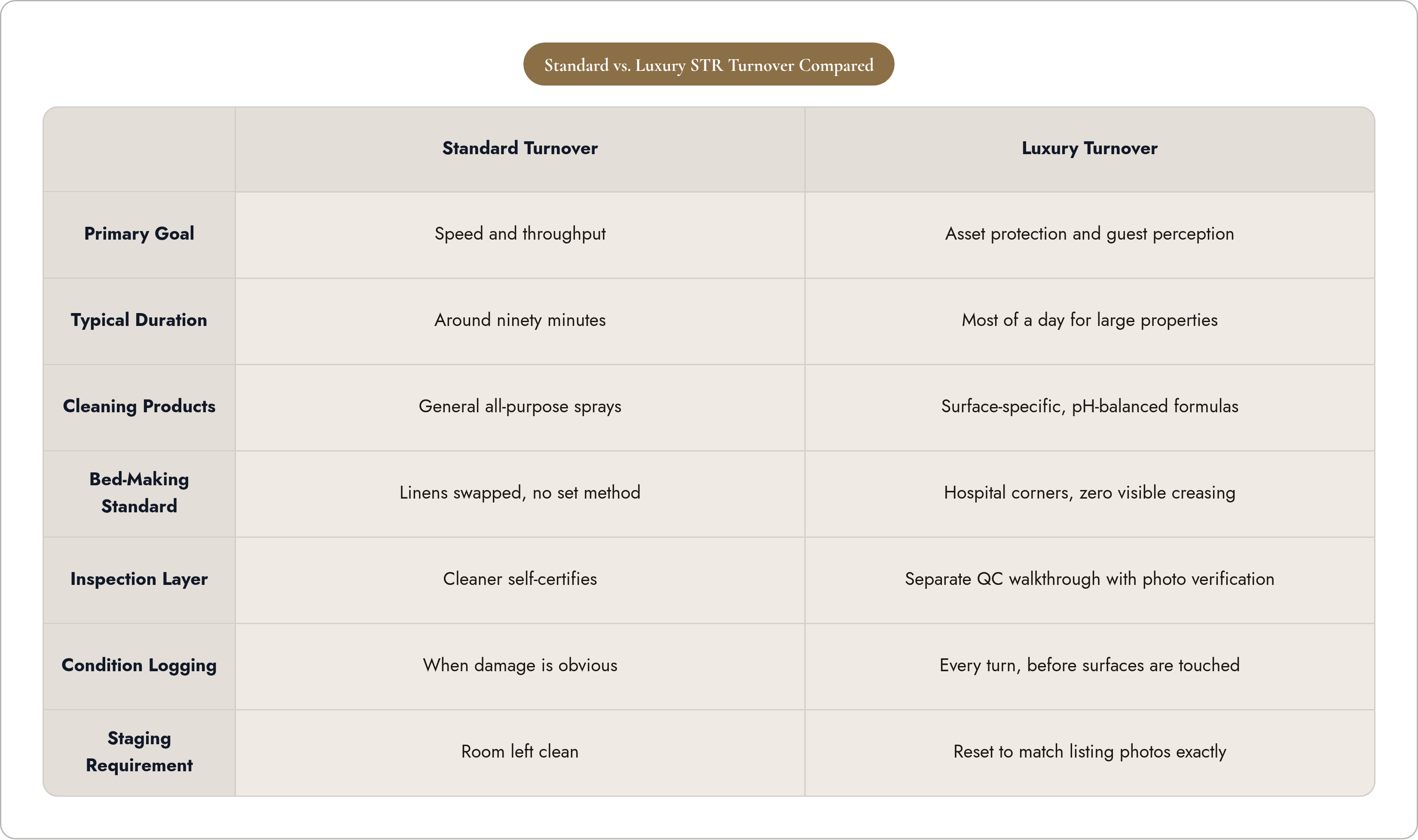
A standard vacation rental turn optimizes for speed. Surfaces get wiped, linens swapped, a checklist run, and the cleaner's on to the next job, usually inside ninety minutes. Fine for a $150-a-night rental where the margin lives in volume.
Luxury turns optimize for something else entirely: asset protection and guest perception. Both take longer, both need more skill, and neither forgives the wrong product.
Stone surfaces need pH-balanced cleaners; grab the wrong all-purpose spray and you've etched marble that isn't coming back. Wood and brass need their own treatments. Delicate upholstery gets steamed, never sprayed, because the fabric can cost more per yard than most people pay in rent.
Perception is the softer half, but it's just as real, maybe more so. A room can be hygienically spotless and still feel off if the scent is wrong, the thermostat is set wrong, or the lighting doesn't match what the listing photos promised. Staging precision isn't garnish on top of the clean. It is the clean.
A few tasks show up at this level that just don't exist on a standard checklist:
- Hospital-corner bed-making with zero visible creasing, since the bed is the first thing a guest notices within sixty seconds of entering the room
- Streak-free glass and mirrors using dedicated glass product, never all-purpose spray
- Robes, slippers, and welcome amenities restaged hotel-style, not dumped on the bed
- Condition logging on high-value furnishings every single turn, not just when damage is obvious
- Scent, thermostat, and lighting reset to a defined welcome preset specific to that property
A large property with stone floors, custom millwork, and a full furniture inventory can eat a full day of labor. That's against the ninety minutes a standard rental budgets. It's a different checklist built around a hotel-reset standard, not a housekeeping minimum stretched thin.
The sequence a professional luxury turn follows
Every reliable luxury turn runs a fixed order. Improvise it and you either waste time or leave a gap that surfaces after the guest has already checked in, which is the worst possible time to find out.
Strip the beds and start laundry first. Linens come off immediately, before anything else, because laundry runs longest of any task in the turn and the machines need to be working while the crew works the rooms.
Then comes condition assessment, before a single surface gets touched. Someone walks the property and logs the state of furnishings and fixtures against the pre-arrival record. Wait until after the clean and you've lost the ability to tell what happened during the stay versus what happened during the turn itself.
Kitchen and bathrooms come next, the highest-contamination zones, cleaned with the right product for each surface. At this level that includes the inside of appliances, not just countertops.
Bedrooms and living areas follow: dusting, vacuuming, upholstery checks, dedicated glass treatment on mirrors and windows. Bed-making comes after, deliberately, hospital corners and zero wrinkles, so fresh linens aren't catching dust kicked up by the vacuum pass.
Restocking and resetting come next: toiletries, coffee, paper goods, kitchen basics, all inventoried and refilled. Décor and furniture go back to their exact staged spots so the room matches the listing photos. Floors get done last, working toward the exit, so nothing tracks back into a room that's already finished.
Restocking and resetting are what turn "clean" into "guest-ready." That distinction only survives across a team if it's written down somewhere, not carried around in one cleaner's head, because memory doesn't scale and turnover in staff (the human kind) will eventually prove it.
The inspection layer that standard operators skip
In a well-run luxury operation, whoever cleans the property never certifies it as guest-ready. That separation is deliberate.
A quality-control visit happens after the clean wraps, covering ground the cleaning checklist doesn't touch: staging verified against listing photos, amenities checked for presence and placement, linens and surfaces inspected for missed wrinkles or lingering odors, maintenance issues flagged before they become work orders discovered by the guest. The whole thing gets walked front door to back, in the order a guest would actually experience it.
Photo verification is standard here. Timestamped images do two jobs at once: they catch failures before a guest ever sees them, and they give the operator something solid to point to if a damage dispute shows up after checkout.
Skip this layer and you're trusting the cleaning team to grade its own homework. That's fine until it isn't, and at $2,000-a-night rates, one missed detail gets expensive fast. The operators who protect their review scores year over year, instead of scrambling to recover from a bad one, built this layer in from day one rather than bolting it on after the first complaint.
Linen standards as a proxy for the whole operation
Guests form their first quality judgment within seconds of walking into a bedroom, and linens are usually the first thing they touch. White stays the hospitality standard for a reason: it shows soil immediately, to the inspector and to the guest, and there's nowhere for a bad wash to hide.
Hospitality-grade linens get specified by weight and blend, not the thread-count number retailers print on the package to sound impressive. Bed linens typically run a cotton-polyester blend around sixty-forty, because that blend survives repeated high-heat commercial washing without breaking down the way pure microfiber does. Towels should be a hundred percent cotton at commercial weight; the difference in hand-feel against a lightweight retail towel is immediate, and guests notice within the first fold.
Inventory depth matters as much as fabric choice. The standard is a PAR system: three sets per bed, one in use, one staged as backup on property, one moving through the laundry cycle. That third set is the only thing keeping a tight same-day turn from stalling out. Towels follow the same math, roughly two full sets per guest plus a spare. Run two sets per bed instead of three and you're one delayed laundry load away from a late check-in, guaranteed.
Rotation has to be tracked on a schedule, not eyeballed at the folding table. Linens degrade quietly over dozens of washes, and without a documented replacement calendar, operators keep reusing sets that slipped below standard weeks ago without anyone catching it until a guest does. Commercial linen services can launder at the scale and turnaround these schedules demand, and the per-turn cost is almost always worth it against what it buys in consistency.
Getting the material, the depth, and the rotation right isn't a luxury add-on. It's the baseline, and it's what makes the whole thing survive a full season instead of just the first few bookings.
The same-day turn and why it's the hardest test of the operation
A same-day turn compresses every one of those phases into a window that might only be a few hours. For a property that normally takes most of a day to turn properly, that compression is where the operation either holds or breaks.
An undertrained cleaner. A linen shortage. A staging standard that lives in someone's memory instead of on paper. A maintenance issue nobody flagged. Any single one of these derails the turn, and the check-in scheduled right behind it.
Operators who hit same-day windows reliably share a few habits. The cleaning team gets assigned the moment the booking confirms, not the night before and certainly not that morning. Every step of the turn is documented in advance, so nobody's improvising under a countdown clock. And a final guest-ready inspection with photo verification stays the last step before check-in gets confirmed, no exceptions carved out because the schedule's tight.
The PAR linen system exists partly for this exact scenario. Without that spare set sitting ready on property, a same-day turn stalls out waiting on a dryer that just doesn't run fast enough.
Same-day turns cost more too, and operators need to price that in rather than treat it as an inconvenience they absorb. Cleaning teams reasonably charge premium rates for tight windows, weekend turns, peak-season dates, because that work is genuinely harder and more compressed.
The same-day turn exposes every weak point in the system at once. The properties that run it clean, without shortcutting a single step of the checklist, have actually built a process. Everyone else has just described one on paper.
How technology handles the coordination that can't be done by text message
Coordinating turnover by text, tracking supplies in a spreadsheet, running inspection notes through email: all of it works fine for one property. It breaks the moment you add a second property, a third cleaner, or a weekend where four checkouts and four check-ins land the same day.
Professional management has moved toward platforms built to handle that coordination without a human relaying every message by hand. High-end furnished-residence rental services, such as Rove, a luxury vacation-rental platform and property manager that offers vetted homes with hotel-quality service in markets like the Hamptons and South Florida, depend on exactly this kind of operational infrastructure to hold their standards across every turn. Reservation data flows straight into the cleaning schedule, so a cleaner gets assigned and notified the second a booking confirms. Checklists live inside the platform, property-specific, updated from one central place, so every team member runs the same version no matter who trained them. Photo documentation is required and timestamped, so inspection records sit in the system instead of scattered across someone's camera roll. Maintenance issues flagged mid-turn generate a work order immediately, instead of waiting on a text that gets forwarded three times before anyone acts on it.
Breezeway is one of the platforms built specifically for this. It connects with a wide range of property management systems, automates the scheduling handoff, enforces checklist completion with photo proof, and surfaces maintenance flags before they become guest complaints.
The value is consistency: the same turn, run the same way, whether it's the lead housekeeper on site that day or someone three weeks into the job. For an operator running properties across markets like the Hamptons and South Florida, the coordination load without that kind of tooling turns unmanageable fast, and inspection quality is usually the first thing to slip when it does.
Technology enforces a well-trained crew and a well-designed protocol at scale. At the luxury end, that enforcement is the job.
The cost structure of a luxury turnover done properly
Cleaning labor is the single biggest line item in turnover cost, typically more than half the total. It's the floor of the budget, not the ceiling, and operators who stop counting there are underestimating what a turn actually costs them.
Labor rates vary hard by market. Experienced cleaning staff in the Hamptons, Aspen, or Miami command meaningfully higher hourly rates than the national average, and an operator budgeting off a national number while hiring in one of these markets is going to come up short, fast.
Beyond labor: consumable restocking (toiletries, coffee, paper goods, kitchen basics, which add up across a full season more than anyone expects), linen service or laundry per turn, coordination and inspection time that rarely gets tracked on paper but is real hours nonetheless, and the premium surcharges tied to same-day, weekend, or peak-season scheduling. Add it all up honestly and the true cost per turn runs well past cleaning labor alone.
Maintenance ties in directly here. A large share of repair costs industry-wide come from emergency, reactive work, and emergency work always costs more than planned work. A lot of that emergency spend traces back to damage caught late, or never caught at all, because nobody was looking closely enough during the turn. Consistent inspection is what turns an emergency repair into a scheduled one, and that difference shows up on the bottom line every time.
Cleaning fees charged to guests have climbed industry-wide as labor costs rise, and luxury operators need to price the full cost of the turn into that fee rather than quietly eating the difference out of room revenue.
For an owner who hands the whole operation to a full-service manager, all of this gets bought out in one transaction. That's a fair trade. But it's worth knowing exactly what's being bought, and what a properly run turn actually costs to deliver, before deciding whether the number on the invoice reflects it.