Vacation Rental Damage Protection Options for Owners
Most owners need multiple protection layers, not just platform coverage or deposits alone.

I've had owners tell me they didn't know they needed dedicated rental insurance until the week after a guest put a golf cart through their pool fence. That's the real subject here: vacation rental damage costs money, and most owners are covering that cost with the wrong tools, or with tools stacked in the wrong order. Four layers of protection exist, security deposits, platform programs, damage waivers, and dedicated short-term rental insurance, and each covers a different kind of loss. The owners who stay profitable long-term are the ones who stack more than one, on purpose, instead of stumbling into whatever their booking platform defaults to.
The U.S. vacation rental market pulls in tens of billions a year. At that scale, damage isn't some rare unlucky event, it's a line item, plain and simple, and formal damage claims filed through the major platforms stay low even though most hosts, if you ask them directly, will tell you they've dealt with guest-caused damage at some point, often more than once. That gap between what gets filed and what actually happens matters more than any single statistic I could throw at you. Most incidents aren't dramatic: a cracked lamp, a stained rug, a coffee maker that mysteriously stops working, cleaning that runs long because someone's dog had the run of the carpet. None of it makes headlines, and it just quietly eats margin, month after month, invoice after invoice. Roughly a third of owners carry no dedicated STR insurance at all, and plenty more haven't thought past whatever protection their booking platform claims to offer, which, as I'll get into, is a lot less than they think.
Why standard homeowners insurance cannot serve as a foundation for rental protection
Owners find this out the hard way, usually after a claim gets denied. A standard homeowners policy is written for a house where the owner lives, or where a long-term tenant lives year-round. The moment you start renting to paying guests, you've turned the property into a commercial operation, whether you think of it that way or not, and most policies say so explicitly. The exclusion language is right there, and it excludes exactly what you're now doing.
The exclusion itself isn't even the scary part. Discovery is. If an insurer finds out, after a loss, that the home was being rented out at the time, they can deny the claim outright or cancel the policy retroactively, and you don't find out you're uninsured until the worst possible moment, which is precisely when you need coverage the most.
Some homeowners policies offer a rental rider, meant to cover a property rented "occasionally." That word does a lot of quiet work. Nobody defines it, not the insurer, not the policy language, nobody. That vagueness isn't an oversight; it's the exact hook insurers lean on when a claim shows up and they'd rather not pay it.
So the gap isn't an edge case for a few unlucky owners. It's the starting condition for everyone renting out a property, full stop, until something specific gets added to close it. Everything below is about what closes it.
What platform protection programs — Airbnb AirCover and Vrbo's coverage — actually provide
Airbnb's AirCover for Hosts kicks in automatically. No opt-in, no extra step, applies to every stay booked through Airbnb. It includes up to $1,000,000 in host liability coverage plus separate host damage protection, covering art, valuables, vehicles parked on the property, pet damage, deep cleaning, and lost income if a guest cancels because of damage they caused. On paper, that reads like a lot.
Here's what trips owners up, though: AirCover is a contractual reimbursement program, not an insurance policy, and you have no rights under state insurance law here. There's no insurance commissioner to appeal to if Airbnb denies your claim, because it isn't insurance in any legal sense. You also have to go after the guest directly first, before Airbnb will even look at your claim, and you get 14 days after checkout, or until the next guest checks in, whichever comes first, to file. Miss that window and you're out of luck, no matter how legitimate the damage was. And AirCover only covers stays booked through Airbnb. Direct bookings, Vrbo stays, anything outside that one platform, none of it counts.
Vrbo runs things differently. Their liability program is free to hosts, but it sits as excess coverage on top of your own policy, not as a primary one. It doesn't touch guest-caused property damage, furnishings, or lost income at all; that's left entirely on the host's shoulders. Vrbo actually spells this out plainly in its Host Terms of Service: hosts are responsible for carrying their own adequate insurance. Vrbo even points hosts toward Proper Insurance as a recommended provider to fill that hole, which tells you something about how seriously they take their own liability program.
Now stack that against how owners actually operate. Most active owners list on more than one platform, or take direct bookings alongside them, and any stay that doesn't run through Airbnb specifically has zero AirCover behind it. Platform protection is one layer, and a genuinely useful one, but it was never built to be the whole stack. Treating it that way is how owners end up eating a costly repair bill out of pocket because the booking came through their own website instead of Airbnb.
Security deposits: the psychological lever that also has real operational costs
A security deposit puts a hold on the guest's card at booking, usually somewhere from a few hundred to a couple thousand dollars, and releases it after checkout if everything checks out. A lot of owners charge a percentage of the total booking cost, scaling up for longer or pricier stays, which makes sense on a spreadsheet even if it's a little arbitrary in practice.
The logic is simple enough. When a guest's own money is sitting on the line, they tend to treat the place better, and it's less a fund and more a behavioral nudge, honestly. When something does go wrong, the money's already sitting there, so you're not waiting on an insurer or a platform adjuster to sign off before you fix the broken window.
Deposits aren't free to run, though. If you've got real booking volume, someone on your team is spending hours every month tracking holds, processing refunds, handling disputes, and photographing the unit at every single checkout, and that's a real cost, even if it never shows up on a damage report anywhere.
There's a demand cost too, and it's not small. Nowistay's 2024 analysis found listings without a security deposit pull in meaningfully more bookings than similar listings requiring one. The very thing meant to protect you might be quietly turning guests away toward a competitor's listing down the street. On top of that, some states and cities regulate how deposits get held, how fast they're returned, and what paperwork is required, which adds legal exposure if you're managing this loosely or by memory.
Deposits suit owners who want hands-on control and don't mind the reconciliation grind. They fit less well for high-volume operators, or anyone taking direct bookings where there's no platform mediator standing between you and a guest disputing a charge on their credit card statement three weeks later.
Damage waivers: trading deposit friction for a small non-refundable fee
A damage waiver flips the whole model around. The guest pays a small, non-refundable fee at booking, and in exchange, they're released from liability for most accidental damage up to a set cap. You stop chasing individual claims one by one; you build a reserve over time instead, funded by everyone who books, not just the unlucky few who get charged.
Guests overwhelmingly prefer this. When Airbnb offers the choice, most guests pick the waiver over a deposit, and Enso Connect's 2024 analysis found listings switching from deposits to waivers saw a real bump in bookings. Less friction at checkout converts, and it's not complicated.
Vrbo has its own built-in version: guests buy accidental damage protection for a flat fee per stay, covered up to a set dollar amount, and hosts can offer it instead of a traditional deposit. Beyond Vrbo, third-party platforms give owners more control, independent of whichever channel the booking came from. Waivo offers coverage from a few hundred dollars up to $20,000, though most owners land in the $1,500 to $5,000 range. Truvi (formerly SUPERHOG), Safely, and RentalGuardian, which powers OwnerRez's built-in damage protection, round out the field. For reference: OwnerRez's $1,500 coverage tier runs $27 per booking.
The cap is the catch, always. A waiver priced for typical guest wear and tear was never built to absorb a serious incident at a high-end property; go past the ceiling and you're on your own, full liability, no cushion. List across multiple platforms and each one might handle waivers a little differently, which is exactly why a dedicated third-party service, applied the same way no matter where the booking came from, beats relying on whatever each platform bolts on. Waivers work best as the front line for small stuff, paired with real STR insurance behind them, not as a substitute for it.
Dedicated short-term rental insurance: the only tool that functions as a true safety net
STR insurance is a commercial policy built specifically for properties rented to paying guests short-term. It's not a rider bolted onto a homeowners policy, and it's not a program run by a booking platform that can change its terms whenever it wants. It's insurance in the full legal sense, and that distinction matters more than it sounds like it should on paper.
It covers three things, mainly. Property damage covers guest-caused destruction, vandalism, and theft, sometimes extending to valuables depending on the policy. Liability covers the scenario where a guest gets hurt on your property and you're facing real legal exposure, something platform liability programs only partially cover, and only for bookings made on that specific platform. Loss of income kicks in if the property can't be rented while it's being repaired; some policies reimburse part of what you would have earned during that downtime.
The form of the policy matters more than most owners realize, and this is where I'd slow down if I were you. Broad Form policies cover a specific, named list of perils, typically around 16 of them. Special Form, sometimes called all-risk, covers everything except what's explicitly excluded, which is meaningfully stronger protection for high-value or unusual properties. Proper Insurance is one of the few U.S. carriers writing Special Form coverage for STR buildings and contents, and that's part of why Vrbo endorses them specifically over other carriers.
A few providers stand out, each for a different reason. Proper Insurance carries Vrbo's exclusive endorsement, offers $1,000,000 in commercial general liability (with a $2M option), Special Form coverage on building and contents, no sub-limit on guest damage, theft, or vandalism, and extends liability to amenities like pools, hot tubs, and watercraft. Safely covers on-site incidents for owners, managers, and guests alike, up to $1,000,000 for structural damage or bodily harm, and markets itself on speed, with most claims paid within four days. Obie is available in all 50 states and works well across a range of price points, with strong marks in independent reviews. CBIZ positions itself as a full replacement for a dwelling or landlord policy, with built-in loss of income and commercial general liability up to $2M in aggregate.
Premiums vary by property, location, and coverage level. For most single-family STRs, though, the annual cost breaks down to a manageable per-night allocation once you spread it across bookings, usually a few dollars a night once you do the math. The real difference from everything else on this list: an STR policy sits in your name, giving you enforceable rights under it no matter which platform the booking came from, or whether a platform was involved at all.
How the protection layers fit together — and how to think about which ones to use
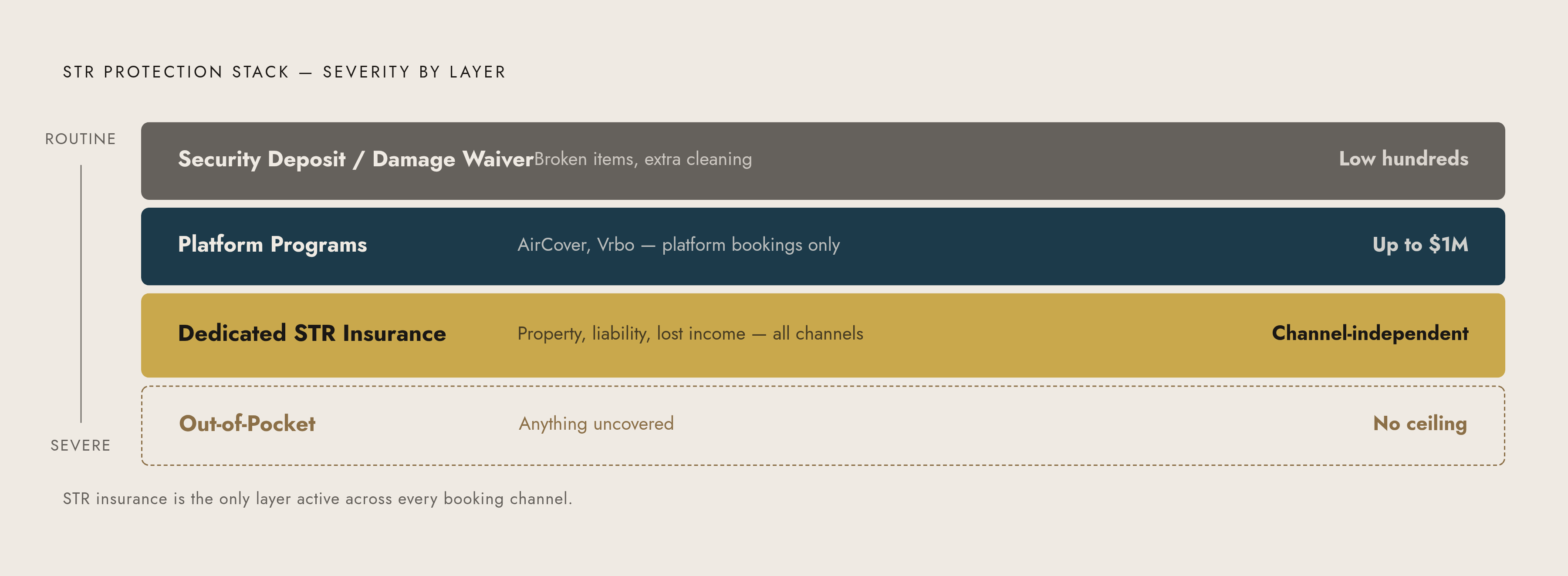
Put it all together, and a solid protection stack for most active owners looks something like this. STR insurance sits at the foundation, because it's the only layer giving you enforceable, channel-independent coverage when something serious actually happens. Platform protection, AirCover or Vrbo's liability program, sits on top as supplemental coverage for whatever bookings run through those specific channels; it was never meant to replace the foundation, and treating it that way is where owners get burned. A damage waiver or security deposit handles the front line, absorbing routine guest incidents before they ever touch your insurance at all.
Each layer matches a different level of severity, and I think that's the part owners miss most often. Waivers handle the small stuff: broken glassware, a stained couch cushion, an extra hour of cleaning time. Platform programs pick up mid-range guest damage on bookings made through that platform, resolved without ever filing an insurance claim. STR insurance is there for the serious stuff, real property damage, liability claims, lost income, and anything falling outside a platform's reach entirely, which is more territory than most owners assume.
If you take direct bookings, through your own site, a curated marketplace, or a property manager, don't assume platform protection is following you around, because it isn't. Only your STR policy and your own waiver or deposit setup travel with the booking no matter where it originated, and that's worth repeating to yourself every time you're tempted to skip the policy renewal.
There's a simpler path, too, for owners who'd rather not manage all of this piece by piece. Working with a full-service manager, like Rove+ in Rove's premium markets, means guest screening, damage protection, and liability management get handled as part of the service itself, instead of getting assembled one vendor at a time by someone who'd rather be doing literally anything else with their Tuesday afternoon.
For everyone else, the decision comes down to three things, in order: what you're comfortable absorbing yourself, what a waiver reserve should cover, and what your insurance policy needs to stand behind once the first two run out. Work through those honestly, in that order, and the right stack for your property stops being a mystery.