VRBO Property Damage Protection vs Damage Deposit
Hosts pick one damage protection method per listing, and the wrong choice costs money or bookings.

Vacation rental damage is rare, but it's not cheap. Fewer than 1% of bookings on VRBO end in a claim (0.43%, according to an Avada Properties review of over 20,000 bookings), yet when something does break, the average cost runs past $2,000. That's the tension every host is actually managing: low odds, high stakes. VRBO gives you three separate ways to handle it, Property Damage Protection insurance, a refundable damage deposit, or plain card on file, and you can only pick one per listing. Get the pick wrong and you're either scaring off bookings or eating a repair bill you had no way to collect on.
The choice also shapes things beyond risk. It affects how many people finish a booking, how much friction guests feel at checkout, and how much paperwork lands on your desk after. And if you never make a choice at all, VRBO quietly defaults you to card on file, which happens to be the weakest of the three.
How Property Damage Protection insurance works
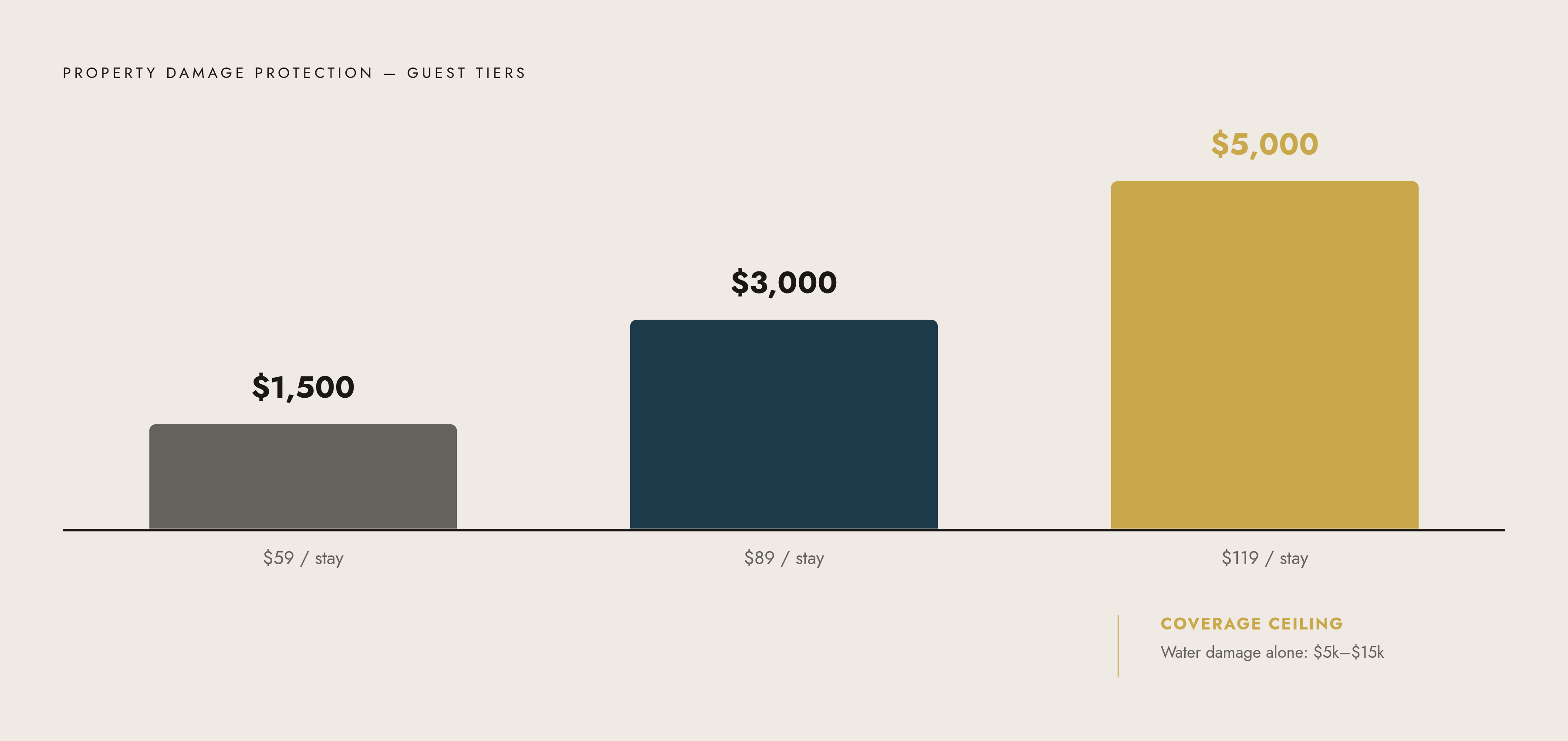
Property Damage Protection, or PDP, is insurance the guest pays for, underwritten by Generali Global Assistance. It's non-refundable, and hosts can make it mandatory at the time of booking. It has to be purchased at least 24 hours before check-in.
Guests choose from three coverage tiers, and here's the part hosts often miss: the guest picks the tier, not you.
Now, the twist most hosts don't see coming. Even if you turn PDP on and require it, the guest can opt out of the insurance and put down a cash deposit instead, equal to whatever coverage tier you set. So if you've enabled the $89 tier, a guest can hand over a $3,000 deposit instead of buying the policy. Don't assume PDP means every guest is insured. Some will pay cash, and you need to plan around that possibility.
What does PDP actually cover? Accidental damage caused by any guest on the reservation, including a listed pet, plus theft or third-party damage if a police report gets filed. What it won't touch: intentional damage, theft that isn't reported to police, cleaning fees, and pet damage if the pet wasn't listed on the booking or was banned under the rental agreement. Sneak a dog in against a no-pets policy, and PDP won't pay a dime toward the aftermath.
Then there's the gray zone nobody loves talking about: wear and tear. Whether a stain, scuff, or worn cushion counts as "accidental damage" or just normal use is a judgment call, and it's the insurer's judgment, not yours. Hosts who've filed claims report that adjusters lean toward calling borderline cases wear and tear more often than not. A stain on a five-year-old couch gets evaluated very differently than the same stain on a couch you bought last month.
How the refundable damage deposit works
With a deposit, the guest pays the full amount at booking, and VRBO holds onto it. If you don't file a claim, it's returned automatically, either 7 or 14 days after checkout. Add another 5 to 7 business days on top of that for the guest's bank to actually release the funds. It's not instant on their end either.
There's a $5,000 line that changes how this works mechanically. Set a deposit at $5,000 or under, and VRBO just stores the guest's card details, card on file style, rather than charging anything upfront. Go above $5,000, and VRBO actually charges the card at booking, holding a real balance rather than just a promise to pay.
Most hosts, per VRBO's own numbers, land somewhere between $250 and $500. A common alternative, especially for longer or pricier stays, is to set the deposit at 10% of the total booking cost instead of a flat number.
One rule trips people up constantly: you get one shot. You can't withhold part of a deposit now and come back for more later, and you can't split a claim into two separate actions. Whatever you decide to withhold, you decide once, and that's the final word on that reservation.
Deposits also can't be used for things like bike rental fees, extra utility usage, or a lost bathrobe. Those need a separate additional payment request, filed on their own.
There's a behavioral piece here too, and it's worth naming directly: guests treat a place differently when their own cash is sitting on the line. A deposit also lets you write terms into your rental agreement covering things PDP simply doesn't address, noise complaints, a filthy kitchen at checkout, stuff that isn't property damage but still costs you money and time.
How card on file works, and why it's the weakest default
Card on file is exactly what it sounds like. No charge up front, no hold, nothing. VRBO just keeps the guest's card on record, and only charges it if you file a claim within 14 days of checkout.
For the guest, this is the easiest option there is. No money tied up, nothing to think about at booking.
For the host, it's the shakiest ground you can stand on. If that card is expired, declined, or simply doesn't have the funds when you go to file a claim, there's no guarantee you get paid. VRBO says it may cover valid claims it can't collect on from the guest, but "may" is doing a lot of work in that sentence. It's not a promise.
Here's the trap: hosts who never actively pick a protection method get defaulted into card on file automatically. Plenty of hosts only find out this happened once a claim fails to collect and they're left holding a bill with nowhere to send it.
Card on file makes sense in one scenario: a genuinely low-risk, low-value property where you've thought about the collection risk and decided you're fine with it. It should never be the option you land on by accident.
Filing a damage claim under each option — and where the process breaks down
All three options share the same 14-day filing window. You've got two weeks after checkout to inspect the property and file. For high-turnover listings, that window shrinks to almost nothing in practice: a guest checks out Saturday morning, the next one checks in Saturday afternoon, and your actual inspection time is measured in hours, not days.
Deposit claims tend to move the fastest. Most get processed right away, and funds land in your account within 3 to 7 business days. VRBO will cover a valid claim up to the deposit ceiling even if the guest's card can't be charged, which is a real advantage over card on file. The catch is still the one-shot rule: once you file, you can't go back and adjust or add to it.
PDP claims take longer, and the process is more involved. You file through VRBO's e-claims portal, run jointly with Generali, using the email tied to your host account. From there, a third-party insurance reviewer takes over, and that review can stretch on for weeks. They may ask for more documentation, push back on your repair estimate, or approve only part of what you asked for. Steadily's review of host experiences found a consistent pattern: payouts landing lower than hosts expected, and the whole process feeling more like a negotiation than a claim.
Whichever path you're on, documentation isn't optional. Time-stamped photos and video at checkout, written repair estimates, actual receipts, this is the stuff that determines whether your claim goes through clean or gets picked apart. Weak documentation is the single most common reason claims get reduced or denied outright.
Where both options leave hosts exposed
The $5,000 cap on PDP's top tier is the real ceiling to worry about if you own anything above a modest property. A burst pipe, an overflowing tub, a dishwasher that floods the kitchen below, any of these can run $5,000 to $15,000 in remediation alone. Anything involving structural repair, appliance replacement, or a contractor crew is likely to blow past what PDP will ever pay out.
Intentional damage and vandalism sit outside both systems entirely. PDP flatly excludes it. A deposit gives you more leverage, sure, but a $500 hold does nothing for a property that's been deliberately trashed. At that point your options are small claims court or a separate landlord or short-term rental policy built for exactly this.
People also misread what VRBO's $1 million liability program actually does. It covers a guest's injury or damage the guest causes to someone else's property, third-party stuff. It does not cover damage a guest does to your own property. Those are two completely different categories, and confusing them is an expensive mistake to discover after the fact.
VRBO's own Host Terms of Service, Section 15.1, require you to carry insurance sufficient to protect your property and your guests before your very first booking arrives. A standard homeowners policy almost certainly doesn't meet that bar. Short-term rental insurance isn't a nice-to-have here, it's a condition of hosting on the platform at all.
Neither PDP nor a deposit is a substitute for a real short-term rental policy. They sit on top of one. They were never built to replace it.
Matching the right option to property type, value, and booking volume
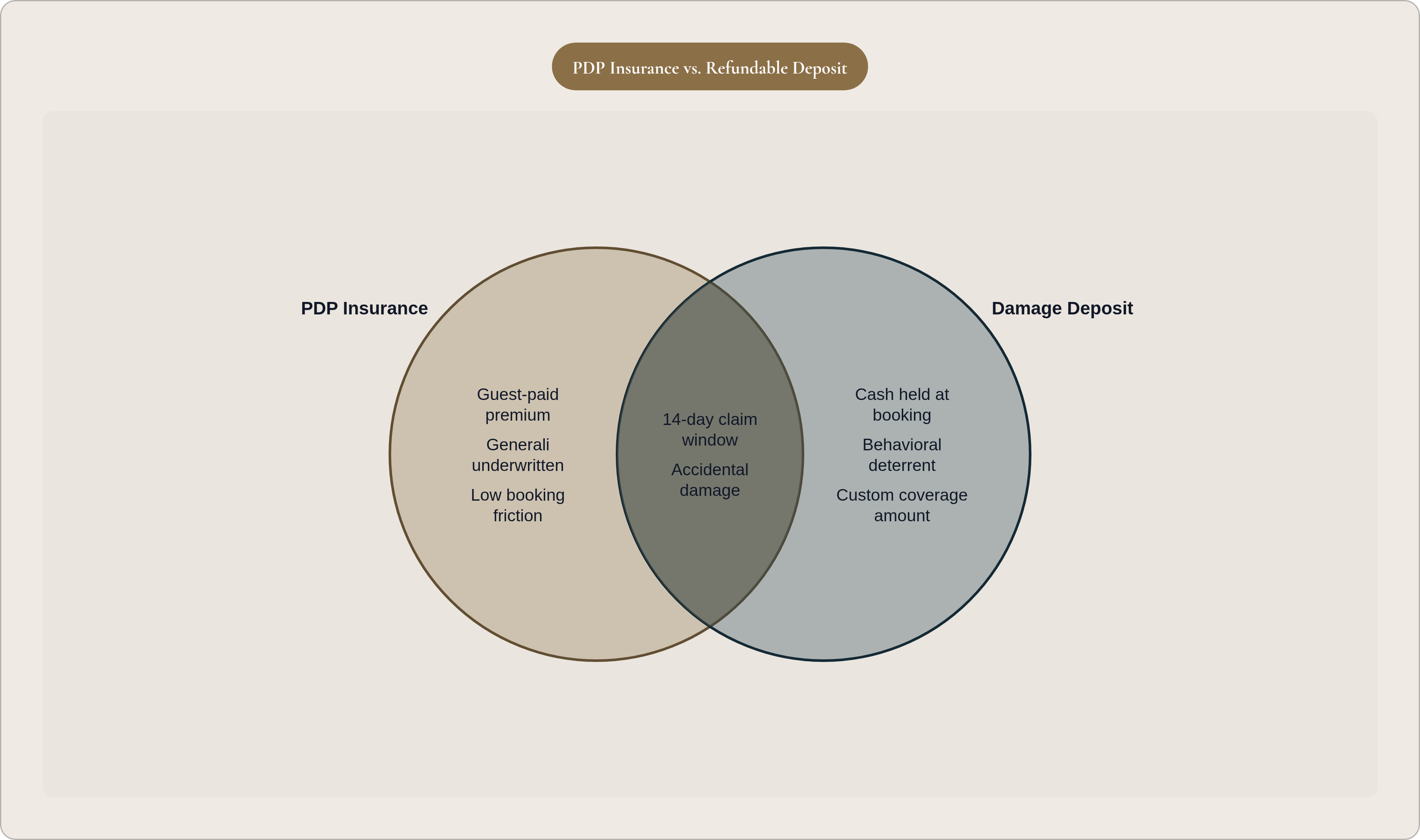
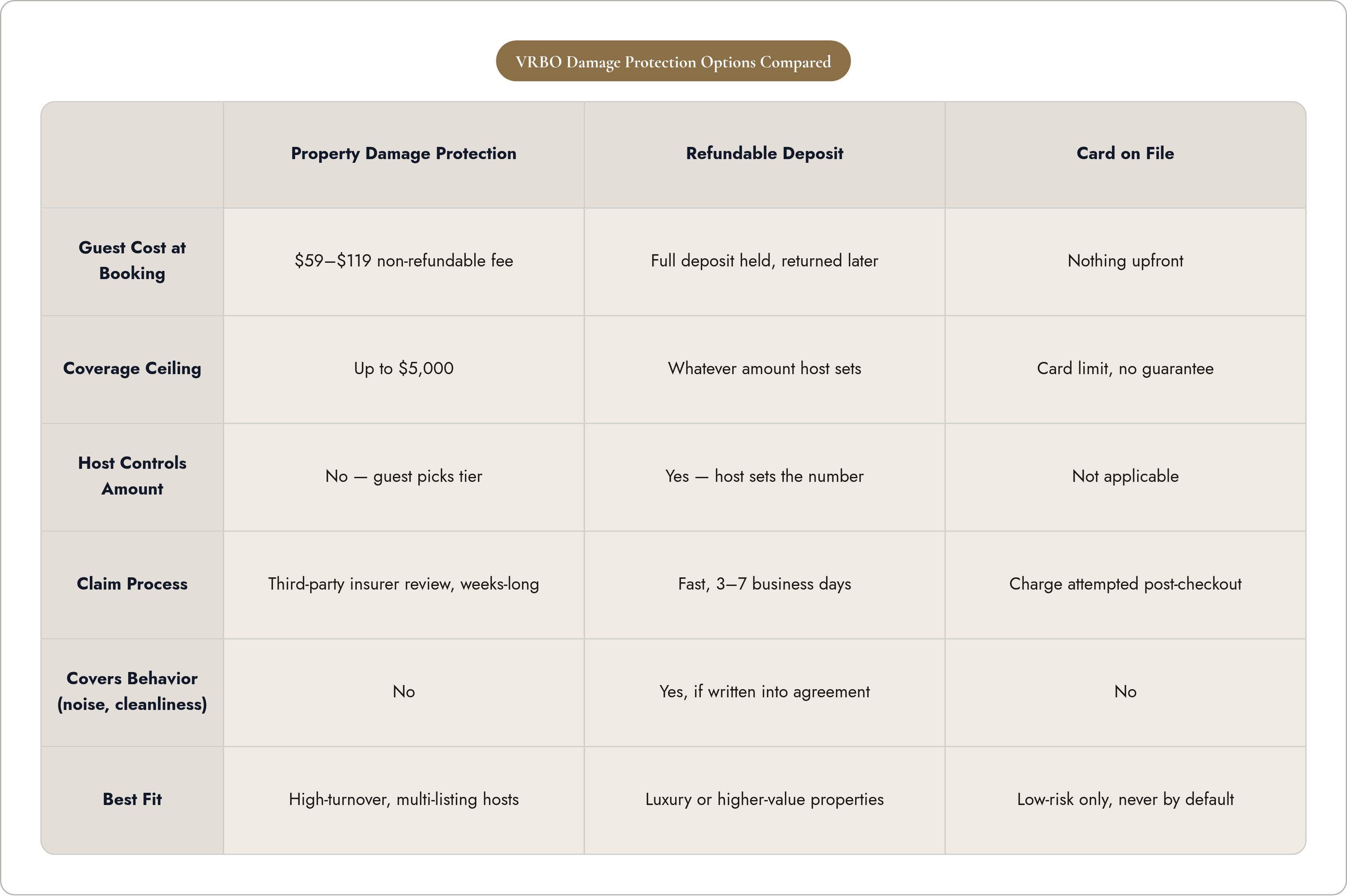
If you're running several listings with heavy turnover, PDP tends to be the better default. It cuts down on booking friction, since guests pay a small non-refundable fee instead of tying up cash, and it removes the deposit administration work that piles up fast across multiple units. Hostfully's research backs this up: for most multi-listing operators, insurance is the lower-friction choice and fits the operational model better.
For higher-value or luxury properties, a deposit usually gives you more control. You set the number based on what's actually at risk in your home, not capped at whatever PDP's top tier happens to be. And deposit terms let you address behavior, noise, cleanliness, things PDP was never designed to touch. Hostfully's analysis lands here too: hosts with premium properties get more real coverage control from a deposit than from insurance.
Calibrating that deposit is its own puzzle. Set it too high and you scare off bookings; a $500 hold on a two-night stay can feel wildly out of proportion to a guest. Set it too low and you're underprotected the moment something actually breaks. That $200 to $500 range most hosts default to might be fine for a budget rental, but it's not enough for a premium home where a single appliance replacement could eat the whole deposit and then some.
Card on file, again, should never be a default. It's fine when a host has actually thought it through and decided the risk is low enough to live with, and it's a mistake everywhere else.
For luxury and high-value rentals specifically, the strongest position is a layered one: a deposit sized to match the property's actual value, paired with a dedicated short-term rental insurance policy underneath it. Some hosting platforms build damage protection directly into their structure at levels well beyond what PDP offers, which removes this whole calculation for owners who list there, since the protection level is fixed by the platform rather than negotiated booking by booking.
Boiled down: budget or mid-range properties with high turnover and multiple listings do best with PDP as the default. Higher-value, lower-volume properties with real behavioral risk do better with a deposit scaled to match. And no matter which VRBO mechanism you choose, pair it with a short-term rental insurance policy that actually meets what the platform requires of you. Skipping that last step is the one mistake that turns a rare bad night into a genuinely expensive one.