Dynamic Pricing Strategies for Luxury Vacation Rentals
Owners can gain $30,000 to $40,000 yearly with smarter pricing.

Luxury vacation rental demand is growing fast, but the pricing systems most operators use to capture that demand were built for a different market entirely. That mismatch is costing owners real money, and it's not a small gap. We're talking $30,000 to $40,000 a year between an operator who prices well and one who doesn't, according to West Coast Homestays' figures on well-calibrated versus poorly-calibrated strategies.
The luxury vacation rental market is set to grow from $28.5 billion in 2025 to $63.7 billion by 2034, a 9.3% annual growth rate according to GM Insights. That's against a broader short-term rental market sitting around $136.3 billion globally this year, which tells you something important: luxury isn't just riding the wave, it's a smaller, faster-moving current inside a much bigger river. PwC found that 72% of luxury travelers now prefer short-term rentals over hotels in 2025, chasing privacy and space over standardized hotel rooms. Occupancy at the top end has climbed too, from around 65% in 2023 to somewhere between 68% and 72% in 2025 in the hottest destinations. North America holds roughly 38% of the luxury rental platform market, Europe sits at 33%, and Asia-Pacific is contributing about 29% of the global growth.
Put that together and you get a growing, supply-constrained, high-net-worth audience where every rate decision carries weight. Price too low and you leave money on the table that doesn't come back. Price wrong in the other direction and you sit empty while a better-calibrated competitor down the street fills up. This market rewards precision. It punishes a rate card that gets set once at the start of the season and left alone.
How supply growth is outpacing demand growth, and what that does to pricing leverage
Here's the uncomfortable part: supply is growing faster than demand. AirDNA found that vacation rental listings jumped 12.8% in 2024, while occupancy actually dropped 5.3%. More properties chasing roughly the same number of guests. That's not a luxury-specific trend, but it hits luxury owners hard because the properties are expensive to carry and the margin for error is thin.
This is the real reason static pricing has become a liability, not a preference issue. When your competitive set is adjusting rates daily and you're holding a fixed number, you're handing revenue to whoever's paying closer attention. It's that simple.
The industry has noticed. Hostaway reported that 84% of short-term rental operators adopted AI pricing tools in 2025, up from 60% just the year before, and 62% named dynamic pricing an essential part of running their business. Dynamic pricing isn't a differentiator anymore. It's table stakes. The real question for any operator now is whether the tool is configured well or badly, because a bad configuration can look like activity without producing results.
For luxury specifically, getting this wrong costs more. A budget property that's mispriced by 10% loses a modest amount per night. A seven-figure oceanfront home mispriced by the same percentage is bleeding thousands of dollars a week, and that's before you count the brand damage from attracting the wrong guest at the wrong rate.
Why standard dynamic pricing algorithms treat luxury properties incorrectly by default
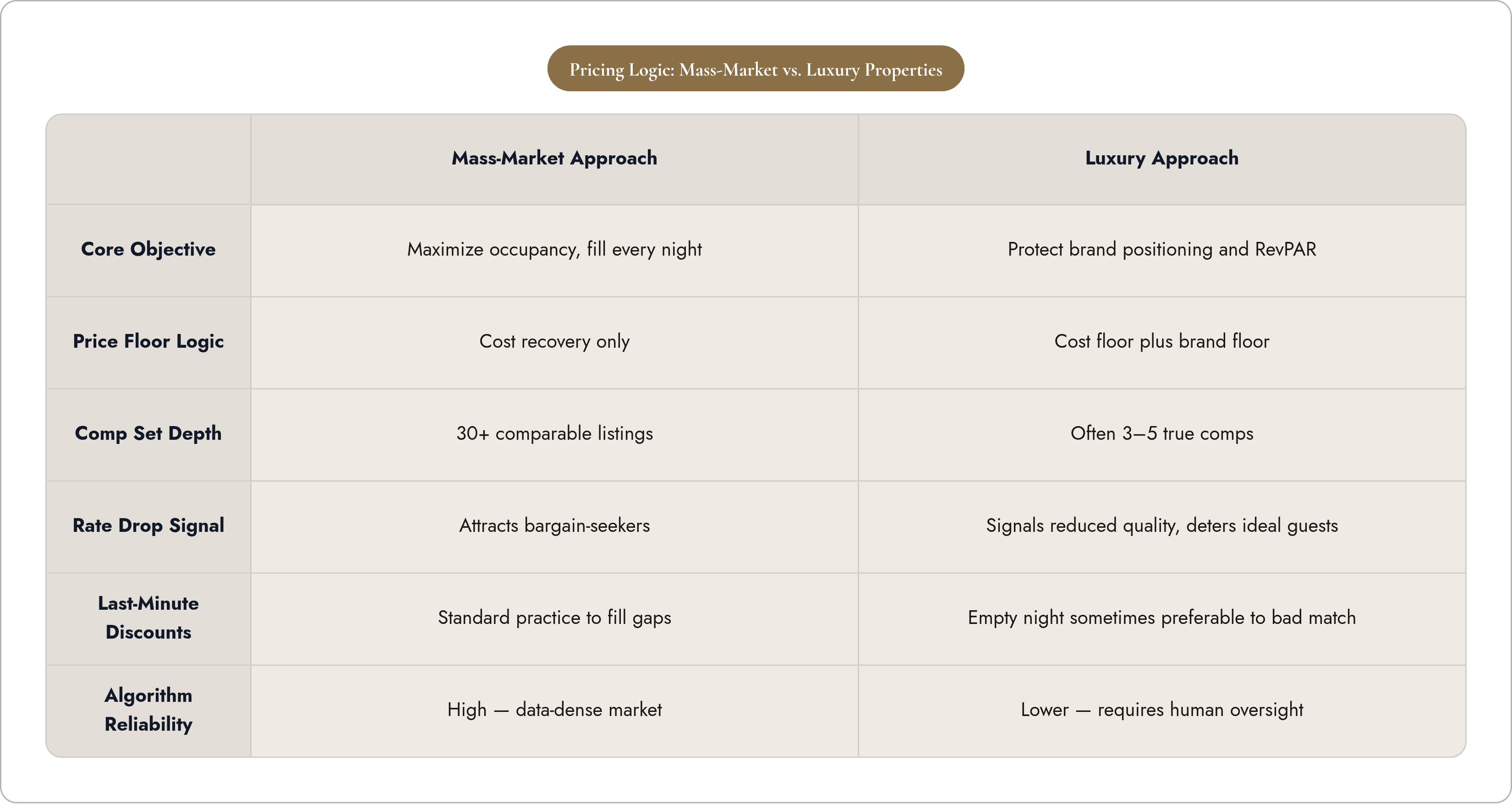
Most mainstream pricing tools are built on volume. They're trained across huge pools of comparable listings and optimized to keep those listings full. That works fine for a three-bedroom condo near a convention center. It works badly for a compound with a private dock and a wine cellar.
The core problem is a mismatch in logic. Mass-market pricing tools lower the rate until the night fills, full stop. Luxury pricing has to work differently, because price itself is a signal of quality. Drop the rate on a high-end-nightly-rate property because occupancy is soft one week, and you're not just losing revenue on that single night. You're telling every guest who sees the algorithmically discounted rate that this property isn't actually worth its asking rate. That perception doesn't reset itself the next morning.
Luxury guests behave differently, too. They're less sensitive to price than budget travelers, but far more sensitive to perceived value. A rate that looks like it dropped out of desperation reads as a red flag, not a deal.
Then there's the comp problem. Algorithms need a wide pool of comparable properties to benchmark against, and a seven-bedroom oceanfront home simply doesn't have thirty true comps in most markets. It might have three. When the algorithm can't find enough real comparables, it often reaches for properties that aren't actually comparable at all, and that pulls the suggested rate toward a floor that doesn't fit. Beyond Pricing has said as much directly: luxury and unique properties need human-assisted configuration, because the data density that makes fully automated pricing accurate just doesn't exist in most luxury submarkets.
None of this means dynamic pricing is wrong for luxury. It means the algorithm needs a human layered on top, someone applying brand judgment the software can't infer from booking data alone.
Setting a price floor that reflects the property's brand, not just its costs
A price floor is the rate below which a property should never appear, no matter what the algorithm suggests or how much occupancy pressure builds. Every luxury property needs one, and it needs two layers.
The first is a cost floor: cleaning, linens, property management fees, platform fees, taxes, plus whatever minimum margin makes the booking worth taking. That's the absolute basement, the number below which you're losing money to have a guest in the house at all.
The second layer matters more for luxury, and it's the one operators skip. Call it the brand floor: the rate below which the property starts undermining its own positioning, even if it's still profitable on paper. If a home is marketed at a premium nightly rate and it shows up at a steeply discounted price during a slow week, you haven't found a bargain-hunter who'll come back. You've attracted a guest whose expectations don't match the house, and that mismatch shows up in wear on the furniture, friction with the housekeeping team, and reviews that complain about things a $1,500-a-night guest wouldn't blink at.
The brand floor should be set jointly, owner and manager sitting down together, using comparable closed transactions rather than what competitors have listed (listed rates in luxury are often fantasy numbers nobody actually pays). Guesty's pricing framework backs this up: floors should be built from costs plus a target margin, not from what the guy down the street is charging, because a calendar that looks fully booked can still be quietly bleeding money if too many of those nights sit below margin.
One clarification worth making plain: a brand floor isn't a fixed rate. It's a lower bound. The system should move freely above it, and most of the time, it should.
Reading micro-seasons and local demand signals instead of calendar quarters
Forget the idea that a luxury market has three or four seasons. It has dozens of micro-windows, each driven by a local event, a school calendar, a stretch of good weather, or a demand pattern that shifts week over week and sometimes day over day.
AvantStay found that average daily rates can climb dramatically during peak periods in popular destinations. That's revenue a static pricing system simply never captures, because by the time a manager notices the calendar filling fast, the smart operator next door already raised rates three times.
A few signals worth tracking closely:
Compression events, like concerts, festivals, and conferences, spike local demand suddenly and briefly. Airbnb's own data showed Paris bookings jumping 60% during the 2024 Eras Tour dates. These windows are easy to miss because they're often new each year and don't show up in last year's booking history.
Booking pace matters too. If a given weekend is filling faster than the same weekend booked last year, that's a signal to raise the rate now, not wait around for confirmation that demand is real. And when comparable properties in your micro-market go fully booked, whatever's left standing should command a premium, because the guest's options just narrowed.
Holiday weeks are their own category. Demand can surge several times above the average nightly rate around the right holiday, but which holiday matters depends entirely on the market. Thanksgiving in Aspen doesn't behave anything like Thanksgiving in the Hamptons.
In the markets I know well, this micro-season logic isn't optional, it's the whole game. Hamptons demand compresses hard into Memorial Day through Labor Day, with a spike around July 4th. Aspen runs on ski season peaks layered with a separate summer shoulder period. South Florida peaks around winter and spring break. Treating any of these as one flat "high season" throws away real money. Rates in these markets should update daily based on what's actually happening, not weekly, and definitely not manually after someone happens to notice a competitor's calendar filled up.
Managing booking window and pacing: how far-out demand and last-minute gaps require different rate logic
When a guest books matters just as much as when they're staying. That's a separate pricing dimension from season, and a lot of operators miss it entirely.
Guests booking four to six months out have fewer competing options and tend to be more committed to the trip. That's a moment to hold rates firm or even raise them, locking in high-value nights well ahead of the stay. Minimum-stay rules reinforce this too: requiring a longer minimum for far-out bookings keeps a short reservation from blocking a calendar slot that could've gone to a longer, higher-value stay.
The other end of the window works differently. Key Data found that bookings made within 14 days of arrival rose 7% in 2024, which means there's a real pool of last-minute guests worth capturing with a targeted, well-timed discount rather than letting the night sit empty. Orphan nights, single unbooked gaps between two existing reservations, are the sharpest version of this problem. They generate zero revenue by default, and a rule-based discount can recover at least some of that.
Charging the same rate no matter how far out someone books misses money on both ends: too cheap early, potentially too expensive right before arrival when the only alternative is an empty house.
Luxury properties need to be careful with last-minute cuts, though. Slashing the rate in the final days can pull in a guest who doesn't fit the property, and for a high-end home, an empty night is sometimes the better outcome than a bad match. The fix is to pre-configure these rules in the pricing system ahead of time rather than making the call reactively. If a manager is noticing a gap three days before arrival, it's already too late to adjust the rate without it looking like a fire sale.
Competitive set positioning for properties with few true comps
Standard competitive benchmarking assumes a wide comp set, thirty or more similar listings to draw from. At the luxury tier, you're often working with three to five properties, not thirty, and that thin pool creates two distinct risks.
The first is over-anchoring. If one of those three comps makes an irrational pricing decision, a panic discount, say, it can pull a well-run property's rates in the wrong direction simply because the algorithm treats that one data point as meaningful. The second risk runs the other way: a tool that can't find enough true comps may quietly default to a lower tier, systematically undervaluing a property that has no business being compared to what it's being compared to.
Building a comp set that actually works starts with the property's real characteristics: bedroom count, exact location (beachfront versus a five-minute walk to the beach is a meaningful difference, not a rounding error), the amenities on offer (private dock, chef's kitchen, pool), and the condition and design quality of the home itself. From there, layer in the booking platform. A home listed on a curated marketplace alongside other vetted luxury properties, Rove is one example, sits in a different competitive position than an identical home listed on a mass platform with no vetting process at all.
Track closed rates, what comps actually booked at, not their listed rates. In luxury, listed prices are often aspirational numbers that never get paid.
Positioning also isn't just about matching the comp set, it's about deciding deliberately where to sit relative to it. A property with genuinely better amenities or a stronger management reputation can price above its comps and hold that premium, as long as the value shows up clearly in the listing photos, the guest reviews, and how the property presents itself. AirDNA's 2025 research on short-term rentals found that properties using dynamic pricing outperform manually priced comparable listings by an average of 18% in revenue per available room, but that gap depends heavily on how well the comp set was built in the first place, not just whether a pricing tool is switched on.
How channel strategy interacts with rate-setting and why direct booking changes the math
The same property can and should show up at different effective prices across different platforms, because the fee structures behind each one are not the same. Airbnb charges guests around 14%. Vrbo's fee ranges roughly 5% to 15%. Booking.com typically charges the property owner rather than the guest. Same nightly rate, three different amounts landing in the owner's pocket.
That opens up a real lever: a property with its own direct booking channel can offer a guest a slightly lower rate than the OTA listing, reflecting the commission the owner just saved, while still netting more per booking than they would through a third-party platform. The guest gets a better price. The owner keeps more of it. Everybody wins except the middleman.
For luxury properties, the platform itself carries pricing weight. Appearing on a curated marketplace alongside other vetted homes, again, something like Rove does this well, signals a level of quality that supports holding a higher floor rate than the same listing might command on a mass platform where it's competing against thousands of unvetted options on price alone.
Rate parity rules complicate this. Some platforms require it, some don't, and knowing which agreements apply to which channel is step one before attempting any channel-differentiated pricing strategy at all. There's also a positioning effect here: a property distributed widely across every OTA is competing in a crowded, price-driven search result. A property distributed narrowly through curated, high-trust channels is competing on an entirely different axis, one based on fit and reputation rather than who's cheapest this week.
The practical upshot is that a pricing strategy has to account for where the rate is being set, not just what the number is. A tool tuned purely for Airbnb visibility might be solving for the wrong outcome entirely if the property's ideal guest never books through Airbnb in the first place.
What the revenue evidence actually shows — and what it leaves unresolved for luxury operators
The numbers on dynamic pricing, taken broadly, are consistent and hard to argue with. A 2025 study by Your.Rentals tracking 541 short-term rental listings found properties using dynamic pricing earned 36% more revenue on average than those running static rates. Beyond Pricing's case studies show 20% to 40% revenue increases, and owners using dynamic pricing in 2025 report profit margins 12% to 18% higher than static pricing produces. Interhome's 2025 model recorded 25% more reservations and 18% higher turnover from rate adjustments tied to multiple market factors at once.
A Colorado luxury chalet case study, reported by listmyproperties.com, found a single property saw a 20% jump in occupancy and a 15% boost in rental income after switching to dynamic pricing in 2024. That number, drawn from one actual luxury property rather than a blended portfolio average, is probably closer to what a luxury owner should realistically expect than the aggregate industry figures above.
Here's what none of this settles, though. Most of these studies pool properties across every price tier, so an 18% RevPAR outperformance measured across the whole market could be hiding a very different picture at the ultra-luxury end, where thin comp sets and brand sensitivity change the math entirely. And a chunk of any reported "lift" from dynamic pricing is really just a measure of how bad the static baseline was to begin with. An operator who never adjusted rates in five years is going to see a dramatic jump from almost any half-decent system. An operator who was already pricing thoughtfully by hand will see a smaller, harder-won gain, and that gain will come from precisely the things a generic algorithm can't do on its own: setting the brand floor correctly, reading the micro-season, and knowing which guest is actually worth the empty night.