What Airbnb Property Managers Charge in Fees
The fees range from 10% to 40% of revenue depending on geography, property type, and service scope.

Airbnb property management fees run from 10% to 40% of gross rental revenue, and that spread reflects something real at every point. Geography, service scope, fee structure, ancillary charges, and the actual base the percentage is applied to all shape where a given arrangement lands. The headline number gets quoted; what sits beneath it is what separates an owner who evaluates fees accurately from one who picks a manager on a percentage and spends the next year wondering where the money went.
AirDNA data updated in August 2025 puts the average full-service property manager between 18% and 25% of gross revenue. Channel-management-only arrangements floor around 10%. Rural and isolated markets with premium or amenity-heavy properties push toward 40%.
Geography moves the needle first, and the mechanism is competition, or the absence of it. Urban markets with dense vendor networks and real rivalry among management firms cluster between 20% and 25%. Rural and coastal-isolated markets push higher, sometimes well past 30%, because the logistical reality is harder: fewer cleaners to choose from, longer vendor travel times, seasonal volatility that demands active pricing attention. The competitive pressure that holds urban fees in check simply doesn't exist out there.
Property type follows. A two-bedroom apartment in a walkable city is operationally simple. A five-bedroom lakehouse with a dock, hot tub, kayak fleet, and propane fire pit is not. The management cost difference between those two properties is genuine, and the fee should reflect it.
Luxury properties carry their own pricing logic. Guests paying premium nightly rates expect fast response times, curated amenities, and no operational gaps. Managers who credibly deliver at that level often charge 2% to 5% more than the general market. On very high-revenue properties, though, that relationship can invert: a listing generating strong annual income is attractive to a management firm, which gives the owner real leverage to negotiate the percentage down.
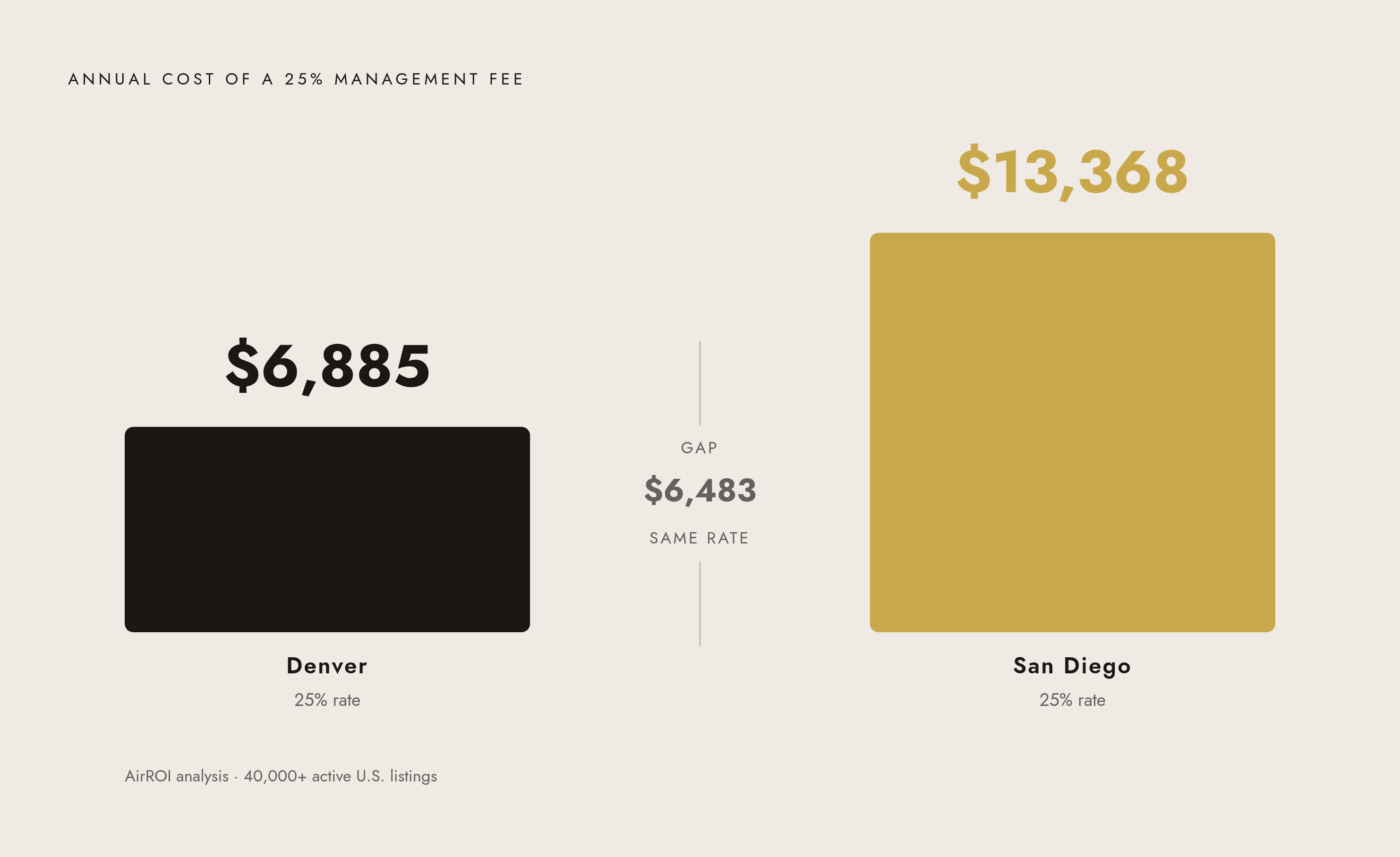
The geography point has concrete dollar consequences. Per AirROI analysis of more than 40,000 active listings across seven U.S. markets, a flat 25% fee costs roughly $6,885 per year in Denver and roughly $13,368 per year in San Diego. Same percentage, entirely different dollar cost, driven by underlying revenue differences. What looks expensive in one market is entirely reasonable in another, and the only fair comparison is effective dollar cost measured against local revenue benchmarks, not a percentage stacked against a national average.
The Four Fee Structures and How Each Shifts Financial Risk Between Owner and Manager
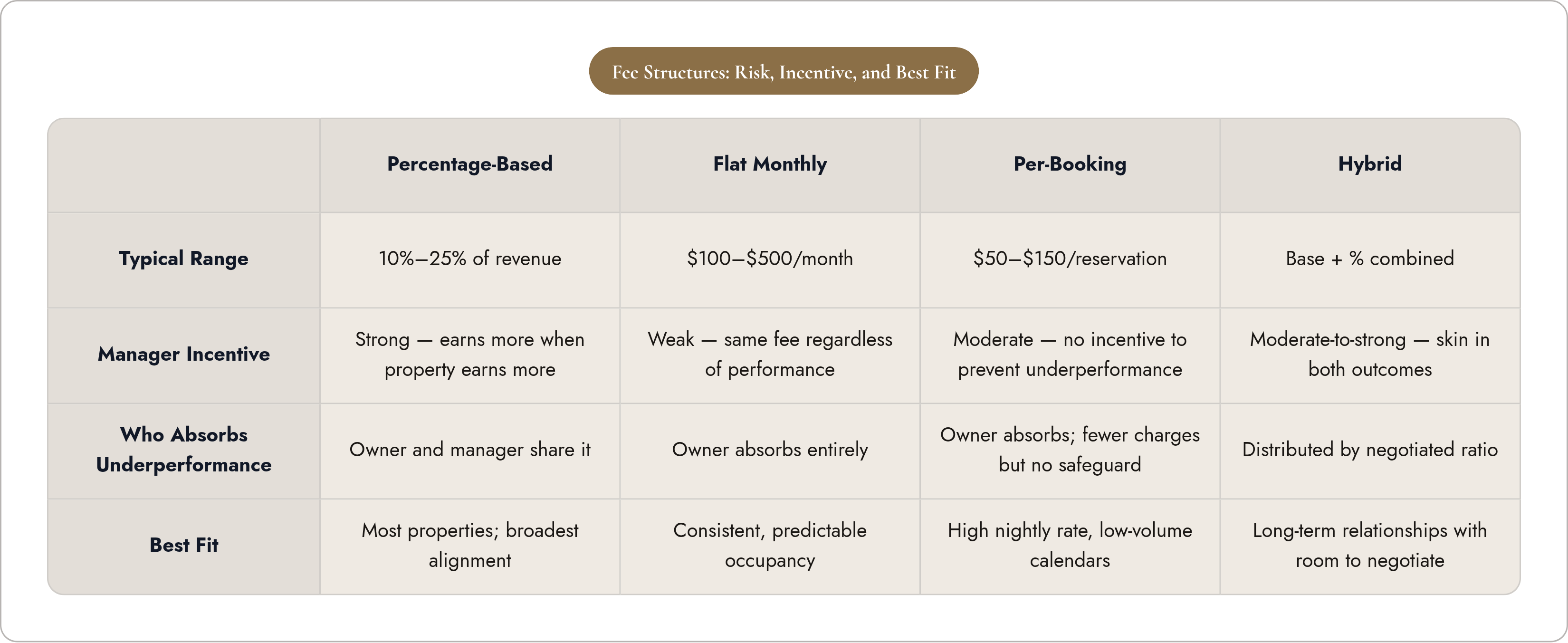
Most owners encounter four fee structures. Which one a manager uses tells you something meaningful about where the financial risk lands when the property underperforms.
Percentage-based is the dominant model: the manager earns a cut of rental revenue, typically 10% to 25%. The alignment is genuine. When the property earns more, the manager earns more, which creates a real incentive to optimize pricing and occupancy rather than just show up.
Flat monthly fees, roughly $100 to $500 per month, are less common. They work for properties with consistent, predictable occupancy where an owner values cost certainty across seasonal swings. The structural problem is motivation: a manager collecting the same fee whether the property books 10 nights or 25 nights has limited incentive to push performance, and that gap matters more than it looks on paper.
Per-booking fees, typically $50 to $150 per reservation, can work well for high-nightly-rate properties where a percentage would compound into a large absolute sum. A high-volume calendar with modest nightly rates makes this structure expensive quickly, so the math has to be run against actual booking patterns, not theoretical ones.
Hybrid models combine a base monthly charge with a percentage of revenue. Both components can move, which makes this the most negotiable structure of the four. It gives the owner some cost-floor predictability while giving the manager genuine skin in performance. For owners building a longer-term management relationship, this is usually the most productive structure to negotiate.
The underlying question each structure answers differently is this: who absorbs the cost when the property underperforms? On a percentage model, the manager absorbs it alongside the owner. On a flat monthly fee, the owner absorbs it entirely. On a per-booking model, underperformance means fewer charges, but the structure creates no incentive to prevent it. Hybrid sits in the middle, with the burden distributed according to whatever ratio the two parties negotiated.
One question belongs in every conversation with a prospective manager, regardless of structure: what is the fee base? Is the percentage applied to the nightly rate only, or does it include cleaning fees, pet fees, and other guest charges? That single clarification can shift the effective fee rate by several percentage points on properties with meaningful ancillary charges.
What Airbnb's Shift to a 15.5% Host Fee Means for Every Owner Using a Manager
Before October 2025, Airbnb split platform costs between host and guest. Hosts paid a modest percentage; guests paid a service fee visible at checkout, typically 14% to 16%.
That model is gone. Airbnb migrated to a single 15.5% host-side fee applied to the full booking subtotal: nightly rate, cleaning fees, pet fees, and extra guest charges. Taxes and security deposits are excluded. The stated rationale was pricing transparency, giving guests a cleaner total at search without a service fee appearing at checkout. The migration began with property management software-connected hosts on October 27, 2025, covering platforms including Guesty, Hostaway, Hostfully, OwnerRez, and Lodgify. Remaining hosts were automatically switched on April 13, 2026.
The revenue math is direct. An owner who leaves pricing unchanged after the migration sees payouts fall by roughly 13%. The markup required to maintain revenue parity is 18.34%. A manager who hasn't made that adjustment is passing that revenue erosion to the owner, one monthly statement at a time, quietly.
This fee change functions as a basic competency test for any manager operating on Airbnb. A qualified manager should be able to tell you specifically what channel markup they applied to your listing, when they applied it, and how owner payouts are calculated under the new structure. If they can't explain why the first statement under the new model looks different from the prior year, you've learned something important about how they operate, and probably about what you've already lost.
The cleaning fee implication deserves separate attention. Because the 15.5% fee applies to cleaning charges, managers who set inflated cleaning fees are now sharing more of that revenue with Airbnb. That creates downstream pressure on how cleaning is structured and priced. Some managers will absorb it; others will restructure their cleaning approach entirely. Ask which is true for yours before the answer materializes in your numbers.
Service Tiers: What Full-Service, Partial-Service, and Co-Host Arrangements Actually Deliver
The fee percentage is inseparable from what it buys. Three distinct service tiers operate in this market, and treating them as comparable is how owners end up with the wrong arrangement at the wrong price.
Channel management and partial service, typically 10% to 15%, covers listing distribution and dynamic pricing software. The manager handles the technology layer. The owner still handles guest communications, cleaning coordination, and maintenance calls. It is a real service. It is not full management, and owners who sign expecting the latter discover the difference through lived inconvenience, not a contract clause.
Full-service management, priced from 18% to 40%, covers the complete operational cycle: guest communication from inquiry through checkout, cleaning oversight, maintenance coordination, pricing, and listing management. The owner's active involvement is minimal. That has genuine value, particularly for owners who live remotely, have demanding schedules, or are managing multiple listings at once.
Co-hosting is a structurally distinct third category that most fee comparisons skip over entirely.
The most consequential difference between a co-host and a traditional property manager is account architecture. A co-host operates inside the owner's Airbnb account. Reviews, Superhost status, and guest history accumulate under the owner's profile. A traditional property manager typically runs listings under their own business profile, which means that equity accrues to them. For an owner who plans to keep the listing long-term, or who wants to preserve optionality to sell the property with its review history intact, that distinction is worth understanding before signing anything.
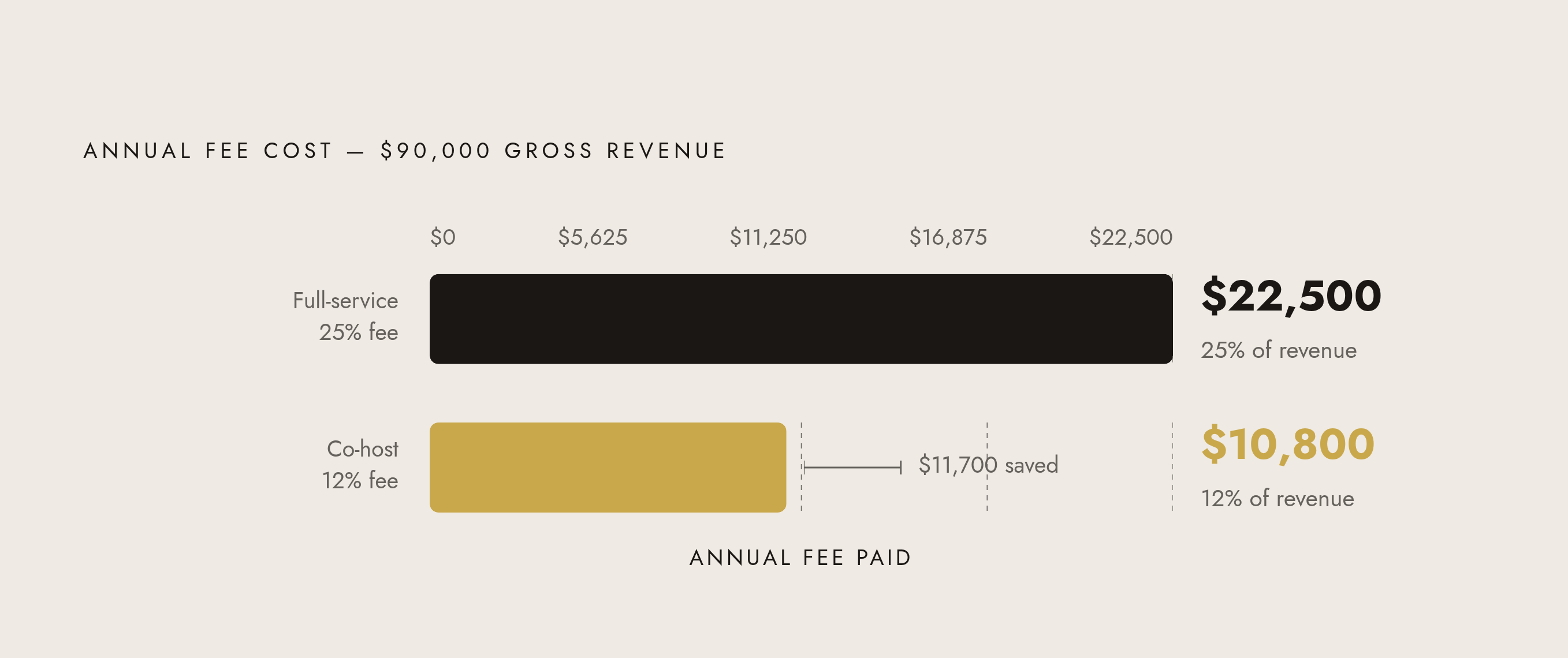
Co-host fee tiers in 2026 run roughly 10% to 15% for communication-only arrangements, 15% to 25% for partial management including cleaning coordination, and 25% or more for full-service arrangements that include marketing and channel management. Some co-hosts offer flat monthly fees in the $500 to $1,500 per property range, which is considerably more cost-effective for high-revenue listings where a percentage compounds sharply. On an annual gross of $90,000, the difference between a 25% management fee and a 12% co-host arrangement reaches approximately $11,700 per year. That is a legitimate option in the market, not a workaround.
The Airbnb Co-Host Network, as of 2026, includes more than 15,000 vetted co-hosts managing over 100,000 listings across 12 countries, with verified profiles, ratings, and payment handled inside the Airbnb platform.
Co-host rates are negotiable. Airbnb provides the marketplace but does not set fees. A co-host who charges one rate for a single property will often accept a lower rate for a portfolio. That leverage exists; most owners never surface it.
The Add-On Charges That Inflate Effective Cost Beyond the Quoted Percentage
Most owners discover the full cost of management after signing, not before. The quoted percentage is almost never the complete picture.
Onboarding and setup fees cover photography, listing creation, smart lock installation, and initial inventory. These range from a few hundred dollars to $2,000 or more. Some firms waive them with a 12-month commitment. The relevant comparison is total first-year cost, not just the ongoing percentage.
Cleaning markups are among the most common and least disclosed add-on charges. Some managers mark up actual cleaning invoices by 20% to 40% and retain the difference; others pass the cleaner's invoice through at exact cost. That markup can add $50 to $100 per turnover. On a property with 150 annual turnovers, the math compounds into something worth knowing before you commit.
Maintenance and vendor markups follow the same pattern. A manager who coordinates a several-hundred-dollar plumbing repair will invoice the owner at a marked-up amount and keep the spread. These charges are frequently buried in monthly statements rather than disclosed upfront.
Technology fees, billed separately from the management percentage, are common in the $20 to $100 per month range, covering dynamic pricing platforms, PMS software, and channel management tools. Some managers absorb them; others pass them through as a line item that doesn't surface until the third month.
Supply costs range from a few hundred dollars annually for a simple one-bedroom to $2,500 or more for a large, amenity-heavy property. Whether these are owner-funded or managed-and-marked-up varies by firm and needs to be clarified before signing.
Early termination penalties deserve explicit scrutiny. Month-to-month contracts offer flexibility but typically carry standard or above-standard rates. Longer commitments of 12 to 24 months earn a modest fee reduction, but they create real exit risk if the relationship deteriorates, and relationships do deteriorate.
A quoted 20% management fee can land significantly higher once markups, setup costs, and technology fees are folded in. That swing between quoted and effective cost is common, not exceptional. Before signing, request an itemized list of every fee category, ask whether cleaning and maintenance are passed through at cost or marked up, and get the specific contract exit terms in writing.
How to Assess Whether a Management Fee Is Fair for a Specific Property
The right question is not what the industry average is. The right question is what this specific fee buys relative to what you'd spend managing the property yourself or through a co-host.
Start with a service scope audit. Map every task the manager covers: guest communication, dynamic pricing, cleaning coordination, maintenance calls, tax remittance, guest screening, linen management. Then map what you would actually do yourself if you weren't paying for it. A full-service fee is only expensive if you'd genuinely perform those functions otherwise. For a remote owner with a demanding schedule, the calculus is different than for a local owner with two free hours per week and a cleaner they already trust.
Then calculate the effective cost. Add the percentage fee, the cleaning markup if one applies, monthly technology fees, and amortized setup cost across a 12-month period. Compare that total to gross revenue: not the quoted percentage to gross revenue, but the actual dollar total to gross revenue. That effective rate is what you're paying.
Apply the repricing test to any prospective manager. Ask how they handled Airbnb's 15.5% fee migration. Ask what channel markup they applied and when. A manager who can't answer that specifically is costing you money before they've managed a single reservation.
Apply market context to what you find. A 30% fee in a rural coastal market with limited vendor access, genuine seasonality, and high operational complexity may be exactly right. A 30% fee in a dense urban market with abundant infrastructure requires a more rigorous justification, and a competent manager should be able to provide one.
Use volume as leverage. Owners with multiple properties, or those willing to commit to a defined contract term, have negotiating room most managers won't volunteer. Surface it in the conversation.
For luxury properties in markets like the Hamptons, Aspen, South Florida, or Manhattan, the evaluation frame shifts. White-glove service, rigorous guest screening, and substantive damage protection are baseline requirements for operating at that level, not premium amenities. The fee question becomes inseparable from whether the manager can credibly deliver those things. Rove operates specifically in the luxury short-term rental segment, with curated listing standards, damage protection coverage up to $5 million, and professional management through Rove+ priced to reflect the actual cost of operating at the top of the market. For owners in that tier, the more pressing question is whether generalist management is the right frame at all, or whether a purpose-built platform better matches the property's risk and service profile.
The percentage is the beginning of the conversation. Everything above is what makes that conversation worth having.