East Hampton Vacation Rental Houses by Neighborhood
Choose neighborhoods carefully: your location determines price and whether you need a car.

East Hampton isn't one rental market. It's seven or eight small ones stitched together under a single name, and the neighborhood you pick matters more than almost any other decision you'll make about the trip.
Right now, that decision comes with actual leverage. The Hamptons rental market has flipped from a landlord's market to a renter's one; Social Life Magazine's 2025 reporting puts prices down 15 to 25% from their pandemic peak, and East Hampton North has absorbed the largest inventory increase of any Hamptons submarket. Active listings sit at 2,483 on VRBO and 988 on Out East, a lot of houses competing for your dollar.
Renter's market doesn't mean cheap, though. Peak-week luxury rates still run $5,000 to $15,000 a night in the top tier, and AirDNA's June 2026 data shows average daily rate up 15.4% year-over-year to $1,521 per booked night. Asking prices softened across the board, but the properties actually getting booked are pulling higher rates than ever, a flight to quality playing out in real time as people choose carefully from a wider pool of houses.
The real risk, then, isn't overpaying. It's picking the wrong neighborhood for what you actually want, and paying the wrong price for it. The rest of this piece is a walk through East Hampton's actual geography, neighborhood by neighborhood, so you know what you're buying before you sign a lease.
How East Hampton is actually organized and why "East Hampton" means something different depending on who's saying it
First, a distinction that trips up a lot of renters: East Hampton is both an incorporated village and a much larger surrounding town. When someone says "we rented in East Hampton," they could mean a five-minute walk from Main Street, or they could mean a twenty-minute drive from it. The regulations, the character, and the price all shift depending on which one they mean.
Inside the town, four zones show up again and again in listings. There's the Village itself, incorporated and walkable. There's Springs, a hamlet to the northeast with its own artistic history. There's Northwest Woods and Northwest Harbor, wooded and quiet, and there's what everyone calls "South of the Highway," the oceanside corridor of estates. Amagansett sits at the town's western edge, technically its own hamlet, but it gets swept into "East Hampton" searches often enough that it belongs in this conversation too.
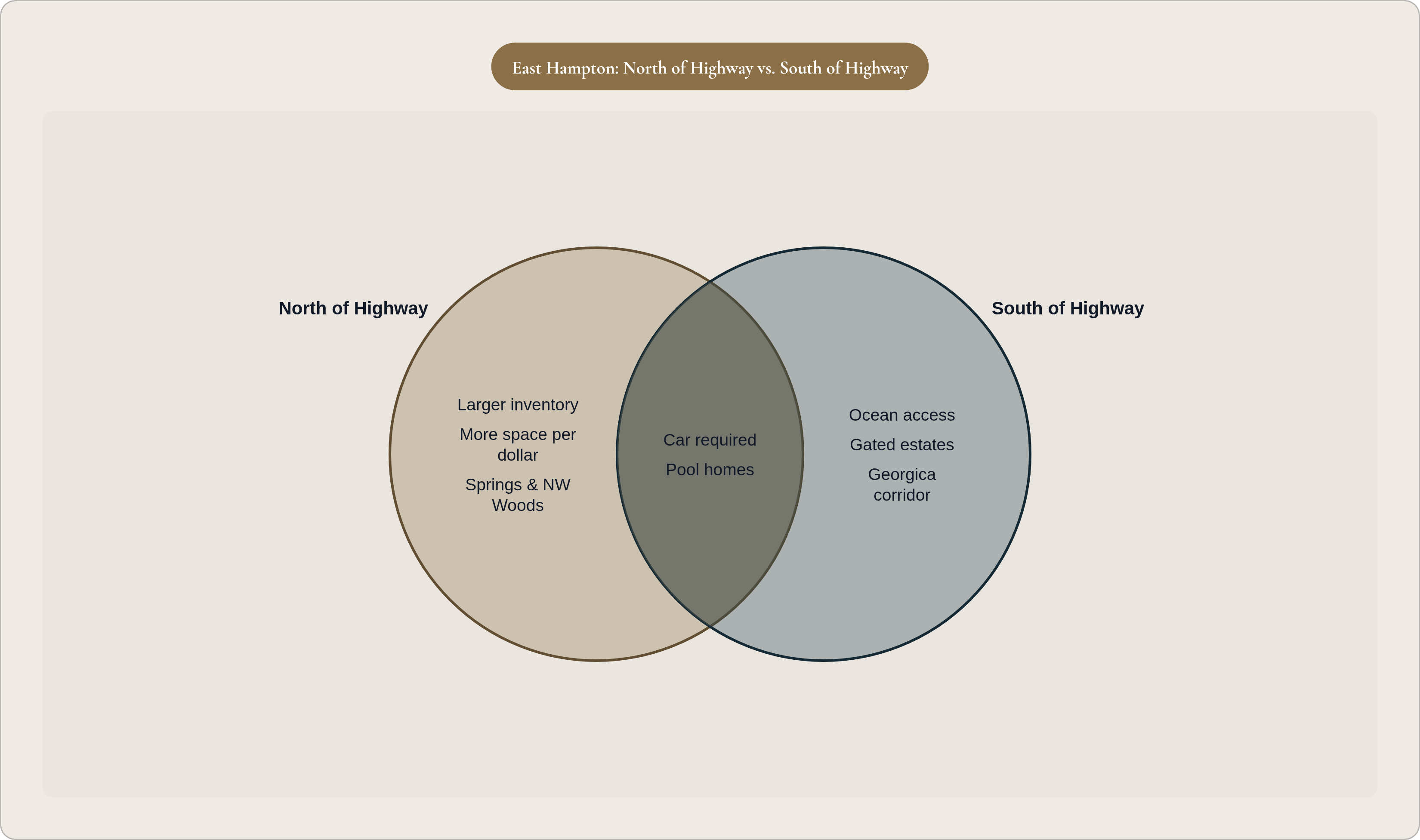
If you remember one piece of shorthand, make it this: north of the highway versus south of the highway. Montauk Highway, Route 27, isn't an official boundary, but it's the line every broker and every renter uses to talk price and character in one breath. South of the highway means ocean, privacy, and estate money, while north of the highway means more house for less, with a tradeoff in prestige and beach proximity.
One more thing worth knowing before you get attached to a listing: East Hampton Village runs its own separate rental registry from the town, and its code doesn't allow rentals under two weeks. There's also a cap of two short-term rentals per calendar year per property, so if you're used to booking a long weekend on an app the way you'd book a hotel, the Village doesn't work that way. Always confirm current terms directly before you commit.
East Hampton Village: the walkable, gallery-and-restaurant core with estate-scale prices to match
This is the East Hampton most people picture: tree-lined streets, historic homes, Main Street boutiques, Guild Hall, the East Hampton Library. It's been the social and cultural center of the East End since long before "Hamptons" became a lifestyle brand.
The renters here skew toward the creative and media crowd, people who want to walk to dinner, walk to the Jitney stop, walk to Main Beach. A typical property is a three-bedroom, three-bath house that sleeps six, with a pool and parking, five minutes on foot from Main Street and ten minutes from Main Beach. You're paying for proximity, not acreage.
And you pay for it. Seasonal estate rentals in the Village typically run into the high five to low six figures for the full summer. That's already the expensive end within East Hampton, and Southampton still costs more. Southampton commands a 14 to 32% premium over East Hampton for comparable properties: a four-bedroom with a pool runs about $60,000 a month in East Hampton Village versus $70,000 a month in Southampton Village.
The thing you're really buying in the Village is the ability to leave the car keys on the counter, and no other East Hampton neighborhood offers that. If you're a couple or a small family who wants restaurants, galleries, and beach access all within a short walk, and you're not chasing pool-and-privacy on a big lot, this is the neighborhood built for you.
South of the Highway and the Georgica corridor: the ultra-luxury oceanside tier
South of Montauk Highway, between the Village and the Atlantic, sits Further Lane, Lily Pond Lane, Georgica Road, Egypt Lane. These are the addresses that show up in shelter magazines and celebrity gossip columns, and for good reason. Gated estates, sprawling acreage, ocean views or direct ocean access, and a level of privacy the rest of the town simply doesn't offer.
The pricing reflects it. A shingle-style Georgica estate listed at $175,000 for July alone, $350,000 for the full July through Labor Day stretch, or $200,000 for August through Labor Day. A Brown Harris Stevens listing on Georgica Road, 10,000 square feet on 1.5 acres, seven ensuite bedrooms, a mile from Georgica Beach, went for $350,000 for the season.
This is also where the $900,000-plus season-long figures live, and it's where the softening has hit hardest. Ultra-luxury price drops of 50 to 75% off peak have been reported across the Hamptons, and this tier is where that negotiating room tends to matter most, if you have the budget to play in it at all.
Just know what you're trading. There's no walk to dinner south of the highway, and a car is required for nearly everything. You're renting the property itself, not proximity to a village scene, and everything around it exists to support that.
One more note if you're shopping this tier: at $175,000-plus a month, photos and square footage numbers are not due diligence. Vetting matters more here than anywhere else in the market, because the gap between what a listing promises and what a property delivers gets more expensive to discover the hard way.
East Hampton North: the largest pool of inventory, and the clearest case for negotiating in 2025
North of the highway is where a large share of all Hamptons summer rental inventory sits. If you want choice, this is where it lives.
And the pricing reflects the volume. North-of-highway four-bedroom pool homes span a wide range well below south-of-highway pricing, and properties comparable to high-priced Southampton Village homes price at $65,000 to $85,000 in East Hampton North equivalents.
The catch is consistency. This area is more suburban, less curated, a mix of post-pandemic spec builds, newer purchases, and older ranch-style homes sitting side by side. Quality varies a lot more than it does in the Village or south of the highway, and that's exactly because this is where the inventory surge has hit hardest. More houses came onto the market here than anywhere else, which is also why renter leverage is strongest here in 2025.
You'll need a car for everything, including the beach, and the neighborhood character is thinner than what you'd find in Springs. But for larger groups who need multiple bedrooms and a pool without paying south-of-highway money, and who don't mind driving everywhere anyway, this is where the math works best. Just don't assume the listing count means the quality is uniform; vet the individual property, not just the neighborhood.
Springs: the artist-colony character that still separates it from the rest of East Hampton
Springs has long been associated with artists and creative figures, and it has held onto an unpretentious atmosphere that the rest of East Hampton largely traded away decades ago.
It's laid-back and car-dependent, with a population density of 541 people per square mile across a population of 7,012. That's a lot more room to breathe than the Village, and a lot less of the seen-and-be-seen energy that defines it. What you get instead is value: comparable square footage and amenities run 30 to 40% below East Hampton Village pricing. Of every neighborhood in the town, Springs offers the clearest case of more house for less money, as long as you don't need to walk anywhere.
The ocean requires a drive from most of Springs, so plan your mornings accordingly. Springs also has calm-water harbor access nearby, a different kind of beach day suited to a different kind of traveler. It's a different kind of beach day, suited to a different kind of traveler.
A representative Springs property might offer generous square footage, multiple bedrooms, and amenities like a tennis court — space that simply costs more in the Village. That's the Springs proposition in one listing. More space, more land, quieter neighbors, and the same East End light everyone's paying for anyway, without the Village markup attached.
Northwest Woods and Northwest Harbor: the nature-first neighborhood for guests who want seclusion over social proximity
Situated in East Hampton's quieter northern reaches, the area has a nature-first character with wooded surroundings and bay access nearby. This is arguably the least "Hamptons" neighborhood in the traditional sense, and for a certain kind of renter, that's precisely the appeal.
A short drive gets you to both East Hampton Village and Sag Harbor from here, two distinct village scenes, without committing to either one. A representative property here might offer several bedrooms, a private pool, outdoor space, and proximity to a private beach — the kind of package that's harder to find at this price point closer to the Village.
There's no ocean walk from Northwest Woods; the private bay beaches within the community are the trade-in, and true ocean access still means a drive. Pricing runs qualitatively below the Village and south-of-highway comparables.
If you want to disappear into nature for a week, skip the summer traffic, and still land in a genuinely nice house, this is your neighborhood. It works especially well for families with young kids who need space to run around and zero interest in a social scene.
Amagansett: the low-key alternative at East Hampton's western edge that retains its own village identity
Amagansett is technically its own hamlet inside East Hampton Town, with a character distinct from the Village: more casual, more relaxed. It gets folded into East Hampton searches constantly, but it has a personality distinct from the Village: more casual, less formal, without the party reputation that follows Montauk a bit further east.
Amagansett has its own beaches separate from the Village, which means even in peak season you're not necessarily fighting the same beach traffic. And you're close enough to East Hampton Village to grab dinner there or catch something at Guild Hall without living inside that scene full-time.
Pricing sits qualitatively below the Village. South-of-the-highway oceanfront in Amagansett still commands a premium, comparable to Georgica-corridor pricing logic, but north-of-the-highway homes here are considerably more accessible. If you want a genuine village feel, surf-and-farm-stand character, real beach proximity, and a social register a notch quieter than the Village, Amagansett delivers that combination better than anywhere else in the town.
How to match the right neighborhood to what you actually want from the week
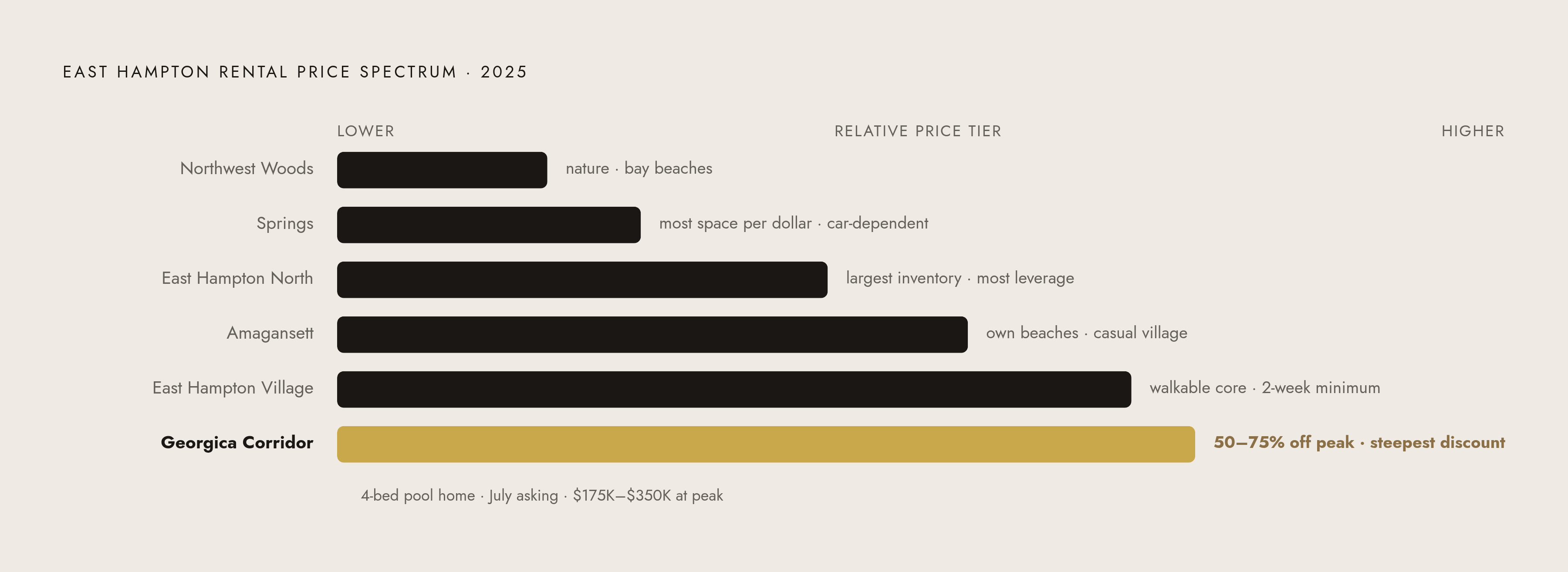
Every choice here comes down to the same handful of trade-offs: walkability against space, ocean proximity against price, social scene against privacy, and inventory volume against curation quality. Once you know which side of each trade-off matters to you, the neighborhood picks itself.
Want to walk to restaurants and shops? Only the Village delivers that, since everywhere else in East Hampton, you're driving. Want maximum space and amenities for your budget? Look at Springs or East Hampton North, since Springs adds cultural texture and history while North adds sheer volume of choice. Want top-tier luxury with ocean proximity and real privacy, and you've got the budget for it? South of the highway, the Georgica corridor, is where the largest price drops from peak have landed, and where you'll find the strongest negotiating position on the highest-ticket properties in the entire market. Want nature and seclusion over bay access and a quiet week away from the scene? Northwest Woods is the answer. Want a low-key village feel without Village prices? Amagansett fits that brief.
One timing note worth factoring in alongside neighborhood: July now outperforms August in rental activity, a real shift from the traditional Hamptons calendar, according to Social Life Magazine. Flexibility on month can matter as much as neighborhood choice if you're working within a budget ceiling.
On structure: a four-bedroom with a pool runs $150,000 to $225,000 for the full Memorial Day-to-Labor Day season, or $55,000 to $85,000 on a monthly basis. Nightly rates during peak July weeks average $753 across all property types, though luxury homes skew far higher than that average suggests.
Here's the thing nobody puts in the listing description. At these price points, anywhere from $50,000 for a modest cottage to $350,000 for a Georgica estate, the biggest risk sits in the gap between what the photos show and what the property actually is when you walk in, more than in the neighborhood itself. Rove's curated East Hampton listings span the Village and the surrounding neighborhoods, with no broker fees, properties verified before they're listed, and $5 million in damage protection built in. At the price range this article has been walking through, that kind of vetting is the whole product.