Hamptons Waterfront Rental Houses for Summer Weeks
Softer rental demand gives summer renters more negotiating power than before.

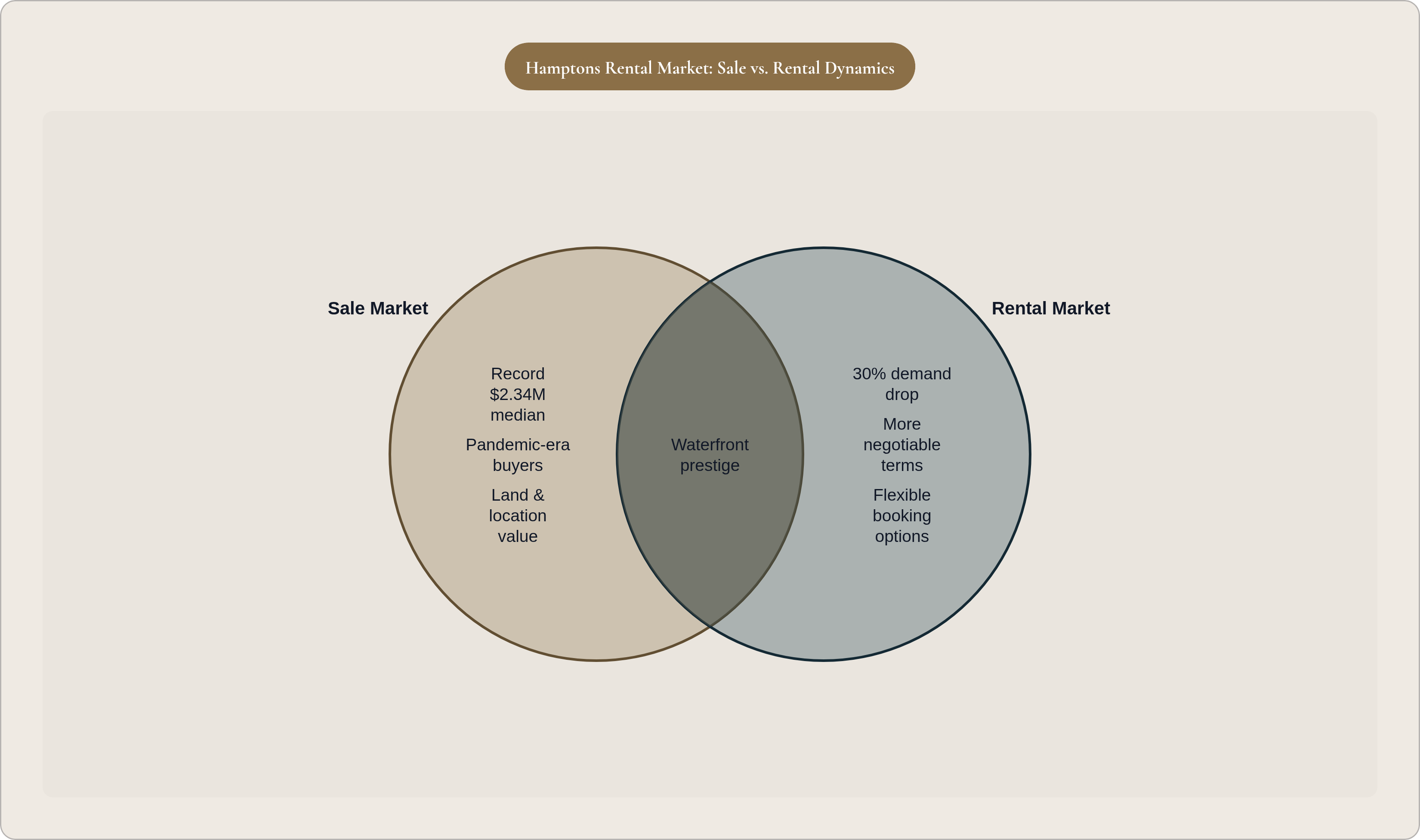
Hamptons sale prices hit a record $2.34 million median in the fourth quarter, up 34% year-over-year according to Douglas Elliman and Miller Samuel. Meanwhile, summer rental demand dropped roughly 30% from prior years, with ultra-luxury properties down 50% to 75%, per CNBC. Those two numbers look like they're fighting each other, but once you see why, you'll know the difference between overpaying this summer and finding a real deal on the water.
About 75% of pandemic-era buyers, the ones who bought between 2020 and 2022 while rates were still low, are now renting out those homes instead of selling, according to Douglas Elliman agents. That's dumping inventory into a market that used to run on scarcity. That dynamic has pushed more inventory into a market that used to run on scarcity. Stock market swings and tariff worries didn't help either; they cooled off the early bookings that usually lock in during January and February.
So if you're shopping for a week on the water right now, you've got more options and more room to push back on price than any summer since before the pandemic. Softer doesn't mean slack, though. Further Lane and Meadow Lane still book up early, snapped up by people who never think twice about the number on the lease.
How Hamptons waterfront geography shapes what you're actually paying for
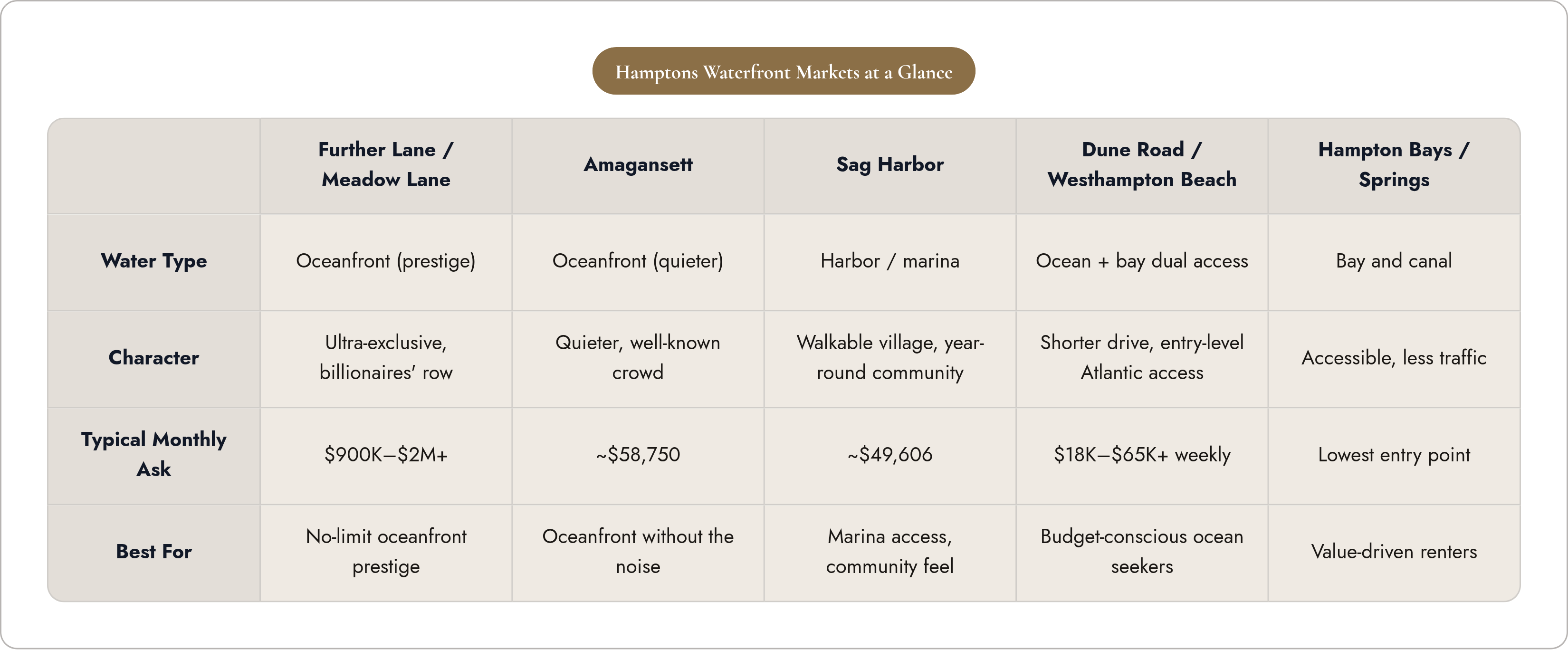
The Hamptons splits into four distinct markets: oceanfront, bayfront, harbor, and canal. Each has its own character, and its own ceiling.
Start with the prestige corridor. Further Lane in East Hampton, and Meadow Lane and Gin Lane in Southampton, get called Billionaires' Row for good reason: the priciest oceanfront estates in the country sit here, and this stretch sets the price ceiling for everything else. Seasonal rentals push past $900,000 and can hit $2 million a month for the right house.
Amagansett gives you oceanfront without the noise. It draws a well-known crowd, but it's quieter than Southampton Village or East Hampton village ever gets. As of June 2026, Amagansett ranks second nationally for typical asking rent at $58,750 a month, per Vettory and Zillow.
Sag Harbor centers on harbor and marina waterfront, not ocean. It's a former whaling village with an actual year-round population, a walkable downtown, and restaurants on the water, so it carries a community feel the pure ocean towns just don't have. Boat docks are common, which makes it the pick for renters who want marina access and an easy drive to both Southampton and East Hampton. Typical asking rent runs $49,606 a month as of June 2026, up 25.4% year-over-year.
Westhampton Beach and Dune Road offer something almost nobody else does: ocean and bay from the same house. Dune Road sits between the Atlantic and Moriches Bay, so you get both at once. It's roughly 80 miles from Manhattan, a shorter drive than East Hampton or Southampton, and noticeably quieter. Call it the entry point into Atlantic oceanfront at a discount to the prestige corridor.
Hampton Bays and Springs sit at the accessible end. You're looking at bay and canal waterfront instead of ocean, and that's where entry-level summer rentals start. Less cachet, less traffic, more room to breathe. It's a real trade, and for a lot of renters, it's the right one.
Then there's Bridgehampton and Sagaponack, which aren't waterfront in the strict sense but come up constantly because people lump "Hamptons luxury rental" in with these names anyway. Sagaponack ranks among the most expensive ZIP codes in the country by median home price. Bridgehampton is known for architect-designed estates with pool complexes and tennis courts built in. Inland estates in Water Mill or Bridgehampton typically run 20% to 40% below oceanfront comparables, a useful yardstick even though they're nowhere near the water.
What waterfront weeks actually cost across the range of properties
Most people shopping for "a summer week" think in weekly rates, so start there. Peak-season weekly rates for estate-class properties run $35,000 to $250,000 and up. Oceanfront weeks and the July Fourth stretch book earliest and sit at the top of that range.
At the accessible end, Sag Harbor bungalows start around $164 a night, and standard properties average $753 a night during peak July weeks. Premium estates run $5,000 to $15,000 a night, which works out to $35,000 to $105,000 for a single week at the top of the market.
The nightly average has actually come down from its pandemic high. It hit $1,080 a night in 2022 and sits closer to $970 now, even with rental volume up 20% compared to last year.
What does the ceiling actually look like? A nine-bedroom, 11,000-square-foot oceanfront home in Bridgehampton listed at $700,000 for any two-week stay this summer, per CNBC. One broker mentioned a waterfront home renting from July through Labor Day for close to $1 million. And the truly exceptional Further Lane or Meadow Lane estates run $2 million a month, full stop.
Most renters land in the mid-market, which is by far the widest tier. A typical four-bedroom with a heated pool runs $150,000 to $225,000 for the full Memorial Day through Labor Day season, or $55,000 to $85,000 a month, per Social Life Magazine's 2026 guide. Mid-market homes in Sag Harbor or Bridgehampton land in the same range. Premium Southampton and East Hampton properties run $250,000 to $500,000 for the season.
Entry-level waterfront access looks like this: Hampton Bays or Springs for the summer season starting around $50,000 to $75,000, or Westhampton Beach and Dune Road at $18,000 to $65,000-plus a week in peak season. That same five-bedroom Dune Road house can cost roughly twice as much in late July as it does in early June.
Bridgehampton's top properties run $25,000 to $75,000 a week in peak season. Sagaponack's top weekly rates frequently clear $100,000.
Prices are negotiable in 2026 in a way they haven't been since before 2020, and that's true across the board. But the room to negotiate lives mostly at the seasonal and monthly level. Peak-week oceanfront pricing hasn't budged nearly as much.
How the six most expensive rental ZIP codes in the country cluster here
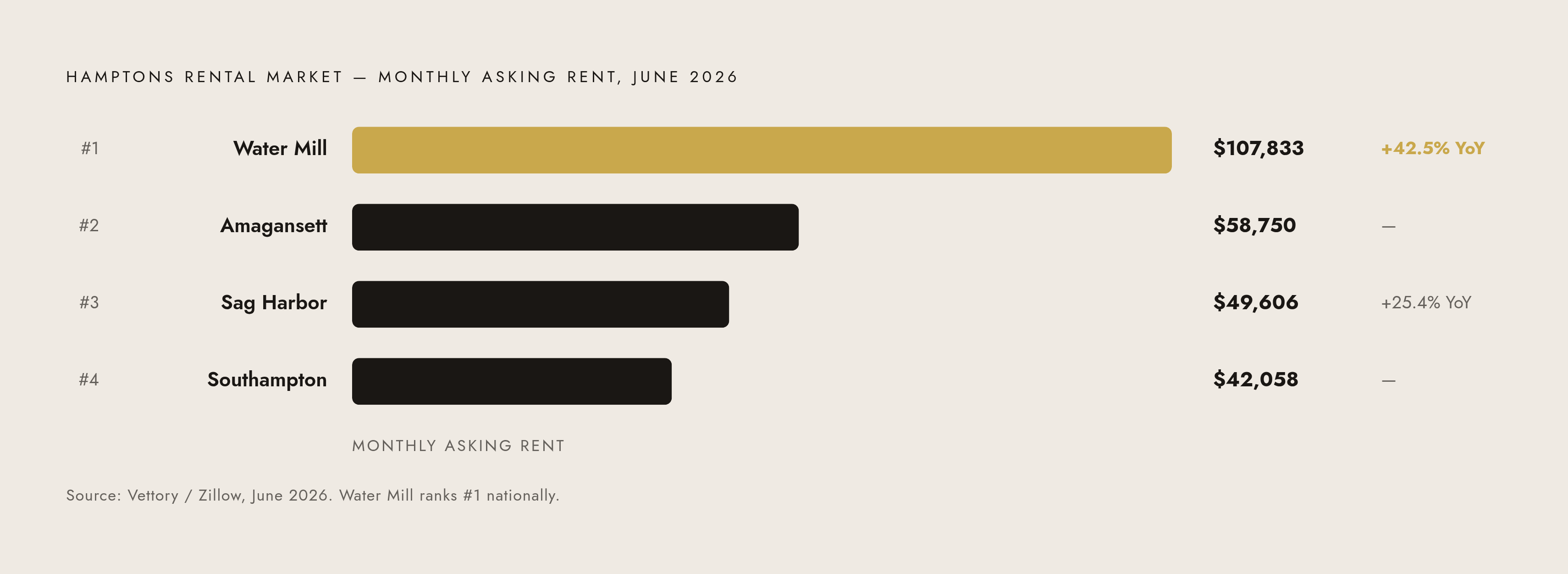
Six of the ten most expensive rental ZIP codes in the entire country sit in the Hamptons, according to a Vettory analysis of Zillow Observed Rent Index data from June 2026. Six, not two or three.
Water Mill, ZIP code 11976, leads the nation. Typical June asking rent runs $107,833 a month, up 42.5% year-over-year, the biggest jump among the Hamptons towns that made the top ten. Amagansett follows at $58,750 a month, second nationally. Sag Harbor comes in third at $49,606 a month, up 25.4% year-over-year. Southampton sits fourth at $42,058 a month.
Worth noting: these are annual observed rent indices, not summer-week asking prices, so actual peak-season premiums run well above these numbers. What the ranking really tells you is how concentrated the demand has gotten. A handful of specific villages are soaking up a wildly disproportionate share of the country's priciest rental listings.
Here's the part that should actually change how you shop. A two-ZIP-code difference within the Hamptons can mean a monthly price gap of $65,000. That's a financial decision as much as a lifestyle preference between neighborhoods, and it deserves to get treated like one.
Water Mill's 42.5% jump runs directly against the softening trend hitting the rest of the Hamptons rental market. Read that for what it is: the most exclusive addresses are holding value, or gaining it, while everywhere else gives renters room to breathe.
When to book, when to wait, and what the calendar actually costs you
The booking calendar starts earlier than most renters expect. Serious inquiries for Memorial Day through Labor Day begin in January and February, when early-season bookings tend to lock in. Larger oceanfront estates for July Fourth weekend are often locked up by March. And 2026 booking patterns show demand concentrated heavily in July, the peak of the peak-week window.
June is the value window. Prices run meaningfully below July for equivalent properties, real money if your dates have any give. Westhampton Beach shows this most clearly: that same five-bedroom home can run twice as much in late July as it does in early June.
There's a late-season discount too. Landlords sitting on unrented properties cut prices 10% to 20% as summer gets closer; a property listed at $200,000 in February can drop to $160,000 or $175,000 by May or June. This year's inventory surplus makes that window wider than usual. Just know the best waterfront homes are long gone by the time it opens up.
Full-season versus weekly is its own calculation. Booking the whole season can cut your per-week cost, but it demands a substantial upfront deposit, which only makes sense for certain renters. The upside: flexible terms—two-week stints, month-long stays—have become more common alongside traditional weekly bookings.
Larger homes are becoming their own category too. Larger homes have become their own draw, as extended families and groups split the per-week cost across more people.
If your calendar has real flexibility, skip summer altogether. Renting September through May costs 60% to 70% less than summer rates for the same property on the same beach.
What to examine before committing to a specific waterfront listing
Airbnb, VRBO, and other booking sites have made Hamptons waterfront homes easier to browse, though harder to fully understand. Photos and amenity lists don't tell you what a property actually delivers, and "waterfront" in a listing title can mean three completely different things.
Verify direct beach or water access before you book anything. There's a real gap between steps-from-the-door ocean access, a deeded right-of-way to a beach down the road, and a property that's simply near water with no real access at all. Bay-front and ocean-front are different products too: bay gives you calmer water and often a boat dock, ocean gives you surf and the view everyone pictures when they say "Hamptons." Neither is wrong, they're just not interchangeable. Boat dock access is common in Sag Harbor, Shelter Island, and parts of East Hampton, so confirm it if that matters to you. And the Dune Road setup, ocean on one side, Moriches Bay on the other, is genuinely rare. Worth chasing down if you want both.
Record sale prices tell you almost nothing about what's inside the house. That $2.34 million median reflects land and location, not renovation quality or upkeep. A lot of the pandemic-era buyers now renting out their homes bought in 2021 and haven't necessarily touched the property since. A house that sold at a record price doesn't guarantee a rental-ready kitchen or a pool that's been serviced this year.
Read the lease terms closely. Traditional full-season leases and flexible-term bookings carry different deposit structures and different cancellation rules, so know exactly what you're signing before you sign it. Utilities, pool heating, cleaning fees, and security deposits stack on top of the stated weekly rate fast; get the total cost in writing before you commit to anything.
Think about where the listing is actually coming from, too. Broker-mediated leases, self-listings on rental platforms, and curated marketplace listings carry different levels of vetting and different recourse if something goes sideways. For a weekend cabin, that barely matters. For a $50,000 week, it matters a lot.
Where to book and what different channels actually provide
The channel landscape has grown, but it hasn't gotten any simpler. Mass platforms like Airbnb and VRBO give you volume and real availability data across hundreds of listings, genuinely useful when you're comparing prices across towns and weeks, while curated services like Rove, a high-end furnished-residence rental company that vets properties and manages them with hotel-level service in markets like the Hamptons, exist further up the spectrum for travelers who want that screening done before they ever open a listing. Vetting varies listing to listing, though, and fees at checkout can surprise you if you skip the fine print.
Local Hamptons brokerages fill a different gap. They know which Water Mill estate actually got renovated last year and which one is coasting on a kitchen from 2019. They'll tell you, off the record, that a listed price has room to move. That kind of on-the-ground knowledge doesn't show up in a search filter, no matter how good the filter is.
For a $50,000-plus week, working with someone who's actually walked the property, or knows someone who has, isn't overkill. It's the same instinct that makes you hire an inspector before buying a house: a little friction upfront beats a lot of regret in July.