furnished luxury rental providers by market: Aspen, Hamptons, South Florida, and Southern California compared
Four markets, four entirely different playbooks for managing luxury short-term rentals.

Four luxury rental markets, four different rulebooks. Aspen, the Hamptons, South Florida, and Southern California all draw the same kind of renter, someone with real money and zero patience for a bad experience. But the more time I spent digging into how each market actually handles supply, season, and regulation, the less they resembled each other, and once you see the structure underneath, the provider landscape sitting on top of it starts to make a lot more sense.
The tenant barely changes from market to market. What changes is everything around him: how many nights a booking has to run, how many units exist to fight over, what a town lets you rent out and for how long, whether the market is starved for inventory right now or drowning in it.
Working through the data across these four places, I kept landing on the same four variables deciding how any one of them behaves. Seasonality first: does demand hit in one sharp burst, two bursts, or run all year without a real dip? Second, what's actually capping supply, geography and zoning, or demand simply outrunning what's been built? Third, the regulatory regime, local short-term rental rules, minimum-stay laws, permit caps written by a five-person town board. Fourth, where the inventory sits right now: scarce, oversupplied, or scrambled by some outside shock nobody planned for.
These aren't academic distinctions. They set the floor on price, they set the size of the booking window, and they decide what a property manager actually has to do to earn the phrase "full service." A firm that's spent a decade mastering Aspen's zoning code would get run over trying to fill Hamptons houses in a soft summer, and neither skill set keeps a Los Angeles owner on the right side of a 30-day minimum.
Aspen runs two tight seasons against a hard supply ceiling and dense short-term-rental zoning. The Hamptons run one brutal season and are still digesting a pandemic-era supply surge that hasn't fully drained. South Florida runs all year on international money, new luxury condos oversupplied even as estate rentals stay tight as ever. Southern California is really six or seven markets wearing one name, pushed toward 30-day-plus stays by regulation and rattled hard in January 2025 by wildfire. Once you see the ground each one stands on, the businesses built on top of them stop looking random.
Aspen: a market defined by physical scarcity and regulatory rationing of rental inventory
Aspen's scarcity is written directly into county code, where demolition permits are capped at six a year. Land runs out fast in a mountain valley, and there's no scenario where supply scales up to meet demand here. That ceiling isn't moving, not this decade.
The math shows it. Pitkin County's average sale price hit $13.3 million in 2024, up 24% from the year before. By early 2025 prices were clearing $5,000 a square foot in parts of town, a number no other mountain market in the country gets near.
Rentals stack regulation on top of that scarcity. STR permits are tied to zoning district, so a Lodge Zone property runs under completely different rules than a house two blocks over in a residential zone. More than half of Aspen listings, 51.9%, carry a minimum stay of 30 nights or longer, which has nothing to do with what guests want and everything to do with what the zoning code allows. Buyers have caught on: units in the Lodge Preservation District or in Snowmass, where shorter stays are still legal, carry a real price premium now, because that flexibility is worth money. Properties offering 30-plus-night flexibility make up over 40% of local rental stock, a sign of how much of this market got pushed into the long-stay format whether owners wanted it or not.
Condos run $700 to $3,000 a night in high season, depending on age and finish, while luxury single-family homes typically clear $5,000 a night, with the top of the market touching $20,000. The best 10% of listings run $1,952 a night or more; the median across the whole market sits closer to $788.
Aspen also runs on two seasons instead of one. Ski season brings a wave of demand, summer's festival and outdoor season brings another, and a manager needs the staffing and booking systems to run two completely different guest populations through the same houses every year. Events like X Games, Jazz Aspen Snowmass, and the Food & Wine Classic create demand spikes concentrated enough that operators here can hold rates other mountain towns can't touch.
2026 has brought a real cooldown. The Estin Report shows luxury transaction volume down meaningfully from 2025, and even the tightest supply-constrained market in the country runs in cycles. How a provider handles a soft patch, holding rate discipline versus chasing volume, tells you a lot about what kind of operator you're dealing with.
The provider landscape reflects all of this. Aspen Signature Properties focuses on privately owned luxury homes across Aspen and Snowmass and offers guests access to the Caribou Club as a differentiator. SkyRun Aspen runs a direct-booking model built to skip platform fees, competing on price while keeping professional, on-site service in place. LVH Global operates as an ultra-luxury network with Aspen as one of its flagship markets, useful for renters who want a concierge relationship that follows them from city to city.
The scarcity that props up Aspen pricing also makes zoning-aware, compliance-first management a requirement, not a nice-to-have. A generalist listing site simply has no way to navigate a Lodge Zone distinction the way a local specialist can.
The Hamptons: how a pandemic supply surge and returning inventory are reshaping a single-season market
One fact explains most of what's happened here over the past few years. A Douglas Elliman agent has said roughly three-quarters of the buyers she sold homes to during the pandemic are now renting those houses out instead of selling them. They're sitting on mortgages locked in near 3%, and renting has become the way to squeeze cash out of the asset without giving it up.
That single behavioral shift flooded the market with supply that wasn't there before. Rental brokers felt it directly, some reporting business down 50% to 75% in spring 2025 versus prior years. The booking numbers back it up: online rental volume hit 40,480 bookings in 2024, down 2% from 2023 and down 14% from the 2022 peak.
Yet total revenue climbed anyway, up meaningfully year-over-year in 2024 to over two hundred million dollars, with fewer bookings each paying more. Nightly rates have climbed notably since 2021 even as total bookings shrank. The market is splitting between properties that command a premium and everything else fighting for scraps.
There are already signs of a turn. The sale side is heating up, with the luxury median jumping 30% to $13 million in early 2026.
What renters actually pay still spans a wide range. Entry towns like Hampton Bays or Springs run around $50,000 for a full summer. A solid four-bedroom with a pool in the middle of the market runs $150,000 to $225,000 for the season. Premium homes in Southampton or East Hampton climb into the high hundreds of thousands, and oceanfront estates start at $900,000 a season. Southampton itself commands a meaningful premium over East Hampton for a comparable house, a real spread for two towns ten minutes apart.
Regulation here is hyper-local, down to the zip code. Southampton, East Hampton, Bridgehampton, Sag Harbor, and Montauk each write their own rules, permit requirements, and occupancy caps. Minimum stays swing from three nights to two full weeks depending on where you're standing. Some towns have tightened their rules further, restricting short-term advertising and stiffening penalties for violators. For an outside provider trying to run five towns at once, that patchwork is a real wall. For a local specialist, it's the whole reason to exist.
Brokerage houses like Corcoran, Douglas Elliman, and Compass have handled Hamptons rentals for decades, mostly as a byproduct of their sales relationships. That model tends to be transactional by nature, built around closing a deal rather than managing a property over time. In a market with more supply and choosier renters, presentation and service decide whether a house sits occupied or empty in July, and that's where dedicated rental managers earn their fee. Rove Travel runs a curated, direct-booking platform in the Hamptons, no broker fees, vetted properties, $5 million in damage protection, which matters in a region where the brokerage commission has always been the default and renters are watching price harder than they used to.
When supply loosens up like this, pricing strategy, guest screening, and how a listing gets presented online decide whether the house sits empty come August. That's exactly the environment where paying for managed service starts to make sense.
South Florida: a year-round market where international demand and new luxury supply are running in opposite directions
South Florida doesn't go quiet the way Aspen or the Hamptons do. International money out of Latin America, Canada, and Europe keeps filling the months that would otherwise sit dead, which makes this the one market on this list that never really stops.
The bar for "luxury" has climbed across Miami Beach, Coconut Grove, Coral Gables, and Palm Beach, pushed up by a steady run of trophy-level demand. Still, the oversupply story here is real, and it's concentrated in one place. New-construction high-rise condos, especially in submarkets like Edgewater and Brickell, have added a lot of units fast, and that's put genuine pricing pressure on that segment specifically. Single-family estate rentals haven't felt the same squeeze at all.
That split matters for how a provider ought to be built. A new condo tower competing against a dozen near-identical towers is fighting on price alone. A private waterfront estate in Miami Beach or a compound in the Grove is fighting in a much smaller, thinner market where price isn't the only lever. Providers who specialize in estates are largely insulated from the condo glut; platforms that list across both categories feel the pressure across the whole portfolio.
Regulation is a moving target too. Florida state law preempts a lot of local short-term rental restriction, but Miami Beach and a handful of other cities have fought to keep tighter local control, and that fight isn't settled. Anyone operating here needs someone watching it in real time, not applying one set of assumptions to the whole state and hoping it still holds next year.
Even in a year-round market, there's still a season. Snowbird demand, roughly November through April, is the peak, and summer slows down domestically, but international travel keeps it from going flat the way the Hamptons does in January.
The big national platforms, Airbnb and VRBO among them, carry plenty of South Florida inventory, but the gap in listing quality is wider here than almost anywhere else on this list. Local luxury specialists have built their businesses around the estate and ultra-luxury waterfront segment, where concierge service and how a property gets staged and photographed are the actual product being sold. Rove Travel operates here too, direct booking, no broker fees, $5 million in damage protection, alongside the big platforms and the traditional South Florida brokerage model, particularly in the estate and high-end condo segment where vetting is what a renter is really paying for. LVH Global also runs in South Florida's ultra-luxury tier, cross-market with Aspen and its other flagship cities.
International demand puts requirements on providers here that the other three markets don't. Speaking multiple languages, knowing how international guests actually prefer to pay, handling a cross-border booking without a hitch: these are core to the job in South Florida, not extras you bolt on later.
Southern California: regulatory pressure on short stays, a fragmented multi-submarket, and the 2025 wildfire disruption
Southern California functions as six or seven markets sharing a single name. Malibu, Beverly Hills, Newport Beach, La Jolla, Santa Barbara, and Palm Springs each run on their own demand logic and their own rulebook, and treating the region as one market is the fastest way to misread every part of it.
The regulatory pressure is constant, and it's reshaping the product itself. Los Angeles, Santa Monica, West Hollywood, and other cities have layered on strict STR permit requirements, caps on nights per year, and primary-residence rules, and the net effect has pushed luxury rentals away from short vacation stays and toward 30-day-plus furnished rentals. Owners and managers have mostly routed around the short-term rulebook rather than fought it, and that shift says more about regulation than about any real change in what guests want.
The 30-day furnished stay has become the default luxury format across much of SoCal for that exact reason. It sidesteps STR rules while still serving the corporate relocation crowd, entertainment industry demand, and travelers who want an extended stay with real furniture and a working kitchen instead of a hotel suite.
Then January 2025 happened, and it changed things fast. Fires in the Palisades and in Altadena displaced a huge number of residents, and demand for furnished monthly rentals in the surrounding areas spiked hard. That spike exposed exactly how much furnished rental capacity existed in Southern California, and the gap in it: providers with deep local inventory matched displaced families quickly, while providers running thin rosters simply couldn't keep up. By mid-2025 the acute crisis demand had eased, but it left behind a much wider awareness of furnished rentals as a category, among people who'd never thought about the option before.
Malibu and Beverly Hills remain the prestige core of the region. Oceanfront compounds in Malibu and estate properties in the Flats or the Bird Streets pull the same high-net-worth crowd and the same top-of-market rates you'd find in Aspen or the Hamptons. Palm Springs runs as its own thing entirely: strong weekend and winter demand, a historically looser STR environment now tightening fast, and an aesthetic that has nothing to do with the coastal towns two hours west.
No single provider covers all of this ground. The fragmentation is too real, and most specialists stick to one or two submarkets instead of trying to span the whole region. Furnished Finder and Furnished.com serve the longer-stay corporate end of the business. The ultra-luxury players in Malibu and Beverly Hills operate closer to a concierge brokerage than a rental platform, where relationships and discretion carry as much weight as the inventory itself. A direct-booking, no-fee, vetted-property approach fits naturally into the longer-stay luxury segment, where guests want consistent quality and no surprise line item at checkout.
The compliance load in Southern California is heavier than anywhere else on this list. Owners who want to rent legally and professionally need a manager who knows the specific rules in their specific submarket, not someone treating the entire state of California as one interchangeable zone. That distinction decides who's still in business in five years and who isn't.
How provider models map onto these four market structures
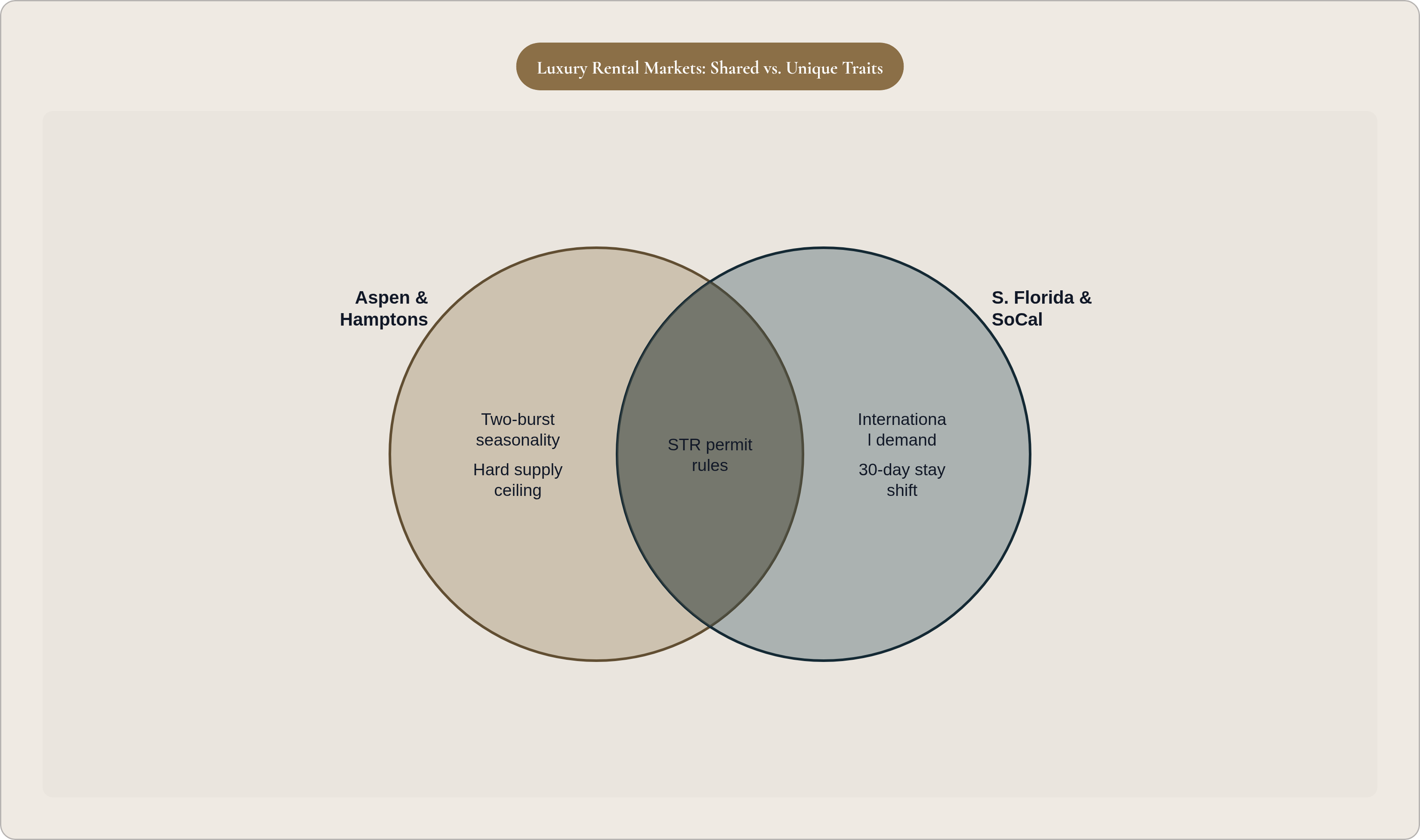
Line these four markets up and one thing becomes obvious: there's no single "luxury rental" playbook that works everywhere. What works in Aspen would fail in the Hamptons. That same Hamptons approach wouldn't survive a week under Southern California's permit rules.
Aspen rewards the specialist who can read zoning code as fluently as a rate sheet. The Hamptons reward whoever can manage the driest part of the business, presentation and pricing discipline, in a market suddenly full of options after years of scarcity. South Florida rewards operators built for two different customers at once: the estate buyer who wants white-glove service, and the international traveler who needs a payment method and a language the big platforms don't always bother with. Southern California, meanwhile, rewards whoever actually knows the difference between what Santa Monica allows and what Malibu allows, because getting that wrong carries real legal exposure, not just a bad quarter.
National, generalist platforms tend to struggle wherever local rules or local relationships decide who wins the booking; that's the pattern that holds across all four markets. Specialists and curated, multi-market operators exist precisely because scarcity, seasonality, oversupply, and regulation are different problems in each of these towns, and no single national playbook solves all four at once. The provider that understands the actual structure of the market it's working in, not just the demand sitting on top of it, is the one holding the real value here.