Luxury Vacation Rentals in Palm Beach vs Miami Beach
Palm Beach requires monthly leases while Miami Beach allows short-term stays.

Palm Beach and Miami Beach sit an hour apart on the same coastline. Both pull in wealthy travelers, both charge prices that make an average vacation rental look like a rounding error, and that's about where the similarities stop. I've watched people book the wrong one, or budget for the wrong one, or assume a rental works the way it worked somewhere else. It usually costs them money, and sometimes it costs them a booking that legally can't happen the way they pictured it. So let's get into what each market actually is, what the rules actually allow, and which one fits the trip you're planning.
What Palm Beach actually is, and what that means for renters
Palm Beach is a town first, a tourist destination a distant second. It's a narrow barrier island, mostly residential, mostly owner-occupied, built around a quiet that gets guarded almost as fiercely as the shoreline. There's no nightclub strip, no crowd spilling onto the sidewalk at midnight, and Worth Avenue covers the shopping while the estates cover the privacy. The social calendar peaks every winter and spring with galas, polo matches, and old-money habits passed down through families who've wintered there for generations.
The geography shapes everything. The Atlantic sits on one side, the Intracoastal on the other, and estate-scale homes get packed onto lots that feel small next to the price tags attached to them. The island itself offers limited restaurants or transit, so most people lean on West Palm Beach across the water for that: dinner out, the Brightline stop, museums, the ordinary stuff of daily life the island largely leaves to its mainland neighbor.
This adds up to a market built for retreat rather than stimulation, drawing people who want weeks or months rather than days. Multi-generational families settle in for a season, while executives work remotely somewhere quieter than home, and snowbirds have already decided January through April belongs here, every year, going forward.
What Miami Beach actually is, and what that means for renters
Miami Beach is a barrier island too, but it grew up chasing a different idea entirely: tourism, nightlife, a global crowd that treats the city as a destination rather than a place to disappear into. South Beach's Art Deco blocks, Ocean Drive, the glass towers climbing in Mid-Beach and North Beach, all add up to a skyline you'd recognize from a single photo. That image alone pulls visitors from Bogotá, São Paulo, London, Toronto, Buenos Aires, Madrid, and plenty of cities across Europe and Latin America.
The energy is urban, and it barely lets up. Restaurants good enough to anchor the food scene in most cities are just one of a dozen options here, and Art Basel takes over every December while Ultra brings a different crowd each spring. There's barely a dead month on the calendar, and winter hits hardest of all.
The typical booking here leans toward company over solitude. Couples on a long weekend, groups celebrating something, international visitors who flew a long way and want to actually be in the middle of it. A rental instead of a hotel gets you a kitchen, a pool, some room to breathe, without giving up the five-minute walk to wherever the night is happening.
How short-term rental rules in Palm Beach effectively reshape the market
Here's the thing most people don't expect: you can't just rent a house in Palm Beach for a week. The town's Code of Ordinances bans short-term rentals outright, and the town's own FAQ says it plainly: rentals under three months are capped at three times per calendar year. Nobody forgot to update that rule, and Palm Beach enforces it; getting caught ignoring it means real consequences, not a warning letter.
So what can you actually book? Seasonal leases, essentially. Furnished homes rented by the month, arranged through estate agents who've built these relationships over years, not through an app on your phone. Pricing runs $15,000 to $150,000 a month depending on the property, the neighborhood, and how close you land to peak season, and a well-located estate at the height of the season can clear $40,000 a month without much trouble.
West Palm Beach, on the mainland, plays by a different set of rules altogether. Short-term rentals are legal there, but they come loaded with a license stack (city, county, and state), a required inspection, and a seven-night minimum. Certain census tracts cap how many STRs can even operate at once, and pushing further out into unincorporated Palm Beach County means registering for the Tourist Development Tax on top of a Business Tax Receipt, with that TDT running 6% of whatever rent you collect.
So "Palm Beach rental" really covers two different products wearing one name. One is a long-stay lease on the island, and the other is a shorter mainland rental in West Palm Beach. Know which one you're shopping for before you fall for a listing.
How Miami Beach's rules create a legitimate but demanding short-term rental market
Miami Beach allows short-term rentals. That word "allows" carries more weight than it looks like it should. Single-family homes are off the table entirely, and plenty of multi-family buildings ban them too, depending on zoning. Buildings from before 1995 can apply for resort permits that open the door to short stays, but a lot of residential buildings block anything under six months through their own condo rules, separate from whatever the city technically permits.
Any host renting under 180 nights has to register with the city's Finance Department, hold a business tax receipt, and carry a resort tax certificate number. There's a rule with actual teeth attached: no unit can rent more than once in a seven-day stretch, which is the city's way of strangling party-house turnover before it starts. Enforcement isn't passive, either. Miami Beach mines its own data to find violations instead of waiting for a neighbor to call it in, and the fines back that up: $20,000 for a first offense, climbing to $100,000 for repeat violators.
About 85% of active Miami Beach STR listings show up properly registered. That number is the whole story: compliance here is simply the cost of operating. For renters, that means the properties you can legally book are real and there's plenty of them, but they're a filtered slice of the total housing stock, not every condo you spot on a map. Booking through a platform or manager that actually checks registration status matters, since it's the line between a clean stay and walking into a property mid-enforcement action.
What renters actually pay in each market
Palm Beach island rentals run on monthly math. Leases span $15,000 to $150,000 a month depending on the home and the season, and even the "modest" end of the island isn't cheap: median apartment rent hit $12,472 in July 2025, up 4.5% year over year. That's not a mansion number; that's the floor. Scarcity does most of the work here, since there just isn't much inventory, and the demand comes from households who don't blink at these figures.
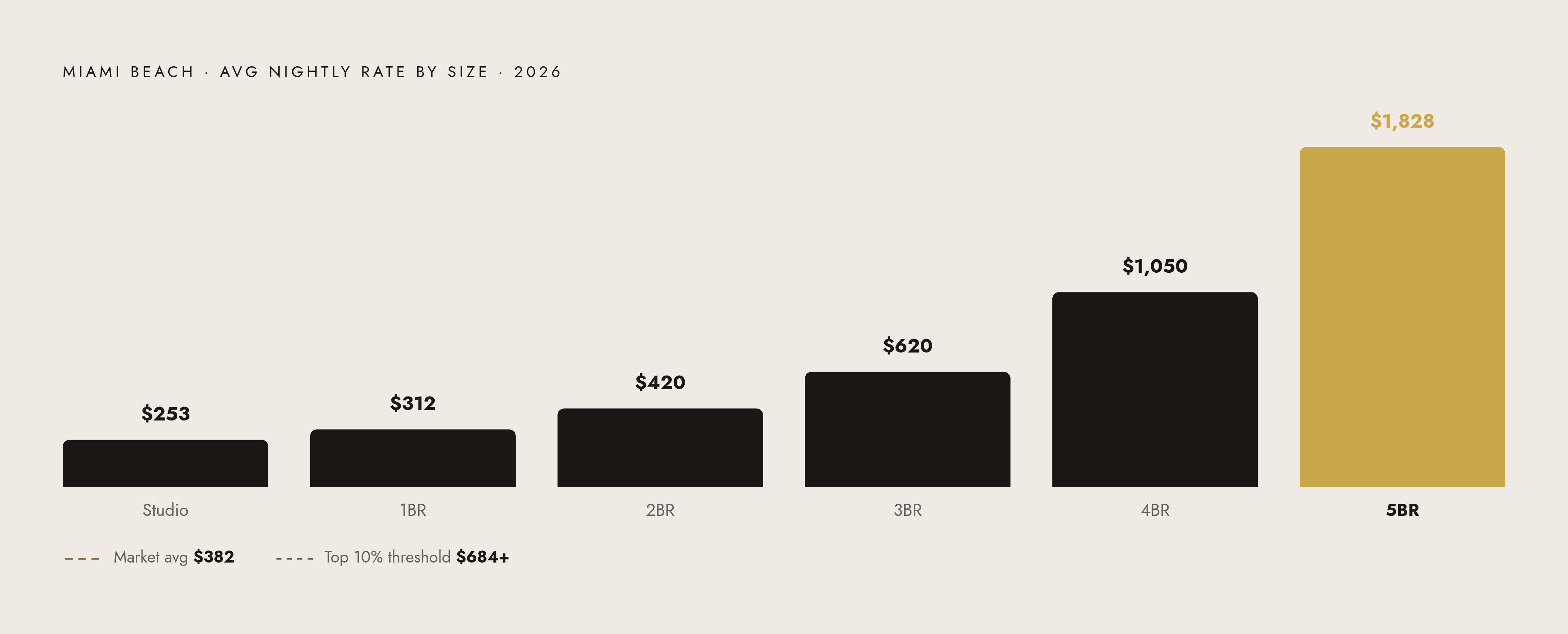
Miami Beach spreads across more of a range. High-end condos land between $12,000 and $30,000 a month, waterfront homes routinely blow past $50,000 in peak season, and luxury rentals broadly span $25,000 to $75,000 monthly depending on timing and location. Miami Beach also lets you rent by the night, an option Palm Beach's leasing structure doesn't include. AirROI's 2026 data puts the average Miami Beach short-term rental at $382 a night, with a RevPAR of $156 reflecting 41.7% average occupancy. The top 10% of listings pull $684 or more a night, while the top quarter clears $423 and up. Size matters a lot too: studios average $253 a night, and five-bedroom properties average $1,828. March is the peak month, with average revenue per listing hitting $8,919.
Palm Beach asks for a monthly commitment and prices itself accordingly. Miami Beach lets you choose your own length of stay, a weekend or a season, and that flexibility is genuinely part of what you're paying for.
The inventory each market offers at the luxury level
Miami Beach has real, browsable supply. AirROI's 2026 numbers put active listings around 4,325, and Airbnb counted nearly 4,994 listings there as of mid-2025. Supply grew 28.2% over the prior year, and rates still climbed anyway, which tells you demand is soaking up the new inventory rather than getting spread thin by it. At the luxury tier, eligible properties cluster in pre-1995 buildings with resort permits, condo-hotel towers along Collins Avenue, and a smaller pool of qualifying single-family homes. Not every glossy listing you scroll past is one you can actually book.
West Palm Beach, the mainland market next door where short stays are legal, runs much smaller: roughly 1,279 active listings, 67% average occupancy, and an average daily rate of $189.
Palm Beach island itself has no conventional short-term inventory. What exists instead is a quiet, largely off-market world of seasonal leases, handled by estate agents who've built relationships with these families over years, sometimes decades. You don't scroll through this market; you call someone who already knows it.
That difference changes how you even start looking. In Miami Beach, you open a platform and compare listings side by side, while in Palm Beach, you find an agent who specializes in seasonal leases and let them do the matching for you.
The seasonal rhythms that should shape when you book
Both markets run on a winter calendar. The shape of that peak looks nothing alike between the two, though.
Miami Beach heats up, figuratively, from January through March, with March standing well above the rest: average revenue per listing hits $8,919 that month. December carries its own spike thanks to Art Basel, which drags in a globally wealthy crowd willing to pay for the privilege. Summer is the shoulder season; heat, humidity, and hurricane risk push demand down, which actually creates decent value for renters who don't mind sweating a little.
Palm Beach's season runs deep into tradition, roughly November through April, built around the charity gala circuit, polo season, and the annual migration of wealthy families fleeing colder cities up north. Peak months command the island's highest lease rates, and by summer, the place goes quiet, with a lot of owners closing their homes entirely for the off months. There's no meaningful off-season discount to chase here, because there's no meaningful off-season short-stay market at all; the whole product only exists within its own calendar.
Lead time works differently too. Miami Beach STRs move on normal platform timelines, booked a few weeks out, maybe a couple months ahead for peak dates. Premium Palm Beach leases often get locked up months in advance through agent relationships, sometimes before the season has even started.
Which traveler each market actually fits
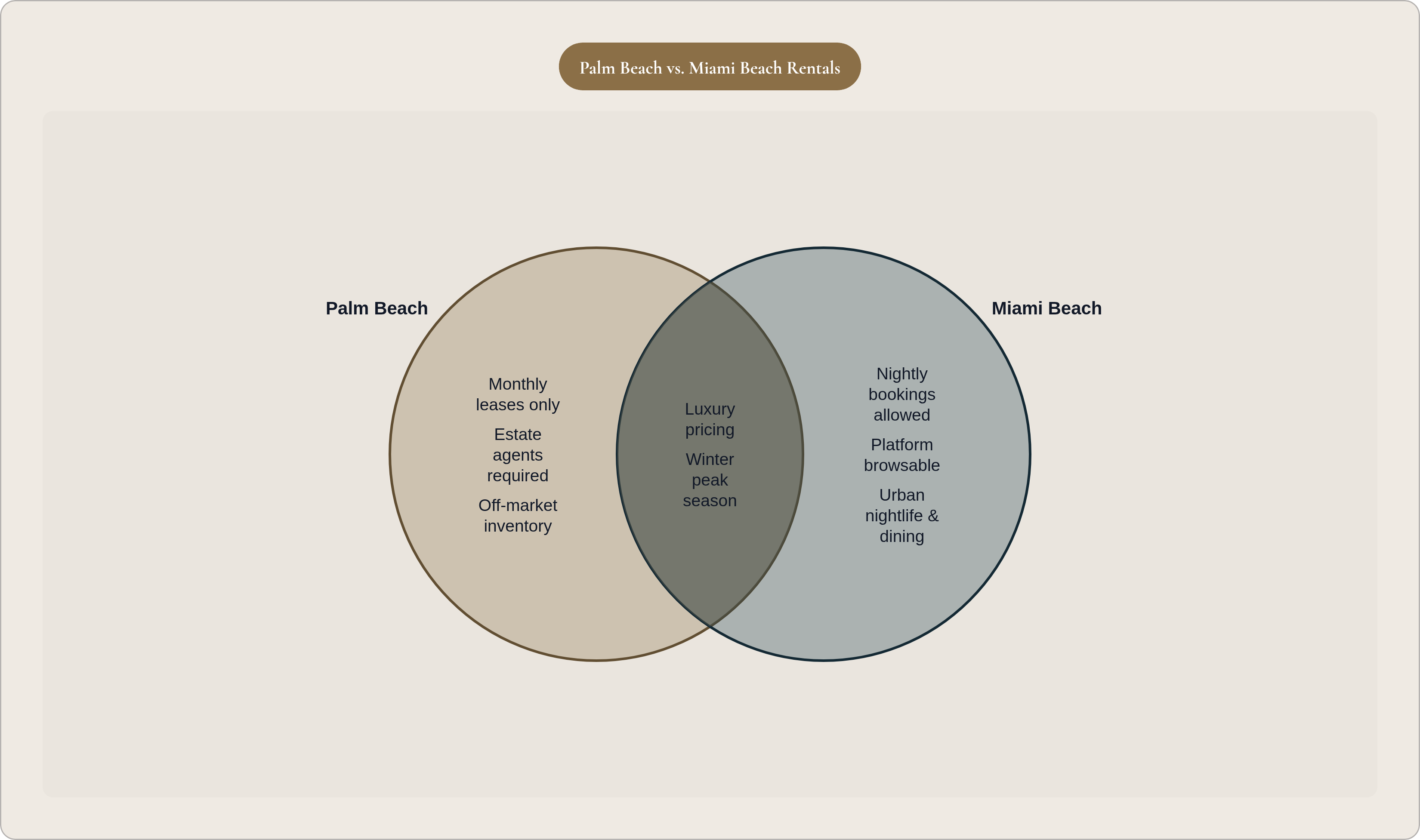
Palm Beach makes sense if you're staying a month or a full season, not a long weekend. It fits renters who want privacy and quiet over nightlife, who gravitate toward estate-scale homes and a calendar built around private clubs and charity events rather than restaurants and bars. It also demands flexibility, financial and logistical both, since you're committing to a lease and working through an agent instead of tapping "book now." The typical profile: a multi-generational family, an executive on an extended relocation, a snowbird household setting up its winter base.
Miami Beach fits the renter who wants options on length of stay, whether that's a weekend, a week, or a month depending on what the trip calls for. It suits people who want dining, nightlife, and international energy built into the stay itself, and it works for couples, friend groups, or families who want the amenities and the buzz without giving up privacy completely. It also suits anyone who'd rather browse a transparent marketplace than build a relationship with an agent over years. Typical profile: an international visitor, a design-minded couple, a group marking some occasion, a family splitting time between the beach and the city.
Some travelers want both, and that's not unreasonable at all. A few days in Miami Beach followed by a longer stretch in Palm Beach works fine logistically; the two are close enough along the coast to treat as one trip rather than two separate ones. Whichever market you land in, the platform you book through matters more at this price point than most renters realize going in. Verified properties, honest pricing, and real damage protection change the experience from start to finish, and those are the standards worth holding any platform to across South Florida's luxury rental market.