Aspen Fall Foliage Rental Season Timing and Availability
Drought pushes Aspen's peak foliage window earlier and narrower this year.

Aspen's fall colors don't unfold over a month. They hit hard, over a short stretch, and 2026's drought is squeezing that stretch even tighter, moving the peak earlier and making the end date harder to pin down. Elevation, not the calendar, drives the timing. Aspens at higher elevation cool off faster in early fall, triggering color change ahead of lower elevations, so even within the Aspen corridor, trees at different heights shift on different schedules. That means a renter can't just circle a date on a calendar. The Aspen Chamber of Commerce puts the typical peak in the third and fourth weeks of September, and that's the baseline figure before weather gets involved.
Weather is very much involved this year. Nearly all of Colorado sits under some level of drought right now, with a large chunk of the state in extreme or exceptional drought, according to the U.S. Drought Monitor's report. Dan West, a forest entomologist with the Colorado State Forest Service, notes that drought-stressed aspens tend to turn earlier, look duller or browner in patches, and drop their leaves faster than they would in a wetter year. Alan Smith of OpenSnow makes a similar point: dry, below-average late-summer rain pushes the color change earlier, and the most vivid falls come out of wet years without drought stress. This year qualifies as neither.
Forecasters are converging on similar numbers. The FOX31 Pinpoint Weather team forecasts Aspen's peak window as Sept. 10 through Sept. 23, with colors starting earlier than a normal year due to drought. Seth Linden, an atmospheric scientist at the National Center for Atmospheric Research, forecasts the Aspen and Crested Butte forests peaking Sept. 18 through Oct. 1. The Aspen corridor peak is therefore estimated across sources as approximately Sept. 10–Oct. 1, with the highest-elevation spots leading and color quality degrading faster than in a wet year.
How elevation divides the Aspen corridor into timing zones
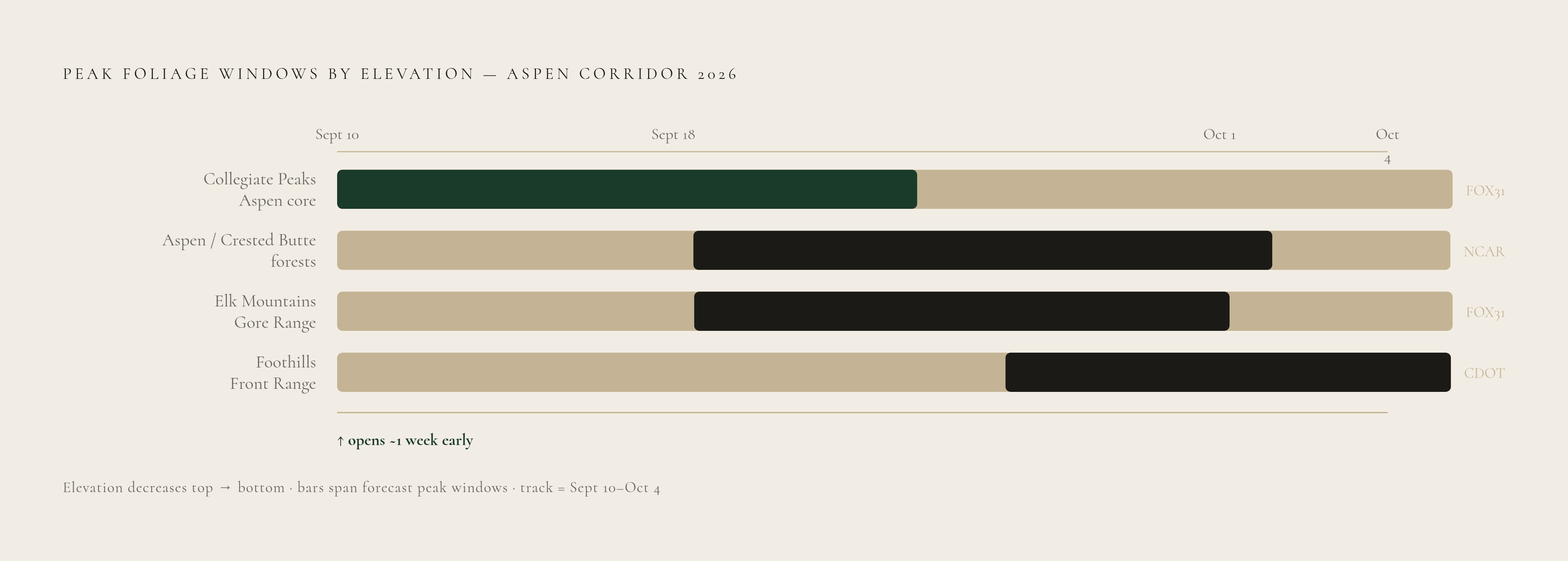
Aspen's fall foliage season is a brief, elevation-compressed event rather than a month-long stretch, and elevation explains why one side of Aspen turns before the other. A difference of a few hundred feet in elevation is enough to shift peak timing meaningfully, so picking a neighborhood or a specific property decides which few days of color a renter will actually see.
Colorado's Department of Transportation maps this out in bands for its 2026 fall planning guidance. Northern mountains and high passes peak earliest, in early to mid-September. The Aspen Chamber of Commerce confirms the typical window as the 3rd and 4th weeks of September, the baseline before weather variables. Foothills and the Front Range trail behind, peaking late September into early October. CDOT also tracks a separate band for southern Colorado and the San Juan Mountains, peaking late September. The KDVR/FOX31 Pinpoint Weather forecast separates Aspen from surrounding ranges: Collegiate Peaks/Sawatch Range and Aspen are forecast Sept. 10–Sept. 23, while the Elk Mountains and Gore Range, which surround Aspen, are forecast Sept. 18–Sept. 30.
That gap matters for anyone choosing where to stay. A property up on the flanks of Aspen Mountain, or near Independence Pass, sees color sooner, and loses it sooner, than a property down on the valley floor near downtown. Maroon Bells, often called one of the most photographed mountain scenes in North America, sits inside this same corridor, and during peak season it can only be reached by shuttle or with a parking reservation. That makes proximity to a shuttle pickup point a real, practical factor in choosing a rental.
Snowmass Village, a short distance from Aspen, sits at a comparable elevation and runs on a similar timeline, making it an overflow option or a better-value alternative. The scenic drives the Aspen Chamber points visitors toward, Maroon Creek Road, Castle Creek Road, and Independence Pass, each cut through different elevation bands. Where a renter bases themselves determines which of those drives sits closest, and which one happens to be at its peak during the actual stay.
Why the foliage core window behaves like peak season
Fall in Aspen gets filed under "shoulder season" in a lot of travel guides, and that label is misleading for anyone booking around foliage. The stretch on either side of peak color really does behave like shoulder season, with lighter demand and softer pricing. Fall is shoulder season on either side of the foliage peak, but the two-to-three-week core window, roughly Sept. 10 through early October in 2026, functions as a demand spike that erases the availability and pricing advantages shoulder season normally offers.
Early September and mid-October fit the shoulder-season description well: deals appear, crowds thin out, and last-minute plans are realistic. The core window doesn't work that way. Inside it, accommodations managers push hard on booking early, because this stretch functions as their actual peak season, whatever the calendar says about fall being an off-season. Industry practitioners at Colorado mountain properties advise locking in dates by July or early August if a renter wants a specific property for peak September.
The demand isn't just tourist traffic chasing photos. Aspen Signature Properties markets September as, in its words, the ideal window for undisturbed exploration, and calls it the month locals themselves consider the best of the year. That's not just marketing copy: it reflects real local demand layered on top of visitor demand. Drought compounds all of it in 2026: with color arriving earlier, CDOT's September planning advisory expects mountain corridor weekend traffic to ramp up earlier in the month than usual. Aspen Filmfest 47, running Sept. 29 through Oct. 4, 2026, at the Aspen Isis Theatre, overlaps directly with the tail of peak foliage and creates a secondary demand spike for late-September and early-October rentals beyond foliage visitors alone. The market splits in two: book early for the core window, or wait and accept that real availability only opens back up once the color is already gone.
The supply constraints that make Aspen rental availability structurally tight
Demand explains half the squeeze on Aspen's foliage season. Supply explains the other half, and it's a fixed supply, by design. Aspen requires a minimum stay of four nights per booking, caps how many nights per year a permitted property can rent, and requires a documented history of short-term rental use on that specific property between May 11, 2017, and May 11, 2022. Those rules cap the number of legal listings in the city and strip out flexibility. These rules constrain both the number of legal listings and the flexibility with which they can be booked, so a renter cannot book a two-night foliage weekend at a compliant property. Occupancy adds another constraint on top: two people per bedroom, plus one extra, which squeezes larger groups out of smaller units right when demand for the peak window is highest.
None of this is new for 2026, but enforcement is tightening. Aspen City Council's Ordinance #08, passed in 2025, amended the land use code specifically to streamline permit applications and increase compliance. Enforcing these caps was an explicit city goal going into 2026. Layered on top of that: as of June 1, 2026, the city moved short-term rental permitting and tax remittance onto a new system called Localgov. That's an administrative changeover landing right before foliage season, and it could create short-term friction for smaller operators still adjusting to the new platform. Whether that friction meaningfully shrinks inventory isn't confirmed by anything currently available, and it remains a live variable to watch.
Put those pieces together: right as demand spikes for the core foliage window, the pool of legal, compliant properties stays fixed, and in 2026 specifically, some of that inventory may be temporarily sidelined by the platform transition.
Booking Timeline for the Sept. 10–Oct. 1 Window
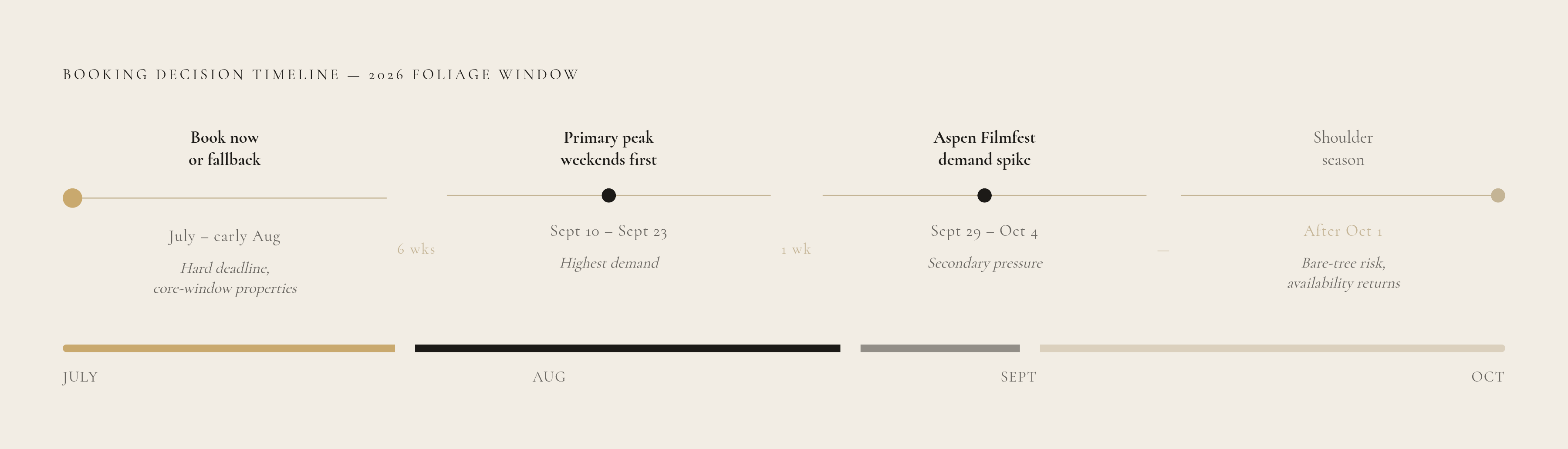
Given the supply caps and a 2026 peak that's arriving early, the booking window for the core stretch has a hard deadline: July or early August, at the latest. After that, mid-week stays become the fallback strategy for anyone still trying to piece together a trip. That July/August target applies in any year, not just a drought year. It's the standard advice for Colorado mountain properties chasing peak September dates in any year. The standard July/early-August deadline becomes the actual cutoff in 2026 because the window itself has compressed.
For renters who miss that window, mid-week arrival, Tuesday through Thursday, is a genuinely better bet than trying for a weekend. CDOT's September 2026 advisory pushes mid-week travel specifically to cut down on weekend congestion, and that same congestion pattern tracks rental availability too: weekends get claimed first and earliest. Timing on the back end matters just as much. Late September and very early October carry elevated risk of bare trees in 2026, with renters arriving after October 1 facing a meaningfully higher chance of post-peak color than in a normal year, according to Summit Daily's reporting on drought effects.
A renter can't just show up for the single best-looking day and leave. The minimum stay forces a commitment to a longer block that has to straddle the peak. That's a planning problem as much as a booking one, and it rewards renters who build in buffer days rather than betting on a single date.
Operators are already positioned around this reality. Frias Properties of Aspen Snowmass offers a concierge team for bookings year-round, which gives renters a path to guidance on timing rather than guessing alone. Aspen Alps, right next to the Silver Queen Gondola, markets its condos specifically as a foliage-viewing base and flags that the season typically kicks off in September, which signals that operator inventory gets positioned and marketed well ahead of the actual season. Aspen Signature Properties goes a step further, pushing early booking of private drivers and winter ski services alongside fall rentals, bundling foliage season directly into winter planning for its most in-demand properties.
Choosing the right property type for the 2026 foliage window
Timing decides when to book. Property choice comes down to group size, how much proximity matters, and whether a renter wants a managed experience or is fine navigating a fragmented, fast-moving market alone.
Proximity determines access, not just convenience. It's about access. Maroon Bells requires a shuttle or a parking reservation during peak season, so a property near a shuttle pickup point carries real functional value, not just a scenic bonus on a listing page. Group size runs into the city's occupancy rule directly: two people per bedroom plus one, meaning larger groups need larger units, and in a capped supply market, those larger units get booked first.
For renters who miss the primary window, fallback options include the following. Snowmass Village, a short drive away, functions as overflow inventory once in-town rentals dry up, and it keeps renters close to the same corridor. The Inn at Aspen, near Buttermilk Mountain, offers a budget-conscious alternative when central Aspen tightens up.
On the operator side, the market splits into two clear lanes: Frias Properties represents the managed end, offering vacation homes and Ritz-Carlton condos aimed at visitors year-round, foliage travelers included. Aspen Alps represents the self-managed condo lane, positioned right by the Silver Queen Gondola specifically for foliage bookings. For renters spending serious money on a property during a window this narrow and this in-demand, the property itself becomes part of the experience, and that raises the bar for what "managed" needs to mean: photos that match reality, no checkout surprises, and real accountability if something goes wrong. A narrow, high-anticipation window like this one has little patience for a rental that doesn't deliver what was promised, and it's exactly the kind of booking where a curated, vetted marketplace, rather than a general listings board, earns its keep.
Planning for the 2026 Foliage Window
Booking the right property solves one problem. It doesn't solve the ones waiting on the ground, and 2026 brings a few that are specific to this year's accelerated, drought-driven peak. Arriving mid-week, Tuesday through Thursday, cuts down on that traffic and, as a knock-on effect, cuts down on competition for parking and trail access too.
Maroon Bells access isn't flexible. The shuttle or parking reservation requirement during peak season is a hard rule, not a recommendation, and visitors without one simply can't drive in during daytime hours. CDOT also flags active late-season construction zones on state highways heading into fall 2026, so travel-time estimates need some padding built in.
Colorado's Traction Law took effect September 1, 2026, on key corridors including the I-70 Mountain Corridor. It requires every vehicle to run winter-ready tires with adequate tread depth, or approved traction devices, well before most people think of it as winter driving season. For a trip built around a handful of good days of color, that's the kind of detail that decides whether the drive up matches the plan.
Sources
- CDOT urges fall travelers to plan ahead for a popular and potentially earlier leaf-peeping season — Colorado Department of Transportation
- Colorado fall colors forecast 2026: When and where to see peak colors
- Leaves are starting to turn in Colorado’s High Country, but experts say this year’s fall peak won’t be as vibrant as most | SummitDaily.com
- Fall Foliage Aspen Trip Highlight | Aspen Chamber
- Short-term rental market continues to shrink in Aspen and Pitkin County - Aspen Journalism
- New short-term-rental rules limit supply, restrict future growth - Aspen Journalism
- Short-term Rentals | Aspen, CO
- Aspen in September Monthly Bog