Luxury Vacation Rentals in NYC for Families Compared to Hotels
Local Law 18 eliminated most short-term rentals, leaving families few legal options besides hotels.
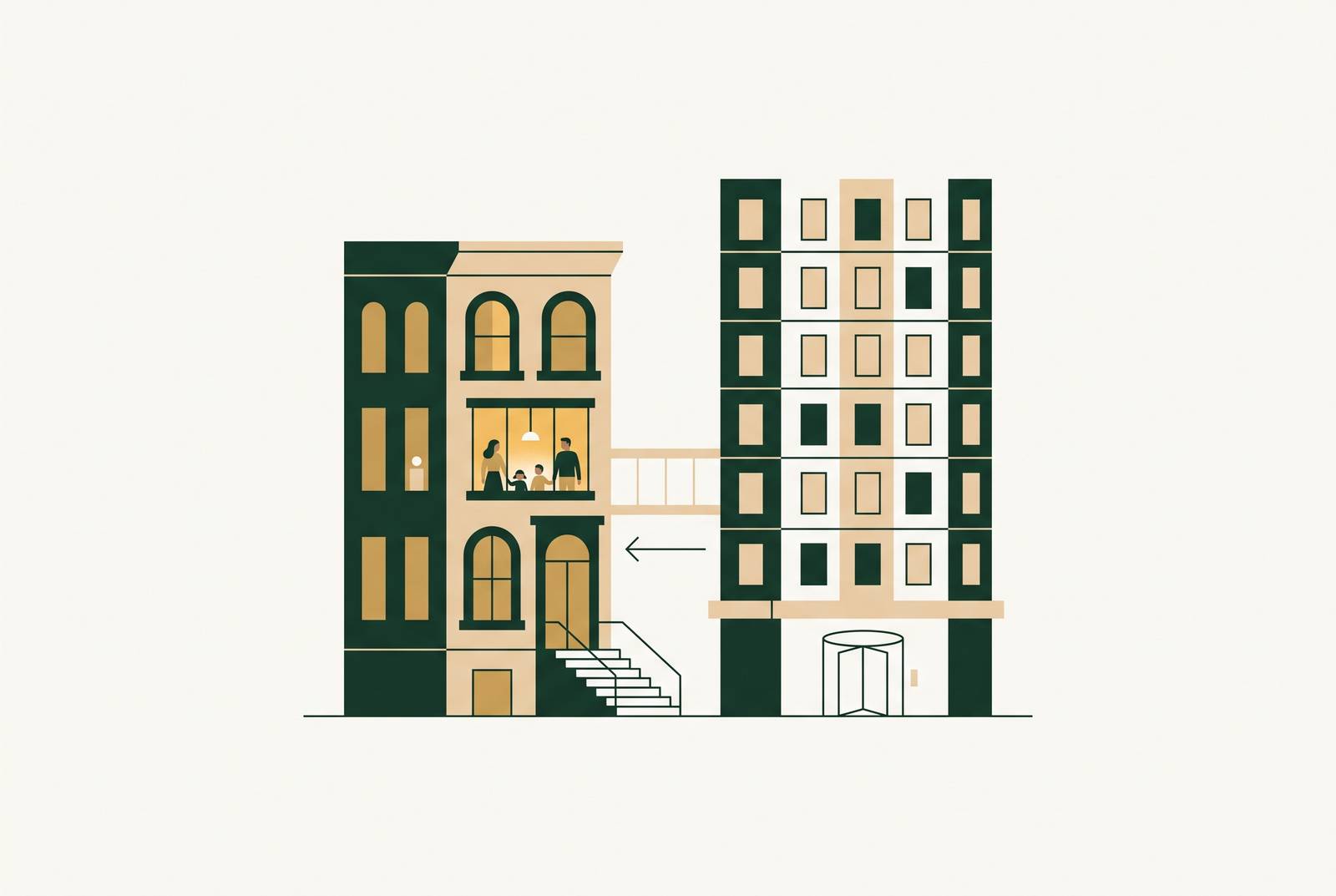
Local Law 18 changed New York's short-term rental math so completely that most assumptions about vacation rentals no longer apply. Passed in 2022 and enforced from September 2023, the law didn't tweak the market. It gutted it.
The mechanics are straightforward, even if the effect is drastic. Hosts now have to register with the Mayor's Office of Special Enforcement before listing a unit. Only apartments where the host actually lives, and is present for the stay, can be rented at all. Guest count is capped at two people per booking. And in Class A residential buildings, which cover most apartment buildings with three or more units, renting out a whole unit for a short stay is off the table entirely.
That two-guest cap turns the law from inconvenience into a wall for families. A family of four or five isn't fighting bad odds or thin inventory alone. There's no compliant path to booking an entire unit in a typical NYC building, full stop. The law didn't make it harder. It made it structurally impossible.
The numbers show how fast the market folded. Airbnb listings across the city fell to roughly 2,300 by early 2024. Inventory that families used to book without a second thought simply stopped existing.
Basic supply and demand did the rest. CoStar data reported by the Wall Street Journal shows that with short-term rental supply gone, hotel demand absorbed the overflow and rates climbed sharply over the next two years. One month the previous fall set records, with average nightly rates hitting extraordinary peaks. Anyone booking a family trip to New York now works within a market reshaped by regulation rather than organic demand. That's the backdrop for everything that follows.
What "luxury vacation rental" means in NYC now
Since Local Law 18 made entire-home short-term rentals in multifamily buildings nearly impossible, "luxury vacation rental" in NYC now refers to a narrower set of legal formats, each with its own tradeoffs for families.
The format that actually delivers full-apartment privacy is the 30-night minimum furnished rental. Local Law 18 requires any whole-unit stay without the host present to run at least 30 nights, making it a legally defined format rather than an operator loophole. It's the only legal path to what most families think of as a vacation rental. Manhattan furnished apartments booked this way carry a real premium on monthly rent, and operators in this segment include LVH Global, which lists distinctive townhouses, penthouses, and high-rises structured around the 30-night minimum, and Top Villas, with a similar ultra-luxury, compliant portfolio. Curated marketplaces also serve this space, vetting properties directly, skipping broker fees, guaranteeing pricing upfront, and adding concierge service for Manhattan and other high-end markets. Rove, a high-end furnished-residence rental service that pairs vetted homes in premium destinations with hotel-quality management, operates in this tier.
Below that sits the hosted stay: legal, short-term, and defined by the resident still living there with the guest. For a family looking for privacy and space, this format solves almost nothing. It's capped at two guests and comes with someone else's presence built in.
Then there's the apartment-style hotel, a hybrid that splits the difference. AKA Times Square comes up most often here, offering full kitchens and, in select suites, washers and dryers, steps from Broadway, without the legal exposure of a non-compliant rental.
One more flag: VRBO and Airbnb still list plenty of New York properties, and VRBO alone returns thousands of results for the city. But much of that inventory sits in the outer boroughs, is structured as a hosted stay, or is a one- or two-family home where Local Law 18 applies differently than in a standard apartment building. Book one of these without checking compliance, and the risk is a canceled reservation, not just inconvenience. It's a canceled reservation days before a family trip.
When the noise is stripped away, families face three lanes: a 30-night furnished apartment, a hotel, or an apartment-style hybrid. Everything from here compares those on the things families actually care about: space and cost, given rules like the two-guest cap and the ban on renting entire apartments for short stays in most multifamily buildings.
Space, bedrooms, and daily life across the formats
Families everywhere choose rentals over hotels for the same reasons: more room, separate bedrooms, a working kitchen. That logic holds in New York too. It only holds inside the 30-night furnished apartment format, which most short-trip families never access.
The square footage tells the story on its own. A standard economy or midrange hotel room in the city runs somewhere between 160 and 230 square feet. Luxury rooms start around 400 square feet. A furnished apartment in Brooklyn or Manhattan typically runs 650 to 900 square feet. That's a substantial upgrade. It's roughly triple the space of an economy room, and it changes what a family's day actually looks like.
Picture what that space buys in practice. A younger kid can go to bed at 7 PM in a separate bedroom without the family tiptoeing around a shared hotel room. Multiple bathrooms mean nobody's standing in the hallway waiting for a turn before school or sightseeing. A living room, an actual one, means the family can sit together after dinner without whispering so a toddler doesn't wake up. These aren't abstract comforts: AvantStay's data shows 68% of families cite space and privacy as their top reason for picking a rental over a hotel.
Multi-generational trips make the case even stronger. Grandparents, teenagers, and parents each move at different paces, which doesn't work cleanly across separate hotel rooms sharing only a hallway. A furnished apartment lets every generation keep its own rhythm inside one space.
Then there's the kitchen, which matters more in New York than most places, since restaurant bills for a family of four to six add up fast. A working kitchen doesn't mean skipping dinner out; it means breakfast and lunch stop costing restaurant prices, reshaping the whole trip's budget.
AKA Times Square earns its place as the middle path here. Full kitchens and, in some suites, washers and dryers get a family partway to rental-style living without legal gray area. It can't match a furnished apartment's square footage, and pricing runs closer to hotel rates than rental rates.
For short-stay families stuck with hotels, true family suites or internally connecting rooms are limited, and many properties advertising adjoining rooms won't guarantee them at booking. Confirming whether adjoining rooms are guaranteed at booking is a detail to nail down before arrival, not after.
The cost math, with all the fees included
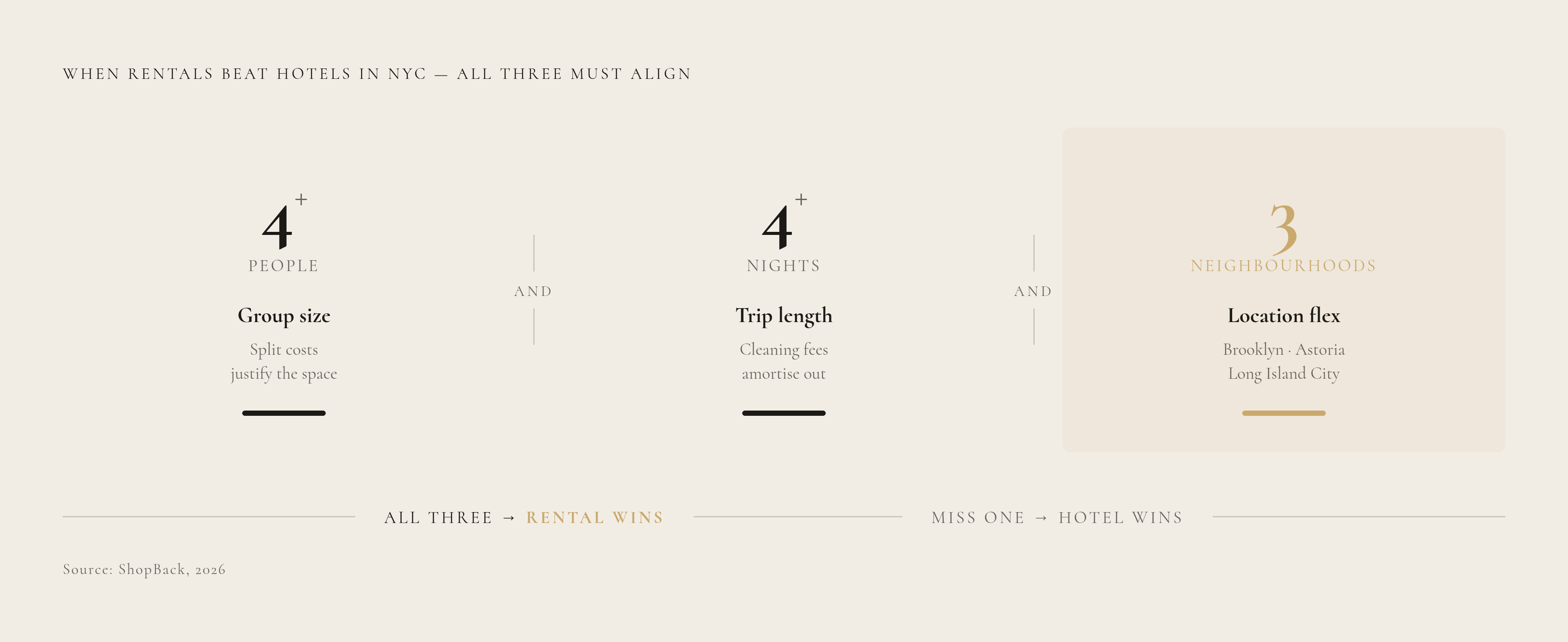
The assumption that rentals are cheaper than hotels doesn't travel to New York in one piece. Savings depend on group size, trip length, neighborhood flexibility, and the ability of the booking to legally hit the 30-night furnished threshold.
ShopBack's 2026 analysis lays out the break-even rule: a rental beats a hotel only when three things line up at once. The group needs to be four people or more, the trip needs to run four nights or more, and the family needs to be open to Brooklyn, Astoria, or Long Island City instead of insisting on Midtown. Missing any one of those three tips the math back toward hotels.
Location is where a lot of families lose the advantage without realizing it. Book a two-bedroom in Midtown, and once cleaning and service fees are added, the total often matches a hotel. The location premium quietly cancels out whatever the rental format was supposed to save.
Rentals lose outright in a few specific situations. Trips under three nights don't let the cleaning fee amortize, so it eats a disproportionate share of the total. Solo travelers or couples nearly always come out ahead with a single hotel room once fees are added to a private apartment.
Hotels carry their own fee stack that's easy to underestimate. Many Midtown properties add daily destination or amenity fees. And if the family's driving in, parking can tack on a real cost per night.
The one format where the math clearly favors rentals is the 30-night furnished apartment, structuring the upscale rental market for families who can commit longer. A mid-range monthly rental works out to roughly $200 a night all-in, below the average hotel rate before taxes or fees. Here the cost advantage is neither marginal nor conditional, it is the clearest, most durable case for renting in the city.
At the top of the market, the gap gets even more dramatic. A 30-night furnished luxury apartment tilts the per-night value heavily toward the rental by comparison.
What the best luxury family hotels in NYC offer
None of this makes hotels the fallback option. Getting the most out of that option just takes some care at booking.
At the top, The Plaza and the Waldorf Astoria set the standard: spacious suites, dedicated kids' programs, and proximity to major attractions. These two properties are the benchmark the furnished-apartment option is really competing against at the luxury tier.
For families wanting Times Square proximity, New York Hilton Midtown and Hyatt Grand Central offer it, plus on-site spas and 24-hour concierge, though premium rooms at both are pricey. Location convenience here comes at a real cost, to be weighed against how much that walkability actually matters for the trip.
AKA Times Square offers real advantages on its own terms, not just as a workaround. Full kitchens and washer/dryer access give real rental-style convenience without a non-compliant rental's legal exposure or a furnished apartment's 30-night commitment.
Neighborhood choice should follow what the family actually plans to do each day. Staying near Central Park puts the Upper East Side within reach of the Central Park Zoo, and the Upper West Side within reach of the American Museum of Natural History and Children's Museum of Manhattan, all walkable. Midtown, on the other hand, puts Times Square, Radio City Music Hall, Grand Central, Bryant Park, MoMA, Madison Square Garden, Rockefeller Center, and the Broadway Theater District all within a short walk or a quick subway ride.
Two details are easy to overlook at booking and expensive to discover at check-in. First, connecting rooms: many NYC hotels allow requests but few guarantee them, so look for "internally connecting" rather than vaguer "adjacent," since families have shown up expecting connected rooms only to land on different floors. Second, room size and beds: NYC luxury rooms start around 400 square feet, so prioritize rooms over 300 square feet with queen beds rather than the common doubles.
There's a reliability argument for hotels that's easy to undersell. A hotel guarantees check-in, daily housekeeping, a staffed front desk, and a consistent standard across the stay. Rentals, even well-run ones, vary more in condition and host responsiveness, a gap that matters most for families with young children. For families who can't structure a 30-night stay or are traveling during peak weeks, NYC's luxury hotels offer genuine advantages furnished apartments can't match (but careful booking is needed to get the space and connectivity required). Three standout value-oriented family hotels from S6's guide (the writer should verify current pricing and availability).
How to choose based on your family's actual situation
None of this adds up to one universal answer, because there isn't one. The right choice between a furnished rental and a luxury hotel follows predictably from four variables: trip length, group size, timing, and tolerance for logistics.
Group size moves the needle faster than almost anything else. Adding a third kid, or bringing a multi-generational group of six or more, makes hotels require multiple rooms, at which point a furnished apartment wins on space, cost, and simplicity.
Timing can flip the whole equation regardless of group size.
The age of the kids changes what actually matters most, too. Families with very young children, needing a crib on schedule or same-day repairs, should lean toward a hotel's reliability. Families with older kids or teenagers who can handle unpredictability get more value from a rental's space and kitchen access.
Location flexibility is the other lever families underuse. Families willing to stay in Brooklyn, Astoria, or Long Island City and rely on the subway unlock the rental cost advantage that Midtown erases. Families needing walking distance to everything, for young kids or mobility reasons, will find rental savings mostly disappear once the location premium is factored in.
For longer stays, the calculation simplifies. For families relocating temporarily, taking extended summer stays, or spending a month in the city, the furnished apartment clearly wins on space, cost, and livability; look at operators like LVH Global and Top Villas, plus curated direct-booking platforms structured at the legally required minimum term.
Whatever gets booked, confirm the property is actually compliant with Local Law 18 before putting down money, since skipping that check can leave the booking canceled or invalid. A non-compliant listing risks last-minute cancellation, about the worst outcome for a family trip already paid for. Favor platforms that screen properties and carry their own damage protection, rather than relying on a marketplace's dispute process after something goes wrong. Understand the legal landscape first, and the rest of the decision, rental or hotel, follows from there almost on its own. ShopBack data shows timing overrides the cost advantage of rentals during peak weeks: NYC vacation rental prices during Thanksgiving, NYE, and spring break can exceed hotel rates entirely, and hotel loyalty points redemptions often become the best value play during major NYC events (Fashion Week, UN General Assembly in September).