Hamptons Summer Rental Timeline and Booking Windows
Book your Hamptons rental tier by tier, starting in January for trophy properties.

There's no single "right time" to book a Hamptons summer rental. The right time depends on what tier of property you want, whether you need a full season or just a month, and how much schedule flexibility you actually have. The 2025 market gave renters more room to wait than usual; 2026 is already signaling that the window is closing back up. This piece maps out exactly when to move, tier by tier.
What "tier" actually means in Hamptons rentals — the price and property distinctions that drive different booking pressures
I think about the Hamptons rental market in three tiers, and honestly, once you see it this way, the timing questions answer themselves.
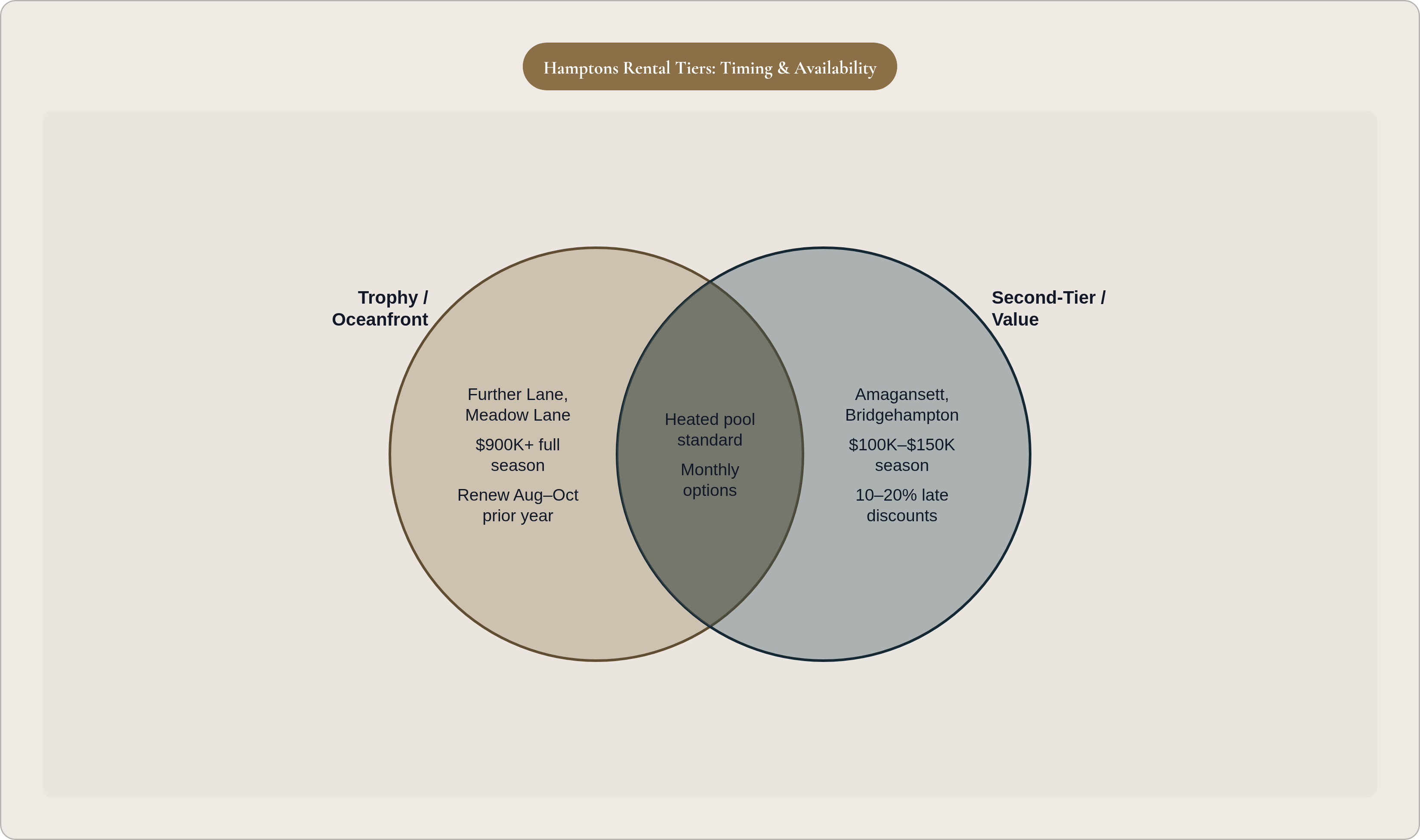
At the top sits trophy and oceanfront: think Further Lane, Meadow Lane, the Southampton Estate Section. Full-season rates start at $900,000 and waterfront estates can run $2 million a month. There's almost nothing else like these properties, and there's almost none of them. That scarcity drives everything about how early you need to move.
Below that is premium, or turnkey luxury; this is the segment where most serious renters actually live. Four bedrooms or more, heated pool, finished basement, beach access you can walk to or that's deeded to the house. A typical four-bedroom here runs $150,000 to $225,000 for the season. Southampton Village and East Hampton Village push the top of this category to $250,000 or more for the best turnkey homes. One note on pools: heated is the standard expectation at this tier, so always confirm if a listing isn't explicit about it.
Then there's second-tier, or value: places that need some updating, or that sit in neighborhoods with less name recognition, like Amagansett and Bridgehampton. Amagansett four-bedrooms start around $100,000 to $150,000 for the season; Bridgehampton starts closer to $125,000. You get more square footage per dollar here than you will in either Village.
A few pricing quirks worth knowing. New construction, anything built after 2020, commands a 20-30% premium over comparable older homes. Southampton runs 14-32% higher than East Hampton for similar properties; a four-bedroom with a pool that rents for $60,000 a month in East Hampton might go for $70,000 in Southampton.
Tier matters so much for timing because scarcity works completely differently at each level. A trophy oceanfront estate is one of one. A second-tier three-bedroom in Amagansett is one of hundreds. You can't apply the same booking calendar to both.
One more thing worth flagging: this is exactly the segment we built Rove around. We work premium-to-trophy, vetted listings, guaranteed pricing, and meaningful damage protection. That's a different experience than scrolling through Airbnb or VRBO, where the quality within any given price point can swing wildly from one listing to the next.
August through December: the ultra-early movers and the repeat-renter window
Some brokers get calls in August, for the following summer — a pattern that speaks to just how scarce the trophy tier really is. That's not typical behavior, but it tells you something real about how scarce the trophy tier is.
October through December is when repeat renters lock in the same house for another year. This window is basically invisible if you're new to the market, because these deals happen quietly, between the owner and the existing tenant, before anything ever gets listed publicly.
So if you rented a place last summer and you want it again, renew before Thanksgiving. That's not being overly cautious; that's just how the mechanism works at this level.
For a first-time renter, this window doesn't give you much to act on directly. Its real value is explanatory: it's why, when the broader market opens up in January, half the best oceanfront listings already show as taken. They were never really available to begin with.
January and February: the primary booking window for premium and trophy properties
January and February is when the real action starts for anyone chasing a premium or trophy property. Oceanfront homes, turnkey Village rentals, this is the window where they get committed.
President's Day weekend has historically worked as an informal deadline. In a normal year, by that point, the properties everyone wants are gone.
There's a clean reason February moves so fast: bonus season. Bonus season falls around this time, and lease signings spike right along with it. Money shows up, and it goes straight into a summer house.
2025 broke that pattern, though. The February-March window, usually frantic, was slow. Renters sat on their hands, waiting for owners to come down off prices that felt inflated, and a lot of them didn't sign until much later than usual. That's worth remembering: even the "reliable" window bends when the broader market softens.
2026 looks different already, though. Brokers are describing a strong start to the season, even with winter weather working against them, which tells me the 2025 slowdown was a blip, not a new baseline.
My advice, if you're chasing something specific, a certain oceanfront estate, a certain block in a Village, move in January. Waiting until February means you're bidding on whatever's left, and at this tier, "whatever's left" is a much shorter list than you'd think.
One practical note: on a $150,000 to $225,000 full-season rental, a broker fee on top of that price is not small money. Booking directly through a platform that skips that intermediary fee entirely changes the math.
March and April: second-tier properties, monthly leases, and the shrinking window for full-summer terms
By March, the premium tier has mostly cleared out. What's left is genuinely second-tier: homes that need work, locations that require a car for everything, or properties where the owner priced too aggressively in January and just never moved.
That's not a knock on this window, though. Bridgehampton and Amagansett still have real inventory here, and the prices are meaningfully lower than what you'd pay in the Villages.
This is also roughly where the full-summer lease window closes. If you want Memorial Day to Labor Day, get it locked before the end of March. After that, the market shifts toward monthly deals, and full-season availability starts thinning fast.
For reference, monthly rates on a comparable four-bedroom with a pool run $55,000 to $85,000. Here's a detail worth knowing if you're weighing single months: July is the priciest month to book on its own, full stop. June runs roughly $13,000 less for an equivalent property, and it's noticeably easier to book.
The July-versus-August shift — and what it means for when renters can still find leverage
Something structural has changed in the last few seasons: July now beats August in rental demand, and 2026 booking data confirms it's sticking.
Renters want July for the Fourth, for the near-guarantee of warm weather, and honestly, for the feeling that July is when the season peaks. August has lost the premium status it used to carry across a lot of property categories.
That shift creates real leverage for a certain kind of renter. As July fills up, owners sitting on August-only vacancies get more motivated to deal, and August rentals often end up pricing below equivalent July stays for the exact same house.
If you can be flexible and take August instead of July, you may land properties that were completely out of reach when the season started, at a real discount.
September follows the same logic, just further along. Smaller crowds, warmer ocean water than you'd expect, restaurants that'll actually seat you without a reservation. June works the same way on the front end of the season, for the same underlying reason: less demand pressure, more room to negotiate.
May and June: the late-market opportunity, and what you're actually trading away by waiting
In 2025, anything that had been sitting on the market since February without moving became genuinely negotiable by May and June. Brokers confirmed price cuts of 10 to 20% on these properties, because owners decided a discounted tenant beat an empty house all summer.
A concrete example: a property listed at $200,000 for the season back in February was going for $160,000 to $175,000 as summer got close. That's not a rounding error; that's real money.
Owners also loosened up on lease structure in this window. Places that demanded a full season or a full month earlier in the year started accepting one- and two-week stays instead.
Here's the trade-off, though, and it's worth being honest about: the discount is real, but you're picking from the leftovers. These are properties that didn't move earlier because of price, condition, or location, not because nobody noticed them. The oceanfront estates and the turnkey Village homes are long gone by May.
This window works well if you've got real flexibility on dates, you're not attached to a specific neighborhood, or you just want a week or two rather than the whole summer. It does not work if you have your heart set on a particular kind of property in a particular place.
And one caveat brokers kept repeating in 2025: even in a soft market, the premium tier still rented out in January and February. The late discounts applied to second- and third-tier inventory. The top of the market doesn't wait around for anybody.
Compare that to where 2026 sits. Sale prices in the Hamptons hit a record high in Q4 2025, up 34% year-over-year, and brokers are already calling the rental season strong out of the gate. That tells me the wide-open discount window from 2025 probably won't repeat itself at the same scale this year. Plan your summer with that in mind, since the pattern may not hold twice.
A consolidated booking calendar by tier — when to act for each scenario
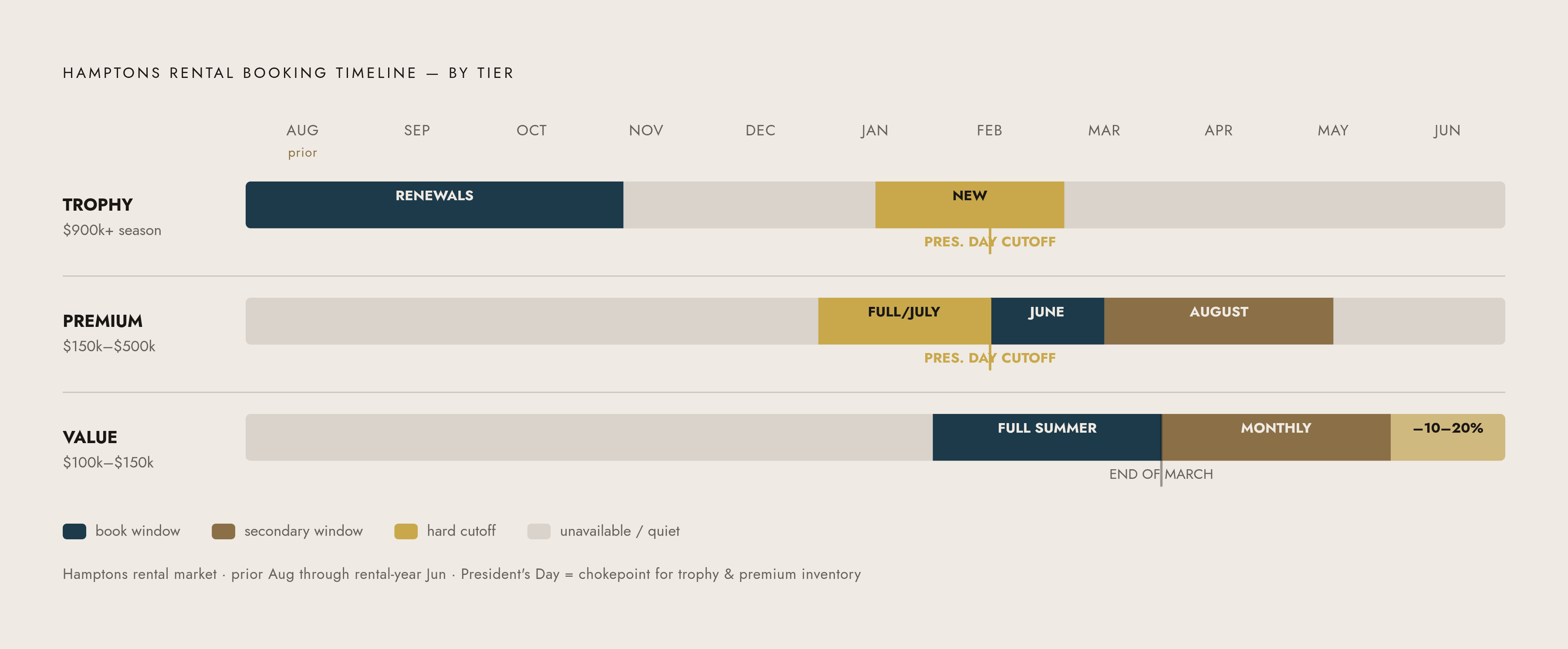
Here's how I'd lay it out, tier by tier, based on everything above.
Trophy / oceanfront (Further Lane, Meadow Lane, Southampton Estate Section; $900,000+ for the season): if you're renewing, move between August and October of the prior year, directly with the owner or manager. If you're new to the property, January is your window, full stop. Wait until February, and you're bidding on whatever's left over.
Premium / turnkey luxury (four-bedroom-plus, heated pool, Village locations; $150,000-$500,000): for a full season, book in January or February, with President's Day as your practical cutoff. For a single month in July, same window applies; July has become the most competitive month on the calendar. For June or August alone, you have more runway: March-April for June, April-May for August, with real negotiating leverage available the closer you get to the date.
Second-tier / value (Amagansett, Bridgehampton, homes needing some updates; $100,000-$150,000): lock in a full-summer lease by the end of March. For monthly or shorter stays, April through June gives you the most room, and negotiating leverage builds as summer approaches. May and June specifically are where you'll find the 10-20% discounts on properties that didn't clear earlier in the year.
One last practical point. On a $150,000 to $225,000 rental, broker fees add up fast, and it's worth factoring a direct-booking model into your total cost, not just the headline rental price.
The bigger picture: 2025 created flexibility at nearly every tier except the very top, and that was unusual. The 2026 sales numbers, record prices, a strong early rental season, suggest that window is narrowing again. The old pattern, top-tier books in January and everyone else follows behind, is the historical norm for a reason. I'd plan around that, not around the exception.