Short-Term vs Long-Term Rental for a Luxury Property

Start with the nightly rate math, because it anchors everything else. A property leasing for $5,000 per month as a long-term rental works out to roughly $167 per night. That number looks almost quaint against what the same property commands as a short-term rental during peak demand. The gross income ceiling is structurally different between the two models, and the gap widens as you move up the market.
Here is a concrete illustration: a luxury two-bedroom Miami condo running as a short-term rental can generate around $60,000 annually. The same unit as a long-term rental produces $30,000. That 2x gross revenue differential is representative of what the luxury tier actually looks like. It is the number that draws owners to the STR model in the first place, and it is real.
Event-Driven Pricing Is a Real Lever at This Tier
What makes luxury STR economics genuinely distinctive is event-driven pricing. A luxury estate holds a moderate rate during midweek shoulder season and prices significantly higher during high-demand windows: the WM Phoenix Open in Scottsdale, ski weeks in Aspen, July and August in the Hamptons, winter in South Florida. These demand spikes are where the gross income gap between STR and LTR widens most dramatically. They are simply unavailable to long-term rental owners at any price, full stop.
Occupancy context matters here, though. STR occupancy ran at 55.5% through mid-2025, and analysts now treat 55% as the benchmark for healthy performance. Underwrite to that number. Owners who project full-season occupancy based on peak-week experience are building a financial model on optimism, and the market has no interest in protecting that optimism.
The gross income advantage is real, but it is not automatic. It requires the right market, the right seasonal demand patterns, and active rate management. For some properties, that first assessment is also the last one needed.
How Operating Costs Compress the Net Return, and Where Luxury Properties Diverge From the Average
Across the STR industry broadly, operating costs can consume roughly half of gross revenue. Professional management reduces the owner's operational burden, but luxury property management fees run higher than standard market rates. Higher per-turn cleaning costs, more frequent turnovers, more complex logistics: the cost structure at the luxury tier is categorically different from the midmarket case studies that populate most STR guides. Using those guides as a reliable proxy will produce a flawed pro forma every time.
Turnover Economics at the Luxury Tier
Each guest changeover at a luxury property carries higher cleaning, restocking, and staging costs than a comparable midmarket property. Multiply that per-turn cost by ten to fifteen turnovers per month and the line item becomes significant. For larger luxury homes, the math sharpens further.
Furnishing and setup costs compound this. A well-executed luxury STR requires upfront capital investment in furnishings, staging, and amenities that can exceed $50,000. That is not a sunk cost; it is an investment with a depreciation schedule and a return expectation that belongs in the pro forma from day one, not as a footnote added after the fact.
Insurance: The Most Underestimated Line Item in the Pro Forma
STR insurance across the broader market averages between $2,000 and $3,000 annually. For luxury properties with pools, waterfront access, or high guest volume, premiums are higher. More critically, an estimated 95% of vacation rental owners carry inadequate coverage, specifically policies that exclude business activity, guest-caused damage, and amenity liability. A single uninsured incident at a property with a pool or a dock can exceed the property's entire annual net income. This risk is not theoretical; it is routinely ignored until it surfaces, and by then it is expensive.
Long-term rental cost structure is simpler by comparison. Management fees are lower, tenants absorb utilities and consumables, the property does not need to be furnished, and landlord insurance runs below STR coverage costs. The operational simplicity of LTR is a real cost advantage.
Where This Lands on Net Return
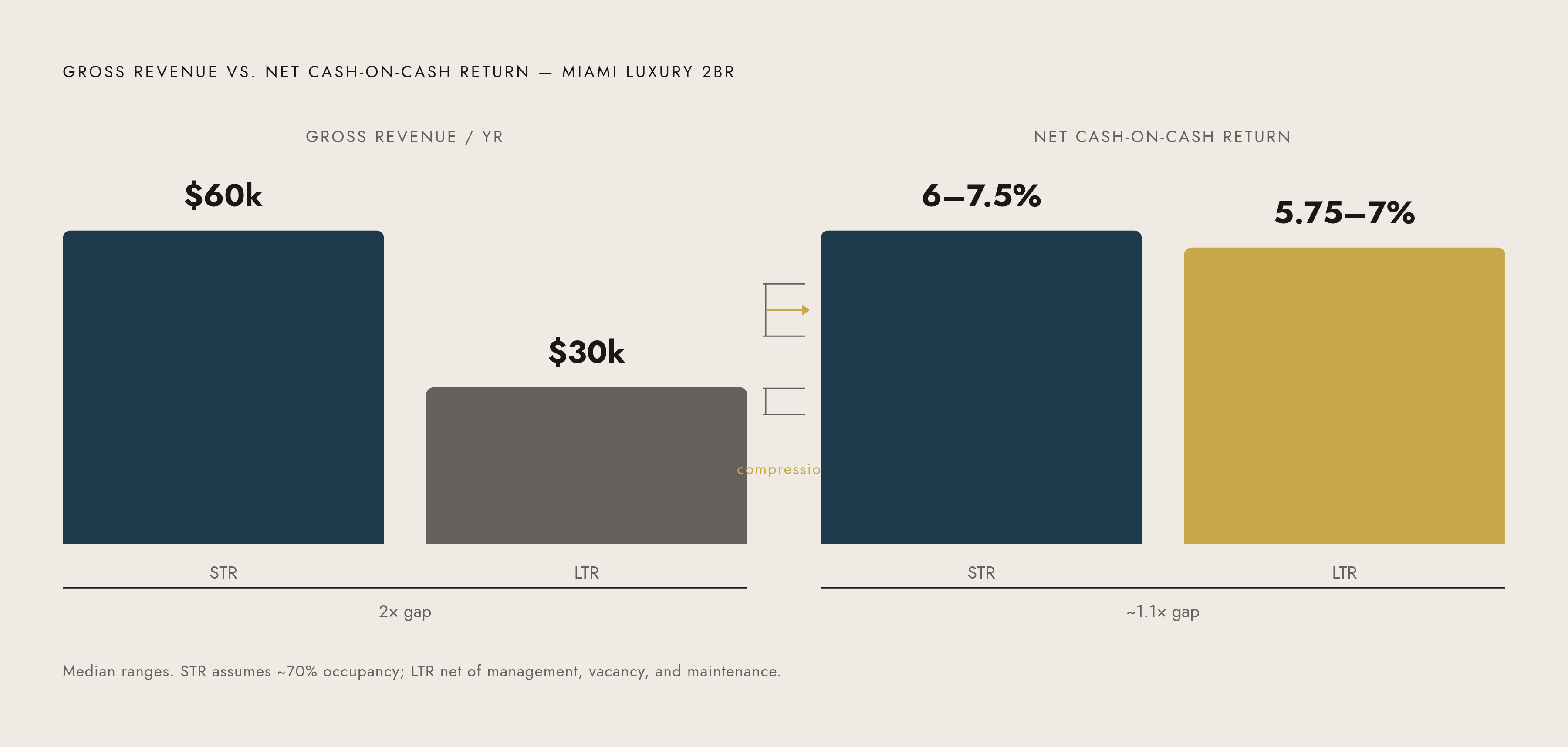
The net return gap between STR and LTR is narrower than the gross revenue gap suggests. Across top STR markets, median cash-on-cash returns range from roughly 6% to 7.5%; in comparable LTR markets, the range is 5.75% to 7%. Operators managing large portfolios of luxury properties are explicit about what double-digit cash-on-cash returns actually require: professional revenue management, intentional design investment, and distribution strategies that fill shoulder-season calendars. Simply listing a nice property is not sufficient, and the owners who discover that after the fact discover it at considerable cost.
The Tax Picture, and Why STRs Are Structurally Better Suited to Luxury Property Owners Who Are Active in Their Finances
Tax treatment is where the STR versus LTR decision becomes structurally asymmetric, but only for certain owner profiles. It is a conditional advantage, and conflating it with a universal one is a common and consequential mistake.
The 14-Day Rule and the STR Non-Passive Loss Treatment
Start with the 14-day rule. Owners who rent fewer than 14 days per year pay no tax on that income. This matters specifically for owners who want occasional rental revenue without the complexity of a full STR operation, and it is worth knowing if your use case is more lifestyle than business.
The more significant mechanism is the STR non-passive loss treatment. When average guest stays are seven days or fewer and the owner materially participates in the operation, the property's losses classify as non-passive and can offset active W-2 income. For a high-income earner, this is a meaningful structural advantage. It does not exist for standard long-term rentals, where losses above a threshold are suspended for higher-income taxpayers until the property is sold.
Cost Segregation Is Where the Luxury Advantage Becomes Structural
Cost segregation is the mechanism that separates a well-advised luxury STR owner from one leaving real money on the table. A furnished luxury property has far more reclassifiable assets than a bare long-term rental: furniture, fixtures, outdoor kitchens, hot tubs, AV equipment, landscaping improvements. Under restored 100% bonus depreciation for property placed in service after January 19, 2025, the first-year depreciation acceleration available through a properly executed cost segregation study on a $2 million luxury property can be substantial. For an owner with the income profile to absorb those deductions, this changes the after-tax return calculation in ways that make the gross revenue comparison look like a footnote.
LTR tax treatment is simpler and more passive, which suits owners who want equity accumulation without active tax strategy. The tax variable does not favor STR universally. It favors owners who are willing to engage with the property operationally and who have the income to deploy non-passive losses. Owners seeking genuinely passive returns are better served by the LTR structure, and no amount of depreciation strategy changes that basic reality.
How Local Regulation Has Become the Variable That Overrides Everything Else
Regulatory exposure is not a future risk to underwrite at a discount. It is the present operating environment. By the end of 2023, roughly 80% of Airbnb's top 200 markets had enacted some form of local STR regulation, and that number has continued moving in one direction only.
The Precedents That Matter for Luxury Owners
New York City's Local Law 18, enforced from September 2023, requires host presence for all rentals under 30 days. That rule effectively eliminated the non-hosted luxury STR in Manhattan for investment properties. A $5 million apartment that could have generated substantial STR revenue is now legally prohibited from operating that way unless the owner is physically present during the stay. The prohibition is absolute, not merely complicated.
Los Angeles limits STRs to primary residences, capped at 120 days per year. Second homes and investment properties are excluded entirely. In 2025, Portland, Oklahoma City, Pinellas County in Florida, Houston, and Austin all added new restrictions, with enforcement escalating and fines reaching into the tens of thousands in markets like Cape Coral.
The Asymmetry Luxury Owners Need to Understand
The risk calculus is not uniform across revenue levels. A $30,000 fine or permit revocation on a property generating $200,000 annually in STR revenue is painful but recoverable. The same fine on a property generating $80,000 is a material disruption to the entire investment thesis. Luxury owners with higher gross revenue are more resilient to enforcement events, but they are also more visible, operating expensive properties in markets where regulatory pressure tends to concentrate.
Before running any income projections, determine whether STR operation is legally permitted for your specific property. Primary residence requirements, permit availability, density restrictions, and minimum-stay rules are non-negotiable constraints. This step comes first. It is not part of any analytical framework; it precedes the framework entirely.
Some luxury markets remain genuinely STR-friendly. Parts of the Hamptons, Aspen, and South Florida have not enacted primary-residence-only restrictions. Location specificity matters far more than general regulatory sentiment. What is true in one market tells you nothing reliable about a market two hours away.
What Management Intensity Actually Means for an Owner Who Doesn't Want a Second Job
STR management is different in kind from LTR management, not just in degree. Guest communication, turnover coordination, dynamic pricing adjustments, quality maintenance, and guest screening happen continuously. For a long-term rental, those tasks happen annually, at most.
Self-managing a luxury STR is running an active hospitality business. The brand risk of a poor guest experience at a property priced at $5,000 per night is categorically higher than at a $200-per-night listing. One bad review at the luxury tier affects pricing power, occupancy, and the property's position in search rankings. Guest expectations scale with price point, and the margin for operational error shrinks accordingly. Guests paying $5,000 per night have stayed in five-star hotels. They are not grading on a curve.
The Real Cost of Outsourcing the Complexity
Professional management for luxury STRs costs more than standard market management fees, which already run above LTR management costs. This is a legitimate trade: someone else absorbs the operational complexity, and you pay for it. But that cost must be factored into the net return calculation before the management agreement is signed, not after. An owner who sees the gross STR revenue figure and models management fees as a rounding error has not done the math.
Property condition cuts in both directions. Professionally managed STRs are often better maintained than neglected long-term rentals, because the cadence of turnovers keeps quality visible and surfaces problems quickly. High guest volume also means more wear on finishes, fixtures, and furnishings. Both are true.
LTR management is genuinely lower-intensity: one tenant relationship, one annual lease cycle, predictable cash flow.
The Owner-Use Question
STRs allow owners to block dates for personal use. A long-term rental eliminates that flexibility for the duration of the lease. For an owner who treats the property as part of their lifestyle rather than purely as an investment instrument, this is a real variable. It does not belong on the income-and-expense spreadsheet, but it belongs in the decision.
How you answer "do I want to be involved in the operation, or do I want to collect a check?" should carry as much weight as the income projections. The two questions are not independent of each other.
A Framework for Matching the Right Model to a Specific Luxury Property

Think of this less as a formula and more as a sequence of filters. Each one either eliminates an option or passes it forward. Work through them in order.
Regulatory eligibility. Is STR operation legally permitted for this specific property? Primary residence requirements, permit availability, minimum-stay rules, and density restrictions are binary constraints, not considerations to weigh. If the answer is no, the decision is made.
Market depth. Does the local market have sufficient STR demand at the luxury tier to sustain meaningful occupancy? Markets with pronounced seasonal peaks and event-driven demand clear this filter more reliably than thin markets where luxury STR supply is chasing limited demand. Benchmark against 55% occupancy, not peak-week performance.
Income ceiling versus stability preference. Does the owner prioritize maximizing the income ceiling or predictable cash flow? STR revenue is variable by structure. LTR revenue is not. Neither characteristic is inherently superior; they suit different owner profiles, and being honest about which profile you are saves a great deal of subsequent frustration.
Management model. Is the owner willing to engage professional management for an STR, and does the net return after management fees still justify the model over LTR? At the luxury tier, self-managed STR is rarely the right answer. If professional management fees compress the net return to parity with LTR, the LTR's simplicity wins on its own terms.
Tax profile. Does the owner have the income profile and engagement level to use non-passive STR losses and accelerated depreciation? If yes, STR carries a structural tax advantage that improves after-tax returns in ways that change the comparison materially. If not, the tax variable is effectively neutral.
Asset and lifestyle priorities. Does the owner want personal-use flexibility and active quality oversight, or a clean passive investment with the asset committed to a tenant for a defined term?
Owners who clear the first two filters and commit to professional management at the fourth are the natural STR candidates. Owners who fail the first filter, prefer stability at the third, or find the management cost at the fourth unacceptable are the natural LTR candidates. A meaningful group will find that neither model resolves the tension cleanly. That is where medium-term and hybrid strategies become worth examining.
Where the Two Models Can Overlap: Medium-Term and Hybrid Rental Strategies
Medium-term rentals, defined as stays of 30 days or longer, occupy a distinct regulatory position in most markets. They avoid the strict permitting requirements that apply to sub-30-day STRs while still commanding per-night rates substantially above long-term lease equivalents. In markets where STR regulation has tightened most severely, medium-term rentals have moved from a niche strategy to a primary one.
How New York City Created a Middle Path
New York City's Local Law 18 pushed a segment of the luxury market toward medium-term operations. Corporate housing, extended-stay business travelers, and relocation tenants now occupy luxury apartments that previously operated as short-term rentals. The regulatory constraint created demand for a product that did not need to exist at scale before the law passed. For Manhattan luxury owners, this is not a consolation prize; it is a viable revenue model with its own demand base and a per-night premium well above what an annual lease produces.
Hybrid Strategies for Seasonal Markets
Some luxury owners structure operations to capture the income ceiling when demand is highest without sustaining year-round operational intensity. Running STR during peak season, whether July and August in the Hamptons or Christmas through ski weeks in Aspen, then either using the property personally or placing it in medium-term corporate lets during shoulder seasons, captures the revenue upside without requiring a continuous hospitality operation. It also preserves personal-use flexibility outside the peak window, which matters to owners for whom the property serves double duty as an investment and a lifestyle asset.
The luxury long-term rental market is growing, with demand for upscale properties in the LTR segment rising over the past year. That growth establishes a healthy baseline that medium-term rental competes against and, in premium markets, exceeds on a per-night basis for stays in the 30-to-90-day range.
The medium-term model is not operationally effortless. Guest quality and screening matter as much as in full STR operation. Turnover frequency is lower, though, which makes owner-managed or lightly managed operation more feasible than it would be in a high-volume STR. For owners who fall somewhere between the STR and LTR profiles, this is often where the right answer actually lives.