Rental Property Deductions Owners Can Claim
Mortgage interest on rentals is uncapped, and bonus depreciation rules just changed in your favor.

For most financed rentals, mortgage interest is the largest deductible expense on the return. It flows to Schedule E as a business cost, and unlike the mortgage interest deduction on a primary residence, there is no dollar cap. That asymmetry is one of the more consequential differences between owning a home and owning an investment property.
The interest on any loan used to acquire or improve the rental is deductible. Principal payments are not. Your lender sends a Form 1098 each January; verify that number against any personal-use allocation before you record it. If you use part of the property personally, only the rental-use share of interest counts.
One development worth knowing about: Section 163(j) can restrict interest deductions when expense exceeds 30% of Adjusted Taxable Income. Per IRS Fact Sheet 2025-09, the current ATI calculation adds back depreciation, amortization, and depletion, which raises the ceiling and allows more interest to flow through for investors who previously hit the cap. If you're carrying significant debt across multiple properties, this change quietly improves your position.
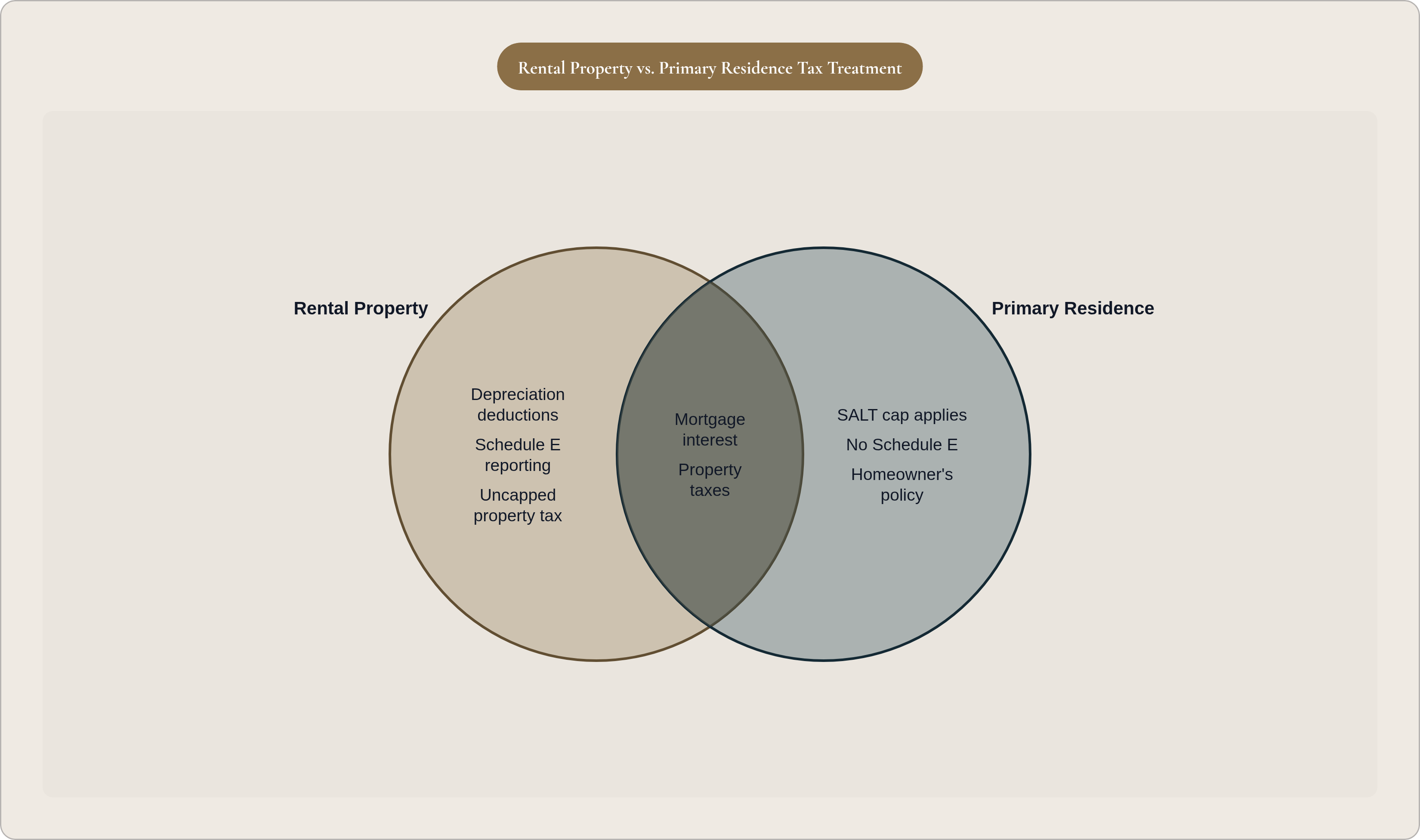
Property Taxes on Rental Property: Why the SALT Cap Is Irrelevant Here
Every dollar of property tax paid on a rental deducts as a business expense on Schedule E. The SALT cap, now raised to $40,000 for homeowners under the One Big Beautiful Bill Act, belongs to personal returns. It does not touch investment property. Rental property taxes are uncapped, full stop.
For owners with rentals in high-tax states, that adds up quickly. Effective property tax rates range from roughly 0.30% on the low end to over 2% in states like New Jersey and Illinois, according to Tax Foundation data. Where you buy is, among other things, a tax decision.
One thing to watch: special assessments levied for local improvements, new sidewalks, sewer line upgrades, do not deduct as taxes. They add to your cost basis instead, which becomes relevant when you sell.
Depreciation: The Deduction That Requires No Cash Outlay
Depreciation is the deduction that genuinely surprises new landlords, and I don't say that as a rhetorical setup. You spend nothing; you still get the write-off. The IRS acknowledges that a building deteriorates over time and permits owners to deduct that wear gradually, even if the property's market value is climbing. The building can appreciate and depreciate simultaneously on your tax return, and the IRS is entirely comfortable with that contradiction.
Residential rental property depreciates over 27.5 years on a straight-line schedule. Land does not depreciate. You allocate your purchase price between structure and land, and that allocation drives every depreciation calculation you make for as long as you own the property. On a $500,000 property with an 80% building allocation, annual depreciation runs approximately $14,545 with no cash outflow required.
The clock starts when the property is available for rent, not at purchase, not at first occupancy.
Bonus Depreciation, Fully Restored
The One Big Beautiful Bill Act, signed July 4, 2025, restores 100% bonus depreciation for qualifying property acquired and placed in service after January 19, 2025. Property placed in service between January 1 and January 19, 2025, or acquired before January 20, 2025, remains subject to the prior phase-down schedule. This doesn't touch the full structure, which still depreciates over 27.5 years. It applies to components, and the tool for identifying those components is a cost segregation study.
Cost Segregation: The Engineering Analysis That Unlocks Accelerated Depreciation
A cost segregation study reclassifies components of a property from the 27.5-year schedule to 5, 7, or 15-year schedules. Eligible items typically include furniture, appliances, outdoor improvements like fencing and walkways, and specialty systems such as security and irrigation. Paired with 100% bonus depreciation, those reclassified components can be fully expensed in the year placed in service.
On a $500,000 property, a cost segregation study will typically identify between $125,000 and $175,000 in components eligible for immediate expensing, which at the 32% bracket translates to roughly $40,000 to $56,000 in first-year tax savings, per Steadily's published estimates. Short-term rentals are often especially well-positioned for this because their interior components tend to be more substantial relative to overall property value.
Section 179: A Separate Mechanism With Its Own Rules
Section 179 is distinct from bonus depreciation, and conflating the two is a common mistake. For 2025, the maximum Section 179 deduction is $2,500,000, reduced dollar-for-dollar once qualifying property placed in service exceeds $4,000,000. It works best for personal property within a rental: appliances, equipment. Not the structure. Which mechanism serves you better depends on the specifics; run both scenarios before filing.
Depreciation Recapture: The Bill That Arrives at Sale
When you sell, the IRS recaptures previously claimed depreciation and taxes it, often at a rate higher than the standard long-term capital gains rate. Recapture happens whether or not you actually took the deduction during ownership. Skipping depreciation does not eliminate the liability; you simply paid more tax while you owned the property and still face the same recapture bill at sale. Model that into any disposition analysis before you're sitting at a closing table wondering how it happened.
The Repair-vs.-Improvement Line and Three Safe Harbors That Actually Resolve It
The IRS draws a sharp line between repairs and improvements. Repairs deduct in full in the year paid. Improvements get capitalized and depreciated over time. An improvement results in a betterment, restoration, or adaptation to a new use, per IRS Publication 527.
Exterior painting is a repair. A full furnace replacement is a capital improvement. A patched roof section is a repair; a complete roof replacement is an improvement. In practice, the line gets blurry faster than you'd expect, and that's where the safe harbors matter.
Three Safe Harbors That Pull Costs Into the Current Year
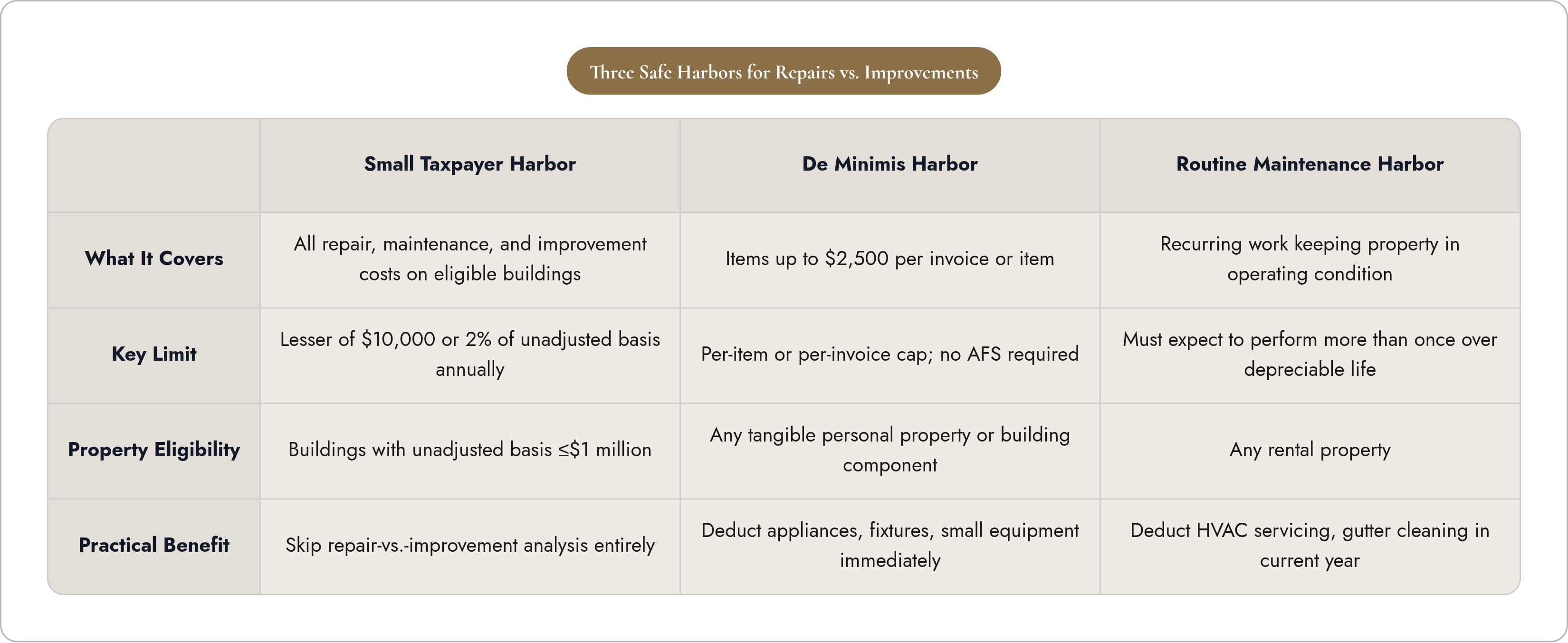
The Safe Harbor for Small Taxpayers lets you currently deduct all annual repair, maintenance, and improvement expenses on buildings with an unadjusted basis of $1 million or less, up to the lesser of $10,000 or 2% of the unadjusted basis annually. If your property qualifies, you skip the repair-versus-improvement analysis entirely for amounts within the cap.
The de minimis safe harbor allows owners without an applicable financial statement to currently deduct items costing up to $2,500 per invoice or per item. Appliances, fixtures, small equipment that would otherwise require capitalization: covered.
The routine maintenance safe harbor treats recurring work that keeps the property in ordinary operating condition as currently deductible, even if it could technically be characterized as a restoration. Gutter cleaning, annual HVAC servicing. If you reasonably expect to perform the work more than once over the property's depreciable life, it qualifies.
Knowing which safe harbor applies converts a multi-year depreciation schedule into a same-year deduction. That's a cash flow difference, not an accounting preference.
Insurance Premiums: What's Deductible and Why the Policy Type Matters
Premiums on rental property insurance deduct in full in the year paid. The deductible categories are broad: fire, theft, and special peril coverage; flood insurance; landlord liability; health or workers' compensation for any employees of the rental business.
Here's the practical issue I've seen trip people up: owners who convert a primary residence to a rental and simply keep the original homeowner's policy forward. A standard homeowner's policy covers different risks than a landlord policy, and in a claims situation, that distinction can render coverage legally inadequate. The transition to proper landlord coverage changes the premium, and whatever you pay on a correctly structured policy is fully deductible.
For owners using a full-service management platform, understanding how platform-level protections layer with your own policy matters. Some full-service management platforms include substantial damage protection as part of their offering. Where platform-level coverage reduces your residual loss exposure, that affects what would qualify as an uninsured casualty loss on your return.
One timing detail: premiums paid in advance on a multi-year policy must be allocated across coverage periods. Only the portion attributable to the current tax year deducts in that year.
Property Management Fees, Professional Services, and the 2026 Reporting Threshold Change
Fees paid to a property manager deduct as ordinary and necessary business expenses. So does a broader set of professional costs: leasing agent and broker commissions, accountant fees for preparing the rental portion of your return, attorney fees for lease drafting, eviction proceedings, or rental-related tax disputes. Fees paid in 2025 to prepare the 2024 rental schedule deduct in 2025, the year you paid them.
A compliance change takes effect for the 2026 tax year. If management fees or broker commissions paid to a non-incorporated business exceed $2,000 in a calendar year, you must file a Form 1099-MISC or 1099-NEC. That threshold was $600 for 2025. Update your record-keeping now; scrambling for contractor information in January 2027 is a fixable problem you'd rather avoid.
For owners using a full-service management arrangement, the entire management fee is deductible, which offsets a meaningful share of the service cost.
Get itemized invoices from every service provider. Documented, line-by-line records are your first and best defense if an audit reaches this category.
Travel, Advertising, Utilities, HOA Fees, and the Operating Costs That Add Up on Schedule E
These categories are individually modest and collectively material. None should be skipped.
Travel to collect rent, supervise repairs, or manage the property is deductible. You can use either the actual vehicle expense method or the standard mileage rate; verify the current IRS-published figure for rental activities against IRS Publication 527 before filing. Ordinary commuting between home and the rental doesn't deduct unless your home is the principal place of business for the rental activity.
Advertising deducts in full: listing fees, photography, paid digital promotion, and platform listing fees charged on the owner side by services like Airbnb or VRBO.
Utilities you pay on behalf of the rental, water, gas, electric, trash, are deductible. If the tenant pays the provider directly, those amounts won't appear on your Schedule E at all.
HOA and condo fees on a rental unit deduct under the ordinary-and-necessary standard. Special assessments levied for capital improvements are the exception; those go to basis, consistent with how other improvements are treated.
Supplies and incidentals used in managing the property, locks, cleaning materials, small maintenance items under the de minimis threshold, deduct in the year purchased.
Casualty and Theft Losses: The Deduction That Only Applies to What Insurance Doesn't Cover
A fire, flood, storm, or theft can produce a deductible loss on a rental property, but the calculation is precise: you deduct the uninsured portion only. Any insurance payout received or reasonably expected reduces the loss dollar-for-dollar. Full coverage means no deduction.
Documentation has to be assembled contemporaneously, not reconstructed months after the fact. You need proof of the event, the property's fair market value immediately before and after the casualty, the adjusted basis, and complete insurance claim records.
For owners in storm-exposed or flood-prone markets, the relationship between coverage and deductibility is a planning consideration from day one. Where platform-level damage coverage eliminates residual loss exposure, the casualty loss deduction simply doesn't arise. That's the better outcome.
Passive Activity Rules and the $25,000 Allowance That Decides Whether Your Deductions Work This Year
Most rental activity is passive under IRS classification, and that single fact determines whether a net rental loss reduces your tax bill this year or sits in a carryforward account waiting for passive income to absorb it. This is where all the careful deduction-tracking either pays off immediately or gets deferred.
The general rule: passive losses offset passive income only. A net rental loss does not automatically reduce your W-2. It carries forward.
The significant exception is the $25,000 rental loss allowance. If your adjusted gross income is $100,000 or less and you actively participate in the rental, you may deduct up to $25,000 in rental losses against non-passive income annually. Active participation is a lower bar than material participation; approving tenants and setting rental terms qualifies, even if a property manager handles daily operations. The allowance phases out between $100,000 and $150,000 of AGI and disappears entirely at $150,000.
For real estate professionals, a separate and more powerful pathway exists. Spend more than 750 hours per year in real estate activities, and have real estate constitute more than half of your total working time, and your rental activities can be treated as non-passive. That allows net rental losses to offset ordinary income without limitation, which is why the designation matters so much to full-time investors. It changes the character of every loss you generate.
Know where you fall in this framework before you file. If you're pursuing professional status, document your hours with the same discipline you apply to your expenses; that documentation is what makes the designation defensible.