Material Participation Rules for Short-Term Rental Owners

The statutory architecture matters here, so let's be precise. Section 469(c)(2) makes rental activities passive per se. Full stop. But under Treasury Regulation §1.469-1T(e)(3)(ii)(A), an activity is not a rental activity at all if the average period of customer use is seven days or fewer. That definitional exclusion is the first door an STR owner must walk through, and a lot of owners either don't know it exists or don't understand what getting through it actually does.
The average is computed straightforwardly: total days across all rental periods, divided by the number of rentals during the tax year. Every booking counts. This is exactly where owners get into trouble. A single 20-night winter booking, dropped into an otherwise short-stay calendar, can drag the annual average above seven days and reclassify the entire property back into rental-activity treatment for that year. Think of it like a single drop of ink in a glass of water — one long booking colors everything. The math doesn't care about your intent, and it doesn't forgive you for running the numbers in December. You have to monitor this in real time.
There's also a second exit under §1.469-1T(e)(3)(ii)(B): average stay exceeds seven days but stays at or below 30 days, and significant personal services are provided. This applies less often to typical STR operators, but it's available, and owners with a longer average-stay profile should understand it.
Here's what I want to be clear about, because this is where I see people get turned around: clearing the seven-day test removes the automatic passive designation that §469(c)(2) attaches to rental activities. That's it. It does not, by itself, render anything non-passive. An activity that is not a rental activity is still passive unless the owner materially participates. Step one without step two gets you nothing. The sequence is fixed.
The Seven Material Participation Tests and Which Ones Matter Most for STR Owners
A taxpayer satisfies material participation by meeting any one of the seven tests for the tax year. They're alternatives under Temporary Regulation §1.469-5T, not a checklist you work through cumulatively. Worth knowing all seven, but in practice, most STR owners are going to find their realistic options sitting in two or three of them.
Test 1 is the 500-hour test, and it's the most defensible one in an audit room. More than 500 hours of participation in the activity during the year. Managing the property, handling guest communication, supervising cleaners, overseeing maintenance, setting rates, managing bookings, doing the books: it all counts. Both spouses' hours combine toward the threshold, which matters enormously for households where both partners are involved. Employees and contractors don't count toward your total. Only you.
Test 2 requires that the owner's participation constitutes substantially all of the participation in the activity by anyone, owner or not. It works cleanly for a sole operator who does essentially everything and keeps outside labor minimal. The moment a property manager or cleaning crew handles a meaningful share of operations, this test becomes unavailable. There's no ambiguity in how that math plays out.
Test 3 is where most active STR owners actually live. More than 100 hours of participation, and no other individual, including employees and non-owners, participates more than the owner does. For owners who use some outside help but are genuinely running the show themselves, this is the most reachable standard. It's also where the property manager question becomes urgent and requires real analysis, not a handwave.
Test 4 covers the significant participation activity scenario: more than 100 hours in a single activity that doesn't satisfy any other test, with total participation across all significant participation activities exceeding 500 hours combined. Relevant for multi-property owners where no individual property clears the threshold independently, but the portfolio hours collectively get there.
Tests 5 and 6 are historical. Test 5 grants material participation in the current year if the owner materially participated in the activity for any five of the preceding ten tax years. Test 6, applicable to personal service activities, requires three prior years of material participation. If you've been actively running an STR for years and have a lighter year, Test 5 can save you. These matter.
Test 7 is the facts-and-circumstances test: regular, continuous, and substantial participation, based on all available evidence. Requires more than 100 hours and explicitly excludes management time if anyone else was compensated to manage the activity or spent more time managing than you did. This is the test you turn to when nothing else fits, and it's the hardest to defend when the IRS comes asking.
Most STR owners are making their case under Test 1 or Test 3. The property manager question, specifically how that arrangement affects which test is available, is not academic. It determines whether you have an argument at all.
What Hours the IRS Counts Toward Material Participation and What It Disallows
Guest communication qualifies. Cleaning and turnovers qualify. Maintenance and repair work qualifies. Booking management, rate-setting, vendor supervision, and bookkeeping directly tied to operations all qualify. These are the things an operating business owner does, and the IRS treats them accordingly.
For STRs specifically, there's a distinction worth flagging: time spent on property acquisition counts toward material participation. That's different from long-term rental treatment, and it's genuinely useful in a purchase year when an owner may be logging substantial hours on due diligence, setup, and pre-launch work. Don't leave those hours off the log.
What doesn't count: reviewing financial statements in a non-managerial capacity, monitoring performance without operational involvement, general record organization, tax preparation where management has been delegated to a third party. The IRS calls these investor activities, and the characterization is intentional. An investor passively holds an interest. An operator runs a business. That distinction is not a technicality; it is the entire argument you're making.
Spousal hours deserve specific attention. Married couples filing jointly may combine both spouses' participation hours toward STR material participation tests. In a dual-income household where both partners are genuinely involved in operations, this can be the deciding factor in reaching 500 hours. One constraint, and it comes up more than people expect: if both spouses are present at the same repair visit or the same guest check-in, that's one instance of time, not two. Simultaneous activities cannot be double-counted.
The property manager problem needs its own paragraph. Engaging a full-service property management company that handles guest communication, check-ins, cleaning, and maintenance shifts the majority of operational hours to someone else. That shift makes Test 3 harder and makes Test 1 more demanding. It does not, however, automatically foreclose material participation. The Kline Tax Court case is instructive here: the court found material participation under Test 3 because no single employee of the management company exceeded the owner's hours, given that the management company's work was distributed across multiple staff members. The spouse's hours counted toward the combined total. That holding has real implications. A property management arrangement doesn't categorically close off material participation, but you need to be prepared to show, specifically, that your hours exceed those of any single individual involved in the activity.
How STR Material Participation Differs from Real Estate Professional Status
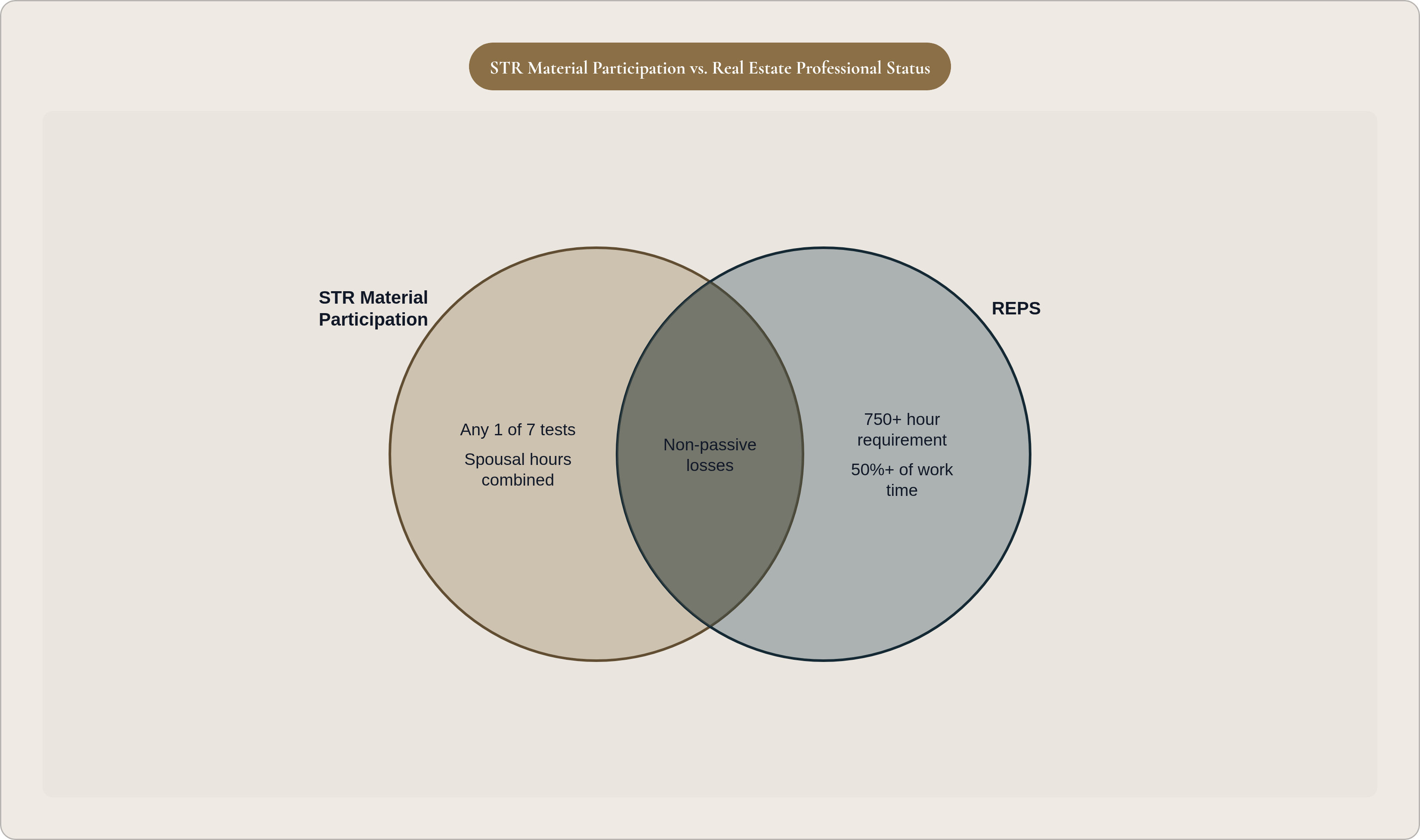
Both strategies require material participation. That surface-level similarity causes a lot of confusion, but they are not interchangeable and they are not redundant. They serve different taxpayer profiles under meaningfully different qualification standards.
Real estate professional status under §469(c)(7) runs two conditions in parallel: more than 750 hours in real property trades or businesses during the year, and more than 50% of total working time spent in those activities. Both must be satisfied by the individual claiming REPS. Once qualified, it allows the taxpayer to treat rental activities as non-passive across their entire portfolio. It's a broad designation with broad effects.
STR material participation requires passing one of the seven tests for the specific STR activity. No primary-occupation requirement. A full-time W-2 employee can qualify. The 100-hour floor under Test 3 is reachable for most committed owner-operators. The benefit applies to the STR activity in question, not to a broader portfolio.
The sharpest divergence is how spousal hours are treated. For STR material participation, both spouses' hours combine, which is why the math often works for dual-income households. For REPS, each spouse must independently satisfy both the 750-hour requirement and the more-than-50%-of-working-time requirement. Spousal hours don't aggregate for REPS qualification. A couple where one spouse works full-time outside real estate can often reach STR material participation together through combined effort; that same couple almost certainly cannot qualify either spouse for REPS unless one of them has no other material occupation.
The two strategies are not mutually exclusive. An owner who qualifies for REPS still needs material participation in the specific rental activity. But for the large population of active STR owners who have careers outside real estate, the STR material participation route is the accessible one.
The Tax Benefits That Become Available Once Both Conditions Are Met
The core benefit is direct: STR losses become non-passive and can offset W-2 wages, S-corporation K-1 income, and investment income in the year they arise. Suspended losses are no longer the default outcome. A deduction that reduces your tax bill this April is categorically different from one sitting in a suspended loss carryforward, accumulating years of waiting before it does anything useful for you. Waiting on a suspended loss is like planting a tree and hoping your grandchildren enjoy the shade.
The net investment income tax adds another layer. Under IRC §1411, passive rental income is generally subject to the 3.8% NIIT surtax above the applicable thresholds, $200,000 for single filers, $250,000 for married filing jointly. Income from a non-passive STR activity conducted as a trade or business falls outside the NIIT. For high-income owners, removing that additional 3.8% on rental income is real money, and it compounds the value of achieving non-passive treatment.
Cost segregation is where the strategy's loss-generation capacity becomes most pronounced. STR properties carry a 39-year depreciation baseline as non-residential real property. A cost segregation study reclassifies building components into shorter asset lives, and those reclassified components qualify for bonus depreciation. The resulting first-year deduction can be substantial.
The legislative environment reinforces this meaningfully. The One Big Beautiful Bill Act, signed July 4, 2025, permanently restored 100% bonus depreciation for property placed in service after January 19, 2025. Owners acquiring STR properties in 2026 and beyond can deduct the full cost basis of bonus-eligible components in the acquisition year, not the reduced percentage the prior phase-down schedule would have allowed. That restoration makes qualifying for material participation more valuable today than it was during the phase-down years.
The compounding logic is not complicated. Large first-year depreciation deductions create large losses. Material participation makes those losses usable against ordinary income in the same year. Without both conditions satisfied, the deduction exists on paper and does nothing for you until you sell. The mechanics only work together.
What Records the IRS Expects and How Audits of STR Material Participation Actually Proceed
The IRS does not prescribe a required format for tracking participation hours. What it does expect, and what actually holds up when an examiner starts asking questions, is contemporaneous documentation. Logs assembled at year-end from memory and calendar scraps are a recognized audit red flag. The standard isn't perfection; it's that the record was kept as the work was done.
A defensible log contains four things for each entry: the date, a specific description of the task, the time spent, and, where both spouses are contributing hours, a clear attribution of who did what. Shared activities count once. The task description needs to be specific enough to distinguish qualifying operational work from passive investor review. "Checked property status" establishes nothing. "Coordinated emergency plumbing repair with vendor, communicated revised timeline to arriving guests" does.
Supporting records amplify the log rather than substitute for it. Platform booking records document both rental periods, which establish the seven-day average, and the operational activity surrounding each stay. Contractor invoices with dates corroborate maintenance entries. Guest communication threads establish the scope and timing of owner involvement. Supply and repair receipts connect expenditures to operational decisions.
The seven-day average must be independently documentable, separately from your hours log. Booking platforms generate exportable records that let anyone compute the average stay length. An owner with 500 logged hours but a booking calendar that computes an average stay above seven days fails the threshold condition regardless of how many hours they worked. The two elements are independent, and both must hold.
STR material participation claims have attracted meaningfully increased IRS scrutiny as the strategy has become widely publicized. Claims combining large bonus depreciation deductions with material participation assertions are especially prone to examination. That combination is not improper; it is the intended and legitimate use of the tax code. But it draws attention, and attention requires preparation.
For owners using property management companies, an audit is a granular, fact-specific exercise. The IRS will want to know, specifically, that no single employee of the management company contributed more hours to the activity than the owner did. The Kline precedent is favorable for owners in that situation, but it is not a blanket safe harbor. It is a fact-specific holding that benefited a taxpayer who could demonstrate the specifics. Owners who cannot demonstrate the specifics cannot rely on the outcome.
I'll say this plainly: the documentation discipline required to defend material participation is not a separate administrative burden you layer on top of managing a property. It is part of managing a property. Owners who treat recordkeeping as an afterthought aren't just risking a deduction on audit; they're risking a full reversal of the tax benefit, with interest and penalties included. The records are the argument, and without them, you don't have one.