Caribbean Islands Compared for Luxury Villa Stays
Which Caribbean island actually fits your trip depends on character, not just price.

Booking a Caribbean villa means real money on the line: rates start around $1,200 a night, most properties land between $3,500 and $25,000, and picking the wrong island turns an expensive trip into a wasted one. The mistake almost everyone makes is treating these islands as interchangeable backdrops, when they're built for completely different kinds of trips. Book the scene-driven island for a family that wanted calm water and quiet, and everyone's miserable by day three. Book the quiet, privacy-first island for a group that wanted restaurants and nightlife, and the trip feels empty by day two. The question that matters is which island actually fits the people going, not which beach photographs best.
The variables that actually differentiate one island from another
Six things decide whether an island fits a trip. Everything else is decoration.
Character comes first. Is the island built around a scene, around barefoot privacy, or around a deeper cultural texture that rewards leaving the villa? Price tier matters too, and not just the nightly rate: what that rate buys in space, staff, and seasonal swing tells you more than the number alone. Guest access covers the unglamorous stuff that decides everything, flight connections, transfer time, language, currency. Water and beach profile splits islands fast, since calm, reef-protected water is a different product entirely from open Atlantic surf, especially with kids in the mix. Hurricane risk tracks geography, with islands further south carrying real, measurable advantage during the June-to-November window. And dining outside the villa determines whether the property is the whole trip or just base camp for it.
Luxury villa pricing across the Caribbean has moved up hard: prime values up 27% over five years as of 2025. Anyone still benchmarking against a pre-pandemic price memory is working from numbers that don't exist anymore, and that gap is exactly why waiting for a deal on the wrong island is the worst version of this mistake.
St. Barts: where the villa is the destination and the island is the stage
St. Barts runs on French sensibility dropped into a Caribbean setting. Call it the St. Tropez of the Caribbean; the comparison holds up. It's chic, curated, and socially charged in a way no other island on this list matches. Here the villa carries part of the statement, right alongside the island itself.
The market runs deep: about 490 luxury villas across 24 neighborhoods, from beachfront estates at Flamands and St. Jean to hilltop hideaways at Colombier, Gouverneur, and Pointe Milou. Nightly rates run €2,500 to €8,000, with panoramic ocean-view villas sleeping 6 to 12 guests averaging €5,000 to €8,000. The weekly market average sits around €40,000, and the ultra-premium tier runs $38,000 to $140,000 a week. High season pushes rates up 40 to 60% from December through April, and Christmas and New Year's weeks book out a full year ahead.
The current flagship is The O2, which starts at $90,000 a week through Wimco. Private pools and staff service are defining features of St. Barts villa rentals at the top end.
Here's the tradeoff, and it's not small. Getting there means a small-plane connection or a ferry, with no mass-market infrastructure to fall back on if plans change. That limitation is exactly what protects the island's exclusivity, but it makes St. Barts a bad fit for anyone who wants spontaneity in how their week unfolds. It suits couples and small groups chasing design, scene, and a genuinely glamorous New Year's Eve. Skip it if you've got young kids who need calm swimming water, or if peak-week pricing swings make you flinch.
Turks and Caicos: the most accessible luxury villa market in the Caribbean
Grace Bay is the product here: calm, shallow, almost impossibly clear water that does most of the selling on its own. The villa is a beautiful base built around the beach as the main event, ease and natural beauty setting the mood rather than scene or discovery.
That ease is exactly why families default to it. Direct flights run from most US East Coast hubs, landing before lunch. English is the language, the US dollar is the currency, and there's zero friction for American families. The water is calm and reef-protected, safe for kids to swim off the beach without a current pulling them out. Villa infrastructure is genuinely well run, and it's the most-requested collection among first-time villa renters.
But there's a real cost to that ease, and it's worth taking seriously. Turks and Caicos now reads as increasingly polished and resort-heavy by Caribbean luxury standards. It feels more like a polished resort destination than an undiscovered one, and for repeat Caribbean travelers chasing intimacy, that's a real strike against it. For families and milestone trips built around comfort and predictability though, that same polish works in the island's favor. Price-wise, Turks and Caicos sits at the upper end of premium Caribbean markets, and the per-night cost is worth comparing carefully against alternatives before booking. That gap is the one to sit with before booking either.
Anguilla: privacy, beaches, and a food scene that earns its reputation
Anguilla has 33 beaches, no casinos, no cruise ships, and no chain resorts. Everything is independently run. Luxury here leans intimate rather than performative, and that one distinction shapes the entire island.
The smallness is deliberate, not accidental. Anguilla has stayed flat, coral-based, and quiet by design; minimal tourism infrastructure functions as policy, not limitation. It's exactly what keeps the island feeling private, and it shows up in the pricing: a beachfront villa sleeping 12 in Anguilla often costs less per night than a comparable Turks and Caicos property, while delivering more privacy, more beach variety, and better food. That gap is starting to pull repeat Caribbean travelers away from the more obvious choice.
The dining case deserves specifics. Blanchard's, Veya, and Jacala get cited constantly as restaurants that punch far above what an island this size should produce, from beach shacks at Sandy Ground to chef's tables in the West End. Food is where Anguilla most clearly beats expectations, full stop. It suits couples, privacy-focused travelers, and families who don't need a packed social calendar, especially repeat visitors who've already done Turks and Caicos and want something with more layers. Getting there takes a ferry or small-plane connection from St. Maarten, a hurdle that filters out casual travelers and keeps the atmosphere low-key. Skip it if you're a first-timer chasing maximum convenience, or if your group's trip depends on nightlife.
Barbados: Anglo-Caribbean culture, the Platinum Coast, and multi-generational reach
Barbados pairs colonial architecture with modern villa comfort and backs it up with a genuinely world-class restaurant culture. The west coast's Platinum Coast is the prestige address, villas sitting above powdery beaches and calm, blue water.
The villa style runs to large terraces, ocean views, full staff service, and private infinity pools. Call it Anglo-Caribbean: more formal than Anguilla, more culturally grounded than Turks and Caicos. The hospitality culture is refined, and the villa market genuinely works across generations, fitting grandparents and kids into the same stay without anyone compromising.
Access has gotten meaningfully better. Access from both North America and the UK is well served by direct routes, reducing the connection friction that affects some other islands on this list. There's also a real geography argument here: as a southern island, Barbados's southern position in the Caribbean gives it a geographic advantage during the June-to-November season, making it a stronger shoulder-season consideration than many northern islands. It fits multi-generational families, golfers, culture seekers, and UK travelers well. It's a weaker fit if you're chasing intimate privacy over cultural engagement, or if you'd rather go barefoot than formal.
Antigua: family-friendly infrastructure and the arrival of serious ultra-luxury
Antigua claims 365 beaches and a genuinely varied coastline, and the family-villa market rests on real, calm, protected water along the north and west coasts. Not every beach here is a showstopper, but the variety across the island is real and it's useful.
The north and west coasts offer reef-protected water that's genuinely good for kids, and the family villa infrastructure has matured significantly. The bigger story though is what's arriving at the top of the market. Estate-level product is arriving at the top of the Antigua market, with new ultra-private offerings at the Jumby Bay private-island format representing the clearest example.
That arrival says Antigua has moved past being a secondary luxury market. Estate-level product is showing up now, and travelers booking early are getting in before the island's price tier catches up with its infrastructure, in the way early movers often benefit when a market develops. Improved airlift options, alongside Barbados, have reduced connection friction for North American travelers. Antigua works well for families wanting real beach variety and calm water, and for groups drawn to the Jumby Bay private-island format. It's a weaker choice if you want an established social scene or the dining density Anguilla and Barbados already have built.
How the five islands compare across the decisions that matter most
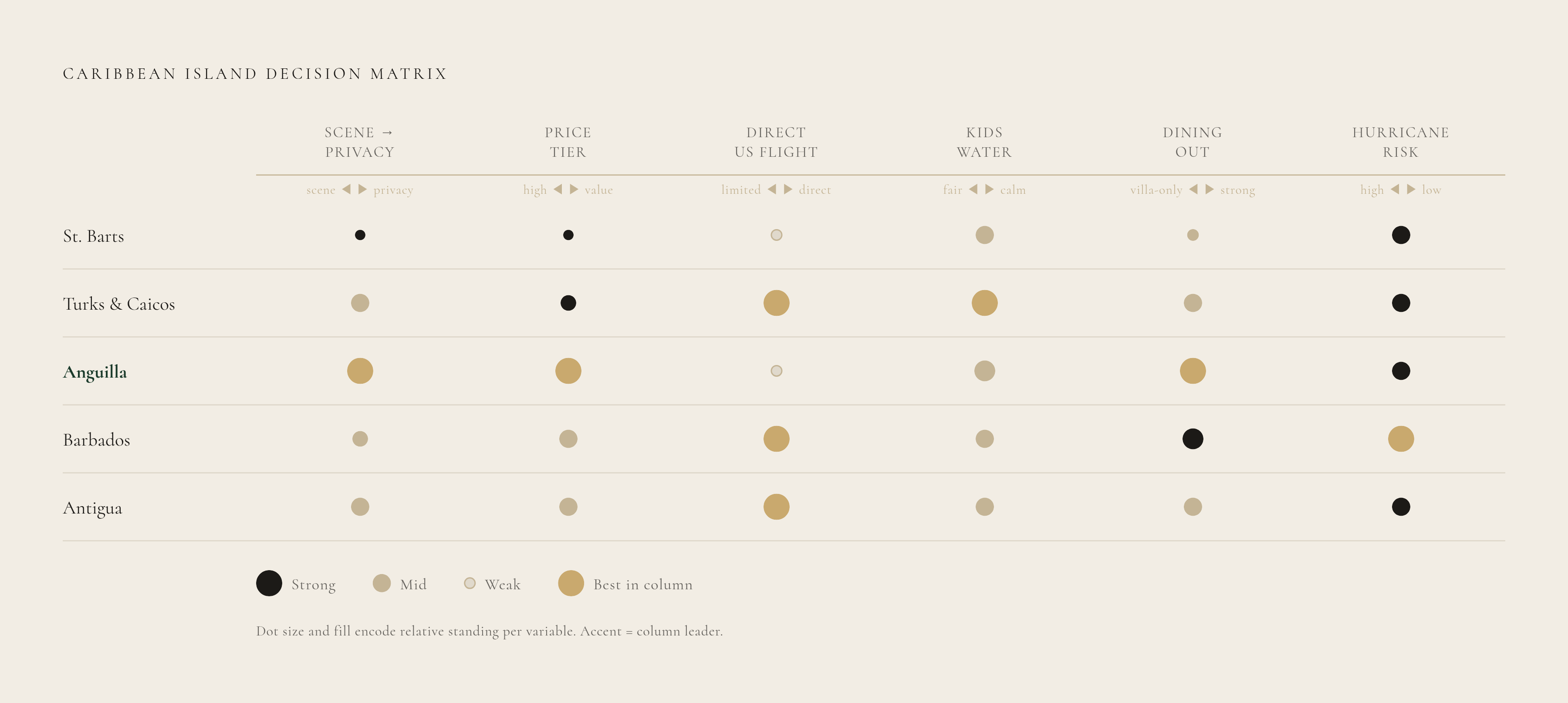
Line the five up against the same six variables and the pattern gets easy to read. Anguilla wins on privacy and value. St. Barts wins on scene. Everything else is a tradeoff between the two.
On scene versus privacy, it runs St. Barts (scene-forward) to Barbados (culturally engaged) to Turks and Caicos (resort-comfortable) to Antigua (family-structured) to Anguilla, which sits furthest toward true privacy. On price, St. Barts sits well above everyone else, while Anguilla often offers strong value per guest per night among beachfront villas, particularly for those who have been comparing rates across islands. For ease of access from the US East Coast, Turks and Caicos, Barbados, and Antigua lead on direct routing; St. Barts and Anguilla both still require an extra connection.
For young kids, Turks and Caicos wins on calm water and simple logistics, with Antigua's protected north coast and Anguilla's 33 varied beaches close behind. For dining outside the villa, Anguilla punches furthest above its size, Barbados carries a genuine Platinum Coast restaurant culture, and St. Barts holds a French Caribbean culinary standard that's hard to match. For hurricane risk in shoulder season, Barbados holds a geographic advantage by virtue of its southern position.
None of this settles the most personal variables: tolerance for logistical hassle, party size, and whether the villa itself or the island's off-property life is the real draw. Those calls belong to the traveler, not the comparison chart.
At $3,500 to $25,000 a night, the gap between a vetted villa and an unvetted one, in photo accuracy, staff quality, whether the amenities actually work as advertised, is the difference between a great week and a ruined one. How and where the booking happens matters almost as much as which island gets picked. Specialist villa marketplaces that focus on the top of the Caribbean market exist for exactly this reason: they check the properties, verify the listings, and handle guest screening and damage protection in a way a general rental platform isn't built to do at this price level, platforms like Rove, a high-end furnished-residence rental service, operate on this premise in premium leisure markets.
Timing
Booking windows aren't uniform across these five islands, and treating them as if they were is its own version of the same mistake. St. Barts moves fastest at the top: Christmas and New Year's weeks lock in a full year out, and waiting until six months ahead means picking from what's left, not what's best. Turks and Caicos and Barbados run on more conventional high-season timelines, with real pressure building three to six months out for winter travel, especially around school holidays for family groups.
Anguilla and Antigua give a bit more room to breathe, partly because both carry a lower profile than their neighbors and partly because ultra-luxury supply is still expanding, Jumby Bay being the clearest example. That won't last. As Antigua's estate-level product matures, the early-booking advantage will shrink the same way it did on Turks and Caicos over the last decade.
The rule holds across all five: peak weeks in the Caribbean's luxury villa market don't get cheaper by waiting, and the best properties don't sit unbooked. A 27% price gain over five years, as of 2025, is a trend line, not a one-time correction. It rewards travelers who commit early over the ones still waiting for a deal that isn't coming.