Luxury Beach House Rentals in the Hamptons with a Pool
Prices have dropped 15-25% but quality gaps widen for savvy renters.

The Hamptons rental market flipped in 2025. Prices sit 15-25% below the pandemic peak, inventory has topped 3,500 listings, and renters have leverage they haven't had in five years. Still, not every pool house is a deal. The gap between a real bargain and an overpriced relic just got wider, and telling the difference comes down to village, price tier, and a handful of line items most people never think to ask about.
Pandemic-era buyers are renting out their Hamptons homes instead of selling them, and that's what flooded the market with supply. CNBC reported summer rental volume down 30% from prior years; at the ultra-luxury tier, the drop ran 50-75%. Economic uncertainty also pushed affluent renters to book later than usual, which compressed the decision window even as inventory grew. The math favors renters, but the timeline still punishes anyone who waits too long to get organized.
Soft pricing doesn't flatten quality. Some listings are genuine deals; others sit priced off 2022 comps like nothing happened. Sorting one from the other is the whole game.
How Hamptons villages divide by character, not just price
The Hamptons isn't one destination with interchangeable zip codes, and treating it that way is the first mistake most renters make. Each village carries its own price ceiling and its own crowd, and picking the wrong one for your group costs more than overpaying for the right one ever would.
Southampton Village sits at the top, commanding a 14-32% premium over East Hampton for comparable properties. It's the gated-estate, high-privacy village, lots frequently running past five acres, guest lists skewing toward those who prioritize privacy and prestige.
East Hampton Village draws a more creative, media-industry crowd. It's also absorbed the most new inventory: East Hampton North alone accounts for roughly half of all Hamptons summer rental supply. More supply means more room to negotiate, which makes it the strongest starting point for anyone hunting value over status.
Bridgehampton and Water Mill are where architecture becomes the selling point. Bridgehampton is known for architect-designed homes on flat, open land, often with full pool-and-tennis compounds. Water Mill's newer builds, anything post-2020, command a 20-30% premium over older stock in the same area, and that premium buys modern kitchens, smart-home systems, and finished basements that older houses just don't have.
Sag Harbor breaks the pattern. It's a year-round village, restaurants and shops that don't shut down after Labor Day, and rental pricing there has held up better than the rest of the market through the broader softening. Real estate in Sag Harbor appreciated 79% in recent years, which points to real demand rather than pandemic froth. Sag Harbor's year-round village character makes it a distinctive option for renters who value both walkability and a private estate setting.
Amagansett and Montauk sit further east and skew younger, more outdoors-focused. Properties run smaller, pricing sits meaningfully below Southampton or East Hampton, and those drawn to a more outdoors-focused, less formal atmosphere tend to gravitate this way.
One rule cuts across every village, and it's the one renters ignore most: inland estates in Water Mill or Bridgehampton typically run meaningfully cheaper than oceanfront equivalents at the same square footage. The block matters more than the village name, and chasing the name over the location is how people overpay.
What to expect at each price tier, from seasonal cottage to oceanfront estate
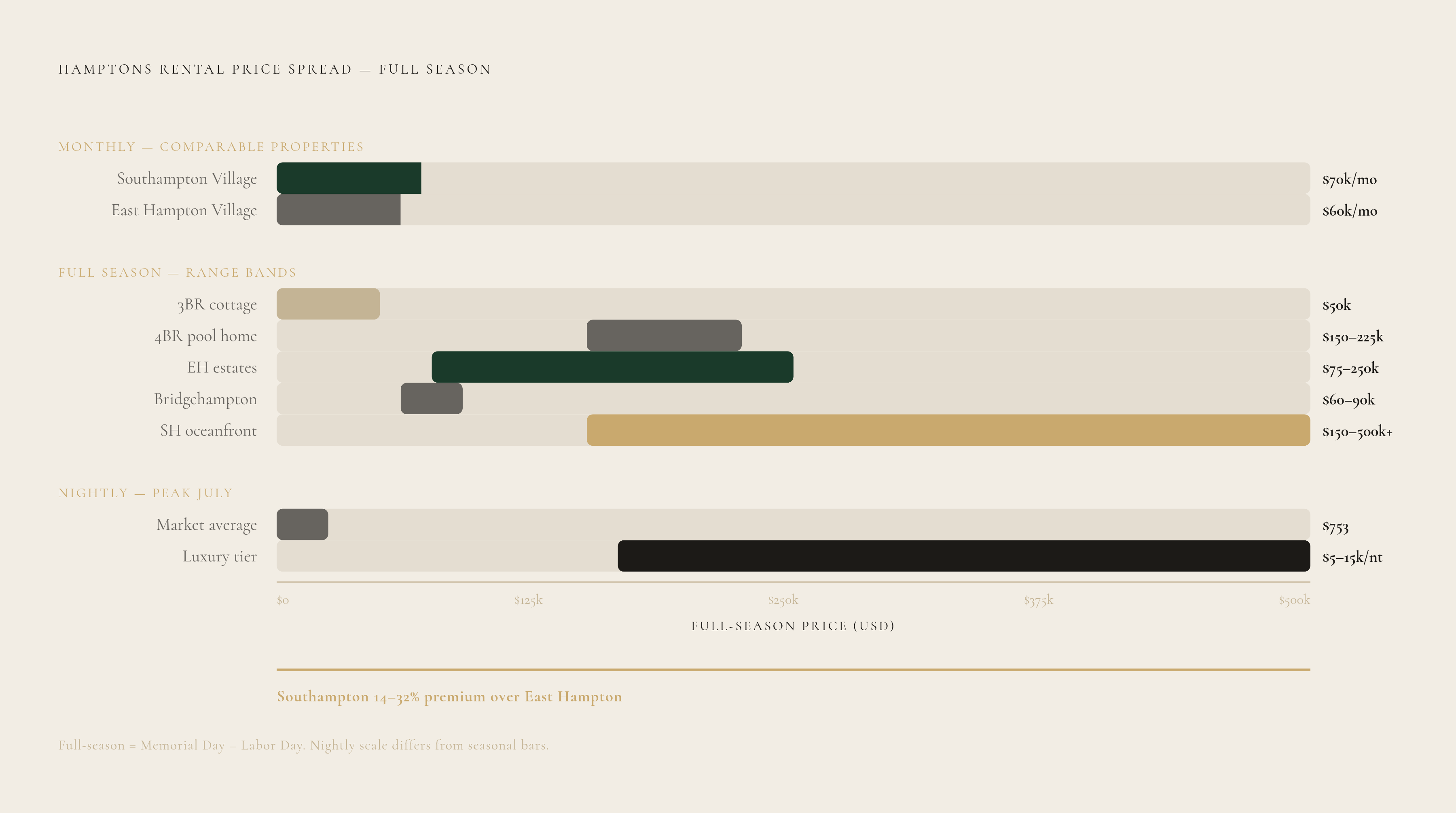
The range is wide. A modest 3-bedroom cottage for the full Memorial Day to Labor Day season runs around $50,000 in 2025. Oceanfront estates at the top of the market cross $900,000 for that same stretch. Most renters land in the middle: a 4-bedroom house with a pool for the full season typically costs $150,000 to $225,000.
Monthly numbers sharpen the picture. A 4-bedroom with a pool runs about $70,000 a month in Southampton Village, closer to $60,000 in East Hampton Village, and $60,000 to $90,000 in Bridgehampton, though south-of-the-highway estates there cross $150,000 for the season without much trouble.
Full-season estate pricing follows the same shape: Southampton oceanfront runs $150,000 to $500,000-plus for the season, East Hampton estates run $75,000 to $250,000. Peak July weeks average $753 a night market-wide, while luxury properties run $5,000 to $15,000 a night. The average nightly rate has fallen from $1,080 in 2022 to roughly $970 in 2025, a number that shows the softening in actual transactions rather than in inventory counts alone.
Treat these figures as anchors, not ceilings. If a 4-bedroom pool home in Southampton is quoted well above $70,000 a month with nothing to justify it, push back or walk away. If it's priced below that with comparable specs, that's a real find, and it won't sit on the market long.
The hidden costs that change the real price of a Hamptons pool rental
The number on the listing is rarely the number you pay. Several line items get buried in the lease and surface only after you've already committed, and this is where renters lose the most ground.
Security deposits run 10-25% of the total rental cost. On a $150,000 seasonal rental, that's $15,000 to $37,500 tied up before you've even picked up the keys. Cleaning fees add another $500 to $2,500 per stay, depending on house size. Pool and tennis court maintenance sometimes gets bundled in, but often shows up as a weekly surcharge of $500 to $1,500; across a full summer, those surcharges can add up to a substantial sum that never appeared in the original listing price.
Staffing is its own trap. Housekeeping and groundskeeping are sometimes optional extras, sometimes contractually mandatory minimums buried deep in the lease language. Before signing anything, ask three questions: is pool heating included or metered separately, are cleaning fees charged per stay or weekly, and is staff a requirement you're paying for regardless of use?
Mass booking platforms tend to surface the nightly rate prominently and disclose fees late in checkout. Direct or agency bookings lay out pricing from the first phone call instead. Direct or agency bookings can also remove intermediary cost layers that may not be visible in the headline price. On a six-figure seasonal rental, understanding every cost layer upfront matters considerably.
What actually separates a luxury pool from a pool that happens to be at a luxury price
A heated pool is the baseline at this level of the market. Any listing that doesn't mention heating should be treated as a red flag, not an oversight. Hamptons evenings cool off fast even in July, and an unheated pool is close to disqualifying for anyone shopping at the top of the market. Size and configuration matter too: a 46-foot pool with an integrated spa is a different product than a standard rectangular pool, and listing photos don't always make that distinction obvious at a glance.
What surrounds the pool has become part of the product itself at the high end. That means landscaped privacy screening, whether hedgerows, walls, or mature plantings, plus an outdoor kitchen and bar built for actual entertaining rather than a grill parked on a patio. Al fresco terraces designed for dining, fire pits, and a smooth transition from pool deck into interior living space round out the package.
Wellness infrastructure has quietly gone from bonus to expectation. Fitness rooms, Finnish saunas, and steam rooms show up regularly in post-2020 construction. Smart-home systems for lighting, climate, and security matter too, because they let a large property run smoothly without staff on-site around the clock. This is where that 20-30% premium on new construction earns its keep: updated interiors, modern kitchens, and smart-home tech are the tangible things buying that gap over older inventory.
Here's the real test: does the pool area function as a destination in its own right, or does it feel bolted on as an afterthought? A genuine luxury pool estate is built so a family could spend an entire day on the property without ever needing to leave. Watch for warning signs, too: photos cropped tight on the pool that hide the surrounding grounds, no mention of heating anywhere in the description, or a separate pool cleaning fee with zero explanation of what it covers. Any one of those should slow you down.
How to read a Hamptons pool rental listing the way a local agent would
Three words matter more than any other phrase in a Hamptons listing: south of the highway. That phrase signals proximity to ocean beaches and correlates directly with the top of the pricing range in every village. If a listing doesn't mention it, assume it's north, and price accordingly.
Construction vintage tells its own story. Pre-2000 homes often carry real charm, but frequently lack the updated systems, insulation, and open floor plans renters expect now. Post-2020 construction is where that 20-30% premium shows up most clearly, and it's usually earned rather than inflated.
Lot size and setback affect pool privacy more than total square footage does. A generously sized lot with meaningful separation from neighbors delivers a completely different experience than a tight parcel, even when the house interiors look nearly identical on paper.
Bedroom count and guest capacity aren't always the same number, and mixing them up is an easy way to end up in a lease dispute. Hamptons leases sometimes specify a maximum occupancy separate from the bedroom count, which matters for larger group rentals. Before signing, check whether the lease allows partial-season bookings or locks you into the full summer, whether pets are permitted (plenty of luxury owners ban them even when the listing doesn't say so outright), and what the cancellation policy looks like given how compressed booking timelines have gotten this year.
Photos tell you almost everything if you know what to look for. Good listings include evening exterior shots that show landscape lighting and how the pool looks after dark, aerial or drone shots that reveal lot context and privacy, and close-up kitchen and bathroom photos that confirm the interiors actually match the headline claims. What renters at this level consistently want is confidence the home will match expectations, that it will be professionally managed, and that the whole process from booking to departure will feel effortless. That's a fair standard to hold any listing against.
Where to actually book and what each channel is built for
Two genuinely different booking channels exist, and they solve different problems. Picking the wrong one for your budget and timeline is where most bad bookings start.
Mass platforms, Airbnb among them with over 5,000 Hamptons listings, along with sites like VRBO, offer the widest inventory and the fastest way to browse. Platforms like Rove, a furnished-residence rental service focused on the Hamptons and a few other premium markets, occupy a different position, prioritizing vetted properties over raw volume. Rental volume rose about 20% year over year, so the scale is real. The trade-off: listing quality is self-reported, fees surface late in checkout, and guest screening or damage protection varies property by property. This channel suits renters who are flexible on location and willing to do their own legwork; anyone renting a six-figure estate sight unseen should look elsewhere.
Curated luxury marketplaces offer a more selective alternative, with a narrower set of properties and pricing structures disclosed earlier in the process. This tier fits anyone booking at $15,000 a week or more, or committing to a full season, where the cost of a misrepresented listing is high and there's no time for independent due diligence.
Off-market concierge agencies represent a third channel, operating outside public listings and catering to guests who place the highest priority on privacy and full-service execution.
Regardless of channel, asking to book directly with a vetted property management company cuts out the broker commission layer and usually produces a cleaner lease. Given that village-to-village pricing can swing 14-32%, that commission math adds up fast on a large booking. A well-run management operation shows its hand early: proactive communication before arrival, clear documentation of exactly what's included, and one named point of contact during the stay.
Timing the booking to the 2025–2026 market conditions
The Hamptons rental season is short and front-loaded. Memorial Day through Labor Day drives the bulk of annual rental revenue, and July and August weeks command the highest rates by a wide margin.
In past peak years, the most desirable properties moved early in the booking cycle. Market conditions in 2025 pushed affluent renters toward booking later, which means the calendar has compressed even though supply hasn't dried up. That's an unusual combination: less pressure to commit early, but a shorter runway once the decision actually gets made.
The buyer's-market logic holds for now. With rental prices down 15-25% and inventory running deep, waiting carries less risk than it did back in 2022 or 2023. Still, the best-located, newest-construction pool homes move first no matter how soft the broader market gets. Scarcity at the top end doesn't disappear just because the middle of the market has loosened up, and scarcity at the top end means last-minute options on a south-of-the-highway estate tend to be limited.
A sensible sequence: pick the village first, since that decision shapes everything downstream. Set a budget that includes all the fees outlined above, not just the headline rental rate. Reach out to curated platforms or off-market agencies before searching mass platforms, since off-market inventory tends to clear before it ever goes public. For a full-season booking, start outreach in February or March. For a partial season or a single week, April or May still leaves reasonable choice and room to negotiate.