White Glove Service Standards in Private Rental Stays
Luxury rentals now require concierge-level service just to compete as supply floods the market.
The luxury vacation rental market has crossed a threshold: service quality is no longer a differentiator. It's the entry requirement. According to market research firm Grand View Research, the market sat at roughly $26.5 billion in 2024 and is tracking toward $63.7 billion by 2034. That kind of scale doesn't happen in a niche. It happens when a category matures and the properties that can't deliver start losing to the ones that can.
Supply pressure is where the math gets uncomfortable. According to AirDNA, U.S. listings climbed from 1.46 million to over 1.6 million between early 2024 and late 2025, while average occupancy dipped from 53% to 51%. More inventory, flatter demand. The properties holding their ground through that compression aren't winning because of their kitchens.
The guest cohort driving luxury bookings right now grew up inside systems designed to anticipate them. Airbnb stored their saved searches. Netflix never asked them to re-explain their taste. Amazon shipped before they ran out. According to Statista, millennials and Gen Z account for roughly 60% of hotel bookings. A 2025 leisure travel survey by the American Hotel & Lodging Association found that 78% of respondents expect hospitality properties to remember preferences from prior stays. For these guests, that expectation isn't aspirational. It's baseline. A property requiring re-briefing doesn't read as inconvenient. It reads as broken.
Layer in multi-generational travel. The same 2025 American Hotel & Lodging Association survey found that 47% of respondents chose multi-generational trips, up 17% from the prior year. A group spanning teenagers, parents, and grandparents doesn't arrive with a unified set of needs. It arrives with competing, layered, logistically dense requirements that no standard listing can manage without infrastructure built specifically for that kind of coordination.
These pressures landed simultaneously. That's why white glove service isn't a trend in private rentals. It's what the market required.
The single-relationship concierge as the structural core
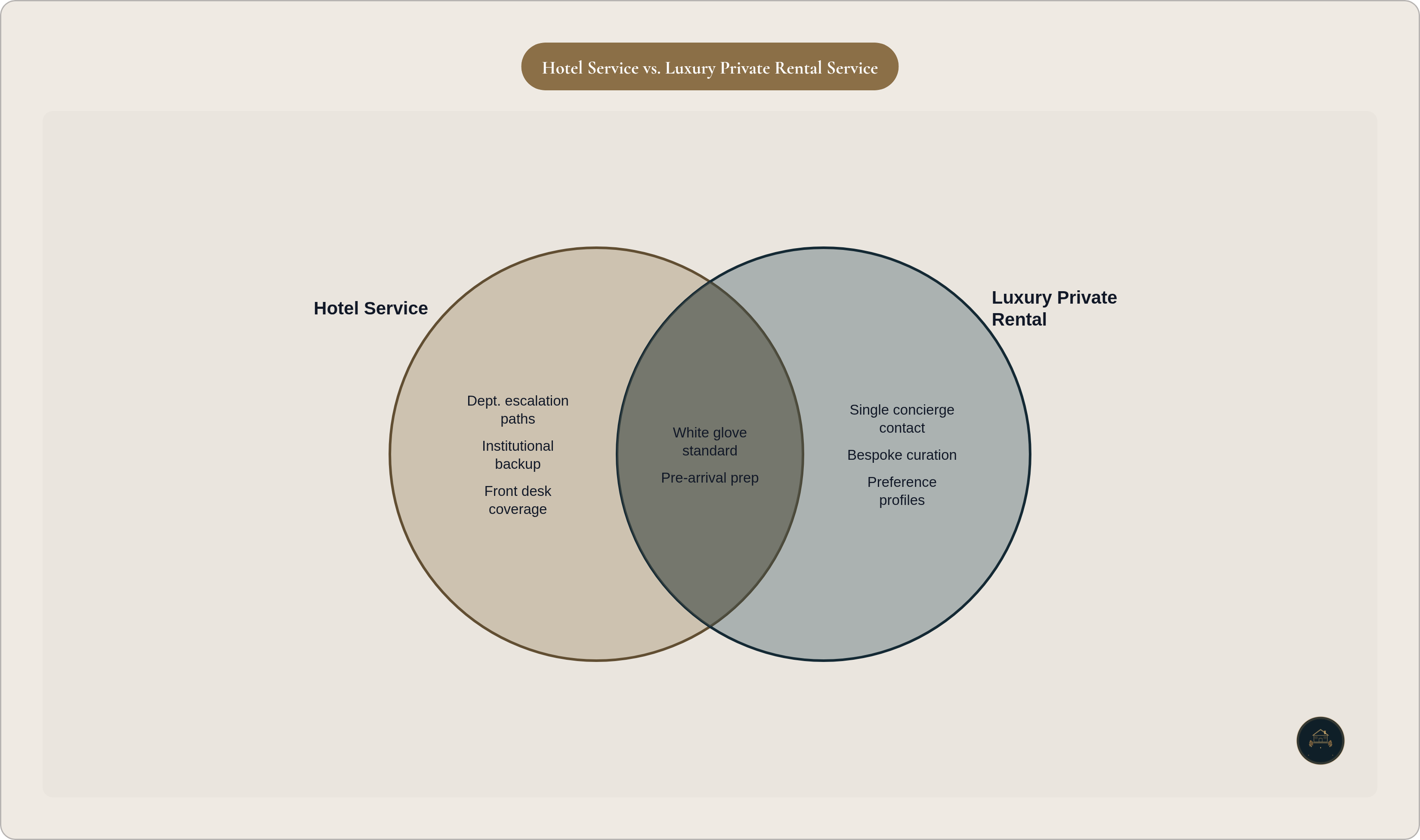
Stay in a well-run hotel for five days, then in a genuinely white glove rental for five days. You feel the difference in a very specific place. In a hotel, every interaction restarts. You re-establish who you are, what was already arranged, what has changed. Even at exceptional properties, that friction accumulates across a week. A dedicated concierge eliminates the restart entirely. Context is permanent. Every conversation begins where the last one ended. Think of it like a bookmark versus starting the chapter over every morning.
Practically, this means moving a private chef's arrival time while rescheduling a yacht charter and notifying the car service is one message to one person. Not three calls and two transfers and a voicemail that won't surface before dinner. The concierge isn't just fielding requests; they are holding the moving parts of the stay so the guest never has to.
Preference profiles are the memory system underneath all of it. Dining choices, room temperature defaults, transportation preferences, how the guest likes to communicate, what their children will actually eat. The goal isn't to compile a dossier. It's to eliminate the cognitive overhead of re-briefing. A guest on their third visit should walk through the door feeling like the property already knows them, because it does.
This role has changed substantially over the past decade. What was once a hotel amenity or credit card perk has professionalized into standalone, subscription-driven, technology-enabled operations staffed by people who chose this work deliberately. According to the Bureau of Labor Statistics Occupational Employment and Wage Statistics, over 1,600 new luxury travel professionals entered the field after 2020, many of them working specifically in the private rental space. That growth reflects where the demand moved, and why.
What pre-arrival preparation actually involves
The arriving guest hasn't spoken to anyone yet. They've made no requests. But within five minutes of walking through the door, they'll know whether the property anticipated them or whether it was entirely unprepared. Pre-arrival is where that distinction gets made, quietly and completely, before the stay actually begins.
Stocking is not a welcome basket. A generic arrangement of sparkling water and a fruit bowl signals that the operator pulled something off a shelf. A pantry stocked to the specific dietary needs, preferences, and ages of the arriving group signals that someone paid attention before the bags were unpacked. For returning guests, that means their brand of coffee, the sparkling water they drink at home, the snacks their kids actually ask for. For multi-generational groups arriving with toddlers and grandparents, it means baby gear already installed, accessibility accommodations already in place, none of it waiting to be requested on arrival.
Property presentation is a separate discipline from cleanliness. A documented, photo-verified inspection protocol ensures the property is at standard before the guest touches the door. Scent, temperature, lighting, music: all of it set intentionally to produce a specific arrival atmosphere, not whatever the previous guests left behind. Operators who execute this well treat the inspection as a repeatable standard, something written down and executed consistently, not a judgment call made by whoever happens to be on-site that afternoon.
The pre-arrival communication rhythm closes it out. Confirming logistics, gathering last-minute preferences, walking the guest through what's already been arranged. The guest arrives informed. Nothing is a surprise that shouldn't be.
In-stay service: the range from housekeeping to private chefs
Housekeeping at this level is not a mid-week tidy. It is a documented inspection framework applied at every service interval: photo verification at each visit, asset checks built into the process so high-value furnishings are accounted for rather than just dusted around, turnovers engineered so that each re-entry to the property feels, to the guest, like the first one. That standard doesn't happen by feel. It happens because someone wrote it down and the whole team executes it the same way every time.
The in-stay menu has expanded well past housekeeping. Private chef dinners coordinated around the group's schedule and dietary requirements. In-home wellness: massage, yoga instruction, personal training. On-call car service, yacht coordination, curated activity bookings. These are what the segment expects now. They stopped being exotic requests a few years ago.
For multi-generational groups, the service complexity multiplies in ways the concierge has to anticipate rather than react to. Grandparents need quieter programming and accessible setups. Teenagers want privacy and autonomy, not organized group activities. Parents are managing meal logistics, childcare, and the coordination of experiences across age groups with very different definitions of a good afternoon. A single stay requires several service tracks running in parallel without generating noise or friction for any of them.
Short-term rental data from AirDNA's 2025 State of Short-Term Rentals report reflects this complexity directly. Six-bedroom and five-bedroom properties posted the clearest booking growth that year. Large homes requiring professional, multi-faceted coordination are the growth segment. They're also the segment that most visibly exposes the gap between what a property photographs like and what it actually delivers.
Experience curation as the differentiating layer
A fire pit and a hot tub are baseline now. So is a chef's kitchen, a wine cellar, a home theater. The amenity checklist stopped functioning as a differentiator sometime around 2022. What separates properties at the premium tier is the capacity to build an experience around a specific group's occasion, not to present a menu of upgrades and wait for selections.
A bespoke wellness program designed for a 60th birthday is different from a spa menu. A winemaker visit arranged through a relationship the concierge spent years cultivating is different from a wine pairing dinner sourced through a booking platform. Museum access after hours, a private market tour with a chef who actually cooks from that market, a guided experience built around something this particular group genuinely cares about: these require relationships and judgment. Budget alone doesn't get you there.
The concierge operating at this level is functioning as a discreet experience designer. They're reading the group's energy across the first day or two. They're anticipating what the guests will want by day three, not just confirming what was requested before arrival. That is a genuinely different skill set, and it doesn't live in a laminated welcome binder or a generic local recommendations list.
This is also the hardest layer to replicate. A competitor can match a property's finishes, its thread count, its appliance brand. What they cannot copy is the local relationships, the accumulated guest knowledge, and the genuine investment in a specific trip that real curation requires. For owners, this is also where the economics get interesting: curated experiences command premium nightly rates and drive the repeat bookings that anchor a property's revenue across the year. A guest who had a trip built around them doesn't start from a search engine next time. The best concierge doesn't just plan the stay — they plant the roots for the next one.
How technology supports — but does not replace — the human standard
According to a 2025 survey by the Vacation Rental Management Association, AI adoption among short-term rental operators crossed 60% in 2025, with the highest concentration among larger properties. Guest communication is where the impact shows most clearly. Operators deploying AI for messaging report meaningfully higher rebooking rates and recover revenue per property that would otherwise have been lost to slow response times, particularly overnight and on weekends when no one is watching the inbox.
What technology does well here is narrow and specific. Smart home systems that guests navigate without hunting for an instruction manual. AI-assisted communication that ensures responsiveness at two in the morning. Preference tracking across stays, so the concierge enters every conversation already briefed. A 2024 survey of luxury travelers by Skift Research found that most considered contactless options essential, and a significant share reported that personalized technology enhanced their overall experience. The smarter operators treat those tools as plumbing: invisible when functioning, immediately noticed when absent.
The bifurcation the best operators have landed on is deliberate. Digital platforms handle routine and transactional requests; human touchpoints are preserved for complex, emotionally significant, or high-stakes moments. This isn't compromise. It's optimization. It protects relationship depth where depth matters and removes friction everywhere else.
The privacy tension underneath all of this is real and worth taking seriously. A meaningful portion of high-net-worth guests want exceptional service while actively preferring that a property avoid modeling their behavior from previous stays and acting on inferences they never explicitly authorized. IBM's 2025 Cost of a Data Breach Report placed the global average breach cost at $4.88 million, with hospitality among the elevated-risk categories. The practice that's emerged among operators who take this seriously: personalization offered as opt-in, not assumed. The guest feels known rather than surveilled. Sophisticated guests notice the difference immediately, and they remember it.
Where white glove delivery breaks down and why
Hotel employment remained below pre-pandemic levels through most of the recovery period following 2020, according to Bureau of Labor Statistics data. Private rental operators draw from the same constrained labor pool without the institutional infrastructure to absorb gaps. When a key person is unavailable, there is no department to escalate to. There is the problem, and whoever is left to handle it.
The breakdown points are consistent. Staff inconsistency, where the experience varies based on who shows up rather than what the documented standard says. Communication gaps between vendors, where the chef doesn't know the guests are running late and the cleaner doesn't know checkout moved. The mismatch between promised personalization and experienced service, which generates the most damaging reviews precisely because the expectation was set at such a high pitch. Research published in the International Journal of Hospitality Management has identified service-quality gaps and staff inconsistency as leading drivers of luxury hospitality complaints. The higher the promise, the more visible the failure.
These failure modes hit harder in private rentals because there are no institutional backstops. No backup front desk when the concierge is unreachable. No housekeeping department to escalate to when a room isn't right. No maintenance team on-site when something breaks at ten on a Saturday night.
What separates operators who hold the standard from those who don't is not that they hired better people. It's that they wrote things down. Structured inspection checklists. Issue-reporting workflows with clear escalation paths. Vendor relationships with redundancy built in. A communication chain that functions when the primary contact is traveling. The standard cannot live only in the minds of the best people on the team. It has to live in something anyone on the team can execute on a difficult day, because that day will come.
What travelers should look for and what owners need to build
For travelers evaluating a property, the signals are specific. A named, reachable concierge contact, not a generic help inbox. Concrete evidence of pre-arrival preparation in the listing or early operator communication: grocery stocking described with actual specificity, preference intake, arrival setup explained in real terms rather than marketing language. Those details indicate infrastructure. A beautiful space and strong photographs don't.
Ask directly about the service model. Who is the single point of contact during the stay? How are after-hours issues handled? What happens if something in the property fails on a weekend? The answers reveal whether you're dealing with a managed operation or a host who has assembled good vendors and is hoping the week goes smoothly. Both can produce a fine stay under ideal conditions. Only one recovers cleanly when something goes wrong, and something always eventually does.
For owners building toward this standard, sequence matters more than most people expect. Start with the inspection and housekeeping framework, because everything else depends on the property being reliably at standard before the guest arrives. Build the concierge relationship next, whether that's a dedicated hire or a partnership with a professional firm. Develop the preference profile system in parallel, so each stay generates information that improves the next one. Layer experience curation last, because it requires the underlying systems to be functioning before it can be executed with any consistency.
White glove delivery in a private rental is harder to build than in a hotel. In a hotel, the infrastructure exists and you are managing it. In a private rental, you are assembling it from scratch: the staffing, the protocols, the vendor relationships, the technology, the systems that hold everything together under pressure. That difficulty is also the protection. A well-appointed property with strong marketing is replicable. A system that makes a specific guest feel genuinely known and anticipated across multiple stays, one that delivers on that promise even when the lead concierge is traveling and a vendor falls through, is not something a competitor can copy from a listing page.